Types of invoices: which one to send, and when

Nnabuike Okoroafor ·
On this page · 13 sections
A client asks for a “proforma”. Another wants a deposit invoice before you book the date. A third has paid, but now the scope has shrunk and they want a credit note. Lists of invoice types online run anywhere from nine to twenty-five entries, and many of those entries are not types at all: “overdue” and “pending” are what happens to an invoice, not a kind of invoice.
This guide sorts the main types of invoices by when you send them: before the work, during it, at the end, and when something needs fixing. It separates real invoice types from invoice statuses and from documents that only look like invoices, follows one project through four documents with real numbers, and links to a full guide for each type. For each one it also says plainly whether Charming Invoices can produce it.
In short#
- An invoice is one document with one job: asking a client to pay for goods or services. If you want the basics first, start with what an invoice is.
- Invoice “types” are versions of that document for a stage of the job (deposit, progress, final) or a purpose (tax, customs, a correction).
- Statuses are not types. Draft, sent, overdue and paid describe where one invoice is in its life.
- Some lookalikes are not invoices at all, such as quotes, purchase orders, receipts and statements.
- You will probably need only a handful: a standard invoice, a deposit invoice and a final invoice, sometimes progress or recurring invoices, and now and then a credit note.
General information, not legal or tax advice. The tax-related types below get a plain definition and a link; the rules for them depend on where you are.
All the main invoice types in one table#
This table lists each type, when you would send it, where to read more and whether Charming Invoices produces it.
| Type | What it is | When you send it | Full guide | In Charming |
|---|---|---|---|---|
| Proforma invoice | A preview of an invoice, not a request for payment | Before the sale | What a proforma invoice is | No |
| Deposit invoice | Bills part of the price up front | Before work starts | Deposit invoices: how they actually work | Yes |
| Retainer invoice | Bills a prepaid balance or a recurring fee for ongoing access | Before or at the start of each period | Retainer invoice | Yes |
| Progress (interim) invoice | Bills a share of a fixed-price job as it is done | During the job | Progress invoicing, with a worked example | Yes |
| Recurring invoice | The same bill on a schedule | Every period | How recurring invoices work | Yes, paid plans |
| Timesheet (hourly) invoice | Bills hours worked at a rate | Weekly, monthly or per job | Turning tracked hours into an invoice | Yes |
| Standard (sales or service) invoice | Bills goods or services once | When the work is done | Service invoice vs sales invoice | Yes |
| Final invoice | Bills the balance and credits what was paid before | At the end of the job | Deposit invoices | Yes |
| Paid invoice (receipt) | An invoice marked as settled | After payment | What a paid invoice is | Yes |
| Credit note | Reduces or cancels an invoice | After a mistake, return or price cut | Credit note vs invoice | No |
| Debit note or supplementary invoice | Adds to an invoice that undercharged | After an undercharge | Supplementary invoices and debit notes | Supplementary: yes, as a new invoice. Debit note: no |
| Tax or VAT invoice | Shows the tax details a tax authority asks for | Whenever tax applies | What a tax invoice is | Yes, with one tax rate per invoice |
| Electronic invoice (e-invoice) | A structured data file a system can read | When a client or law asks for it | What counts as an e-invoice | No |
| Commercial invoice | Describes goods crossing a border for customs | When shipping goods abroad | The commercial invoice guide | Not a customs form |
Before the work starts#
Proforma invoice#
A proforma invoice is a preview: it shows what the client will be billed, but it is not a request for payment and usually does not take a number from your invoice sequence. Clients use one to get internal approval, arrange a payment in advance or, for goods, start an import. What a proforma invoice is covers when to send one and how to turn it into the real invoice.
A quote or estimate is a cousin of the proforma, and neither is an invoice either. Invoice vs estimate vs quote explains the difference.
Deposit invoice#
A deposit invoice bills part of the price before you start, often to hold a date or cover materials. It is a real invoice with its own number. The deposit is then credited on the final invoice, so the client never pays it twice. Deposit invoices: how they actually work has the arithmetic and wording.
Retainer invoice#
A retainer invoice bills money in advance for ongoing work or availability. Either the client tops up a balance that later invoices draw down, or they pay a fixed fee each period for a set amount of your time. The retainer invoice guide covers both models.
While the work is going on#
Progress or interim invoice#
A progress invoice (also called an interim invoice or a milestone invoice) bills a fixed-price job in stages, as the work is done. Each one shows the contract total, what was billed before and what is due now. Some construction contracts add retainage, a share held back until the end. Progress invoicing, with a worked example walks one job through three invoices.
Recurring invoice#
A recurring invoice bills the same amount, or the same kind of work, on a regular schedule: a monthly maintenance fee, weekly cleaning, a quarterly retainer. How recurring invoices work explains how they differ from subscriptions.
Timesheet or hourly invoice#
A timesheet invoice bills hours worked, usually with dates, tasks, hours and a rate on each line. Turning tracked hours into an invoice covers getting from a timer to a bill, and there is an invoice template for hours worked with a printable sample.
When the work is done#
Standard invoice: sales, service and itemised#
The standard invoice is the one most people mean by “invoice”: one bill for goods or services, with line items, a total and payment terms. A sales invoice bills goods, a service invoice bills work, and many invoices do both. An itemized invoice is a standard invoice that lists each part of the job on its own line. Service invoice vs sales invoice covers the differences, and invoicing work done under a contract covers jobs with a signed agreement behind them. If you also paid costs on the client's behalf, billing a client for expenses explains how to add them.
Final invoice#
A final invoice bills whatever is left at the end of a job and credits anything paid before, such as a deposit or progress payments. It is a standard invoice with a “less deposit received” line, not a separate document type. The example later in this guide shows one. Draft invoice vs final invoice covers what makes an invoice final, with an annotated sample.
Paid invoice and receipt#
A paid invoice is an invoice marked as settled, often with a PAID stamp and the payment date, and many clients accept it as their receipt. What a paid invoice is explains when an invoice counts as paid and what to send the client once it is.
Fixing an invoice you have already sent#
Credit note#
A credit note (or credit memo) reduces or cancels an invoice you have sent: a price cut, a returned item, work dropped from scope or a billing mistake. It has its own number and refers to the original invoice. Credit note vs invoice explains when to send one.
Debit note and supplementary invoice#
When you undercharged, the fix runs the other way. A supplementary invoice bills the difference as a new invoice; a debit note is a related document some businesses use to raise the amount owed. Supplementary invoices and debit notes compares them.
Voiding is an action, not a type#
Voiding an invoice cancels it while keeping its number on record. It is something you do to an invoice, not a kind of invoice. How to void or cancel an invoice covers when voiding is enough and when a credit note is the cleaner record.
Tax and cross-border invoices#
These types describe what an invoice has to show for a tax authority or customs. Each gets a one-line definition here; the linked guides carry the official sources.
- Tax invoice: an invoice that shows the tax details a tax authority asks for. See what a tax invoice is.
- VAT invoice: a tax invoice issued by a business registered for value added tax (VAT). See the VAT invoice guide.
- Electronic invoice (e-invoice): an invoice sent as structured data that the buyer's system can read, not just a PDF. See what counts as an e-invoice.
- Commercial invoice: an invoice for goods crossing a border, used by customs. See the commercial invoice guide.
- Self-billing invoice: the customer writes the invoice on the supplier's behalf, by agreement between them. In the UK, VAT self-billing has its own HMRC rules; read HMRC's Self-billing (VAT Notice 700/62) or ask an accountant. Our guide to self-billing invoices (UK VAT) quotes the notice and walks through an example.
Invoice statuses are not invoice types#
Many lists of invoice types include “overdue” or “pending”. Those are statuses: they describe one invoice at a point in its life, and the same invoice can move through all of them.
| Status | What it means |
|---|---|
| Draft | Written but not sent; it can still change |
| Sent | Delivered to the client and waiting for payment |
| Open or outstanding | Sent and not yet paid in full, whether or not it is due |
| Overdue | Unpaid after the due date |
| Partially paid | Some money received, a balance left |
| Paid | Settled in full |
| Void | Cancelled, kept on record with its number |
Outstanding vs overdue vs unpaid untangles the most confused three, and open invoices explains what counts as open. “Due on receipt” is a payment term, not a status or a type; invoice due upon receipt covers it.
Documents that look like invoices but are not#
These turn up in the same conversations as invoices and are often mistaken for them. One line each, with the guide that explains the difference:
| Document | What it does | Read more |
|---|---|---|
| Quote or estimate | Offers a price before the work | Invoice vs estimate vs quote |
| Purchase order | The buyer's order and reference number | What a PO number on an invoice is for |
| Sales order | The seller's confirmation of an order | Sales order vs sales invoice |
| Bill | An invoice seen from the buyer's side | Invoice vs bill |
| Receipt | Proof that payment was made | Invoice vs receipt |
| Statement | A summary of a client's account across invoices | Invoice vs statement |
| Bill of sale | Records the transfer of ownership of an item | Bill of sale vs invoice |
| Remittance advice | The payer's note of what a payment covers | Remit-to details |
| Employee expense claim | An employee asking an employer to repay costs | Billing a client for expenses explains the difference |
A “consolidated invoice” that bundles several jobs is sometimes on these lists too. A statement does a similar job without replacing anything: it lists a client's open invoices on one page. What a consolidated invoice is explains when one invoice for many jobs makes sense and when a statement is the better choice.
One project, four documents: a worked example#
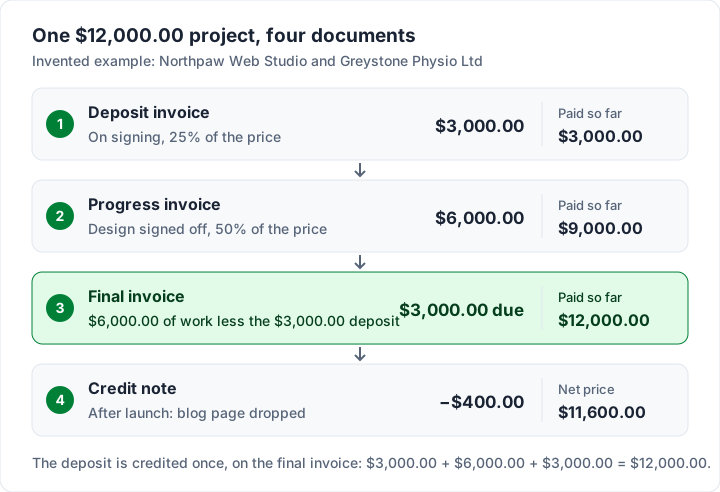
This example is invented. Northpaw Web Studio builds a website for Greystone Physio Ltd at a fixed price of $12,000.00. The contract says: 25% deposit on signing, 50% of the price at design sign-off, and the rest on launch.
| # | Document | When | Amount |
|---|---|---|---|
| 1 | Deposit invoice (25% of $12,000.00) | On signing | $3,000.00 |
| 2 | Progress invoice (50% of the price, design signed off) | Mid-project | $6,000.00 |
| 3 | Final invoice: remaining work $6,000.00, less deposit received $3,000.00 | On launch | $3,000.00 due |
| — | Total paid | $12,000.00 | |
| 4 | Credit note: blog page dropped from scope after launch | After payment | −$400.00 |
| — | Net price | $11,600.00 |
The check: $3,000.00 + $6,000.00 + $3,000.00 = $12,000.00, and $12,000.00 − $400.00 = $11,600.00.
How deposits are handled varies. Some contracts take a share of the deposit off each progress invoice; this one credits it in full on the final invoice. Either works, as long as the contract says which and the deposit is credited exactly once.
For annotated samples of each of these on their own, see the invoice examples.
Which type of invoice do you need?#
Work through these in order:
- Has the client agreed to buy yet? If not, send a quote, estimate or proforma, not an invoice.
- Do you want money before you start? Send a deposit invoice, or a retainer invoice for ongoing work.
- Is it a long, fixed-price job? Send progress invoices at agreed stages, then a final invoice.
- Is it the same bill every period? Use a recurring invoice.
- Do you bill by the hour? Use a timesheet invoice.
- Is it a one-off job, finished? Send a standard invoice.
- Did a sent invoice charge too much? Send a credit note. Too little? Send a supplementary invoice.
- Are goods crossing a border, or does tax apply? Check what a commercial invoice or tax invoice needs to show.
Whatever the type, the basics stay the same: your details, the client's, a unique number, dates, line items, a total and payment terms. Issue date vs due date vs service date explains which dates go where. Invoice abbreviations decodes the short labels, such as INV, PO and Net 30, that turn up on all of them.
Which types Charming handles, and which it does not#
Charming Invoices covers the types most small businesses send. All of these are on the free plan unless marked:
- Standard, sales and service invoices, with 60 templates, line items, units and sections with subtotals.
- Deposit and final invoices. “Add a deposit received” credits a deposit on the balance invoice. The catch: the figure is typed by hand and not linked to the earlier deposit invoice.
- Retainer invoices. The Retainer template adds a “Retainer balance before this invoice” field and draws work down from it. The balance is typed by hand.
- Progress invoices. The Progress Billing template prints contract value, percent complete, retainage held and balance to complete. Retainage is not tracked as a receivable.
- Timesheet invoices. The Timesheet template, an “hrs” unit and a “Total hours” option. Charming is not a time tracker.
- Recurring invoices, on paid plans. Each cycle creates a draft for you to review and issue; they are not sent automatically. See pricing.
- Paid invoices. Record the payment and the invoice is marked paid, with a PAID stamp on the PDF. Payment tracking is manual, and Charming does not take card payments.
- Supplementary invoices, as a new ordinary invoice.
- Tax invoices, with your tax ID, one tax rate per invoice and a tax summary. You can rename the title from “Invoice” to “Tax invoice”, but renaming the label does not change what the document contains.
And plainly, what it does not produce:
- No proforma, quote or estimate. Every invoice you issue takes the next number in your sequence.
- No credit notes or debit notes. You can void an issued invoice that has no recorded payments, but quantities and prices cannot go below zero, and there is no way to record a refund. Issue a credit note outside Charming.
- No e-invoices. Charming gives you a PDF and a private link to send yourself, with no structured e-invoice output.
- No customs form. A commercial invoice can be typed into an ordinary invoice, but there are no customs fields.
- No consolidated invoice. Client statements, as a PDF with ageing, list a client's open invoices instead.
Free-plan invoices carry a “Sent with Charming Invoices” line; on paid plans it is hidden by default. If deposit, progress and final invoices are most of what you send, create a free invoice and pick a template on the templates page.
Questions people ask#
How many types of invoices are there?#
There is no official count. This guide covers fourteen main types, and a small business usually needs only a few of them: standard, deposit and final invoices, perhaps progress, recurring or timesheet invoices, and now and then a credit note. Lists with twenty or more tend to mix in statuses and lookalikes.
What are the main types of invoices?#
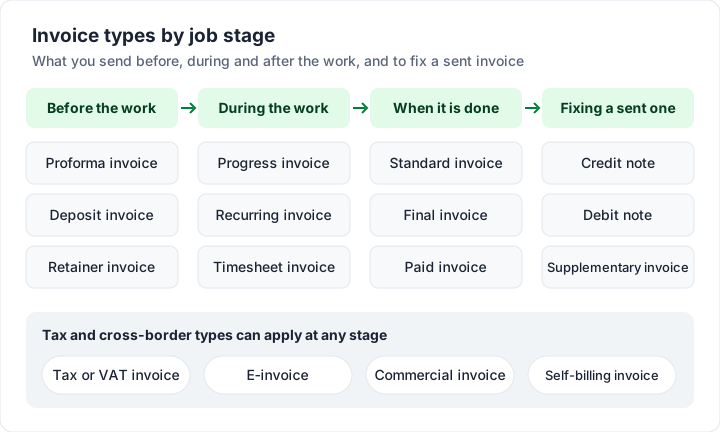
Sorted by job stage: proforma, deposit and retainer invoices before the work; progress, recurring and timesheet invoices during it; standard, final and paid invoices at the end; and credit notes, debit notes and supplementary invoices to fix a sent invoice.
What is the most common type of invoice?#
The standard invoice: one bill for goods or services, sent when the work is done or the goods are delivered. Most other types are versions of it.
Is a proforma invoice a real invoice?#
No. A proforma invoice previews what will be billed but does not ask for payment and is not usually recorded as a sale. When the client is ready to pay, you send a real invoice with its own number.
What is a final invoice?#
The invoice that bills what is left at the end of a job and credits any deposit or progress payments already made. It is a standard invoice with those credits shown, not a separate kind of document.
Is a credit note an invoice?#
No. A credit note reduces or cancels an invoice you already sent, and it refers back to that invoice. It is a separate document with its own number. Credit note vs invoice explains how they fit together.