Remittance on an invoice: remit-to and remittance advice

Nnabuike Okoroafor ·
On this page · 11 sections
A client's accounts team asks for your “remit-to details”. A week later, $2,085.00 lands in your bank with the reference “NGE PAYRUN 46”, and the next day an email arrives headed “Remittance advice”. You are owed $2,100.00 across two invoices. Which one is short, and why?
Remittance is the word for both halves of that exchange: the payment details you put on your invoice, and the note the payer sends back to say what they paid. This guide explains what remittance means on an invoice, what to print so money arrives correctly referenced, what a remittance advice contains, and what to do when it does not match, with a worked example of one payment across two invoices.
In short#
- Remittance means money sent as payment. On an invoice, it usually refers to where and how the payment should be sent.
- The remit-to details are yours to print: the name to pay, the bank details or postal address, and the reference the payer should quote.
- A remittance advice is the payer's note saying which invoices a payment covers, how much went to each, and any deductions.
- Match the payment to invoices using the remittance advice, not guesswork. If it is short, find out why before you write anything off.
- Treat a change to remit-to details as a warning sign. Changed bank details are a common payment-fraud trick; confirm them by phone on a number you already have.
What remittance means on an invoice#
“Remittance” has three common meanings, which is why searches for it return such mixed results:
| Meaning | Who uses it | Relevant here? |
|---|---|---|
| Money sent to pay an invoice or bill | Businesses, accounts teams | Yes |
| Money sent home by someone working abroad | Banks, money-transfer services | No |
| A specific product term in some financing agreements | Lenders, payment platforms | No |
On an invoice, it is the first meaning. You will see it in a few forms:
- Remit to: the name and address, or bank account, where payment should go. It can differ from the address the invoice is billed from, for example when payments go to a separate accounts office, a bank's collection address or a factoring company.
- Remittance advice: a note from the payer telling you what a payment covers. Large companies send them for almost every supplier payment.
- Remittance slip: a tear-off section at the bottom of a paper invoice that the payer returns with a cheque.
So when someone searches for a “remittance invoice”, they usually mean one of two things: an invoice with remittance details on it, or the remittance advice that comes back after it is paid. The rest of this guide covers both.
The remit-to block: what to print on your invoice#
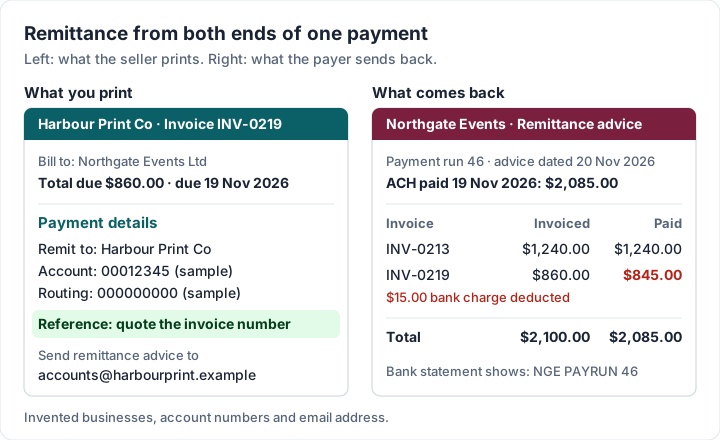
The remit-to block is the part of your invoice that tells the payer exactly how to pay you. On most invoices it sits under a heading such as “Payment details” or “How to pay”. For a business that pays by bank transfer, these are the lines that matter:
| Line | Example (illustrative) | Why it is there |
|---|---|---|
| Remit-to name | Harbour Print Co | The name the payment goes to; it should match the bank account name |
| Bank details | Account name, account number, routing or sort code, IBAN and SWIFT for international payments | So the payment can be set up without a phone call |
| Postal remit-to address | Only if you accept cheques, and only if it differs from your trading address | So cheques reach the right office |
| Payment reference | “Please quote the invoice number as your payment reference” | So you can match the money to the invoice |
| Where to send remittance advice | [email protected] | So the breakdown reaches the person who records payments |
Three habits make remittance far easier:
- Ask for the invoice number as the reference, and make it easy to type. Unique, sequential numbers are covered in how to number invoices.
- Print the PO number if the client gave you one. Accounts teams match payments to purchase orders, and the PO often appears on their remittance advice. Who to address an invoice to covers what else a company's accounts team needs.
- Keep the block the same on every invoice. A client who sets up your details once should never have to set them up again.
Which methods to offer, and how to word bank details for each, is covered in how to list bank details on an invoice. For the rest of the invoice, use the field-by-field invoice checklist.
Remittance advice: what the client sends back#
A remittance advice is a short document from the payer listing what a payment covers. Not every client sends one, but many companies with an accounts payable team produce one from their accounting system on each payment run.
A useful remittance advice contains:
- The payer's name and often their supplier number for you.
- The payment date, amount and method, for example a bank transfer or ACH payment.
- Each invoice paid, by number, with the amount applied to each.
- Any deduction, with a reason: a bank charge, an early-payment discount, a disputed line.
- The payer's own reference, such as a payment-run number, which may be what appears on your bank statement instead of your invoice number.
It arrives in a few ways: as an email (often a PDF from the payer's accounting system), through a supplier portal, on paper with a cheque, or as a short reference carried with the bank transfer. How much of the payer's reference your bank shows you varies by bank and by payment type, so if references often arrive cut short, ask your bank what it displays.
A worked example: two invoices, one payment, one short-pay#
Here is a sample case. The names, account details and email address are invented; the dates and arithmetic are real.
The printer Harbour Print Co bills Northgate Events Ltd for two jobs, each on Net 14 terms:
| Invoice | Issued | Terms | Due | Amount |
|---|---|---|---|---|
| INV-0213 | Thursday 29 October 2026 | Net 14 | Thursday 12 November 2026 | $1,240.00 |
| INV-0219 | Thursday 5 November 2026 | Net 14 | Thursday 19 November 2026 | $860.00 |
| Owed | $2,100.00 |
Both invoices carry the same Payment details block: remit-to name, bank details, “Please quote the invoice number as your payment reference”, and “Send remittance advice to [email protected]”.
Thursday 19 November 2026: one ACH transfer of $2,085.00 arrives. The bank statement shows the reference “NGE PAYRUN 46”, which is Northgate's payment-run number, not an invoice number. The amount matches neither invoice, nor their total.
Friday 20 November 2026: Northgate's remittance advice arrives by email:
| Invoice | Invoiced | Paid | Note |
|---|---|---|---|
| INV-0213 | $1,240.00 | $1,240.00 | Paid in full |
| INV-0219 | $860.00 | $845.00 | $15.00 bank charge deducted |
| Total | $2,100.00 | $2,085.00 | $15.00 short |
Now the money makes sense. INV-0213 is paid in full (a week late; it was due on 12 November). INV-0219 is paid on its due date but $15.00 short, because Northgate deducted a bank charge.
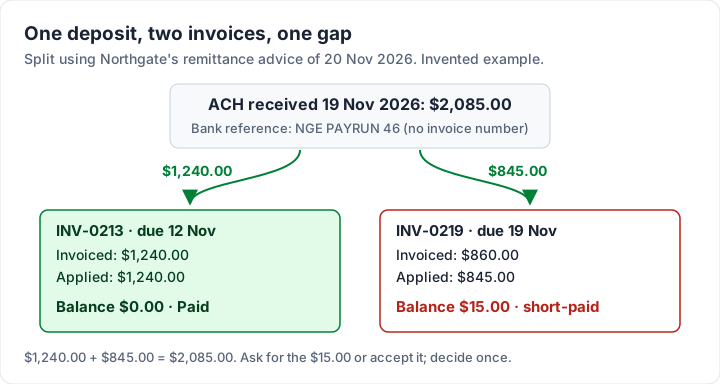
What to record: $1,240.00 against INV-0213, closing it, and $845.00 against INV-0219, which stays open with $15.00 still owed. Note the remittance advice on both, for example “Remittance advice 20 Nov 2026, payrun 46”, so anyone checking later can see where the split came from. Once the full amount is in, when an invoice counts as paid covers what to send the client.
Then decide what to do about the $15.00: ask for it, or accept it. Either is reasonable, but decide once and apply it to every client, and put the rule in your payment terms (“Payments must be made in full; bank charges are the payer's responsibility” or similar).
When the remittance does not match#
A remittance advice explains a payment; it does not always settle the question. These are the common mismatches and a first step for each:
| What happened | How you spot it | First step |
|---|---|---|
| Short-payment with a reason | Advice shows a deduction (bank charge, discount, disputed line) | Accept it, or reply asking for the balance |
| Short-payment with no reason | Advice amount is less than the invoice, no note | Ask which line was reduced and why |
| Lump sum, no breakdown | One deposit, several open invoices, no advice | Ask for the remittance advice before you split it |
| Wrong invoice number quoted | Advice names an invoice already paid or not theirs | Reply with the correct invoice and ask them to confirm |
| No advice and no usable reference | Unknown deposit | Hold it as unidentified; ask the likely client and your bank |
For the full matching method, including lump sums where two different pairs of invoices add up to the same amount, see match payments to invoices. Never guess which invoices a lump sum pays: if you guess wrong, your next statement will disagree with the client's books.
Wording you can copy:
Asking for a remittance advice:
Hi, thank you for your payment of $2,085.00 received on 19 November (reference NGE PAYRUN 46). Could you send the remittance advice so we can apply it to the right invoices? Our accounts address is [email protected].
Asking about a short-payment:
Thanks for the remittance advice for payment run 46. INV-0219 was for $860.00 and we received $845.00, with a note that a $15.00 bank charge was deducted. Our terms ask for payment in full, so could you add the $15.00 to your next payment run? Happy to send an updated statement.
Confirming a deduction you accept:
Thanks for the remittance advice. We have applied $1,240.00 to INV-0213 and $845.00 to INV-0219, and we will not chase the $15.00 bank charge this time. In future, please make sure charges are paid at your end so the full invoice amount arrives.
Remittance slips on paper invoices#
A remittance slip is the bottom part of a paper invoice, separated by a dotted line, that the payer tears off and returns with a cheque. It repeats the essentials: your name and remit-to address, the client's name or account number, the invoice number, the amount due and a box for the amount enclosed.
Slips still make sense if you are paid by cheque through the post, because the slip tells whoever opens the envelope which invoice the cheque pays. If you are paid by bank transfer, they do little: the remittance happens through the transfer reference and the emailed advice instead.
If you want the slip's effect on an emailed invoice, put the same lines in the payment details: remit-to name, address for cheques, “Please write the invoice number on the back of your cheque”, and where to send the remittance advice.
Factoring and changed details: when the remit-to is not yours#
Sometimes the remit-to block on your invoice legitimately names someone else. If you sell your invoices to a factoring company, the factor usually requires its own remit-to details on the invoice, so the client pays the factor directly. How factoring works on one load shows what that remit-to box looks like on a trucking invoice, and invoice factoring explained covers the notice clients receive when it starts.
That legitimate case is exactly what fraudsters copy. A common scam is an email, apparently from a supplier, saying their bank details have changed and the next payment should go to a new account. As the seller, protect your clients from it:
- Tell clients your details will not change by email alone, and that any change will be confirmed by phone.
- If you do change banks, call your clients on the numbers you already have, rather than only emailing the new details.
- As a buyer, verify every change of remit-to details by phone on a number from your own records, never one from the email asking for the change.
Our guide to checks before you pay an invoice covers the warning signs in more detail.
Remittance in Charming, and what it does not do#
Charming Invoices covers your side of remittance: what goes on the invoice and how payments are recorded against it. Checked in our code on 28 October 2026, on every plan unless noted:
- Payment details set once per business: bank details text and a default payment link, copied onto each invoice and frozen when it is issued. They print under a “Payment details” heading, which you can rename in the Template Studio.
- Invoice numbers that assign themselves, in sequence per business, with no gaps unless you raise the “Next number” setting yourself: the reference you ask payers to quote.
- A PO number field printed in the invoice header, and terms and notes on each invoice, where a line such as “Please quote INV-0213 as your payment reference” fits.
- Saved address and note snippets, such as an alternate remit-to address, on paid plans only.
- Payments recorded by hand, with amount, date, method and a note of up to 500 characters, where the remittance advice reference goes. Part payments keep the invoice open with the balance showing.
- Client statement PDFs with ageing, and a CSV export with Amount paid and Balance due columns, for checking balances with a client's accounts team.
The catches, plainly. Payment tracking is manual: Charming has no bank feed, does not read remittance advices and does not match payments automatically. A payment cannot exceed an invoice's balance, so you split a lump sum across invoices yourself, one payment per invoice. Bank details are free text and are not validated, so check them before you issue your first invoice. The payment link is a link you supply: Charming does not process card payments and never holds your money. None of the 60 templates has a tear-off remittance slip; put the remittance lines in the Payment details or Notes area instead. There is no write-off entry for an accepted short-pay; the small balance stays on the invoice until you resolve it. Free-plan invoices carry a “Sent with Charming Invoices” line.
If you invoice companies that send remittance advices, create a free invoice with your remit-to details in the Payment details, and record each remittance as it arrives.
Questions people ask#
What is a remittance invoice?#
It usually means an invoice with remittance details on it: who to pay, how, and what reference to quote. Some people also use it for the remittance advice a client sends after paying. Strictly, the invoice asks for payment and the remittance advice confirms it.
What does “remit to” mean on an invoice?#
It is where the payment should be sent: the name and bank account, or the postal address for cheques. It can differ from the business's main address, for example when a factoring company or a separate accounts office collects payments.
Is remittance the same as payment?#
Nearly. Remittance is the act of sending money in payment, so the words often overlap. In business use, “remittance” usually points to the details around the payment: where it goes and what it covers.
Is a remittance advice a receipt?#
No. A remittance advice comes from the payer and says what they paid. A receipt comes from the seller and confirms money was received. Our guide on whether an invoice is a receipt covers how the three documents differ.
Do I have to send a remittance advice when I pay a supplier?#
It is a courtesy that saves both sides time, especially when one payment covers several invoices. If a supplier asks for one, send it, and check whether your agreement with them says anything about it.
What if a client never sends remittance advice?#
Ask clients to quote the invoice number as the payment reference, and pay one invoice per transfer where possible. When an unreferenced lump sum still arrives, ask for the breakdown before you record it.
The short version#
Remittance is the paperwork around a payment. Your side is the remit-to block: who to pay, how, which reference to quote, and where to send the breakdown. The client's side is the remittance advice: which invoices a payment covers, and any deductions. Match payments using the advice, ask when it is missing or short, keep remit-to details the same on every invoice, and confirm any change by phone. That keeps money arriving in the right place, against the right invoice. For how all of this shows up in your books, see invoices in accounting.