Invoice factoring explained: costs, risks and alternatives

Nnabuike Okoroafor ·
On this page · 14 sections
You did the work, the invoice is sent, and the client pays in 45 or 60 days. Meanwhile rent, wages and suppliers want paying this week. That gap is the reason invoice factoring exists, and the reason so many lenders advertise it to small businesses with unpaid invoices.
This post explains invoice factoring and its cousins, invoice financing and invoice discounting: how the money moves, what recourse means, what a deal really costs as a yearly rate, what your client sees, which contract terms to read twice, and the cheaper fixes to try first.
Two things up front. First, this is general information, not legal or financial advice. Rules and market practice differ by country and state, and they change. Nothing here is a recommendation to use or to avoid any financing product; for a decision about your own business, talk to an accountant or a qualified adviser. Where we quote an official source, we link to the page we read on 23 October 2026. Second, we make Charming Invoices, an invoicing app. Charming does not factor or finance invoices, lend money or hold your money. We have no product to sell you in this post, which makes it easier to be candid about the costs.
In short#
- Invoice factoring means selling an unpaid business invoice to a finance company (a factor). It pays you most of the value now, collects from your client, and pays you the rest minus its fee.
- Invoice financing is the umbrella term. Invoice discounting is the version where you borrow against invoices and keep collecting them yourself, often without your client knowing.
- Recourse means the risk of non-payment stays with you. With non-recourse, the factor carries some of it, for the reasons the contract lists.
- A small-sounding fee can be a high yearly rate. In our illustrative example, a 5% fee on an invoice paid in 45 days works out at about 47.7% a year on the cash you actually receive early.
- Read the contract for minimums, minimum terms, exit fees and how the reserve is released before you sign anything.
- Compare the cheaper fixes too: deposits, shorter payment terms, an early-payment discount, reminders and a call to accounts.
What is invoice factoring?#
Invoice factoring is a way to turn an unpaid invoice into cash before your client pays it. You sell the invoice to a factoring company. The factor pays you an advance, usually most of the invoice value, within a day or two. It keeps the rest as a reserve until your client pays. When the client pays the factor, the factor releases the reserve to you minus its fee. If you are comparing providers, how to choose an invoice factoring service sets three offers side by side on one invoice.
The British Business Bank, a development bank wholly owned by the UK government, describes the general model this way: a business can “assign” (essentially sell) some or all of its outstanding invoices to the provider and then “will then have access to up to 80 or 90 per cent of the value of those invoices virtually immediately”, with the remaining 10 or 20 per cent, less the provider's fees, “made available upon payment of the invoices by the customer” (British Business Bank, Invoice finance, updated September 2026, read 23 October 2026).
A factoring agreement can read a lot like a loan agreement, with security interests and public filings, so read it as carefully as you would a loan.
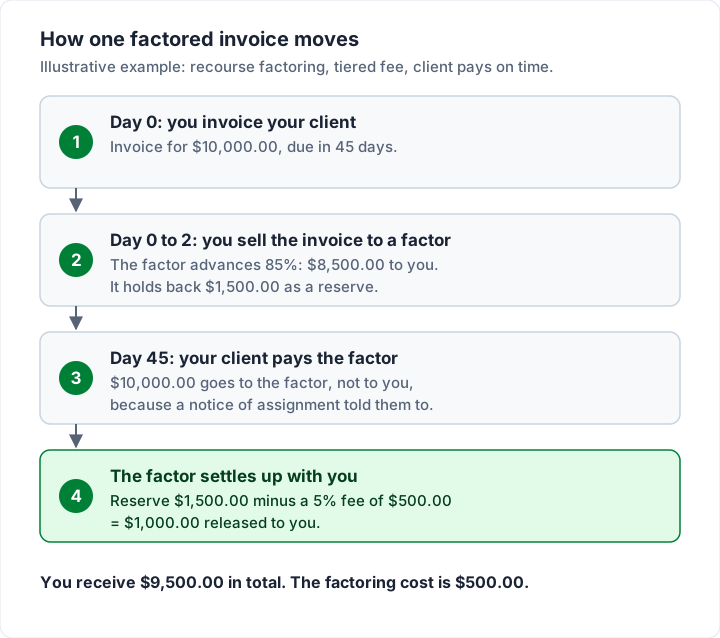
Here is one invoice moving through a factoring deal, using the illustrative numbers from the worked example later in this post:
Factoring is for invoices to businesses. A factor is buying your client's promise to pay, so it cares more about your client's record than yours. The British Business Bank says invoice finance “is normally only available to businesses that trade with other businesses (known as business-to-business, or B2B) on credit terms”. A photographer billing couples is generally not a candidate.
How invoice factoring works, step by step#
The details vary by provider, but most deals follow the same order:
- You apply. Expect to share recent accounts and a list of what you are owed. The factor decides which clients it accepts and how much it advances against each.
- You sign the agreement. It sets the advance rate, fees, recourse terms, minimums and how long you are committed.
- Your client is told to pay the factor, through a notice of assignment and the factor's payment details on your invoices.
- You submit invoices and receive the advance. Once running, the British Business Bank says invoice finance can provide funds “within 24 hours of new invoices being generated”, though setting it up “can take a bit of time”.
- The factor collects and settles up, releasing the reserve minus its fees. If the client does not pay, the recourse terms decide what happens next.
Invoice factoring vs invoice financing vs invoice discounting#
The words are used loosely. “Invoice financing” (or “invoice finance”) is usually the umbrella term for raising money against unpaid invoices. The main products under it differ in who collects and whether your client knows.
| Invoice factoring | Invoice discounting | Spot or selective factoring | |
|---|---|---|---|
| What happens | You sell invoices; the factor advances most of the value | You borrow against invoices as security | You finance one invoice or one client's invoices |
| Who collects | The factor | You do | Usually the factor |
| Does your client know? | Usually yes | Often no (undisclosed) | Usually yes |
| Typical user | Smaller businesses | More established businesses | Occasional cash needs |
| Commitment | Often a facility with a minimum term | A facility with a minimum term | Invoice by invoice |
The British Business Bank draws the same line: with factoring “your customers are likely to know”, while invoice discounting is “a finance-only product” and “many invoice discounting facilities are undisclosed”. Spot factoring suits businesses “that have occasional, rather than ongoing, working capital requirements”.
So, invoice financing vs factoring? If someone offers you “invoice financing”, ask two questions: who will collect from my clients, and will my clients be told? The answers tell you which product it really is.
Who offers invoice finance. Invoice finance companies come in the same shapes as factoring companies: finance arms owned by banks, independent finance companies, online platforms, industry specialists and brokers who place you with one of them. A provider that only does invoice discounting is sometimes called an invoice discounter. We do not name or rank providers; how to choose an invoice factoring service lists the types and the questions to put to any of them, whatever they call the product.
Recourse vs non-recourse factoring#
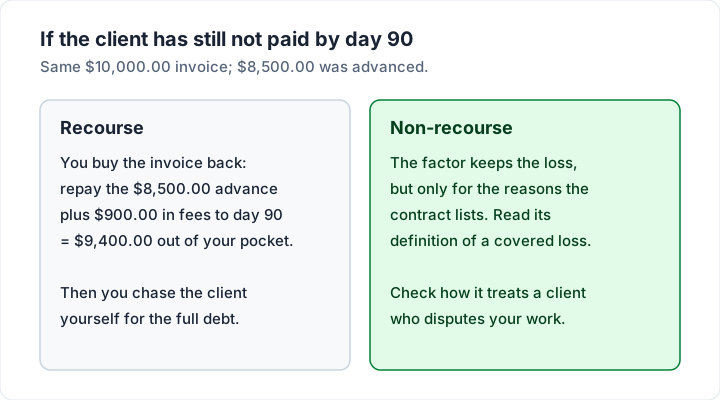
- Recourse factoring: typically, if your client does not pay within a set period, you buy the invoice back. You repay the advance plus the fees that have built up, and the debt is yours to chase again.
- Non-recourse factoring: the factor absorbs the loss, but only for the reasons the contract lists. Read the definition. Protection that covers a client going insolvent does not necessarily cover a client who refuses to pay because they say your work was late or wrong.
The British Business Bank's plain warning applies here: “Depending on the terms set by your lender, you may be held responsible if your customer fails to settle their invoice.” It also notes that many providers offer “forms of bad debt protection” alongside a facility.
Here is what each looks like when the client in the worked example has still not paid by day 90:
Advance rates and fees: what you actually pay#
The advance rate is the share of the invoice you receive up front. The British Business Bank describes advances of “up to 80 or 90 per cent”, set by the provider's view of “the quality of the customer businesses owing the money, and the likelihood of the invoices being paid”.
The fee is where offers differ most. The British Business Bank describes the common UK structure as “a service fee (a percentage of the value of each invoice), and a discount charge (like interest) based on the amount of funds it utilises”. Providers also price factoring as:
- A flat fee: one percentage of the invoice, however long the client takes.
- A tiered fee: a percentage for the first 30 days, then more for each further block of days. This is what the worked example uses.
- A daily or weekly rate: the fee keeps growing until the client pays.
We know of no standard rate. The percentages quoted on lender pages vary, sometimes within one page. What matters is the written quote for your invoices and your clients.
Ask for the estimated APR. Wherever you are, you can ask any provider for an estimated APR and the total dollar cost in writing. Whether a provider has to show you those figures, and in what form, is a question for your state's financial regulator or a lawyer; we do not summarise the rules here.
The fees that are not the headline rate#
Read the fee schedule for charges like these. Not every provider uses them, and the names vary:
| Fee | What it is | Question to ask |
|---|---|---|
| Application or set-up fee | Charged to open the account | Is it refundable if you do not proceed? |
| Due diligence or credit-check fee | Charged to check you or your clients | Per client, or once? |
| Transfer fee | Charged to send each advance | Bank transfer, wire or both? |
| Monthly minimum | Charged if you factor less than an agreed amount | What happens in a quiet month? |
| Collection or late fee | Charged when your client pays late | Who sets the deadline, and is it capped? |
| Termination or exit fee | Charged to leave early | How is it calculated, and when can you leave free? |
A worked example: what factoring one invoice costs#
All numbers here are illustrative, chosen to show the arithmetic. They are not a quote, a typical rate or an offer from any provider.
The deal: a $10,000.00 invoice to a business client, due in 45 days. The factor advances 85% and charges a tiered fee of 3% for the first 30 days plus 1% for each further 10 days or part of 10 days. Recourse applies. The client pays on day 45.
| Line | Amount |
|---|---|
| Invoice value | $10,000.00 |
| Advance (85%), paid in the first couple of days | $8,500.00 |
| Reserve held back (15%) | $1,500.00 |
| Fee: 3% (days 1 to 30) + 1% (days 31 to 40) + 1% (days 41 to 50, paid on day 45) = 5% | $500.00 |
| Reserve released on day 45 ($1,500.00 − $500.00) | $1,000.00 |
| Total you receive | $9,500.00 |
Turning the fee into a yearly rate#
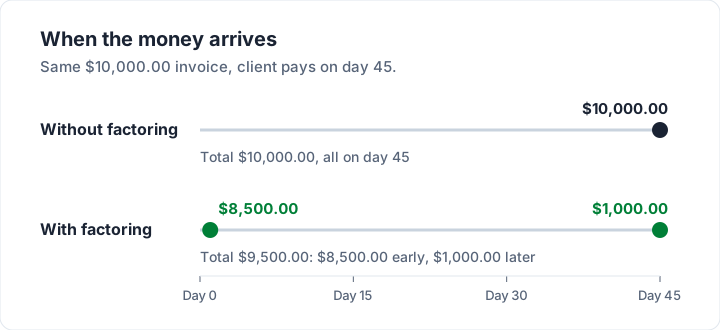
A 5% fee sounds modest, but you are paying $500.00 to have $8,500.00 about 45 days early, not to borrow $10,000.00 for a year. To compare it with a loan or a card, divide the fee by the cash you got early, then scale it to a year:
Fee                         $500.00
Cash advanced               $8,500.00
Days until the client pays  45

Cost for the period   500 ÷ 8,500        = 5.88%
Yearly rate           5.88% × 365 ÷ 45   = about 47.7% a year
This is a simple annualised rate for comparison. A provider's own estimated APR may be worked out a different way, so its figure may differ a little; the order of magnitude is the point. Here is what you are buying:
What changes if the client pays earlier or later#
On a tiered fee, the day your client pays decides the price. Using the same illustrative deal:
| Client pays on | Fee | Fee in dollars | Reserve released | Simple yearly rate |
|---|---|---|---|---|
| Day 20 | 3% | $300.00 | $1,200.00 | 64.4% |
| Day 30 | 3% | $300.00 | $1,200.00 | 42.9% |
| Day 45 | 5% | $500.00 | $1,000.00 | 47.7% |
| Day 60 | 6% | $600.00 | $900.00 | 42.9% |
| Day 75 | 8% | $800.00 | $700.00 | 45.8% |
| Day 90 | 9% | $900.00 | $600.00 | 42.9% |
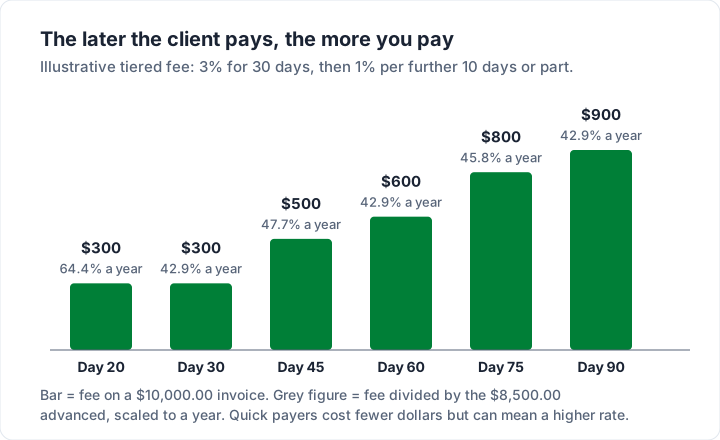
Three things the table shows:
- A minimum period costs you when clients pay fast. A client who pays on day 20 still triggers the full 30-day fee, so the yearly rate jumps.
- Paying a few days into a new block costs the most per day. Day 45 costs more per day than day 60, because the client paid five days into a ten-day block.
- Small flat fees add up. In this example, a single extra $50.00 charge on the invoice adds about 4.77 percentage points to the yearly rate (50 ÷ 8,500 × 365 ÷ 45).
If the client does not pay#
With recourse, suppose the agreement says you must buy back any invoice unpaid after 90 days. On day 90 you repay the $8,500.00 advance plus $900.00 in fees, $9,400.00 in all, and you are back where you started: a $10,000.00 debt to chase, now $900.00 poorer. Factoring moved the date of the cash. It did not move the risk.
Will your client know? Notification and the notice of assignment#
With standard factoring, yes. Your client receives a notice of assignment asking it to pay the factor from now on. If a client pays you by habit after the notice, expect your agreement to require you to pass the money to the factor straight away, and expect an awkward conversation: a fast way to sour a good relationship. What the notice means legally for your client depends on your agreement and the law where you are, so ask a lawyer if a payment goes astray.
What that means for your invoices:
- The payment details change. Your invoice shows the factor's remittance details or assignment wording, exactly as your agreement requires. The trucking invoice guide walks through this for carriers, where factoring is common, and trucking invoice factoring works one load through with the notice of assignment and broker quick-pay. Invoice factoring for staffing agencies covers the same change for agencies that meet payroll before clients pay.
- Consider telling the client yourself first, if your agreement allows it. A short email from you often lands better than a letter from a company they do not know.
- Undisclosed options exist. Invoice discounting is “generally provided on an undisclosed basis”, says the British Business Bank, but tends to suit larger businesses.
Illustrative wording, to adapt only if your agreement allows it:
Payment terms: due in 45 days.
This invoice has been assigned to [Factor name].
Please pay only to the account below.
[Factor's bank or remittance details]
What if your client's contract bans assignment? Some large clients' terms forbid you from selling their invoices. Tell the factor about the clause, and ask a lawyer before you factor invoices under that contract.
Contract terms to read twice before you sign#
Much of the risk is in the agreement, not the rate. The British Business Bank notes that providers “will require you to enter into an agreement for a minimum period of time”. Before you sign, find each of these:
| Term | What to look for |
|---|---|
| Whole ledger or selected invoices | Must you factor every invoice, or can you choose? |
| Minimum volume | A monthly amount you must factor, or pay a fee for missing |
| Minimum term and renewal | How long you are committed, and whether it renews automatically |
| Notice and exit fee | How much notice you must give, and what leaving early costs |
| Advance rate per client | Whether some clients get a lower advance, or none |
| Reserve release | When the reserve is paid out: per invoice, or in batches |
| Recourse period | How many days before you must buy an unpaid invoice back |
| Disputes | What happens if your client disputes the work or the amount |
| Security and guarantees | Whether the factor takes security over other assets, or asks for a personal guarantee |
| Who contacts your clients | How and how often the factor chases, and in whose name |
The US Federal Trade Commission's general advice to small businesses seeking finance applies here too: “If there is anything you don’t understand, contact the lender or provider and insist on an answer in writing” (FTC Business Blog, June 2021, read 23 October 2026).
Questions to send a factor before you sign#
Copy these into an email and ask for the answers in writing:
1. What is the estimated APR for an invoice of $[amount] paid in [days] days?
2. Please list every fee, including set-up, transfer, monthly and exit fees.
3. Is this recourse or non-recourse? If non-recourse, what losses are covered?
4. How many days before I must buy back an unpaid invoice?
5. Do I have to factor all my invoices, or can I choose?
6. Is there a minimum monthly volume or a minimum term? Does it renew automatically?
7. How much notice do I need to give to leave, and what does leaving cost?
8. When and how is the reserve released?
9. How will you contact my clients, and in whose name?
10. Do you require a personal guarantee or security over other assets?
When invoice factoring can make sense, and when it does not#
Factoring is a financing tool with a real cost, built for one problem: reliable business clients who pay slowly, and a cash gap you cannot bridge more cheaply.
It can make sense when:
- Your clients are creditworthy businesses on long terms and you cannot shorten them, for example large companies with fixed payment runs.
- You are growing fast, so each new order needs cash for staff or materials before it pays.
- Your margin is wide enough to absorb the fee, and the alternative is turning down profitable work.
- The need is occasional, and spot factoring lets you use it invoice by invoice.
It may be a poor fit when:
- The client does not pay at all. Factoring is not debt recovery: with recourse, a bad debt comes straight back to you, plus fees. What to do when a client is not paying is the better guide here.
- The invoice is disputed. A factor is buying your client's promise to pay, and a dispute weakens it. Resolve the disputed invoice first.
- The gap is a symptom of your terms, not your clients. Then the fix is in how you bill.
The British Business Bank's line is worth keeping in mind: “no form of commercial finance can make a fundamentally unprofitable businesses successful in the medium and longer-term.”
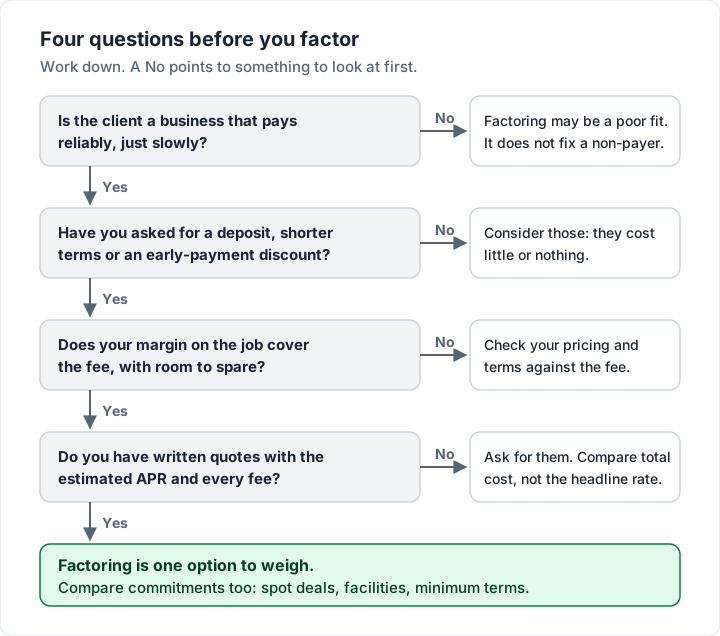
Cheaper alternatives to compare with factoring#
When a client takes 60 days to pay, you are in effect lending them the money for those 60 days, and you may be paying interest elsewhere to cover the gap. Factoring is one way to stop floating your clients. These are cheaper ones, roughly in order of cost:
| Fix | What it costs you | The catch |
|---|---|---|
| Ask for a deposit | Nothing | Some clients will push back on larger upfront amounts |
| Bill in stages | A little admin | Needs a clear schedule agreed up front |
| Shorter payment terms | Nothing | Large clients may insist on their own terms |
| Reminders and a call to accounts | A few minutes | Works on slow payers, not on clients who will not pay |
| A client statement | A few minutes | Only shows what is owed; it does not collect |
| An agreed late fee | Nothing unless charged | Agree it before the work, and check it is allowed where you are |
| An early-payment discount | The discount | The client chooses whether to take it |
| A bank line of credit | Interest and fees | Needs approval; often slower to set up |
Deposits are the cheapest bridge of all: the client funds the start of the job. How deposit invoices work covers amounts, wording and how the deposit shows on the final invoice. On long jobs, progress invoicing means you are never more than one stage of work unpaid.
Shorter terms cost nothing to ask for. How to choose payment terms explains the options, and the invoice due date calculator turns any term into a real date. If you bill large companies, invoicing a company covers purchase orders and payment runs, common causes of long waits. If a client is only now asking to pay by invoice, our guide to what pay by invoice means for the seller works out what agreeing to Net 30 costs you on one $4,000.00 order.
Reminders and statements fix invoices that are forgotten rather than refused. The overdue invoice email, step by step has wording for each stage, and invoice vs statement explains when a statement works better than another reminder. Late fees, agreed in advance and allowed where you work, give clients a reason to pay on time: see late fees on invoices.
An early-payment discount is factoring in reverse: you pay the client, not a factor, to pay sooner. Using the same illustrative $10,000.00 invoice, a 2% discount for paying within 10 days instead of 45 costs you $200.00 to be paid 35 days early. That is about 21.3% a year on the $9,800.00 you receive (200 ÷ 9,800 × 365 ÷ 35): still a real cost, but less than half the factoring example's rate, with no contract and no notice to your client. Our guide to discounts on an invoice covers how to word one on the invoice.
A bank line of credit may cost less, depending on the rate and fees you are offered and whether you qualify. In the US, the SBA's CAPLines program “helps small businesses meet their short-term and cyclical working-capital needs” through SBA-backed lenders (SBA, Types of 7(a) loans, read 23 October 2026).
What Charming does, and what it does not#
To be plain about it: Charming Invoices does not factor invoices, offer invoice financing, advance money or buy debts. It is not a payment processor either, so clients pay you directly using the details on the invoice and you mark it paid. If you need factoring, you need a factoring provider.
What Charming does cover is the preventive work above, on every plan including Free:
- Deposits: on a balance invoice you can add a deposit already received, and it prints as a “Deposit received” line taken off the total. You type the amount yourself; it is not linked to the deposit invoice you sent earlier.
- Due dates and terms: every invoice has a real due date and a Terms section, and you can save default terms on your business profile.
- Overdue at a glance: an issued invoice past its due date shows as Overdue automatically, so you can see what is still owed. Charming does not send reminders; set a calendar reminder for the due date and follow up from your own email.
- Client statements: a PDF listing a client's open invoices with ageing (current, 1 to 30, 31 to 60, 61 to 90 and 90+ days). You download it and send it yourself.
- Payment details: your bank details come from the business settings and are copied onto each invoice each time you save it. If a factoring agreement requires the factor's details or assignment wording, you can put them there or in the invoice's Terms, but Charming does not know an invoice is factored and does not notify anyone for you.
The catches, plainly: payment tracking is manual, clients cannot pay by card from the invoice, Charming has no late-fee feature, and Free invoices carry a small “Sent with Charming Invoices” line.
Invoice factoring FAQ#
Is invoice factoring a loan?#
Factoring is usually structured as a sale of the invoice, not a loan. In practice it behaves a lot like borrowing, especially with recourse, where you carry the risk that the client never pays. The British Business Bank describes invoice finance as “a debt product”. How a particular agreement is treated is a legal question, so read the agreement rather than the label, and ask a lawyer if it matters.
Does invoice factoring affect your credit?#
It can. The British Business Bank notes that providers “will conduct credit checks when you apply for finance”, adding: “These checks could have an impact on your credit report.” A personal guarantee, if you sign one, can also make you personally liable.
Can a freelancer or sole trader use invoice factoring?#
Sometimes, if you bill businesses on credit terms. Factoring and spot factoring are the versions most open to small businesses; the British Business Bank says factoring is “usually available for businesses with annual sales up to £2 million”, and that a traditional facility “would not be suitable for businesses with annual turnover of less than £300,000”, for whom spot or selective finance “may be more suitable”. If you bill consumers, it is unlikely to be available.
What does it mean to finance invoices?#
To raise money against invoices your clients have not paid yet, either by selling them (factoring) or by borrowing against them (invoice discounting and other invoice finance). Either way, the cash comes from a provider now and the client's payment settles it later, minus the provider's fees.
Is invoice factoring worth it for a small business?#
That depends on whether the cash it brings forward is worth more to you than the fee costs. We cannot answer it for you, but you can test it: work out the yearly rate on your own numbers, and compare it with the cheaper fixes above and with any other quotes you have. A shorter commitment limits how long you are tied in if it does not work out. Setting up a facility takes time, so it is a poor fix for a bill due tomorrow.
The one-paragraph version#
Invoice factoring sells your unpaid business invoice for most of its value now and the rest, minus a fee, when your client pays. It can be fast but can work out at a high yearly rate, your client usually knows, and with recourse the risk stays with you. If you are weighing it up, the estimated APR and every fee in writing, the exit terms and the cheaper fixes above are the things to compare.
Most of those fixes start with the invoice itself. If you want deposits, due dates, overdue tracking and statements in one place, create a free invoice with Charming Invoices.