Invoicing a company: what to get right

Nnabuike Okoroafor ·
On this page · 12 sections
You have done work for a company rather than a person, and now the invoice has to go somewhere. Invoicing a company is not harder than invoicing a person, but the invoice passes through more hands: the person who hired you approves it, someone in finance checks it, and a payment run pays it. Each of them needs something specific on the document.
This guide covers who to address it to, the forms a company may ask for first, and a worked example you can copy. It is general information, not legal or tax advice: rules differ by country and state, and they change, so we link the official source wherever the law matters.
What changes when you are invoicing a company#
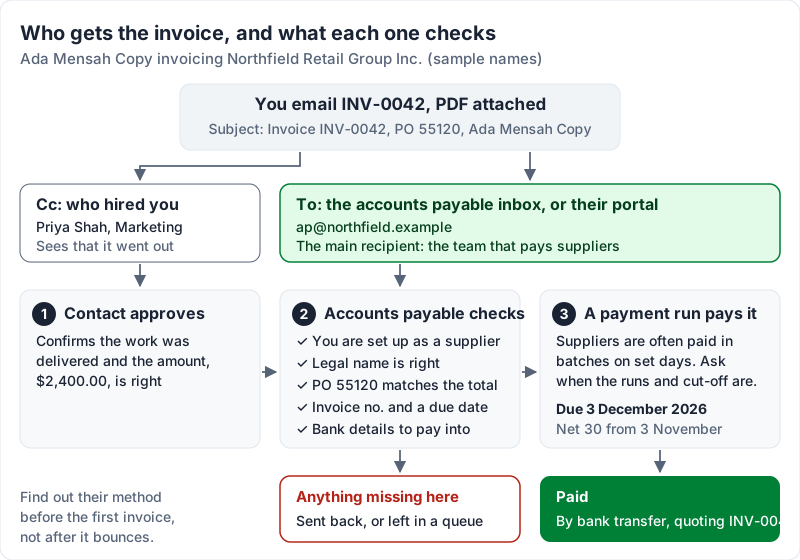
A person pays from their own account when they read your email. A company, especially a larger one, pays through a process. Roughly:
- Your contact confirms the work and the amount.
- Accounts payable checks it. This team pays suppliers. It checks that you are set up as one, that the name is right and that a purchase order matches. Our guide to invoices in accounting shows how your invoice becomes a payable in their books.
- A payment run pays it. Many companies pay suppliers in batches on set days.
Anything missing at step 2 sends the invoice back or leaves it in a queue. Many larger companies have their own method for invoices from contractors. Your job is to find out their method before the first invoice, not after it bounces.
Use the company's legal name, not the brand#
The name on the shopfront is not always the name on the bank account. A company may trade under a brand while its registered name is something else, and a group may run several companies with similar names. In the US, the Small Business Administration explains that a business's entity name is “how the state identifies your business”, while a DBA (“doing business as”) name is a separate registration (SBA, Choose your business name).
So ask one question early: “Which legal entity should the invoice be made out to, and what billing address should I use?” Then copy the answer exactly.
- In the UK, GOV.UK lists “the company name and address of the customer you’re invoicing” among the things an invoice must include (GOV.UK, Invoices: what they must include, as of 23 October 2026). Companies House lets you look up a company's registered address for free (GOV.UK, Get information about a company).
- Anywhere VAT or GST applies, tax rules may add fields, such as the client's tax number. What a tax invoice is covers those, and for a UK or EU client, our guide to what HMRC lists for a UK VAT invoice lists every required detail with a worked example.
The billing address is whatever the finance team gives you. It is often not the building where you did the work.
Who an invoice should be addressed to#
Two people are involved, and the invoice has to serve both. This table shows what each one needs.
| The person who hired you | Accounts payable | |
|---|---|---|
| Their job | Confirm the work and approve the amount | Check, match and pay |
| What they look for | Their name, a description they recognise | Legal name, PO number, invoice number, due date, bank details |
| How it reaches them | Copied on the email | As the main recipient, or through a portal |
Address the invoice to the company, then point it at the right people. A common layout under “Bill to” looks like this:
Northfield Retail Group Inc.
Attn: Accounts Payable
Ref: Priya Shah, Marketing
400 Harbour Road
Portland, OR 97201
Some companies want a named person in finance instead of “Accounts Payable”; others want a cost centre or the requester's name. There is no universal right answer, only theirs, so ask.
Send it to the finance inbox, and copy your contact#
Many companies have a dedicated email address for supplier invoices, and some only process invoices that arrive there. Ask for it. When you send:
- Finance in To, your contact in Cc. Accounts payable gets the document; the person who can vouch for the work sees that it went out.
- Attach a PDF. Finance teams file and forward PDFs. A link on its own may not survive their process.
- Make the subject searchable. Your business name, the invoice number and the PO number.
For subject line patterns and message wording, see how to send invoices by email. Invoice email examples includes one written for accounts payable, with a PO number.
Supplier onboarding: the forms that come first#
Before a company can pay a new supplier, it usually has to set you up in its system. Expect a supplier form (often called a vendor form) asking for your legal name, address, tax details and bank details. Until it is done, a correctly written invoice may still not be payable. Return the form before, or with, your first invoice.
In the US, Form W-9. A US client will often ask a US freelancer or business for a W-9. The IRS describes its purpose plainly: “Use Form W-9 to provide your correct Taxpayer Identification Number (TIN) to the person who is required to file an information return with the IRS” (IRS, About Form W-9, as of 23 October 2026). The form itself says: “Give form to the requester. Do not send to the IRS.” On missing or wrong numbers, the IRS page on backup withholding says: “There are situations when the payer is required to withhold at the current rate of 24 percent." Download the form from irs.gov rather than from a link in an unexpected email. The independent contractor invoice template has a filled-in sample showing where the W-9 and 1099-NEC fit.
Outside the US, billing a US company. The IRS page for foreign individuals says to “Give Form W-8 BEN to the withholding agent or payer” if it applies to you (IRS, About Form W-8 BEN, as of 23 October 2026). Companies elsewhere use their own supplier forms, asking much the same things. These forms carry sensitive details, so send them the way the company asks (often a portal or secure upload). If you are unsure which form applies to you, ask an accountant once. If the company pays in a different currency from yours, billing a client in another currency covers which one to put on the invoice.
A word on bank details. A common supplier fraud sends a company “updated” bank details by email. The FBI's Internet Crime Complaint Center advises companies to “Use secondary channels or two-factor authentication to verify requests for changes in account information” (IC3, Business Email Compromise, as of 23 October 2026). If you change bank accounts, expect a call to confirm it. That call is a good sign.
PO numbers: ask before you invoice#
A purchase order (PO) is the company's internal approval to spend money with you. The company issues the number, and accounts payable often matches your invoice against it. Without it, an invoice may be returned or left waiting.
Ask three things: is there a PO, what is the number, and must the total match it exactly? Put the number near the invoice number and dates, and in the email subject. If the work grows beyond the PO, ask for it to be raised before you invoice the extra. What a PO number on an invoice does goes into the details.
Payment terms and payment runs at larger companies#
Larger companies often set terms in their own supplier agreement, sometimes longer than you would choose. Read them before you sign, and put the terms and an actual due date on every invoice. Invoice payment terms, in plain English explains Net 30, EOM and how to count a due date. If a company asks to pay by invoice rather than by card, our guide to what pay by invoice means for the seller works through what offering it costs on a $4,000.00 order.
Ask when the payment runs are. An invoice approved the day after a run waits for the next one. “When are your payment runs, and what is the cut-off?” is a normal question, and the answer tells you when to send.
Plan for the process, not the paperwork. Approval steps and payment-run timing can add days between the due date on your invoice and the money reaching your account, so leave some slack in your own cash planning until you know how a new client's process works. If a long payment run leaves a gap you cannot carry, invoice factoring explained sets out what it costs to sell the invoice for early cash.
Some places set limits. In the UK, GOV.UK's page on late commercial payments says, as of 23 October 2026: “If you agree a payment date, it must usually be within 30 days for public authorities or 60 days for business transactions.” The same page covers what happens when no date was agreed. Other countries have their own rules, so read your own official guidance or ask a lawyer.
When a company wants its own format or portal#
Some companies ask you to use a supplier portal, follow a set format, or add fields such as a cost centre or the supplier number they gave you. That is normal; treat it as part of the job.
- A portal. Ask for the registration link early, because setup can take days. Some portals accept your PDF; some make you retype the invoice. Keep the same invoice number either way.
- Extra fields or their own template. Add the fields as text in the reference line or notes. If they insist on their template, use it and keep your own copy under the same number.
- Electronic invoicing. Some countries require structured e-invoices for certain business or public-sector work. If a client mentions it, ask exactly what they need, because a PDF may not be enough. Our guide to electronic invoices explains the difference.
How to invoice a company: a checklist#
Before the first invoice:
- Legal entity name and billing address confirmed in writing
- Finance email address, or portal access, confirmed
- Supplier form returned, plus a W-9 or W-8BEN if a US payer asked for one
- PO number received, if they use purchase orders
- Payment terms agreed and payment run timing known
To collect these on paper, print the free client onboarding checklist for billing (A4, or US Letter), which has lines to note each detail as you get it.
On every invoice:
- Company legal name, an “Attn” line and your contact's name or reference
- Your business name, contact details and any tax number you actually hold
- A unique invoice number, the issue date and a real due date
- The PO number and any other reference they asked for
- Line items in words they recognise, with a total that matches the PO
- Bank details or a payment link
- Sent to the finance address, contact copied, PDF attached
For the complete field list, what actually belongs on an invoice is the reference.
Worked example: a freelancer invoicing a company#
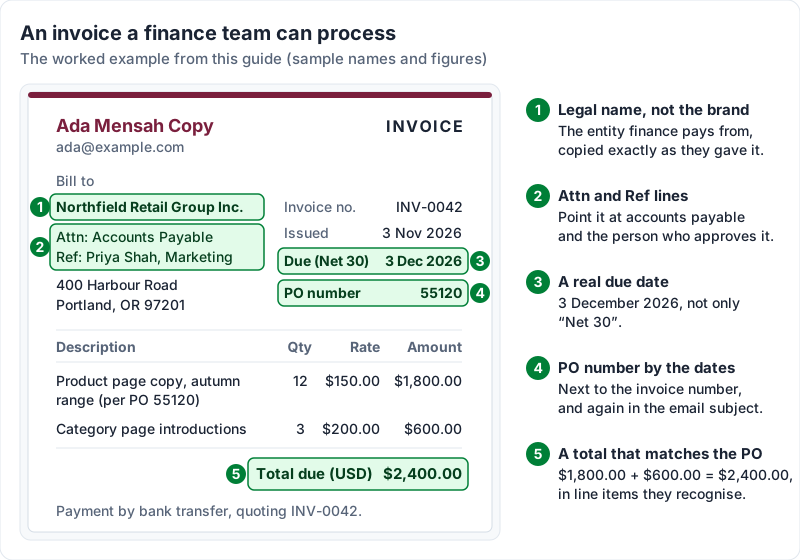
The names and figures here are invented for illustration. Ada Mensah, a freelance copywriter, has written product pages for a retail brand called Northfield. Her contact is Priya Shah in marketing. Before invoicing, Ada asked her questions and got four answers: bill “Northfield Retail Group Inc.”, send to the accounts payable inbox, quote PO 55120, and terms of Net 30.
The header:
| Field | Example |
|---|---|
| From | Ada Mensah Copy, [email protected] |
| Bill to | Northfield Retail Group Inc., Attn: Accounts Payable, Ref: Priya Shah, Marketing |
| Invoice no. | INV-0042 |
| Issued | 3 November 2026 |
| Due | 3 December 2026 (Net 30) |
| PO number | 55120 |
The line items:
| Description | Qty | Rate | Amount |
|---|---|---|---|
| Product page copy, autumn range (per PO 55120) | 12 | $150.00 | $1,800.00 |
| Category page introductions | 3 | $200.00 | $600.00 |
| Total due (USD) | $2,400.00 |
Payment by bank transfer to the account shown, quoting INV-0042.
Put together, the invoice looks like this:
A sample email to send with it:
- To: [email protected]
- Cc: [email protected]
- Subject: Invoice INV-0042, PO 55120, Ada Mensah Copy
Hello,
Please find attached invoice INV-0042 for $2,400.00 (USD) against PO 55120, for the product and category page copy delivered to Priya Shah on 31 October. Payment is due on 3 December 2026 by bank transfer, quoting INV-0042.
My supplier form was returned on 20 October. Please let me know if you need anything else to process this.
Thank you, Ada Mensah
The total matches the PO, the PO number appears twice, and Priya is copied so she can approve it.
Questions people ask about invoicing a business#
Can I invoice a company as an individual? Yes. Use your own legal name, plus a trading name if you have one, and expect the same supplier forms.
What if they do not use purchase orders? Leave the PO field off rather than writing “N/A”, and put your contact's name in the reference line so accounts payable knows who approves it.
What if they say they never received it? Resend it to the finance address, copy your contact, and ask them to confirm it is in their system and which payment run it will go in.
Where Charming fits, and where it does not#
Charming Invoices covers the invoice side of this. A client record holds the client's name, email, phone and a multi-line address, which prints under “Bill to”, so the legal name and an “Attn: Accounts Payable” line sit where finance expects them. Each invoice has a PO number field printed in the header with the invoice number and dates. When you issue the invoice, it gets its number and a stored PDF: download it or copy its private link, and send it to the client's finance address from your own email.
The catches. Charming does not send the email for you, so copy the person who hired you yourself when you send it, or share the invoice's private link. A template can hide the PO number section, so check it is switched on. There is no supplier-portal connection: for a portal, you download the PDF and upload it. Payment tracking is manual, so you mark it paid when the money arrives, and invoices on the free plan carry a small “Sent with Charming Invoices” line in the footer.
If that suits how you bill, create a free invoice and set up your first company client with the details from the checklist above.
Free downloads
No sign-up and no email address. More on the free templates page.
- Download .pdf: Client onboarding checklist for billing (A4)
Client onboarding checklist for billing (A4)
PDFWhat to settle with a new company client before you send the first invoice.
- Download .pdf: Client onboarding checklist for billing (US Letter)
Client onboarding checklist for billing (US Letter)
PDFWhat to settle with a new company client before you send the first invoice.