Invoice payment terms, in plain English

Nnabuike Okoroafor ·
On this page · 9 sections
You have finished the work, the invoice is nearly ready, and there is one box left: when should the client pay? Invoice payment terms are the answer to that box. They tell your client how long they have, and they tell you when a polite reminder becomes a reasonable one. When to send that reminder, and what to say, is covered in invoice reminders.
The jargon makes it look harder than it is. “Net 30” is a count of days. “Due on receipt” means now. The real decisions are which terms to offer, how to turn them into an actual date, and how to word them so nobody can read them two ways. This post covers all three, with worked examples you can check against a calendar.
One note before we start: this is general information, not legal or tax advice. Where a law sets rules on payment periods or late interest, we link to the government page that says so.
What invoice payment terms actually mean#
Payment terms are the agreement about when an invoice must be paid, and sometimes what happens if it is not. “Net” comes from the net amount: the full total, with no discount, is due within the stated number of days. The days counted are calendar days, not working days, unless you say otherwise.
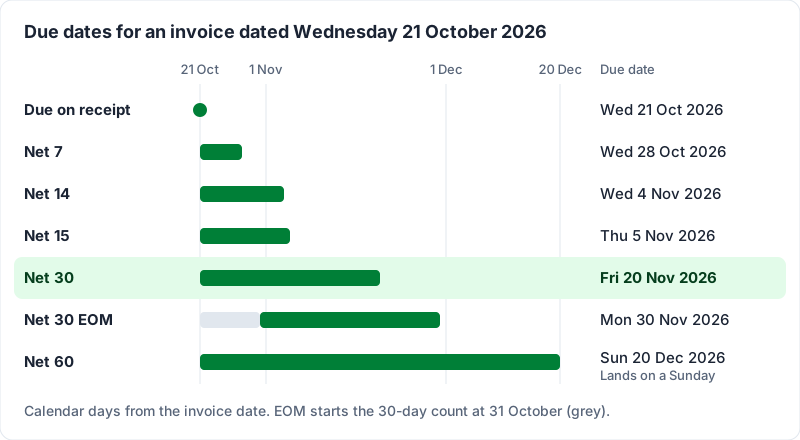
Here are the common ones, using an example invoice dated Wednesday 21 October 2026. The dates are illustrative, worked out on a calendar, so you can see how the count lands. The free Excel invoice template works out the due date from the invoice date and your payment terms.
| Term | What it means | Due date for an invoice dated 21 Oct 2026 | Often suits |
|---|---|---|---|
| Due on receipt | Pay when the invoice arrives | Wednesday 21 October 2026 | One-off jobs, new clients, individuals |
| Net 7 | Within 7 days of the invoice date | Wednesday 28 October 2026 | Small jobs, quick turnarounds |
| Net 14 | Within 14 days | Wednesday 4 November 2026 | Individuals and small businesses |
| Net 15 | Within 15 days | Thursday 5 November 2026 | Small businesses, regular work |
| Net 30 | Within 30 days | Friday 20 November 2026 | Companies that pay on a monthly cycle |
| Net 60 | Within 60 days | Sunday 20 December 2026 | Large companies that insist on it |
Two related terms turn up often enough to know:
- EOM (end of month). The count starts at the end of the month the invoice is dated in. “Net 30 EOM” on our 21 October invoice counts from 31 October, so it is due Monday 30 November 2026. Invoice abbreviations decodes EOM, COD and the other payment term shorthands, with dates.
- 2/10 net 30. A 2% discount if the client pays within 10 days, otherwise the full amount within 30. It is an early-payment incentive, and it costs you 2% every time a client takes it. Offer it only if the cash arriving sooner is worth that to you. Our guide to discounts on an invoice works out whether an early-payment discount pays, and the early payment discount calculator shows what any discount costs you as a yearly rate.
Drawn on one calendar, the same invoice lands on very different days:
Due on receipt: clear on paper, vague in practice#
“Due on receipt” has the shortest deadline and the fuzziest meaning. Your client cannot pay before they open the email, and some accounts departments read the phrase as “whenever we get to it”. It is still a sensible choice for one-off work, deposits and clients you have not worked with before.
One person in the research we did for this product, from public online discussions (none of the people quoted here are Charming customers), described running a business this way:
I invoice everything on due on receipt. Sure some companies can only pay in 30. Always always when getting an order determine payment plan.
The second half of that is the useful part. “Due on receipt” works best when the client already knows it is coming. If you pick it, pair it with a date anyway: “Due on receipt (by 21 October 2026)” leaves nothing to interpret. Invoice due upon receipt covers when an invoice counts as received, how payment runs treat the term and clearer wording to use.
How to calculate an invoice due date#
The count is the same for every “net” term. In order:
- Start from the invoice date. That is the date printed on the invoice, not the day you finished the work and not the day the client opens it. If your contract says the count runs from delivery or receipt instead, follow the contract.
- Add the number of days in the term. Net 30 on an invoice dated 21 October means adding 30 calendar days: 20 November.
- Check what day it lands on. Net 60 on our example lands on Sunday 20 December. Sunday is not a day most accounts teams pay on. If that matters to you, say “due Monday 21 December” or use a shorter term.
- Write the date on the invoice. Not only the term. “Due 20 November 2026 (Net 30)” is unambiguous for the client, their accounts software and you, three weeks from now.
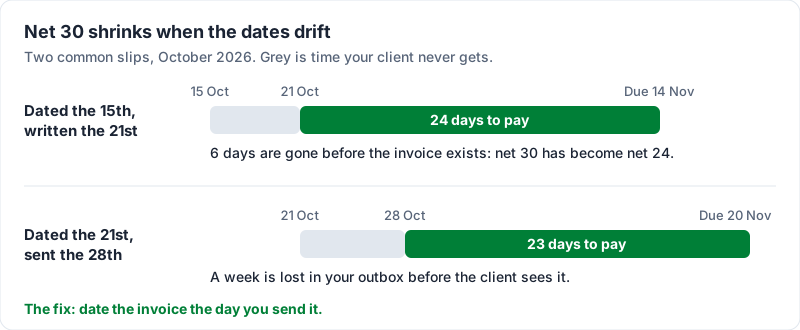
The most common slip is counting from the wrong day. If you write an invoice on the 21st but date it the 15th, your net 30 has quietly become net 24. If you date it the 21st but send it on the 28th, the client has lost a week before they see it. Date it the day you send it. If you would rather not count days by hand, the free due date calculator gives the exact date for Net, EOM and 2/10 terms, with an option to move weekend dates to Monday. Our guide to the invoice date covers what to do when you invoice late, and why backdating causes trouble.
Choosing terms for a one-off job vs an ongoing client#
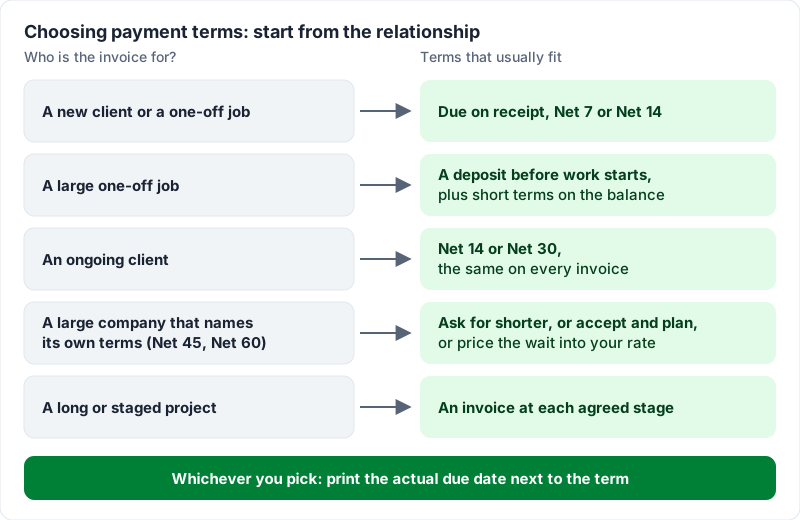
There is no universally correct set of invoice payment terms. There are terms that fit the relationship.
A one-off job, or a new client. You are extending credit to someone you do not know yet. Short terms are reasonable: due on receipt, net 7 or net 14. For larger one-off jobs, a deposit before work starts protects you better than any payment term, because some of the money arrives before the risk does. We cover how that works in deposit invoices and how they work.
An ongoing client. Here the terms are part of a working relationship, and a company’s accounts team may only pay on a fixed cycle. Net 14 or net 30 is common. Agree it once, write it into your contract or your first email, and use the same terms on every invoice so nobody has to ask. If a business client has asked whether they can “pay by invoice” at all, our guide to what pay by invoice means for the seller shows what offering terms costs you on one $4,000.00 order.
A large company that names its own terms. Some organisations will tell you their terms are net 45 or net 60, full stop. You can ask for shorter, accept and plan for it, or price the wait into your rate. Selling the invoice to a factor is another option, at a price: invoice factoring explained works through what it costs. Staffing agencies, which meet payroll long before net 30 or net 60 comes round, are a common case; see invoice factoring for staffing agencies. What you should not do is assume the stated term is the real one. From the same public discussions:
But one consistently takes forever to pay. All terms are net 45. The first time I worked for them, it took 60. Then 90. Then 120.
A term is only a promise. Watch what a client actually does on the first two or three invoices, and adjust your terms, or ask for a deposit, if the pattern drifts.
Long or staged projects. You do not have to wait until the end. Small jobs can be billed on completion; larger ones can be split into stages agreed up front, with an invoice at each. Staged billing keeps each invoice smaller and each wait shorter.
Wording to put on the invoice#
Good terms for payment of invoices are short, specific and dated. Copy and adapt any of these examples:
- Standard: “Payment due within 30 days of the invoice date. Due 20 November 2026.”
- Due on receipt: “Payment due on receipt (by 21 October 2026). Thank you.”
- With a reference: “Due 4 November 2026 (Net 14). Please include invoice number 014 as your payment reference.”
- Deposit: “Deposit of 50% due on receipt to confirm the booking. Balance due on delivery.”
- Early-payment discount: “2% discount if paid by 31 October 2026. Full amount due 20 November 2026.”
If your invoice has a terms and conditions section, keep it to what affects payment: the due date, how to pay, any agreed late fee, and anything the payment covers, such as a deposit holding a date. Long legal boilerplate on an invoice tends to go unread. The contract is where the full terms live; the invoice repeats the parts that matter for getting paid. Invoice terms and conditions get their own guide: invoice terms and conditions has example wording. What actually belongs on an invoice has the rest of the field list.
Late fees: agree them first, then print them#
A late fee is a term like any other, and it works best when the client has agreed to it before the work starts. Printed for the first time on an overdue invoice, it reads as a surprise, and arguing over a term the client never saw can sour the relationship. Mentioned in your contract or your first email, and repeated on each invoice, it is routine.
A neutral way to word it on the invoice, as an example rather than a recommended rate:
- “Overdue balances may be charged interest at [rate] per month, as set out in our agreement of [date].”
Before you pick a rate, check what is allowed where you and your client are. Some governments set rules for this. As one example, here is what the UK government’s pages said when we read them on 23 October 2026. The guidance on late commercial payments says: “If you agree a payment date, it must usually be within 30 days for public authorities or 60 days for business transactions.” Its page on interest on late commercial payments says: “The interest you can charge if another business is late paying for goods or a service is ‘statutory interest’ - this is 8% plus the Bank of England base rate for business to business transactions. You cannot claim statutory interest if there’s a different rate of interest in a contract.” Those pages cover the UK only, and they change. Other countries set their own rules, so check your own government’s guidance or ask a lawyer or an accountant.
Be honest with yourself about whether you will actually charge it. A fee you threaten and never apply teaches the client that your due date is a suggestion. Often the more useful lever is the one in asking for money without the awkwardness: a calm follow-up on a schedule, and pausing new work once an invoice is well overdue.
What net 30 means on an invoice: quick answers#
What does net 30 mean on an invoice?#
The client has 30 calendar days from the invoice date to pay the full amount. On an invoice dated Wednesday 21 October 2026, net 30 means payment is due by Friday 20 November 2026. Print that date beside the term so nobody has to count.
What does net 15 mean on an invoice?#
The same count with 15 days: the full amount is due 15 calendar days after the invoice date. On the 21 October example, that is Thursday 5 November 2026.
Does net 30 count business days or calendar days?#
Calendar days, weekends included, unless your invoice or contract says otherwise. If you mean working days, write the date out instead of relying on the term.
Does net 30 start from the invoice date or the delivery date?#
From the invoice date, by the usual convention. If your contract says the count runs from delivery or from when the client receives the invoice, follow the contract and print the date it gives.
What is net 30 invoicing?#
Selling on net 30 terms: you deliver the work now and give the client 30 days to pay the invoice. In effect you are lending them the money for a month. It is normal with established business clients and a risk with new ones, which is why many small businesses pair it with a deposit, or keep it for clients with a good payment record.
Where Charming fits, and where it does not#
In Charming Invoices, every invoice has a due date, and it is an actual date rather than a phrase. A new invoice starts 14 days after the issue date, and you change it to whatever you agreed. There is also a Terms field for the wording above. You can save default terms on your business profile, and they are copied onto each new invoice so you are not retyping them. If your template hides the Terms section, the invoice form tells you, and you can switch it on in the template settings. Once the due date passes on an issued invoice, it shows as Overdue. All of this is on the free plan.
The catch: Charming does not calculate or add late fees or interest for you. If you charge one, you add it yourself; the free late fee calculator does the arithmetic. It does not take card payments either. Your client pays you directly using the details on the invoice, and you mark it paid.
The short version#
Pick invoice payment terms that fit the client: short for one-off jobs and new clients, net 14 or net 30 for ongoing work, a deposit for anything large. Count calendar days from the invoice date. Print the actual due date next to the term. Agree any late fee before the work starts, and check the local rules before you set a rate.
When you are ready to send one, create a free invoice with the due date and terms filled in.