Discount on an invoice: how to show it, and 2/10 net 30

Nnabuike Okoroafor ·
On this page · 12 sections
You have agreed to knock something off the price, or you are thinking of offering a client money off if they pay quickly. Either way, the discount has to land on the invoice in a form nobody can misread: the client’s accounts team, your bookkeeper and you, three months from now.
This guide covers both kinds of discount on an invoice. First, how to show any discount clearly, with the line order and the label. Then the early-payment kind, usually written as 2/10 net 30: what it means on real dates, what it really costs you as a yearly rate, when it is worth offering, the wording to put on the invoice, and what to do when a client takes the discount after the deadline.
General information, not legal or tax advice. Where tax comes up, we quote one official example and point you to your own tax authority. How a discount is taxed or recorded where you work is a question for an accountant.
Discounts on an invoice in short#
- Show the discount as its own line between the subtotal and the tax, with a reason: “Repeat-client discount (5%) −$240.00”. Never just lower the prices and leave the client to notice.
- An agreed discount and an early-payment discount are different things. The first changes the price now. The second is an offer the client may or may not take, so the invoice shows the full total and states the offer in the terms.
- 2/10 net 30 means 2% off if the client pays within 10 days, otherwise the full amount within 30.
- It is expensive money. Offering 2/10 net 30 is like paying about 37% a year to be paid 20 days sooner. Worth it only if cash now matters more to you than 2%.
- Decide in advance what you do when a client pays the discounted amount late. It will happen.
How to show a discount on an invoice#
A discount should be visible, labelled and in the right place in the totals. The order most invoices use, and the one that reads cleanly to an accounts team, is:
- Line items, at their normal prices.
- Subtotal, the sum of the lines.
- Discount, as a minus amount, with the reason and, if it is a percentage, the percentage.
- Tax, if you charge it, worked out on whatever base your tax rules require (see the tax section below).
- Total due.
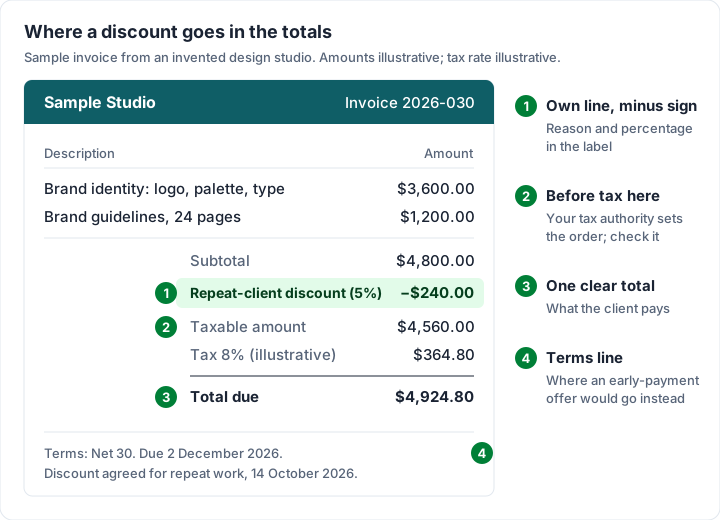
Here is a worked example. An illustrative invoice from a freelance designer to a repeat company client, with a 5% repeat-client discount agreed before the work. The 8% tax rate is illustrative too; use your own.
| Line | Amount |
|---|---|
| Brand identity: logo, colour palette and type system | $3,600.00 |
| Brand guidelines document, 24 pages | $1,200.00 |
| Subtotal | $4,800.00 |
| Repeat-client discount (5%) | −$240.00 |
| Taxable amount | $4,560.00 |
| Tax at 8% (illustrative) | $364.80 |
| Total due | $4,924.80 |
A few habits keep a discount from causing questions later:
- Name the reason. “Repeat-client discount”, “Launch offer agreed 14 October” or “Bulk order, 10 or more units”. A discount with no reason looks like a mistake, and a client may expect it again next time.
- Show the percentage and the amount. “5%” tells the client what was agreed; “−$240.00” is what their accounts team checks.
- Percentage or fixed amount: pick one and say which. A 5% discount on $4,800.00 is $240.00. A flat “$250 off” is simpler, but it does not scale if the job grows.
- One discount on the whole invoice, or one per line. An invoice-level discount is the common case. A per-line discount suits a client who gets money off one service but not another; show it in the line’s description or as a separate line under it. An invoice-level discount also reduces any expenses billed on the same invoice, which the reimbursement invoice guide covers.
- Do not hide it in the prices. Lowering every rate quietly makes the next invoice at full price look like a rise.
For where the discount fits among the other fields, our field-by-field invoice checklist covers every line, and a worked example invoice walks through building one from blank.
Four kinds of discount, and where each one goes#
Not every discount belongs on the invoice in the same way. The question is whether the discount is already agreed when you send the invoice, or depends on something the client does afterwards.
| Kind of discount | Example | Agreed when you invoice? | Where it goes |
|---|---|---|---|
| Agreed price reduction | “5% off for a repeat client” or “$200 off as agreed” | Yes | A discount line in the totals |
| Volume or bundle | 10% off orders of 10 or more | Yes, once the order is known | A discount line, with the rule in the label |
| Early-payment (cash, settlement or prompt-payment) discount | 2% off if paid within 10 days | No: the client chooses | The full total on the invoice, the offer in the terms |
| Pay-by-bank discount | 3% off for paying by bank transfer, not card | No: depends on how they pay | The full total, the offer in the terms |
The last one turns up often among people who take card payments. In one public online discussion from our research (the people quoted are not Charming customers), a wedding photographer suggested:
Provide them with a paper invoice. Factor in the cost of the credit card fees and offer a "3% discount if paid in full by check/cash prior to X date". You still get your full amount and times when people pay with a card you aren't eating the additional costs.
Whether you can do this, or charge a card fee instead, depends on where you are and on your card provider’s terms. Our guide to passing the fee to the client: where to check first sets out what to look up before you try either.
What 2/10 net 30 means, on real dates#
“2/10 net 30” is shorthand for three numbers: 2% off, if paid within 10 days, otherwise the full (“net”) amount within 30 days. The 10 and the 30 both count calendar days from the invoice date, unless your terms say otherwise. If you need a refresher on the net part, see what Net 30 actually means.
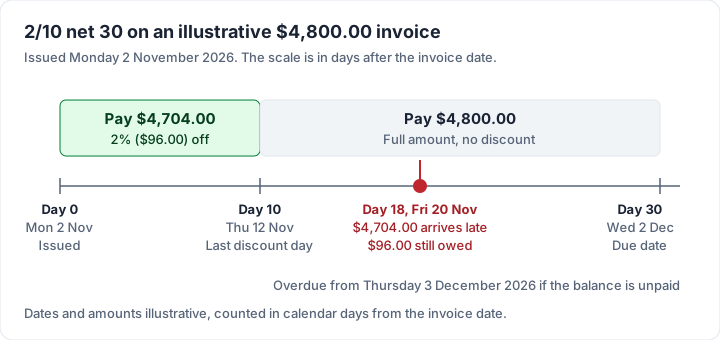
Here it is on an illustrative invoice: number 2026-031, from a freelance designer to a company client, issued Monday 2 November 2026, total $4,800.00, no tax line.
| Event | Date | Amount to pay |
|---|---|---|
| Invoice issued | Monday 2 November 2026 | $4,800.00 |
| Last day for the discount (issue date + 10) | Thursday 12 November 2026 | $4,704.00 (2% = $96.00 off) |
| Due date (issue date + 30) | Wednesday 2 December 2026 | $4,800.00 |
Write the dates on the invoice, not only the code. Plenty of people outside finance have never seen “2/10 net 30”, and a client who misreads it will take the discount on day 25. Our free due date calculator has a 2/10 Net 30 option that prints both dates for any issue date.
Other combinations work the same way. “1/10 net 30” is 1% within 10 days; “3/15 net 45” is 3% within 15 days, otherwise the full amount within 45.
What an early-payment discount really costs you#
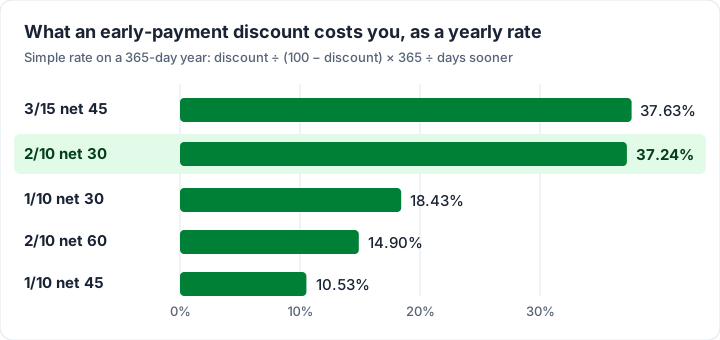
The 2% looks small because it is spread over a short time. The fair way to judge it is as a yearly rate: what you give up, divided by what you receive, scaled to a year.
On the worked example:
- You give up $96.00 to receive $4,704.00 early. That is 96 ÷ 4,704 = 2.04%.
- You are paid 20 days sooner (day 10 instead of day 30).
- A year holds 365 ÷ 20 = 18.25 of those 20-day periods.
- 2.04% × 18.25 = 37.24% a year.
That is the simple rate on a 365-day year. If you compound it, as you would if every client took the discount all year, it comes to about 44.59%. Either way, offering 2/10 net 30 is like borrowing your own money from your client at well over 30% a year.
The same formula for other common terms, worked out on a 365-day year:
| Terms | Discount | Days sooner | Yearly rate (simple) |
|---|---|---|---|
| 2/10 net 30 | 2% | 20 | 37.24% |
| 3/15 net 45 | 3% | 30 | 37.63% |
| 1/10 net 30 | 1% | 20 | 18.43% |
| 2/10 net 60 | 2% | 50 | 14.90% |
| 1/10 net 45 | 1% | 35 | 10.53% |
The formula, if you want to check your own terms: discount ÷ (100 − discount) × 365 ÷ (days to full payment − days in the discount window). Or let our free early payment discount calculator do it: it shows the yearly rate, what the client pays if they pay early and the last day they can.
Cheaper ways to get paid sooner#
Before you offer a discount, compare it with what else would bring the cash forward:
- Ask for a deposit. Part of the money up front, before you start, costs you no discount at all. See deposit invoices: how they actually work.
- Shorten the terms. If net 30 is too slow, offer net 14 or invoice due upon receipt for new clients. Many clients accept shorter terms without needing a reward.
- Sell or borrow against the invoice. Factoring and invoice finance bring cash forward too, at a price. Our guide to what invoice factoring really costs works through the fees, so you can set them beside the 37% above.
- Charge for lateness instead. A late fee agreed in advance is the stick to the discount’s carrot; our guide to how to charge invoice late fees fairly covers the wording.
When an early-payment discount is worth offering#
An early-payment discount makes sense when cash now is worth more to you than the discount. That is a business judgement, not a formula, but a few signs point one way or the other.
It can be worth it when:
- A gap in your cash flow would otherwise cost you more, such as a supplier bill due before the client pays.
- Your margin has room for 2% on the clients most likely to take it.
- Your client’s accounts team asks for it or already runs a process to take early-payment discounts, so it actually changes when they pay.
- The invoice is large and 20 days sooner genuinely matters.
It is usually not worth it when:
- Your clients already pay on time. You would be paying 2% for nothing.
- Your margin is thin. 2% of the invoice can be a large share of your profit on it.
- Your clients are individuals who pay when the invoice arrives anyway.
- You cannot police the deadline. If you will accept the discount on day 25 to avoid an awkward email, you are really just cutting your price.
Some people pair the two ideas. In a public discussion about late payers (again, not Charming customers), one small-business owner described their terms like this:
Carrot: discount prompt payment within net 15 to be a 3% discount Stick: unpaid invoices will incur a 1%/month late fee to be applied to account automatically (most billing has this feature).
The idea is sound, but run the numbers first. If your normal terms are net 30, 3% for paying within 15 days works out at about 75% a year on the formula above. And as another person in the same thread pointed out:
One thing I would add is that depending on how the contract is written you could explore adding a finance charge for late payments or a discount for early payments.
The contract is the right place to start. Whether a late charge is allowed, and how much, depends on where you work, which is why late fees have their own guide.
Wording for an early-payment discount on an invoice#
Put the offer in the invoice’s terms, with the real dates and amounts, so nobody has to do arithmetic. For the worked example:
- Terms: 2/10 net 30. Pay $4,704.00 (2% discount of $96.00) if payment is received in full by 12 November 2026. Otherwise $4,800.00 is due by 2 December 2026.
Three details matter in that line:
- “Received” or “paid”. Say which. A bank transfer sent on day 10 may arrive on day 12. If you will honour a payment sent on time, write “paid by”; if you need it in your account, write “received by”.
- “In full”. Rule out the discount on part-payments, unless you mean to allow it.
- The full total stays the invoice total. The total due on the invoice is $4,800.00. The discount is an offer in the terms, not a line in the totals.
A fill-in-the-brackets version of this offer, with examples for the rest of the terms box and the notes, is in a free Word file and a plain text file. Both are example wording to adapt, not legal or tax advice.
One country’s official wording#
In the UK, HMRC’s VAT guide recommends specific invoice wording for prompt payment discounts. As one example, VAT Notice 700, section 18.2.2 (page last updated 25 June 2026, read on 28 October 2026), says HMRC recommends this wording:
‘A discount of X% of the full price applies if payment is made within Y days of the invoice date. No credit note will be issued. Following payment you must ensure you have only recovered the VAT actually paid’
That wording is for UK VAT. If you are elsewhere, or not registered for a sales tax, check what your own tax authority says before you copy it.
Tax and discounts: where to check#
Whether tax is charged on the full price or the discounted price is set by your tax authority, and it can differ between an agreed discount and an early-payment one. Rules vary by country, by tax and sometimes by state; check your tax authority’s own pages, or ask an accountant.
As one official example, here is what the UK’s VAT guide says. VAT Notice 700, section 7.3.2 (page last updated 25 June 2026), on unconditional discounts:
If you offer a customer an unconditional discount, and the customer pays the discounted amount, then the tax value is based on the discounted amount.
And on discounts for prompt payment, in the same section:
If you offer a discount on condition that the customer pays within a specified time, then the tax value is based on the actual amount paid, but if you need to account for the VAT before you know whether the discount has been taken up, you must declare the VAT on the undiscounted price.
Section 18.2.2 adds: “If the discount is taken up within the specified time you may adjust the consideration and amount of VAT accounted for by issuing a credit note.” If you invoice with VAT, our guide to the VAT invoice covers the rest of what goes on one, and when to issue a credit note explains that document. Everywhere else, including US sales tax, check the official page for your state or country.
When a client takes the discount late#
This is the part nobody plans for. Your client pays $4,704.00 on Friday 20 November 2026: day 18, eight days after the discount window closed. You are $96.00 short. You have three reasonable options.
- Accept it this once, and say so. A good client and $96.00 may not be worth an argument. Tell them it is a one-off, so it does not become the new terms. Ask your accountant how to record the $96.00 you are not collecting.
- Ask for the balance. Under the terms as written, the discount had lapsed, so the $96.00 is part of what is due by 2 December. A short, friendly email usually settles it.
- Change the terms for next time. If this client never makes the 10-day window, the discount is not doing its job. Drop it, or swap it for a deposit.
If you ask for the balance, keep it light. A sample you can adapt:
Hi Sam, thank you for your payment of $4,704.00 on 20 November for invoice 2026-031. The 2% early-payment discount applied to payments received by 12 November, so a balance of $96.00 remains, due by 2 December. You can pay it to the same account as before. Thanks again — it was a pleasure to work on this.
Whatever you choose, apply it the same way to every client. Waiving it for one client and chasing another for the same eight days is how disputes start. For the moment an invoice really counts as settled, see when an invoice counts as paid.
Discounts in Charming, and what it does not do#
Charming Invoices handles the agreed kind of discount directly, and leaves the conditional kind to your terms. Here is exactly what it does, with the catches.
- One discount per invoice, entered as an amount. The field is labelled “Discount” with your invoice currency (for example “Discount (USD)”), and it prints as a “Discount” line in the totals, shown as a minus amount. The catch: it is not a percentage field, so for 5% of $4,800.00 you enter $240.00. There is no per-line discount, and line prices cannot go below zero, so you cannot add a negative “discount line” either.
- The discount comes off before tax. The form says so: “The discount is taken off before tax is applied.” Subtotal, discount and tax calculate as you type, to the cent. The catch: there is one tax rate per invoice, and if your tax authority wants a different order, Charming will not do it for you.
- The discount line keeps its name unless you change it. An owner or admin can rename the “Discount” label in the Template Studio, on every plan, but that renames it on all of your drafts and future invoices (invoices already issued keep the label they were issued with). For a one-off reason such as “Repeat-client discount (5%)”, put it in the invoice notes.
- Your terms go on every invoice. Set default terms once for your business and they are copied onto each new invoice, where you can edit them. That is where “2% discount ($96.00) if paid in full by 12 November 2026” goes.
What Charming does not do with an early-payment discount:
- It does not apply the discount automatically. The total and the balance use the full amount, whatever date the client pays.
- An issued invoice cannot be edited. Once issued, an invoice is frozen, so you cannot lower its total afterwards to reflect a discount taken.
- There is no credit note, write-off or “discount taken” entry. If the client pays $4,704.00 and you record it, the invoice stays open with $96.00 outstanding, and it shows as overdue from 3 December. If you decide to accept the discount, the workaround is to record a second payment of $96.00, with the method “Other” and a note such as “early-payment discount of $96.00 taken, not received” (notes take up to 500 characters). The invoice then shows as paid, but your paid total in Charming includes $96.00 you did not receive, so tell your bookkeeper.
The rest of the usual catches apply too: Charming does not take card payments (your client pays you directly, by bank transfer or through a payment link you print on the invoice), payment tracking is manual, it does not email invoices or send reminders (you download the PDF or copy its link and send it yourself), and invoices on the Free plan carry a small “Sent with Charming Invoices” line, which paid plans hide by default. The Free plan has no invoice or client cap for 1 business. Paid plans add more businesses: Individual is $29 once, Team is $79 once with up to 5 teammates, and Pro is $12 a month or $99 a year. Lifetime plans are final sale; the pricing page has the details.
If that fits how you work, you can create a free invoice with a discount line and your terms, and see how it reads before you send it.
Discount on invoice questions#
Is 2/10 net 30 the same as net 30?#
No. Net 30 means the full amount is due within 30 days. 2/10 net 30 adds an offer on top: 2% off if the client pays within the first 10 days. The due date is the same; the client just has a reason to pay sooner.
Do I charge tax on the discounted amount?#
It depends on the kind of discount and on your tax authority. As one example, the UK’s VAT Notice 700, section 7.3.2, says: “If you offer a customer an unconditional discount, and the customer pays the discounted amount, then the tax value is based on the discounted amount.” The same section treats prompt-payment discounts separately (quoted above). Rules vary; check your own tax authority’s page or ask an accountant.
Can I take back a discount?#
An agreed discount on an invoice you have already sent is part of the price you billed, so changing it means issuing a correction, usually a new invoice or a credit note, and agreeing it with the client first. An early-payment discount simply lapses if the client misses the deadline: the full amount stays due, as the terms said.
What is a settlement discount?#
It is another name for an early-payment discount: money off for settling the invoice within a set time. “Cash discount” and “prompt payment discount” usually mean the same thing. In Germany the same idea is called Skonto, and as one person in a public discussion put it:
For companies Skonto basically means a special way of treating invoices. They need to be recognized early and then most likely worked on separately from other invoices to make sure it gets done in the timeframe.
Should the discount be a percentage or a fixed amount?#
Either works if the invoice shows both. A percentage scales with the job and is how most early-payment terms are written. A fixed amount is easier to read on a one-off price reduction. Showing “5%” and “−$240.00” side by side answers both questions at once.
The short version#
Show an agreed discount as its own labelled line between the subtotal and the tax. Put an early-payment discount in the terms instead, with the real dates and both amounts, and keep the full total on the invoice. Before you offer 2/10 net 30, remember it costs about 37% a year to be paid 20 days sooner, and that a deposit or shorter terms may get you the same result for nothing. Decide in advance what you will do when a client takes the discount late, and do the same for everyone.
Free downloads
No sign-up and no email address. More on the free templates page.
- Download .docx: Invoice terms and notes examples for Word
Invoice terms and notes examples for Word
Word .docxExample wording to adapt for the Terms and Notes boxes on your invoice. General information, not legal or tax advice.
- Download .txt: Invoice terms and notes examples as plain text
Invoice terms and notes examples as plain text
Text .txtThe same terms and notes examples as a plain text file, to paste into any invoice. General information, not legal or tax advice.