Credit note vs invoice: when to use each

Nnabuike Okoroafor ·
On this page · 10 sections
You sent an invoice, and now it is wrong. The quantity was off, the client cancelled part of the work, a product came back, or you agreed a partial refund. The instinct is to open the invoice, change the number and send it again. That instinct is the whole reason credit notes exist.
The short answer to credit note vs invoice: an invoice asks your client to pay, and a credit note reduces or cancels what an earlier invoice asked for. The invoice stays in your records exactly as you sent it. The credit note sits next to it, points back to it, and says how much less is owed and why. In the US the same document is usually called a credit memo.
This guide covers when businesses use one, what goes on it, a worked example with a replacement invoice, and what happens to the balance. The figures are invented, labelled as examples.
General information, not legal or tax advice. Rules vary by country and change; the official pages linked below are the source, and your accountant is the person to ask.
Credit note vs invoice, side by side#
Both documents look alike on the page: your details, the client's details, a number, a date and some lines with amounts. What differs is the direction of the money.
| Invoice | Credit note (credit memo) | |
|---|---|---|
| What it does | Asks the client to pay | Reduces or cancels what an earlier invoice asked for |
| Effect on what the client owes | Goes up | Goes down |
| Stands on its own? | Yes | No. It always refers to an original invoice |
| How often you send one | For every sale | Only when something changes after invoicing |
| Its number | Next in your invoice sequence | Its own unique number, often its own series |
A credit note is not the same as a refund. A refund is money going back to the client. A credit note is the record that says the amount owed has gone down. Sometimes a refund follows it; sometimes the credit is held against the client's next invoice; and if the invoice was never paid, no money moves at all. The types of invoices sets the credit note beside the other documents used to fix an invoice.
Why you should not edit or delete a sent invoice#
Once an invoice has left your hands, your client has a copy, and it may already be in their accounts. If you quietly change your version, the two records no longer match, and nobody can see what happened or when.
Your numbering breaks too. Deleting a sent invoice leaves an unexplained gap, and reusing its number gives two documents one name; both problems are covered in invoice numbers: formats, gaps and examples.
This is the real point of the credit note vs invoice split: the original stays as it was, the correction is a separate dated document, and anyone reading your records later can follow the trail.
When to issue a credit note, and when you do not need one#
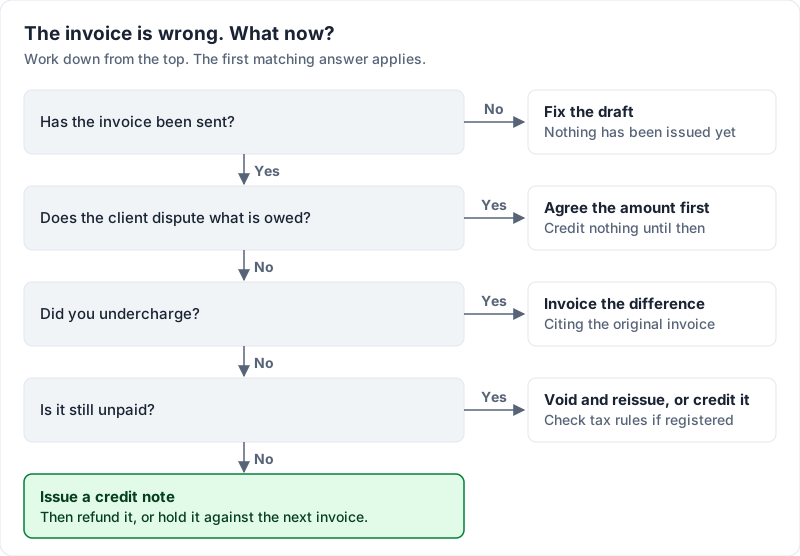
Not every mistake needs a credit note. What decides it is whether the invoice has been sent and whether money has moved.
- The invoice is still a draft. Fix it. Nothing has been issued, so nothing needs correcting.
- Sent, not paid, and wrong. Many small businesses void or cancel the invoice, keep it on file with its number, and send a new invoice with the next number. If you are registered for VAT, GST or sales tax, ask your accountant whether your tax rules call for a credit note here instead. How to void an invoice, and when to delete or cancel walks through each route.
- Sent and paid, and you need to give some or all of it back. Issue a credit note. This is the classic case: a partial refund, goods returned, a session cancelled after payment.
- You agreed a lower price after invoicing. A discount for a delay, a goodwill reduction, a price that was wrong from the start. A credit note for the difference records it.
- Part of the work was cancelled. Credit the lines that will not be delivered, not the whole invoice.
- You undercharged. A credit note goes the wrong way. Send a separate invoice for the difference that refers to the original, or, in places that use them, a debit note. Supplementary invoices and debit notes shows one undercharge fixed three ways.
- The client disputes the invoice. Do not credit anything until you have agreed what is actually owed. What to do when a client disputes an invoice covers that conversation first.
The same rules as a flowchart, worked from the top:
What a credit note commonly shows#
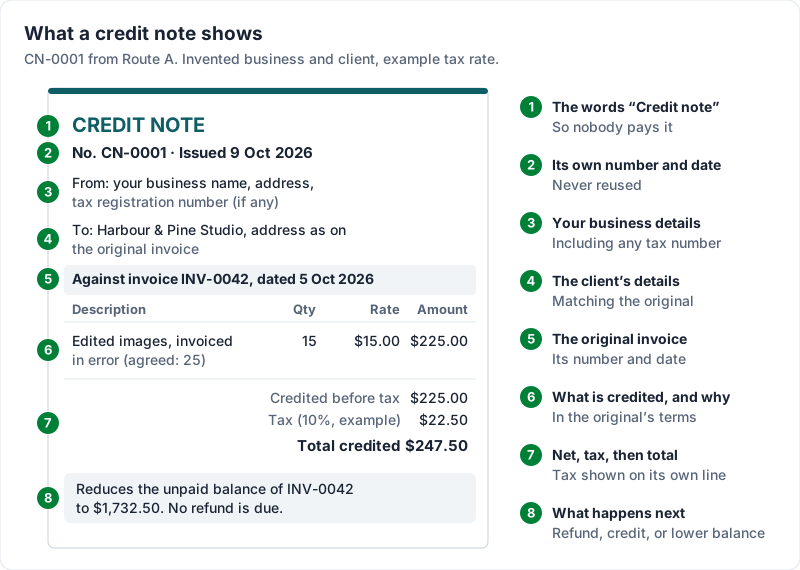
A useful credit note makes sense to someone holding only the original invoice and the credit note. In practice that commonly means:
- The words “Credit note” (or “Credit memo”) at the top, so nobody mistakes it for an invoice and pays it.
- Its own unique number and its date of issue.
- Your business name, address and any tax registration number.
- The client's name and address, matching the original invoice.
- The original invoice's number and date.
- What is being credited and why: the lines, quantities and amounts, in the same terms as the original.
- The total credited, before tax, then any tax being credited, then the total.
- What happens next: refunded to the client, held against a future invoice, or reducing an unpaid balance.
Here are those eight parts on the credit note from the worked example below:
What HMRC's guidance says in the UK#
If you are VAT-registered in the UK, section 18.2 of HMRC's VAT Notice 700 covers credit notes. Quoted as of 23 October 2026 (paragraph 18.2.3): “To be valid for VAT purposes a credit note must:”
- “reflect a genuine mistake or overcharge or an agreed reduction in the value of the supply, and be issued within 14 days of the refund payment being made to the customer”
- “give value to the customer, that is, represent a genuine entitlement (or claim) on the part of the customer for the amount overcharged either to be refunded or offset against the value of future supplies”
- “show clearly all the following details:”, a list that includes “the identifying number and date of issue”, “the total amount credited, excluding VAT”, “the rate and amount of VAT credited (expressed in sterling)” and “the number and date of the original VAT invoice or invoices relating to the supply”
The same paragraph adds: “If credit notes are issued without a VAT adjustment, they should state ‘This is not a credit note for VAT’.” Paragraph 18.2.5 covers which VAT rate to use. Read the section in full, or ask your accountant, before you rely on it. For HMRC's list for the original VAT invoice, see our guide to VAT invoices, with a worked UK example.
Other places#
The European Commission's VAT invoicing page, read on 23 October 2026, lists among an invoice's contents a “Specific, unambiguous reference to the initial invoice and the details that are being amended (on a credit note, debit note or other document treated as an invoice)”. The same page says some areas are left to “national rules set by the individual Member State”, so check the tax authority where the sale is taxed. (We quote the Commission's summary page here rather than the VAT Directive itself.)
In the US, the IRS Schedule C instructions say, as of 23 October 2026: “Report your sales returns and allowances as a positive number on line 2. A sales return is a cash or credit refund you gave to customers who returned defective, damaged, or unwanted products.” For sales tax, check the revenue department of the state concerned; California's tax agency, for example, publishes Regulation 1655 on returns, defects and replacements. Elsewhere, your national tax authority's guidance is the place to look.
A worked example: invoice, credit note and replacement invoice#
An invented photographer bills an invented client, Harbour & Pine Studio, for a brand shoot. The agreement was 25 edited images. The invoice went out with 40. The tax rate of 10% is also an example.
Invoice INV-0042, issued 5 October 2026
| Description | Qty | Rate | Amount |
|---|---|---|---|
| Brand photography, half day | 1 | $1,200.00 | $1,200.00 |
| Edited images | 40 | $15.00 | $600.00 |
| Subtotal | $1,800.00 | ||
| Tax (10%, example) | $180.00 | ||
| Total due | $1,980.00 |
The client spots the error before paying. There are two clean ways to fix it.
Route A: credit the difference. One credit note for the 15 extra images. INV-0042 then stands, less the credit.
| Credit note CN-0001, 9 October 2026, against INV-0042 | Qty | Rate | Amount |
|---|---|---|---|
| Edited images, invoiced in error (agreed: 25) | 15 | $15.00 | $225.00 |
| Tax (10%, example) | $22.50 | ||
| Total credited | $247.50 |
Route B: cancel in full and reissue. Some clients' finance teams prefer one invoice that shows the right figure. A credit note for the whole of INV-0042 ($1,980.00) cancels it, and a replacement invoice goes out with the next invoice number.
| Invoice INV-0043, 9 October 2026, replaces INV-0042 | Qty | Rate | Amount |
|---|---|---|---|
| Brand photography, half day | 1 | $1,200.00 | $1,200.00 |
| Edited images | 25 | $15.00 | $375.00 |
| Subtotal | $1,575.00 | ||
| Tax (10%, example) | $157.50 | ||
| Total due | $1,732.50 |
Both routes leave the client owing exactly the same amount:
| Route A | Route B | |
|---|---|---|
| Invoiced | $1,980.00 (INV-0042) | $1,980.00 (INV-0042) + $1,732.50 (INV-0043) |
| Credited | $247.50 (CN-0001) | $1,980.00 (CN-0001) |
| Balance owed | $1,732.50 | $1,732.50 |
Drawn as a chain of documents, with the amount owed after each one:
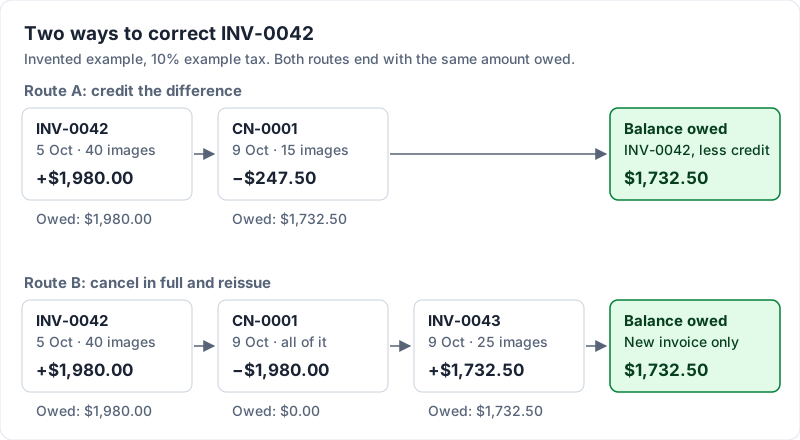
Notice that INV-0042 is never edited, deleted or reused, and INV-0043 is a new number. A note on the replacement saves an email: “This invoice replaces INV-0042, which was cancelled by credit note CN-0001.”
If the invoice had already been paid#
Say Harbour & Pine had paid the full $1,980.00 before anyone noticed. The credit note is the same as Route A, $247.50, but now that money belongs to the client. You either refund it or, if they agree, hold it against their next invoice. Say which on the credit note: “$247.50 refunded by bank transfer on 10 October 2026” or “$247.50 to be deducted from your next invoice.”
How a credit note affects the balance and tax#
In bookkeeping terms, a credit note is a negative entry against the client's account. It lowers what they owe you, and it lowers your recorded sales by the same amount. Where the original invoice charged tax, a credit note commonly shows the matching share of tax being credited, which is why the example credits $22.50 of tax alongside the $225.00.
How and when a credit note is reflected in your tax records is set by your tax authority. In the UK, for example, Notice 700 paragraph 18.2.6 says (as of 23 October 2026): “The accounts or supporting documents must make clear the nature of the adjustment and the reason for it.” Ask your accountant how this works where you are. If you are registered for VAT, GST or sales tax, what a tax invoice is explains the extra fields such invoices commonly carry, and similar fields commonly appear on credit notes.
For a deposit you are giving back, the same logic applies: the deposit invoice stays on record and the credit note records what was returned. How deposit invoices work has wording for refundable and non-refundable deposits.
Numbering credit notes#
Most businesses give every credit note its own unique number, like an invoice. Two common schemes:
- A separate series: CN-0001, CN-0002, and so on. Many businesses choose this, because credit notes can then never be mistaken for invoices or collide with them.
- The same series as invoices: the credit note takes the next number in your one sequence.
For UK VAT invoices, HMRC's list (Notice 700, 16.3.1) refers to “a sequential number based on one or more series which uniquely identifies the document”. Which scheme suits your records is a question for your accountant.
Three habits keep the trail clear. The cancelled invoice keeps its number. A replacement invoice gets a new one. And a credit note's number is never reused, even if you later credit the same invoice again.
Check the cost of a refund before you agree to one#
If the client paid by card or through a payment service, a refund and a fresh payment can each carry a processing fee, depending on your provider's terms. Before you agree to refund and reissue, read your own provider's refund terms to see how fees on a refunded payment are handled, and decide whether a credit against the next invoice would serve the client as well.
What Charming does, and does not do#
Charming Invoices has no credit note feature. Here is what it does offer, so you can plan around it:
- Only drafts can be edited. An issued invoice is a frozen snapshot, so it cannot be changed after the fact.
- A draft can be deleted. It never had an invoice number, so no gap is left.
- An issued invoice with no recorded payments can be voided. It stays on record with its number, is marked as never payable, and its private link stops opening. Voiding cannot be undone, and only owners and admins can do it.
- “Duplicate” copies any invoice's client and line items into a new draft, which gets the next number when you issue it. That is the void-and-reissue route above.
The catch is the paid invoice. A paid or partly paid invoice cannot be voided until its recorded payments are removed with “Mark as unpaid”, and Charming has no way to record a refund. Quantities and prices cannot go below zero, so you cannot build a credit note as a negative invoice inside the app either. For a refund or a partial credit on a paid invoice, issue the credit note outside Charming and keep it with your records.
A checklist before you send a credit note#
- The original invoice is untouched, with its number.
- The credit note says “Credit note” and has its own number and date.
- It names the original invoice's number and date.
- It lists what is credited, in the original's terms, with tax shown separately.
- It says whether the money is refunded, held as credit, or reduces an unpaid balance.
- Any replacement invoice has a new number and says which invoice it replaces.
If the client is happy with the correction, the credit note closes the matter. If what they need is proof that they paid, that is a different document, and the difference between invoice and receipt explains which one to send.