Difference between invoice and receipt

Nnabuike Okoroafor ·
On this page · 8 sections
A client has paid you and now asks for a receipt. Or you are about to bill someone and wonder whether the document you are making is an invoice, a receipt or something in between. The words get used loosely, so the confusion is fair.
Here is the difference between invoice and receipt in one line: an invoice asks for payment, and a receipt confirms that payment arrived. Same transaction, two different moments. The invoice opens a debt; the receipt closes it.
The rest of this post covers when you need each one, how a paid invoice relates to a receipt, what the two look like side by side, and the neighbouring documents (bills, statements, pro formas and quotes) that get mixed up with both. When an invoice counts as paid covers partial payments and what to send the client, and our guide to Invoice Home looks at one tool that offers receipts alongside invoices.
The difference between invoice and receipt, field by field#
The two documents share most of their details, which is why people blur them into “invoices and receipts”, or “invoice/receipt”, as if they were one thing. The person who started one public thread about matching bank payments to invoices wrote it exactly that way, with a slash:
The biggest headache I have is simply matching up the money that hit my bank account with the actual invoice/receipt I sent.
That person is not a Charming customer; the quote comes from public online discussions we read while researching this product. The slash is understandable. Both documents name you, the client, the work and the amount. What differs is the purpose, the timing and a handful of fields.
| Invoice | Receipt | |
|---|---|---|
| What it says | “Please pay this amount by this date” | “This amount was paid on this date” |
| When it is issued | Before payment, usually after the work or delivery | After payment, once the money has arrived |
| Key dates | Issue date and due date | Payment date |
| Key amount | Total due | Amount received, and any balance left |
| Payment details | How to pay you (bank details, payment link) | How it was paid (bank transfer, card, cash) |
| Who relies on it | The client’s accounts team, to pay you | The client, as proof they paid; you, as a record |
| Status of the debt | Open | Closed (or reduced, for a part payment) |
If you remember one row, make it the last one. An invoice that has not been paid is a claim. A receipt is evidence that the claim was settled.
An invoice and a receipt side by side#
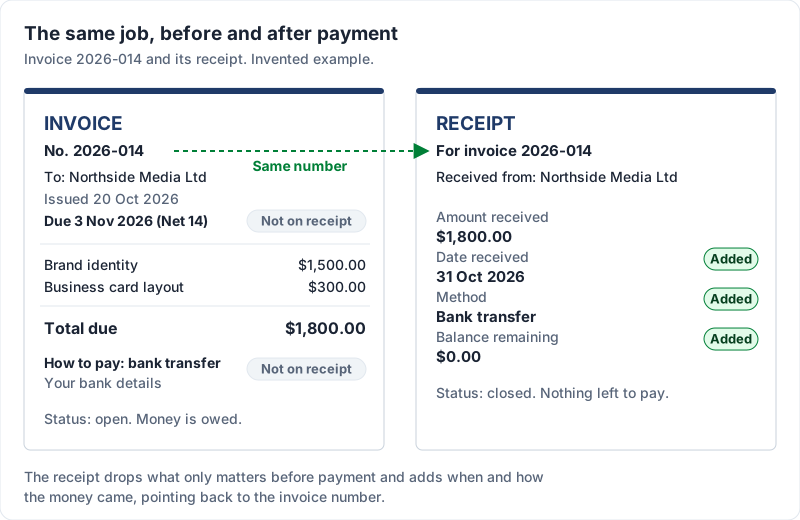
Here is the same job written up both ways. These are invented examples, not a real client.
The invoice, sent when the work was delivered:
| Description | Qty | Rate | Amount |
|---|---|---|---|
| Brand identity — three logo concepts, two revision rounds | 1 | $1,500.00 | $1,500.00 |
| Business card layout, print-ready files | 1 | $300.00 | $300.00 |
| Total due | $1,800.00 |
Above that table sit the word “Invoice”, the number (2026-014), the issue date (20 October 2026), the due date (3 November 2026, Net 14), and your bank details. If any of those are new to you, what actually belongs on an invoice goes through them one at a time.
The receipt, sent once the money landed:
- Receipt for: invoice 2026-014
- Received from: Northside Media Ltd
- Amount received: $1,800.00
- Date received: 31 October 2026
- Method: bank transfer
- Balance remaining: $0.00
Notice what the receipt drops: the due date and the bank details. There is nothing left to pay, so there is nothing left to instruct. Notice what it adds: the date the money arrived and how it came. And it points back at the invoice number, which is what ties the two documents together. This is a large part of why invoice numbers have to be unique: a receipt that says “for invoice 2026-014” is only useful if 2026-014 means exactly one document.
If you want wording to send, this is enough:
Thanks — payment of $1,800.00 for invoice 2026-014 arrived on 31 October 2026 by bank transfer. The invoice is now paid in full, with nothing outstanding.
That is a sample to adapt, not a quote from anyone.
Side by side, the two documents show exactly what changes once the money arrives:
When you need an invoice, and when you need a receipt#
You need an invoice when someone owes you money and has not paid yet. That covers almost all freelance and contract work: you do the job, then you bill for it, and the client pays on terms. A business client may not be able to pay without one, because their accounts team needs a document to approve and file. If you are sending your very first one, your first invoice: what actually has to be on it is the gentler place to start.
You need a receipt when payment happens at the same moment as the sale, or when someone asks for proof that they paid. Retail is the obvious case: a market stall, a shop, a one-off sale paid on the spot. Nobody sends an invoice for a coffee. The till prints a receipt. A clinic taking a self-pay patient’s payment at the desk is a mixed case; our medical invoice template shows that payment credited on the invoice.
You may need both when you invoice first and the client pays later, then asks for confirmation. That is common with individuals rather than companies: someone paying a wedding photographer, a tutor or a builder from their personal account may want a document that says “paid” for their own records or for a reimbursement claim. Our invoice receipt template shows how to write one for a paid invoice, and there is a free receipt to fill in as an Excel file or a Word document.
A receipt template that matches the example#
The free receipt template has a field for every line of the sample receipt above, plus one line saying what the payment was for, so the Northside Media payment fills it in like this:
| Sample receipt above | Field in the receipt template | What goes in it |
|---|---|---|
| Receipt for: invoice 2026-014 | For invoice | 2026-014 |
| Received from: Northside Media Ltd | Received from | Northside Media Ltd |
| Amount received: $1,800.00 | Amount received | 1,800.00 |
| Date received: 31 October 2026 | Date received | 31 October 2026 |
| Method: bank transfer | Payment method | Bank transfer (in the Excel version, from a list: bank transfer, card, cash, cheque, online payment, other) |
| The invoice it settles | One line under “What the payment was for” | Invoice 2026-014, quantity 1, price 1,800.00 |
| Balance remaining: $0.00 | Balance still due | 0.00 (worked out for you in the Excel version) |
The template adds what the short sample leaves out: its own receipt number (RCT-0001 onwards, kept separate from your invoice numbers), a “Paid before this receipt” line for a second instalment, “Cash tendered” and “Change given” for cash sales, and a received-by line for a name and signature. In the Excel version, paid to date, balance still due and change given work themselves out, and those formulas were checked by script; in the Word version you fill the totals in yourself.
One practical note about card payments. If your client pays through a card processor or payment link, the processor often sends its own receipt by email once the payment goes through.
In that case the processor’s email may already be the receipt your client needs, and you do not have to produce a second one unless they ask. Marketplaces work much the same way: our guide to eBay invoices for sellers and buyers shows where an eBay buyer finds the order details that serve as proof of purchase.
Is an invoice a receipt?#
No, not on its own. An unpaid invoice is a request. If a client forwards your unpaid invoice to their employer as proof of payment, it proves nothing, because it says money is owed, not that it was paid.
A paid invoice is different. In everyday practice, many businesses treat an invoice that has been clearly marked as paid, with the payment date and amount, as the receipt for that job. It carries everything a receipt needs: who paid, what for, how much, and when it was settled. For most clients asking “can I have a receipt?”, a copy of the invoice marked paid answers the question.
When a paid invoice works as a receipt:
- It says “Paid” plainly, ideally near the total, so nobody has to infer it.
- It shows the payment date and, if you can, the method.
- It shows a balance of zero, or the amount still outstanding after a part payment.
- It keeps the original number, so it matches the invoice already in the client’s records.
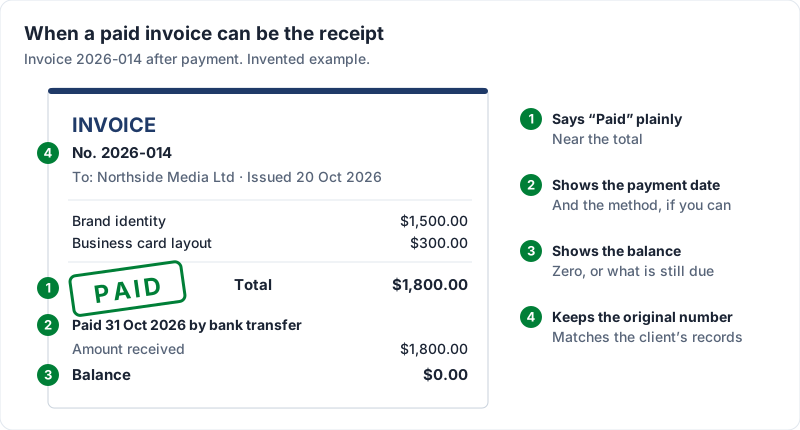
When it does not: if the client’s organisation or a tax rule specifically asks for a separate receipt document, send one. A short receipt like the example above takes a few minutes.
Marking an invoice paid in Charming Invoices#
This is the part of the job Charming Invoices does handle. When you mark an invoice paid, the private link your client already has shows “Paid in full — thank you!” in place of the amount due, and the invoice and its PDF get a “PAID” mark across them (on by default; you can turn the paid stamp off in your template). For a part payment, the private link shows what has been paid and what is still due.
The catch, stated plainly: Charming does not issue a separate receipt document, and it does not email your client, then or at any other point. Payment tracking is manual, because Charming is not a payment processor and never sees the money. You record the payment and mark it paid; if your client wants confirmation, send them the link or the PDF yourself.
For a sale paid on the spot, one of the 60 templates, titled “Receipt”, prints a narrow till-style document headed “Receipt”. A receipt-style PDF from an invoicing app walks through it, including the catch: it is still an invoice underneath, so it shares your invoice numbering.
Invoice vs receipt for taxes and records#
For your own records, the two documents prove different things, and you usually want both sides of the transaction on file.
This is general information, not legal or tax advice. Rules differ by country, change over time, and depend on whether you charge sales tax, VAT or GST. If a receipt or invoice format matters for your tax position, check your own tax authority’s guidance or ask an accountant. The quotes below are from official pages as we read them on 28 October 2026.
The IRS’s page on what kind of records to keep (last reviewed 3 August 2026) lists “Receipt books” and “Invoices” among the documents for gross receipts, and for purchases and expenses lists “Invoices” alongside “Canceled checks or other documents reflecting proof of payment/electronic funds transferred” and “Credit card receipts and statements”. In practice, for something you bought, the invoice shows what you were charged and the receipt or bank record shows that you paid it.
Some tax systems also say something about receipts specifically. In the UK, HMRC’s record-keeping guidance for VAT, in section 4.7 on payment in cash when a VAT invoice has been issued, says: “If asked, you must give your customer a receipt for the amount and date it.” What a VAT or GST invoice has to contain is a separate question, and one where the rules vary by country.
Common mix-ups: bill, statement, pro forma and quote#
Bill, receipt, invoice: three words, two documents#
“Bill” and “invoice” mean the same thing in most everyday use: a request for payment. People tend to say “bill” about what they receive (a phone bill, a restaurant bill) and “invoice” about what a business sends another business. The restaurant bill asks you to pay, so it works like an invoice; the slip you get after paying it is the receipt. The difference between an invoice and a bill is covered in more depth, including the other meanings of “bill”.
Statement#
A statement is a summary of a client’s account over a period: every invoice, every payment, and the balance still open. It is neither a request for one specific payment nor proof of one. It is useful for a client with several open invoices. Invoice vs statement covers it in full.
Pro forma invoice#
A pro forma is a preview of an invoice sent before the sale is final, so the buyer can see the expected cost, arrange payment in advance or get internal approval. It is usually marked “pro forma” so nobody files it as a real invoice. It is not a receipt either, since nothing has been paid yet. What a proforma invoice is, with examples goes further, including how it differs from a deposit invoice.
Quote or estimate#
A quote, or an estimate, is a price offered before any work starts. Accepting it agrees the price; it does not create a debt until the work is done and invoiced. Of the five documents here, it comes first in the timeline. Invoice vs estimate or quote covers that difference, and our quote and invoice template shows how one job moves from the first document to the second.
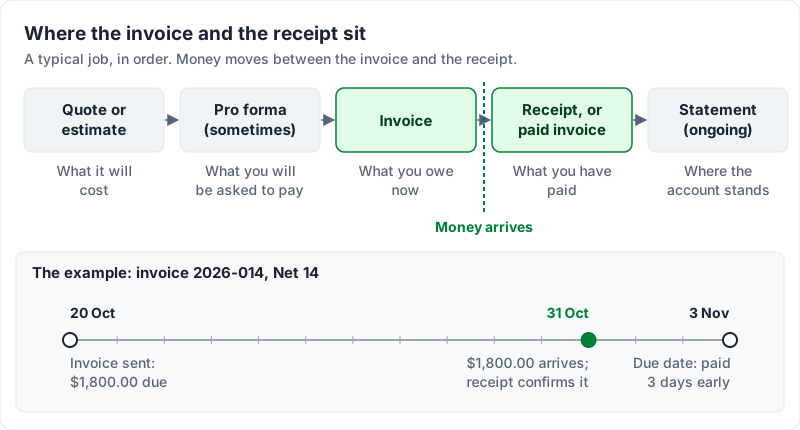
Put in order, a typical job runs:
- Quote or estimate — what it will cost
- Pro forma invoice (sometimes) — what you will be asked to pay
- Invoice — what you owe now
- Receipt, or the invoice marked paid — what you have paid
- Statement (for ongoing clients) — where the account stands overall
Invoices and receipts: quick answers#
What is an invoice receipt?#
People use “invoice receipt” for two things. One is a receipt that confirms payment of a specific invoice and quotes its number, like the sample above. The other is the invoice itself, marked paid with the date and amount, so that it does the receipt’s job; that is often called a receipted invoice. Either way, it records money that has arrived, not money that is owed.
Are invoices and receipts the same thing?#
No. They describe the same sale at two moments: the invoice before payment, asking for it, and the receipt after, confirming it. An invoice only works as a receipt once it is clearly marked paid, as described above.
Is a tax invoice a receipt?#
Not by itself. A tax invoice is an invoice that shows the sales tax, VAT or GST on the sale, in the format a tax system asks for, and it still asks for payment. Once it is paid, a receipt or the tax invoice marked paid records that. What a tax invoice is explains the term, and what one has to show depends on the country.
What to do next#
The difference between an invoice and a receipt comes down to timing: one before the money, one after. If a client has asked for a receipt, check whether a copy of the invoice marked paid, with the date and amount, will do. Most of the time it will. If it will not, write a short receipt that names the invoice it settles.
If you are about to bill for something, you need an invoice, not a receipt. You can create a free invoice in Charming Invoices, then mark it paid when the money arrives.
Free downloads
No sign-up and no email address. More on the free templates page.
- Download .xlsx: Receipt template for Excel
Receipt template for Excel
Excel .xlsxConfirm a payment: paid in full, a part payment against an invoice, or a cash sale with change.
- Download .docx: Receipt template for Word
Receipt template for Word
Word .docxThe same receipt as a Word document, for people who would rather type than use cells.