Invoice receipt template and how to write one

Nnabuike Okoroafor ·
On this page · 12 sections
A client has paid your invoice and now wants a receipt. Or someone has just handed you cash at a market stall and asked for something in writing. Either way, you need a document that says “this was paid” and you need it in the next few minutes, not after an afternoon of formatting.
This guide gives you an invoice receipt template you can copy, explains every field, and walks through three filled samples that add up: a receipt for an invoice paid in full, one for a part payment, and a cash sale with change given. It also covers how receipt numbers relate to invoice numbers, what a “receipted invoice” is, and when you do not need a separate receipt at all.
If you are still unsure which document you need, the difference between invoice and receipt is covered in its own post. In one line: an invoice asks for money, a receipt confirms it arrived.
An invoice receipt template you can copy#
If you want a file, there is a free Excel receipt template that adds up the lines, tax and balance still due (and the change for a cash sale), and the same receipt as a Word document for people who would rather type than use cells. No sign-up for either. If you only need one receipt, the layout below does the job: paste it into a document or a spreadsheet, fill the right-hand column, and save it as a PDF.
| Field | What to write |
|---|---|
| Receipt | The word “Receipt” as the title, so nobody files it as an invoice |
| Receipt no. | A unique number, for example RCT-0031 |
| From | Your business name, address and contact details |
| Received from | The client’s name (and business name, if any) |
| For invoice | The invoice number this payment settles, if there is one |
| Date received | The day the money arrived, not the day you wrote the receipt |
| Payment method | Bank transfer, check, cash, card, Venmo and so on |
| For | A short description of the goods or services |
| Invoice total | What the invoice asked for (leave out for a sale with no invoice) |
| Amount received | What was paid this time |
| Balance remaining | What is still owed, or $0.00 |
| Received by | A name and signature line, most useful for cash |
The receipt files above already use these labels: received from, date received, payment method, amount received and balance still due. If you would rather start from a printable invoice, our printable blank invoices can be turned into a receipt by changing the title and the totals labels.
What goes on a receipt for an invoice, and why#
Most receipt templates list the same fields. What they rarely say is why each one is there. Here is the reasoning, so you know what you can drop and what you cannot.
- A unique receipt number. It lets you and the client refer to one receipt without ambiguity, and it lets you spot a gap if one goes missing.
- The invoice number it settles. This is what ties the payment to the debt. Without it, a receipt for $1,250.00 could be for any of several invoices.
- The date received. Use the date the money landed. For a check, write the day you received it and, if it helps, the check number in the method field.
- The payment method. It tells the client which of their records to match against: a bank statement, a card statement or their own cash book. Our guide to invoice payment methods covers the common options, and there is a separate note on what to print for Venmo and Zelle payments.
- Amount received and balance remaining. Together they show whether the invoice is closed or still partly open. A receipt that shows only the amount leaves the client guessing.
- A signature line. Practice varies; nothing on this page says a receipt must be signed. It is most useful for cash, where there is no bank record. More on that in signed invoices.
What makes a receipt trustworthy is consistency. Your business details, the same numbering, and amounts that match the invoice and the bank record. If you ever receive a receipt or invoice that does not hang together, our guide on how to spot a fake invoice lists the warning signs.
Sample 1: receipt for an invoice paid in full#
Every sample in this post uses an invented business (Alder Lane Design) and invented clients. They show the layout and the arithmetic; they are not real records.
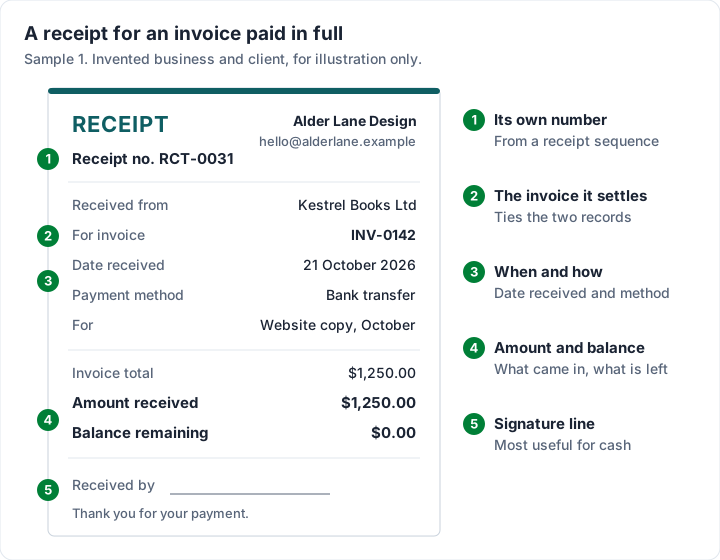
Alder Lane Design sent invoice INV-0142 to Kestrel Books Ltd for $1,250.00. The money arrived by bank transfer on Wednesday 21 October 2026.
| Field | Value |
|---|---|
| Receipt no. | RCT-0031 |
| Received from | Kestrel Books Ltd |
| For invoice | INV-0142 |
| Date received | 21 October 2026 |
| Payment method | Bank transfer |
| Invoice total | $1,250.00 |
| Amount received | $1,250.00 |
| Balance remaining | $0.00 |
If the client only wants confirmation rather than a document, a short payment confirmation email that names the invoice, the amount and the date does the same job.
Sample 2: receipt for a part payment#
Kestrel Books Ltd received a second invoice, INV-0150, for $2,400.00. On Friday 23 October 2026 a check for $800.00 arrived.
| Field | Value |
|---|---|
| Receipt no. | RCT-0032 |
| Received from | Kestrel Books Ltd |
| For invoice | INV-0150 |
| Date received | 23 October 2026 |
| Payment method | Check |
| Invoice total | $2,400.00 |
| Amount received | $800.00 |
| Balance remaining | $1,600.00 |
The arithmetic is the whole point here: $2,400.00 less $800.00 leaves $1,600.00 open. When the next payment arrives, write a new receipt with its own number, the same invoice number, and the new balance.
A part payment is not a deposit. This payment was made against an invoice that had already been issued. A deposit is money taken before the work, usually credited on the final invoice. If that is your situation, deposit and balance invoices shows how to lay it out.
Sample 3: cash sale receipt with change given#
A sale at a market stall on Saturday 24 October 2026. Nobody sent an invoice; the buyer paid on the spot, in cash, and asked for a receipt.
| Item | Qty | Price | Amount |
|---|---|---|---|
| Hand-poured candle | 2 | $18.50 | $37.00 |
| Ceramic dish | 1 | $24.00 | $24.00 |
| Subtotal | $61.00 | ||
| Sales tax (example rate 6%) | $3.66 | ||
| Total paid (cash) | $64.66 | ||
| Cash tendered | $70.00 | ||
| Change given | $5.34 |
Receipt no. RCT-0033, dated 24 October 2026, payment method cash. The 6% is an example to make the arithmetic visible, not a rate to use: whether you charge sales tax, and at what rate, depends on where you sell.
Two things differ from the first two samples. There is no invoice number, because there is no invoice; the receipt number is the only reference. And the change line matters, because cash leaves no bank record. A signature or initials on the “Received by” line is worth the second it takes.
Receipt numbers and invoice numbers#
Every template says “use a unique receipt number”. Few explain how that number relates to the invoice. There is no single rule, but these are the common ways businesses handle it in practice.
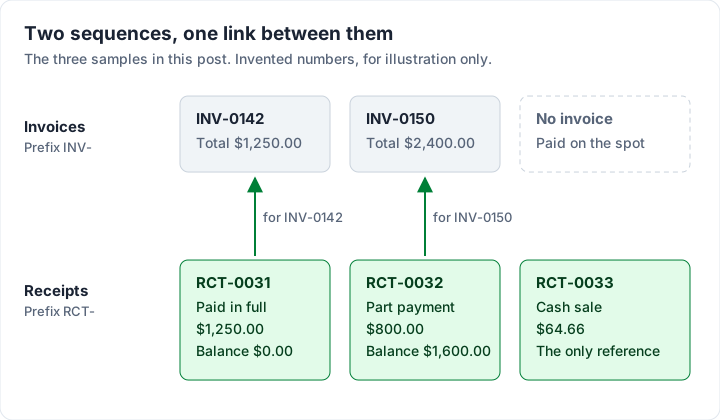
- Receipts get their own sequence. RCT-0031, RCT-0032, RCT-0033, each printing the invoice number it settles. This is the cleanest option when one invoice can have several payments, because each payment gets its own receipt.
- The receipt reuses the invoice number. Some businesses issue one receipt per invoice and give it the same number. That works only if invoices are always paid in one go.
- A sale with no invoice uses the receipt number alone. At a till or a market stall, the receipt is the only document.
What is the invoice number on a receipt?#
When you see an “invoice number” printed on a receipt, it is the reference of the invoice the payment was for, or, on many till receipts, the reference of the sale itself. It is there so the payment can be matched to the right bill. If you are setting up your own numbering, how to number invoices covers formats, prefixes and what to do about gaps.
What is a receipted invoice?#
A receipted invoice is a plain business term for an invoice that has been marked as paid, usually with the payment date and method written on it, so that the invoice itself serves as the receipt. You keep the original invoice number and add the proof of payment to it.
A short example, using Sample 1: invoice INV-0142 for $1,250.00, stamped “Paid”, with a line reading “Received 21 October 2026 by bank transfer, balance $0.00”. That one document now does the work of both.
Whether a receipted invoice is enough depends on who is asking. For most clients filing a copy for their records, it is. If their organisation asks for a separate receipt, send one.
When a separate receipt is not needed#
Often a paid invoice answers the request on its own. Invoice vs receipt sets out the checks for when a paid copy works as a receipt, so they are not repeated here.
The other common case is card and app payments: the processor often emails the payer its own receipt. That may be all your client needs.
One word of caution about the word “receipt” itself. In payment terms such as “due on receipt”, it means receiving the invoice, not a payment record. What due on receipt really means explains that sense.
Why keep receipts at all#
Receipts are not only for the client. They are part of your own paper trail. One person in a public discussion about invoices as records, not a Charming customer, described the habit like this:
I'm not a lawyer so I can't speak to the legalities but I use invoices moreso to just track transactions/payments. Its a paper trail to show budget of the project, agreed payment amount and method, and for completion or lack thereof of payment. It comes in handy for taxes at the end of the year too.
General information, not legal or tax advice. The IRS page on what kind of records to keep (last reviewed 3 August 2026, read 28 October 2026) says: “Supporting documents include sales slips, paid bills, invoices, receipts, deposit slips, and canceled checks.” What a receipt must contain, and whether you must issue one, varies by country and by tax registration. In the UK, for example, HMRC’s record-keeping guidance for VAT has a section on payment in cash when a VAT invoice has been issued. Check your own tax authority’s page and ask an accountant if it matters for you.
Making a receipt-style PDF in Charming#
We make Charming Invoices, so here is exactly what it can and cannot do for receipts. Charming has no receipt feature. It does not generate separate receipt documents, and it does not email your client at all. What it does have are the parts to build a receipt-style PDF.
For an invoice that is already paid, mark it paid and the PDF gets a “PAID” stamp (on by default; you can rename or turn it off). The private link your client has shows “Paid in full — thank you!”. That paid copy is a receipted invoice in the sense above. Payment tracking is manual: you record the amount, date and method yourself, because Charming is not a payment processor and never sees the money.
For a sale paid on the spot, like Sample 3:
- Pick the Receipt template. One of the 60 templates, all on the free plan: a narrow till-receipt column in monospaced type, titled “Receipt”, with quantity and amount but no unit-price column.
- Add the lines and the tax rate. Two candles and a dish, tax at the example 6%, for $64.66.
- Enter the payment as a deposit equal to the total. Charming treats money received before the invoice as a deposit. When credits cover everything, the total is $0.00.
- Rename the labels if you like: “Deposit received” to “Amount paid”, “Invoice no.” to “Receipt no.”.
- Add the date and method in the notes, and anything else, such as cash tendered and change given, which are not fields.
- Issue it. An invoice with a $0.00 total is issued straight as paid, with the Paid stamp on the PDF. Download, print or email the PDF yourself, or copy its private link and send that.
The catches, plainly:
- Shared numbering. Receipts made this way take the next number from that business’s invoice sequence (prefix “INV-” by default). A separate business with its own prefix (such as “RCT-”), numbering and template needs a paid plan: Individual $29 once, Team $79 once, Pro $12 a month or $99 a year. Lifetime plans are final sale.
- The template and labels belong to the business. Switching a business to the Receipt template changes every invoice it issues next.
- No payment date or method is printed automatically. Type them into the notes before you issue it; issued and paid invoices are locked against edits.
- Free plan PDFs and the invoice page carry a “Sent with Charming Invoices” line.
- No card payments. Your client pays you directly, by whatever method you list.
If that route fits, you can create a free invoice and try the Receipt template, or browse all the invoice templates first.
Invoice receipt template FAQ#
Is there a free invoice receipt template?#
Yes. There is a free receipt template in Excel and in Word on our free templates page, and the copyable layout at the top of this post needs only a word processor or a spreadsheet. Most receipt templates online are free downloads too. Whatever you use, check it has a receipt number, the invoice number, the date received, the method and the balance.
How do I write a receipt for an invoice?#
Title it “Receipt”, give it the next receipt number, name who paid and the invoice they paid, then write the date the money arrived, the method, the amount received and the balance remaining. Samples 1 and 2 above show both a full and a part payment.
Should a receipt have its own number?#
It is good practice, especially when one invoice can be paid in several instalments, because each payment then gets its own receipt. Print the invoice number on it too, so the two can be matched.
Can I write a receipt by hand?#
Many small businesses do, often from a duplicate receipt book so the carbon copy stays with them. The same fields apply. The guide to carbon copy invoice books shows how those pads are filled in.
Do I need to sign a receipt?#
Practice varies, and for bank payments a signature adds little. For cash, a signature or initials on a “Received by” line gives the payer something more than your word. If a tax or official rule in your country covers receipts, follow the official page.
Do parents need a receipt for child care payments?#
Parents often ask for one, sometimes as a single receipt for the whole year. Invoicing parents for child care covers that case, including what goes on a year-end receipt.
Where to start#
Copy the template above, fill in Sample 1 with your own numbers, and you have a receipt in a few minutes. If you would rather send invoices that can carry a Paid stamp once the money arrives, create a free invoice in Charming Invoices.
Free downloads
No sign-up and no email address. More on the free templates page.
- Download .xlsx: Receipt template for Excel
Receipt template for Excel
Excel .xlsxConfirm a payment: paid in full, a part payment against an invoice, or a cash sale with change.
- Download .docx: Receipt template for Word
Receipt template for Word
Word .docxThe same receipt as a Word document, for people who would rather type than use cells.