Do invoices need to be signed? The rules and the exceptions

Nnabuike Okoroafor ·
On this page · 10 sections
You are about to send an invoice and a small doubt creeps in. There is no signature on it. Should you be signing every PDF, or asking the client to sign it back? A client’s accounts team may even have asked for a “signed invoice”.
Here is what we found. The official lists of invoice contents we read for the UK, the EU and US federal agencies do not include a signature as one of the listed items. India’s GST rules do list one for tax invoices, with an exception for electronic invoices. This guide shows those official pages, quotes them where they mention signatures, then covers the cases where getting something signed is genuinely useful and how to collect it without holding up payment.
This is general information, not legal or tax advice. The pages below were read on 23 October 2026; rules vary by country and change. Check your tax authority’s current guidance, or ask an accountant or lawyer, for your own situation.
In short#
- The official lists we read do not include a signature. GOV.UK, HMRC’s VAT guide, the European Commission and the US federal prompt payment rules list content such as numbers, dates, names and amounts.
- India’s GST rules list one. Rule 46 of the CGST Rules includes the supplier’s signature or digital signature among the contents of a tax invoice, with a proviso for electronic invoices.
- A signature is most useful as evidence of delivery or approval, not as part of the invoice. Many businesses have the client sign the job sheet, delivery note or change order, not the bill.
- Electronic signatures have their own rules, and some e-invoicing systems use electronic signatures or seals. The official pages are linked below.
- If a client asks for a signed invoice, ask what their process needs. Often a typed name and a signature line will do.
Do invoices need to be signed? The general answer#
An invoice is a request for payment. What tax authorities’ invoice lists focus on is its content: who is billing whom, for what, how much, and when.
That is why, in the official lists we read for the UK, the EU and US federal agencies, a signature does not appear. Whether a client owes you the money is a separate question, about the agreement behind the invoice; whether an invoice is a contract covers that side, and a lawyer can answer it for a real dispute.
What the lists do care about is that the right details are there. What actually belongs on an invoice has the full checklist, and tax invoice vs invoice covers the extra fields once you are registered for VAT or GST.
What the rules list instead: US, UK, EU and India#
Where to read each official list, and what it says about signatures, as read on 23 October 2026:
- United Kingdom. GOV.UK’s page on what an invoice must include lists items such as “a unique identification number”, “the date of the invoice” and “the total amount owed”; a signature is not among them. Nor is one in the VAT invoice list in section 16.3.1 of HMRC’s VAT Notice 700.
- European Union. The European Commission’s VAT invoicing page sets out what a full VAT invoice contains, with no signature on the list, and says businesses are subject to EU-wide rules and, in certain areas, “national rules set by the individual Member State”. Check the tax authority of the country you invoice in.
- United States. There is no single national invoice list; sales tax and other rules are set by each state. For invoices to federal agencies, the prompt payment rules list what makes a “proper invoice”, and a signature is not on that list (5 CFR 1315.9, eCFR).
- India (GST). Rule 46 of the CGST Rules lists the “signature or digital signature of the supplier or his authorised representative” among the contents of a tax invoice, and a proviso says it “shall not be required in the case of issuance of an electronic invoice in accordance with the provisions of the Information Technology Act,2000” (CGST Rule 46, CBIC).
Other countries vary. If you invoice somewhere not listed here, look up that tax authority’s own list of invoice contents, or ask an accountant there.
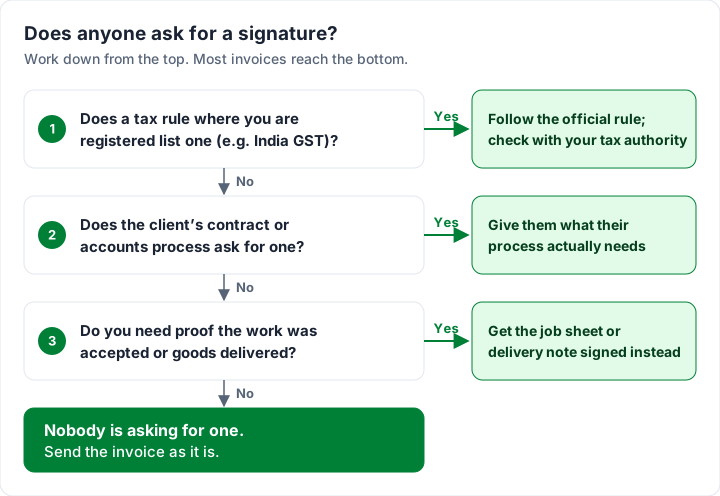
When a signed invoice actually helps#
Even where no official list asks for a signature, something signed can save an argument later. The table shows common situations, and the document that does the job best in practice:
| Situation | Is a signature useful? | Who signs | Better document to sign |
|---|---|---|---|
| Ordinary service or sale, client agreed the price | Rarely | Nobody | None; the agreement and your records are the evidence |
| Goods delivered to a site or a door | Helpful | Client or their representative | Delivery note or packing slip |
| A job finished on site (repairs, installs) | Helpful | Client | Job sheet or completion sign-off |
| Extra work beyond the quote | Very useful, before you do it | Client | Change order or a written approval |
| Large client with an accounts-payable process | Sometimes asked for by them | Their approver | Their purchase order or approval form |
| GST tax invoice in India | Listed in Rule 46 (see the e-invoice proviso) | Supplier or authorised representative | The tax invoice itself |
The pattern is clear: the signature you want is usually the client’s, on the document that records the work or the delivery, collected at the moment it happens. For large clients, the approval usually lives in their purchase order system, not on your invoice: how to invoice a company and what a PO number is for cover how that works.
Delivery and work sign-off: sign the job sheet, not the invoice#
A useful model comes from the US federal government. Its prompt payment rules list what a “proper invoice” contains, and a signature is not on that list. The signature appears on the agency’s receiving report instead, which lists a “Signature (or electronic alternative when supported by appropriate internal controls)” of the official who accepted the goods or services (5 CFR 1315.9, eCFR, read 23 October 2026).
That split works for small businesses too:
- At the end of the job or on delivery, the client signs a short sign-off: what was done or delivered, the date, and their name.
- You send the invoice referring to the sign-off, for example “Work accepted on site, 14 Oct 2026, job sheet JS-118”.
- The client pays against an invoice backed by a record that they accepted the work.
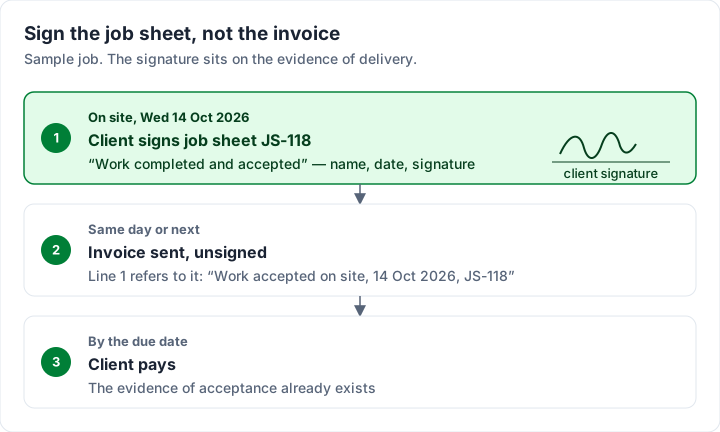
If a client later questions the bill, a signed sign-off is a clear record of what they accepted and when. What to do when a client disputes an invoice covers that conversation, and invoicing work done under a contract shows how to reference the agreement on each invoice.
Digital and electronic signatures on invoices#
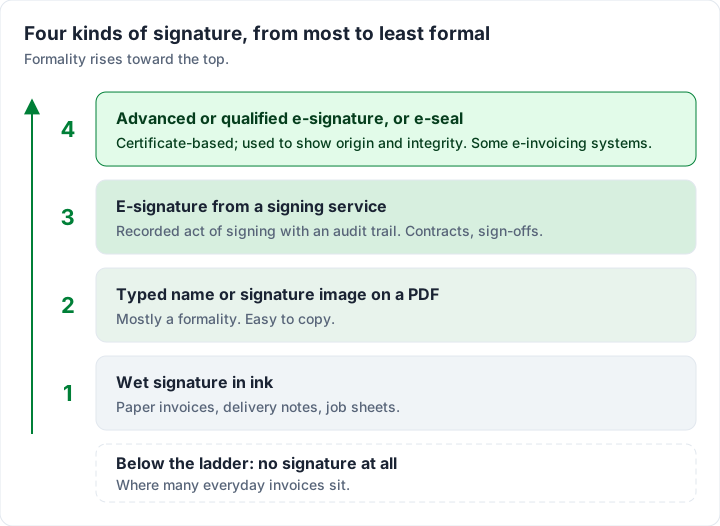
“Digitally signed invoice” can mean several different things.
| Type | What it is | Where you meet it |
|---|---|---|
| Wet signature | Ink on paper, sometimes scanned | Paper invoices, delivery notes, job sheets |
| Typed or image signature | A name or a signature image placed on a PDF | Everyday PDFs; mostly a formality |
| Electronic signature from a signing service | A recorded act of signing, with an audit trail | Contracts, proposals, change orders, sign-offs |
| Advanced or qualified electronic signature, or an electronic seal | A cryptographic signature tied to a certificate, used to show origin and integrity | Some e-invoicing systems |
What the official sources say, quoted as read on 23 October 2026:
- United States. The federal E-SIGN Act says that, for a transaction in or affecting interstate or foreign commerce, “a signature, contract, or other record relating to such transaction may not be denied legal effect, validity, or enforceability solely because it is in electronic form” (15 U.S.C. 7001, govinfo). The Act has conditions and exceptions; whether a particular document is covered is a question for a lawyer.
- European Union. The European Commission’s VAT invoicing page says: “Electronic invoices are equivalent to paper invoices. Businesses are free to issue electronic invoices subject to acceptance by the recipient.” EU e-invoicing rules are changing, so check the current rules with the tax authority where you are registered.
- United Kingdom. HMRC’s VAT Notice 700 says: “Electronic invoices are acceptable as evidence for input tax deduction, subject to the normal rules, providing the following can be ensured:”, followed by a list of three: “authenticity of the origin”, “integrity of the data” and “legibility of the content”.
Signed and stamped invoices#
Some clients ask for a “signed and stamped” invoice: signed by a named person and marked with a company stamp or seal. The request may come from the client’s own accounts-payable rules or from local practice where they are based, so ask which. None of the official pages above mentions a company stamp.
If a client asks for one:
- Ask what exactly their process needs. A named signatory, a stamp, a signature image, or just a PDF they can attach to an approval.
- Sign only as yourself, with your role, and use only a stamp or signature you are entitled to use.
- Keep the sent version unchanged. If you sign or stamp a copy, it should match the invoice you issued, number for number.
Adding a signature line in Charming, and what it is not#
Charming Invoices has an optional signature section you can switch on in a business’s invoice design. It prints a blank line with a label underneath, “Authorised signature” by default, and you can rename the label. The Contractor template, one of 60 on the templates page, comes with it switched on and labelled “Customer acceptance”, which suits a client signing a printed copy to accept a finished job.
Two other things help when someone questions an invoice later:
- Issued invoices are locked. Once an invoice is issued, it cannot be edited, so what the client received is what stays on record.
- “Viewed by the client” tracking records when the client first opened the invoice’s private link.
What it does not do, plainly:
- No electronic signature and no signing workflow. The signature line is for signing on paper. Nobody can sign inside Charming.
- No approval step, and no qualified signature or seal for e-invoicing systems that use one. Use an e-signature service for sign-offs and change orders, or an e-invoicing provider where your country’s system calls for one.
- The section is set per business, so turning it on adds the line to every invoice from that business.
If you want invoices that look finished without a signature, you can create a free invoice in Charming. Free invoices carry a “Sent with Charming Invoices” line; paid plans hide it by default.
Questions people ask#
Is an unsigned invoice still an invoice?#
In the official lists we read for the US federal government, the UK and the EU, a signature is not one of the listed items; the lists ask for content. Whether the client owes the money depends on your agreement. If a specific dispute turns on it, ask a lawyer where you are.
Should the client sign the invoice to accept it?#
In practice, it is more useful to have the client sign the delivery note, job sheet or change order when the work is accepted, and refer to that on the invoice. A signature on the invoice afterwards adds little.
What about debit notes and bills of sale?#
Different documents. A bill of sale records a transfer of ownership and is commonly signed: see bill of sale vs invoice. For billing an undercharge, see supplementary invoices and debit notes. If you are GST-registered in India, check the CGST Rules for debit and credit notes too.
The short version#
In the official invoice lists we read, a signature is not one of the listed items, and India’s GST rules are the notable exception for tax invoices, with a proviso for electronic invoices. Where a signature genuinely helps is on the record that the work was accepted or the goods delivered, collected when it happens. Put the signature there, refer to it on the invoice, and check your own tax authority’s list if you are unsure.