Is an invoice a contract? Invoices vs agreements explained

Nnabuike Okoroafor ·
On this page · 11 sections
You did the work, sent the invoice, and the client has gone quiet. Then the worrying question arrives: you never signed anything, so is an invoice a contract? Does that piece of paper actually oblige anyone to pay you?
Whether anyone is legally bound, and to what, is a legal question that depends on where you are and on the facts, and this post does not answer it for you. What it can do is explain, in plain business terms, how an invoice differs from an agreement, why terms agreed before the work matter, and what to gather if you never signed anything. In everyday practice, an invoice is a request for payment written by one side, and the deal it bills for was usually made earlier: a signed contract, an accepted proposal, an email thread, sometimes just a conversation.
General information, not legal advice. Contract law varies by country and by US state, and it changes. If money is at stake, a short consultation with a local lawyer is the place to get an answer for your situation.
In short#
- An invoice and a contract do different jobs. A contract records what both sides agreed. An invoice is written and sent by one side to ask for a payment.
- The invoice is still a useful record. It records what you say was supplied, when and for how much, and it is one of the documents you keep for tax and for any later dispute.
- How much weight an invoice carries is a legal question. It can depend on what the client agreed, how they behaved, and the law where you both are.
- Terms on an invoice cause least friction when they repeat what was already agreed. A new term the client never saw before, such as a late fee, is likely to be disputed.
- A written agreement or accepted proposal is the clearest record of the deal. It can be short.
- No contract? Gather what you have. Collect the messages, the delivery and the payment history, confirm the deal in writing now, and ask a lawyer if the sum matters.
Is an invoice a contract? What each document does#
In everyday terms, a contract is an agreement between two sides: what will be done, for how much, and on what terms. An invoice usually comes later and asks for one payment under that agreement. People often treat the two as rival documents. They are partners.
| Contract or accepted proposal | Invoice | |
|---|---|---|
| Who writes it | Usually one side drafts; both agree | The seller alone |
| When | Before the work starts | After the work, or at agreed stages |
| Job | Sets out the deal: scope, price, schedule, terms | Requests a specific payment and records the sale |
| Signed? | Often, or accepted in writing | Usually not |
| What you use it for | Showing what was agreed | Showing what you billed, and when |
Anyone can write an invoice for any amount and send it to anyone, so an invoice on its own says little about whether the client agreed to the deal. That is why the agreement behind the invoice matters: the invoice is the document that says, “under that agreement, this amount is now due.”
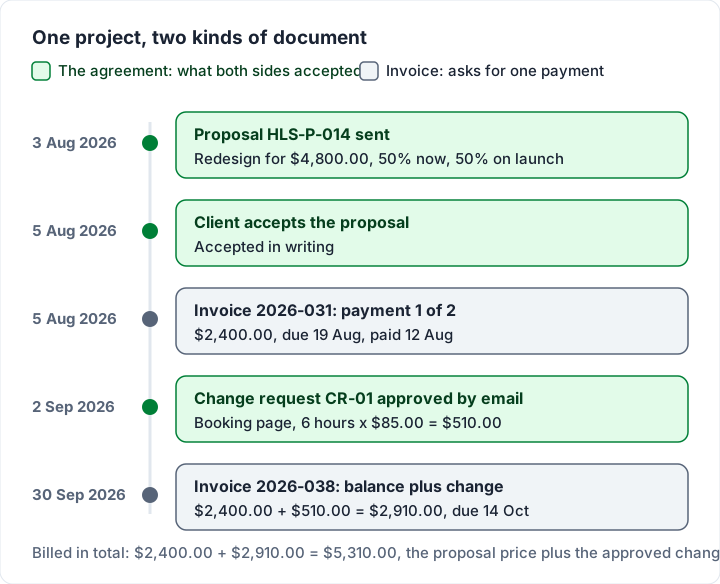
The picture below shows the usual chain on a small project, from the first offer to the final payment.
If you want a fuller explanation of the invoice itself, what an invoice is and how it works covers the basics, and how to write a contract invoice covers billing against a signed agreement, clause by clause.
Is an invoice legally binding?#
That depends on the law where you are and on the facts, so it is a question for a lawyer, not a blog post. What helps in practice is knowing which facts tend to matter, because they are the ones you can collect and keep:
- What the client asked for and agreed. A signed contract, an accepted quote or proposal, an email saying “go ahead”.
- What the client did. Asking for the work, receiving it, using it, approving stages.
- How you have dealt before. Earlier invoices at the same rate that the client paid.
- Whether the client objected. A prompt “this is wrong” is very different from months of silence.
Lawyers have names for some of these situations, such as an implied contract, an account stated or quantum meruit. The rules behind each vary by place, and Cornell Law School's Legal Information Institute has plain-English entries on implied contracts, account stated and quantum meruit if you want to know what the terms mean. They are background reading for a conversation with a lawyer, not a way to bill for work nobody agreed to.
What an invoice is used for#
Even when it is not the agreement, an invoice is a business record people rely on. Three examples:
- Tax records. Tax authorities publish rules on the invoices and records businesses keep. In the UK, for example, GOV.UK's invoicing guide says, as of 23 October 2026, that an invoice “must include certain information such as:” “how much the customer needs to pay you” and “when the customer must pay you”.
- Payment dates. Some governments publish default payment rules. GOV.UK's page on payment obligations says, as of 23 October 2026: “Unless you agree a payment date, the customer must pay you within 30 days of getting your invoice or the goods or service.” Other countries have their own rules; check your government's guidance.
- A dispute or claim. If you ever need to chase formally, the invoice is one of the first documents you produce, alongside the agreement and proof of delivery.
Why putting terms on the invoice helps, and where it stops#
Printing your terms on every invoice is good practice. It just does not do what many people hope. In practice, a term on an invoice works best when it repeats something the client already agreed. A term that appears for the first time on the invoice, after the work is done, is one the client never saw before agreeing, and likely to be disputed. For example wording that repeats what was agreed, see invoice terms and conditions: examples, notes and messages.
| Term on the invoice | Agreed before the work? | What it tends to do in practice |
|---|---|---|
| Payment due within 14 days | Yes, in the proposal | Reminds the client of the agreed date; starts your follow-up clock |
| Payment due within 14 days | No terms agreed at all | Sets a clear expectation; local default rules may also apply |
| 2% monthly late fee | Yes, in the contract | Reminds the client of a term they accepted; local rules may limit it |
| 2% monthly late fee | No, first seen on the invoice | Expect the client to dispute it |
| Ownership passes on full payment | Yes, in the contract | A clear reminder of what was agreed about files or rights |
So put terms on your invoices, and make sure the same terms were in the proposal or contract first. Payment terms like Net 30 and what they mean explains how to choose them, and how to add a late fee that holds up explains why a late fee should be agreed before the work.
Here is terms wording you can adapt. It points back to the agreement instead of inventing anything new:
Payment is due within 14 days of the invoice date, as agreed in
proposal HLS-P-014 (accepted 5 August 2026), section 4.
Please quote the invoice number with your payment.
In Charming Invoices, each business has a Terms field that is copied onto every new invoice, and each invoice can carry its own terms and notes, printed in their own section of the PDF. Once an invoice is issued it is locked against edits, and the app records when the client first opened its private link. That is a tidy record of what you asked for and when. The catch: Charming does not write contracts, send proposals or collect e-signatures, and it has no estimates or quotes. The optional signature section prints a line to sign on paper; it is not a digital signature. Use a contract or e-signature tool for the agreement, and Charming for the invoices that follow. You can create a free invoice to see how the terms print.
Why a written agreement or accepted proposal matters#
The agreement is what you point to when a client stops paying or disputes the price. It does not have to be long. In a public online discussion where a new freelancer was about to send a first invoice without ever having agreed a price, one commenter (not a Charming customer) put it simply:
In the future, you need to have a contract or at least written agreement in the form of an email outlining the cost of your services.
That is the minimum. A one-page agreement or proposal that the client accepts in writing commonly covers:
- Scope: what you will deliver, and what is not included.
- Price: a fixed fee, a rate, or how the price will be worked out.
- Payment schedule: deposit, stages, balance, and what triggers each one.
- Payment terms: how many days after the invoice, and how to pay.
- Changes: how extra work is priced and approved, ideally in writing first.
- Late payment: any late fee or interest, if you plan to charge one.
- Cancellation and ownership: what happens to money and work if either side stops.
E-signatures and email replies. Many businesses accept proposals by e-signature or by a reply such as “Approved, please go ahead”. Whether that counts as acceptance where you are is a legal question; in the US, for example, the federal ESIGN Act (15 U.S.C. 7001) is one law that deals with electronic signatures and records. A clear reply to a clear proposal is easier to point to than a vague one.
Some places have rules on written contracts. New York City's Department of Consumer and Worker Protection, for example, says on its freelance workers page, as of 23 October 2026: “All contracts worth $800 or more must be in writing.” Check whether a rule like this applies where you or your client are.
If you take a deposit before starting, how deposit invoices work shows how to tie the deposit to the agreement.
What to do if you have no contract#
Plenty of work starts on a handshake. Another person in a public discussion (also not a Charming customer) described a common position:
How do you guys handle when a Architect contracts with you (I dont have legal contract, just emails approving the go-ahead with the work) and they end up passing the invoice to the client to pay?
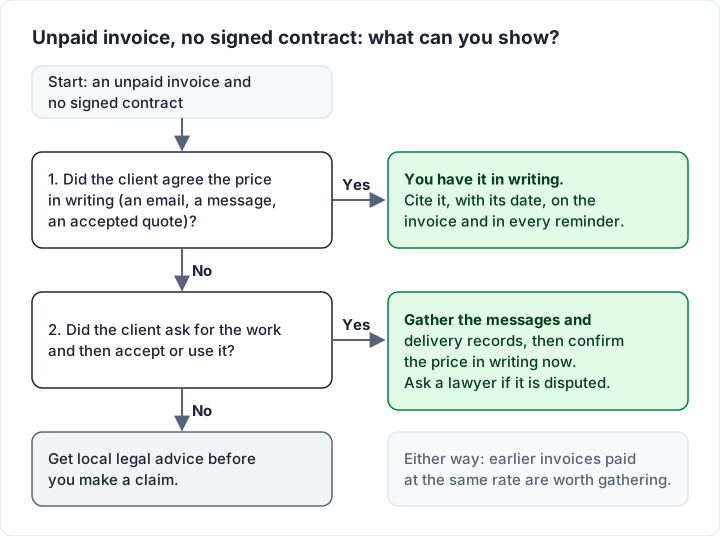
Emails approving the work are a written record of what was agreed, and often a better one than people fear. Work through these steps.
- Gather what shows the deal. Emails, texts, messages, call notes, a quote you sent, the client's go-ahead, earlier invoices they paid at the same rate.
- Gather what shows delivery. Files sent, sign-offs, the client using the work, photos of a finished job.
- Make the invoice point to that record. Name the email or message the client approved, with its date, in the invoice notes or description.
- Confirm the deal in writing now. Send a short, friendly email restating the price and what was delivered, and ask the client to reply if anything is wrong. A prompt objection tells you there is a real dispute; a reply that agrees, or a payment, settles it.
- Follow up on a schedule. Polite reminders first. What to do when a client is not paying an invoice lays out the order.
- Separate a dispute from a delay. If the client questions the price or the work, how to handle a disputed invoice covers how to get the undisputed part paid.
- Get advice before you escalate. A demand letter for an unpaid invoice is a common next step; for a large sum, talk to a lawyer first.
A confirmation email you can adapt:
Hi Sam, a quick note so our records match. On 4 September you
approved the logo project by email at a fixed price of $1,200.00.
I delivered the final files on 25 September and you confirmed them
the same day. Invoice 2026-041 for $1,200.00 is attached. If anything
here does not match your notes, please let me know this week.
The chart below shows the questions to ask about your own records, and what to do next for each answer.
Worked example: a contract and invoice chain that holds up#
Here is one illustrative project, Harbour Lane Studio (a sample web design business) building a website for a sample client, Brightwater Physio. The numbers are an example, not data.
| Date | Document | Who | What it amounts to |
|---|---|---|---|
| 3 Aug 2026 | Proposal HLS-P-014: redesign for $4,800.00, 50% on acceptance, 50% on launch, invoices due in 14 days, extra work at $85.00 an hour approved in writing first | Studio | The offer |
| 5 Aug 2026 | Client signs the proposal | Client | Acceptance, in writing |
| 5 Aug 2026 | Invoice 2026-031: payment 1 of 2, $2,400.00, due 19 Aug | Studio | Request for the first payment |
| 12 Aug 2026 | Client pays $2,400.00 | Client | Payment at the agreed figure |
| 2 Sep 2026 | Change request CR-01: booking page, 6 hours at $85.00 = $510.00, approved by email | Both | A written change, approved by the client |
| 30 Sep 2026 | Site launches; invoice 2026-038 for $2,910.00, due 14 Oct | Studio | Request for the balance plus the change |
The second invoice adds up like this: the scheduled balance of $2,400.00 plus the approved change of $510.00 is $2,910.00. Across both invoices the studio bills $5,310.00, which is the proposal price of $4,800.00 plus the $510.00 change, and nothing more.
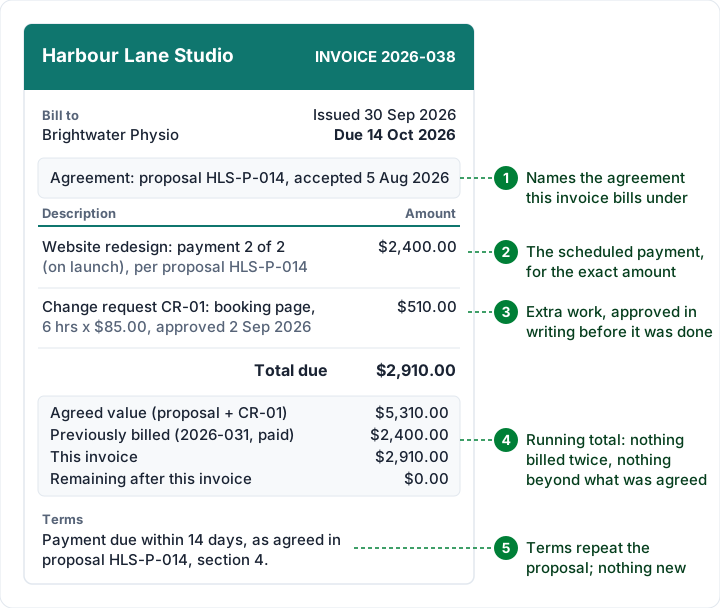
Now suppose Brightwater Physio stops replying after 14 October. The studio does not have to argue about what an invoice is. It can show the signed proposal, the change approval, the launch, the first payment and the invoice, with every figure traced back. That set of documents is what a lawyer, or the client's own accounts team, will want to see. The invoice is the last link, not the whole chain.
How long to keep invoices and contracts#
Record-keeping rules are set by tax authorities and differ by country, and the time limits for legal claims are a separate matter, so there is no single answer here. A common habit is to keep the agreement, the emails and the invoices together for as long as you keep your tax records. For the periods that apply to you, check your tax authority's guidance, for example the IRS page on how long to keep records in the US or GOV.UK's pages on records for the self-employed and company and accounting records in the UK, and ask a lawyer about time limits for claims.
Frequently asked questions#
Can I send an invoice without a contract?#
Yes. Nothing stops you sending an invoice for work you did without a signed contract. What matters if it goes unpaid is whatever records the agreement: emails, messages, an accepted quote, the client's go-ahead. Reference that record on the invoice.
Does a client have to sign an invoice?#
In everyday practice, invoices are usually not signed by either side. GOV.UK's list of what an invoice must include, for example, does not mention a signature (as of 23 October 2026). A client signing a quote or proposal before the work is far more useful than a signature on the invoice afterwards. Some trades print a “customer acceptance” line on the invoice to record sign-off of finished work. For more, see our guide to whether invoices need to be signed.
Does an invoice count as a contract if the client pays it?#
That is a legal question. In practice, a client paying an invoice at an agreed rate is a useful record of the deal, and a run of paid invoices at the same rate is a useful record of the terms for the next one.
Can I add a late fee on the invoice if it was not in the contract?#
You can print one, but a late fee the client never agreed before the work is likely to be disputed. Some places have their own rules on interest for late payment; in the UK, for example, GOV.UK says “You have the right to charge interest for late payment, but you can choose not to” (GOV.UK, Payment obligations, as of 23 October 2026).
Is a proforma invoice legally binding?#
A proforma invoice is a preliminary document sent before a sale is final. What it commits anyone to is a legal question; in practice it is treated as a preview of the final invoice. See what a proforma invoice is and when to use one.
Is an invoice proof of payment?#
No. An invoice asks for payment; a receipt confirms it. The difference between an invoice and a receipt explains which to send when.
Make the invoice the last link in a clear chain#
An invoice will not create the agreement for you, but it can make a good agreement easy to point to. Agree the price and terms in writing first, then send invoices that cite that agreement, repeat its terms and add up to its numbers. If you want a working due date for those terms, the invoice due date calculator works it out from the issue date.
When the agreement is in place, create a free invoice in Charming: your terms copied onto every invoice, a locked record once it is issued, and a note of when the client opened it. Free invoices carry a small “Sent with Charming Invoices” line, payment tracking is manual, and clients pay you directly by the details you print, not by card through the app.