What is an invoice and how does it work?

Nnabuike Okoroafor ·
On this page · 12 sections
You have done some work, or you are about to, and someone has said “send me an invoice”. Or a client asked for one before they can pay you, and you are not entirely sure what they are expecting. So, what is an invoice, exactly? It is the document a seller sends to a buyer that says what was sold, what it costs and how to pay. It asks for money, and it records the sale.
That is the whole idea. The rest of this guide is the detail that makes the idea useful: who sends one, what it looks like, how it moves from draft to paid, what official guidance says about it, and how it differs from the documents people confuse it with.
In short#
- An invoice is a request for payment and a record of a sale. The seller sends it; the buyer pays it.
- It lists what was supplied, the price, the total and when payment is due, plus how to pay.
- The same document is a “bill” to the person paying it. From the seller's side it is an invoice.
- In practice it records a deal already agreed. The price and scope are settled before the invoice; the invoice states what is owed.
- Both sides keep it as a record for their books and taxes, which is why the details on it matter.
- It has a lifecycle: draft, sent, partly paid or paid, sometimes overdue, occasionally cancelled.
What is an invoice? The plain definition#
Dictionaries agree on the core of the invoice definition. The American Heritage Dictionary defines an invoice as “a detailed list of goods shipped or services rendered, with an account of all costs; an itemized bill” (American Heritage Dictionary). Wiktionary puts it from the business side: “a commercial document issued by a seller to a buyer indicating the products, quantities and agreed prices” (Wiktionary). What an itemized invoice is covers how much of that detail to show.
Note the word agreed in that second definition. An invoice is not where the price is decided. It is where the agreed price is written down and asked for.
The word itself comes from sending. The American Heritage Dictionary traces it to the obsolete English “invoyes”, from the French “envoi”, “a sending, shipment”, from “envoyer”, “to send”. An invoice was, quite literally, the list that travelled with a shipment. Today it more often travels as a PDF attached to an email, but the job has not changed: here is what you received, here is what it costs.
So the invoice meaning, in one line: a written request for payment for something already agreed, listing what was supplied and what is owed.
Who sends an invoice, and who receives it#
The seller sends it. That is whoever supplied the goods or did the work: a freelancer, a contractor, a shop, a consultancy, a company of thousands. If you are reading this because you did some work and need to be paid, the sender is you.
The buyer receives it. That is the person or business who owes the money. In a small business, the person who hired you usually pays it. In a larger company, the invoice often goes to an accounts payable team who never met you and know nothing about the project except what is written on the page.
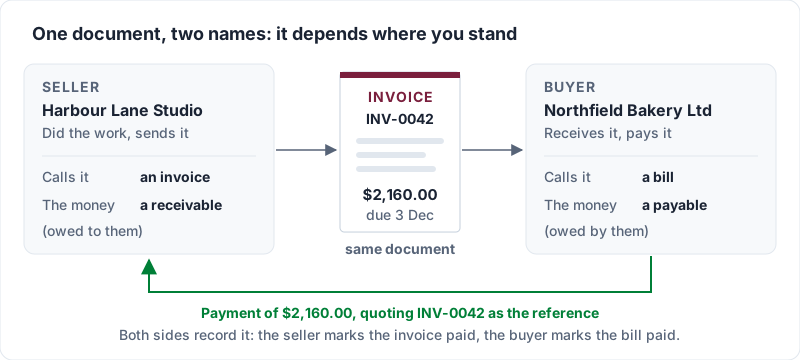
The same piece of paper has two names depending on where you stand. To the seller it is an invoice, and the money it represents is a receivable. To the buyer it is a bill, and the money is a payable. Nothing about the document changes; only the point of view. Our guide to invoices in accounting follows one invoice through both sets of books.
Sole traders and freelancers send invoices as well as companies. Plenty of people meet the word for the first time when a client asks for it, as one commenter in a freelance writers' forum did:
A firm recently hired me to do some work, and I'm supposed to send an invoice to get paid. I've never created an invoice, and I don't know where to start.
That is where many first invoices begin, and it is less complicated than it sounds. (The quote is from a public online discussion; the people we quote in our research are not Charming customers.) Tax registration is a separate question, covered further down.
What an invoice looks like: a worked example#
Here is a complete, ordinary invoice for a small copywriting job. The business, the client and the numbers are invented for illustration.
- From: Harbour Lane Studio, 14 Quay Street, Portsmouth · [email protected]
- Invoice number: INV-0042
- Issued: 3 November 2026 · Due: 3 December 2026 (Net 30)
- Bill to: Northfield Bakery Ltd, Accounts Payable, 2 Mill Road, Leeds
- PO number: NB-7713
| Description | Qty | Rate | Amount |
|---|---|---|---|
| Website copy — 5 pages (home, about, menu, wholesale, contact) | 1 | $1,200.00 | $1,200.00 |
| Product descriptions, seasonal range | 24 | $35.00 | $840.00 |
| Extra revision round (agreed by email 28 October) | 2 hrs | $60.00 | $120.00 |
| Subtotal | $2,160.00 | ||
| Total due (USD) | $2,160.00 |
How to pay: bank transfer to Harbour Lane Studio, account details below. Please use INV-0042 as the payment reference.
Laid out as a page, with the parts numbered to match the notes below:
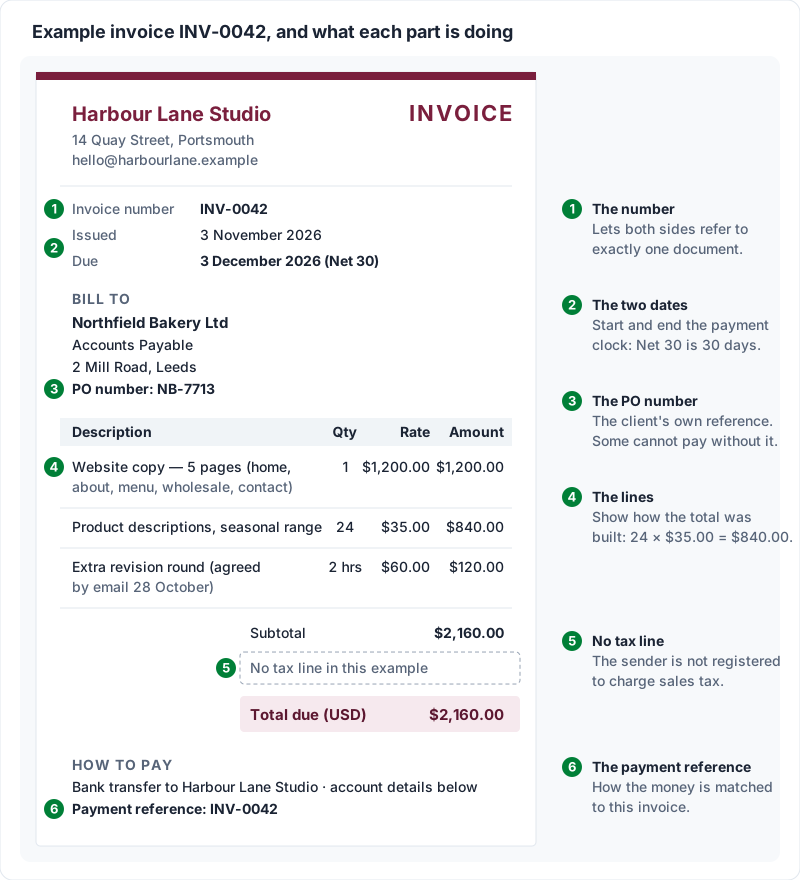
Notice what each part is doing:
- The number (INV-0042) lets both sides talk about exactly one document.
- The two dates start and end the payment clock. Net 30 means due 30 days after the issue date.
- The PO number is the client's own reference. Without it, some accounts teams cannot pay.
- The lines show the build of the total, so nobody has to ask how you got there.
- No tax line, because in this example the sender does not charge sales tax. When tax is charged, it commonly goes on its own line with its rate; your tax authority's guidance sets the details.
- The payment reference is how the payment gets matched to this invoice when it lands.
For the full field-by-field list, including the fields that depend on your country, see what actually belongs on an invoice.
How does an invoice work? From draft to paid#
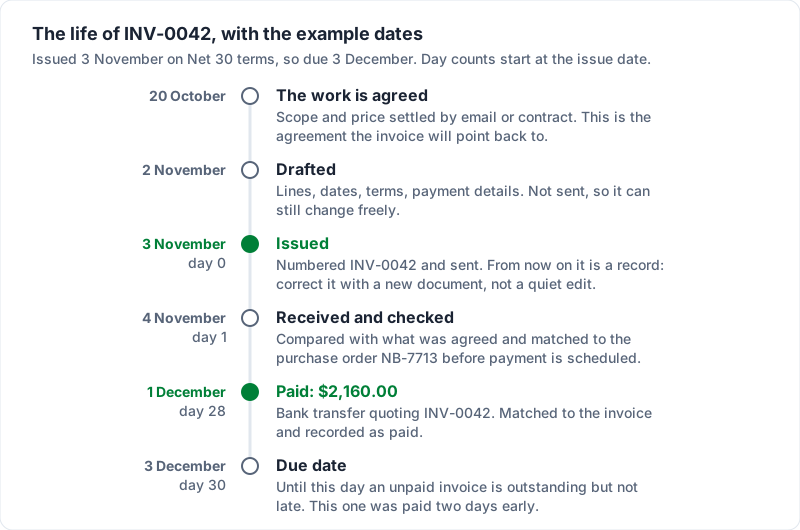
How do invoices work in practice? It is easiest to see as a sequence. Here is the life of INV-0042, with illustrative dates. The first two stages have their own guide: draft invoice vs final invoice.
- The work is agreed (20 October). Scope and price are settled by email or contract. This is the agreement the invoice will point back to.
- The invoice is drafted (2 November). Lines, dates, terms, payment details. Nothing has been sent, so it can still change freely.
- The invoice is issued (3 November). It gets its number and goes to the client, usually as a PDF or a link. From this point it is a record, so you correct it with a new document rather than by quietly editing the old one.
- The client receives and checks it (4 November). Someone compares it with what they agreed. A larger client may need it approved and matched to a purchase order before payment is scheduled.
- The payment is due (3 December). Until then the invoice is outstanding but not late.
- The client pays (1 December). Usually by bank transfer or a payment link, quoting the invoice number. You match the money to the invoice and record it as paid.
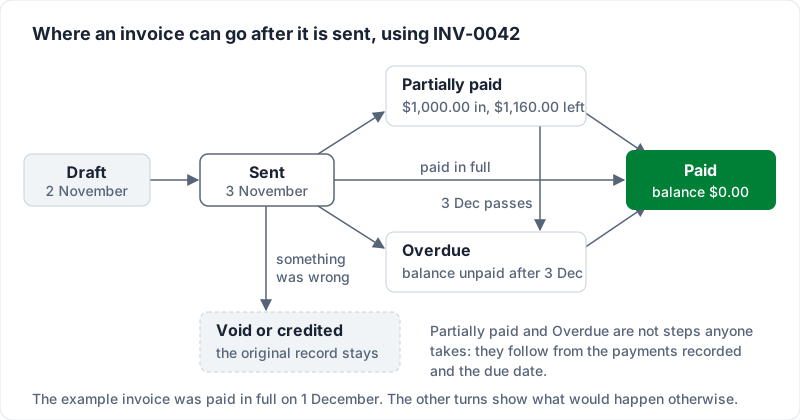
That is the happy path. Three other turns are common:
- Partly paid. The client pays $1,000.00 on 1 December. The invoice now has a balance of $1,160.00 still outstanding.
- Overdue. 3 December passes and the balance is unpaid. The invoice is now overdue, and it is time for a polite reminder.
- Cancelled or corrected. Something was wrong. In most systems you void the invoice or issue a credit note against it, and the record of the original stays. Credit note vs invoice explains when each one applies.
Most of the discomfort in that sequence sits at step 3, the sending. One person in a public discussion described the mindset that helped them:
I try to get in the mentality of say when you get a tradie in for work, you wouldn't dream of not paying them promptly. And they pass the invoice over matter of fact.
Matter of fact is the right tone. An invoice is not a favour you are asking. It is the paperwork for a deal both sides already made.
What is an invoice payment? Invoice vs payment#
“Invoice payment” means paying the amount on an invoice, and it usually refers to the buyer's side of the sequence above. The invoice and the payment are two different things: the invoice is the request, the payment is the money that answers it. One invoice can be settled by several payments (a deposit and a balance, or part payments), and one payment can settle several invoices (a client paying a month's invoices in one transfer).
You will also see “payment invoice”. It is not a separate document type: people usually mean an ordinary invoice that asks for payment, and occasionally a paid invoice kept as proof of payment. When an invoice counts as paid covers that second meaning and what to send once the money arrives.
A few things are worth knowing about how invoice payment happens in practice.
The invoice does not move the money. Unless your invoice contains a payment link from a payment provider, the client still has to make a bank transfer, write a cheque or pay some other way. The invoice tells them how; it does not do it for them.
The terms set the deadline. “Due on receipt”, “Net 14” and “Net 30” are the common forms. Invoice payment terms, in plain English explains each one and how to count the due date.
The reference ties the money to the invoice. When a payment lands in your account, the invoice number in the reference is often the only thing telling you what it is for. Clients who pay several invoices in one transfer sometimes send a remittance advice: a short note listing which invoices the payment covers.
Payment is recorded on both sides. You mark the invoice paid in your records; the client marks the bill paid in theirs. If the two records disagree, the invoice number is what you both check against.
What invoices are used for in business#
An invoice does more than ask for money. In a small business, the same document does several jobs at once, for both sides.
| Who | What the invoice is used for |
|---|---|
| The seller | Asking for payment, with the amount, due date and how to pay in one place |
| The seller | Tracking who owes what: every unpaid invoice is money receivable |
| The seller | Matching payments when they land, through the invoice number in the reference |
| The seller | Records for the books and tax returns, as evidence of income |
| The buyer | Approving the purchase and matching it to a purchase order or quote |
| The buyer | Scheduling the payment for the due date, as a bill payable |
| The buyer | Records for the books and tax returns, as evidence of a cost |
That last row is why the details on an invoice matter even after it is paid: both businesses may need to find it again, sometimes years later. For a running list of who owes you what, an invoice tracker does the seller's side in a spreadsheet.
What official guidance says about invoices#
General information, not legal or tax advice. Rules differ by country, and sometimes by state or region, and they change. The quotes below show what a few official pages said when we read them on 23 October 2026; they are examples from one place, not rules for everywhere. For your own situation, read your tax authority's guidance and ask an accountant or a lawyer.
Tax authorities treat invoices as records. The IRS page on business records says: “Supporting documents include sales slips, paid bills, invoices, receipts, deposit slips, and canceled checks.” (IRS, What kind of records should I keep, as of 23 October 2026). In practice, the invoices you send show your income and the invoices you receive show your costs.
Some official pages list what an invoice should show. GOV.UK's invoicing guide opens its list with “Your invoice must include:” and the items include “a unique identification number”, “a clear description of what you’re charging for”, “the date of the invoice” and “the total amount owed” (GOV.UK, Invoices: what they must include, as of 23 October 2026). Read the full list on that page rather than relying on our excerpt.
Some say when an invoice is needed. The European Commission's invoicing page says that for business-to-business supplies “a business must issue an invoice whenever goods or services are supplied to another business or a non-taxable legal entity”, followed by a list of exceptions, and that “Electronic invoices are equivalent to paper invoices.” (European Commission, Invoicing, as of 23 October 2026). GOV.UK's overview says you “need to give them an invoice (bill) by law if both you and the customer are registered for VAT” (GOV.UK, Invoicing and taking payment from customers, as of 23 October 2026). If you are registered for VAT, GST or sales tax, check your tax authority's own list of invoice fields.
The invoice date can matter for payment timing. GOV.UK's page on late commercial payments says: “If you do not agree a payment date, the law says the payment is late 30 days after either:” “the customer gets the invoice” or “you deliver the goods or provide the service (if this is later)” (GOV.UK, Late commercial payments, as of 23 October 2026). That page covers the UK only.
An invoice is not the same thing as a contract. The Legal Information Institute defines a contract as “an agreement between parties, creating mutual obligations that are enforceable by law” (Cornell Law School, Legal Information Institute, as of 23 October 2026). An invoice is a document one side writes and sends. In practice, this is the reason to agree price and terms in writing before you start, even in a short email, and to raise any disagreement with an invoice promptly and in writing. Is an invoice a contract? covers the general picture; whether an invoice carries legal weight in a particular case is a question for a lawyer.
It does not guarantee you get paid. An invoice is a request and a record. If a client will not pay, it is the starting point for chasing, not the end of it.
Invoice vs bill, receipt, quote, statement and purchase order#
These six documents get mixed up constantly. Here is each one in a line.
| Document | What it does | Sent by | When |
|---|---|---|---|
| Invoice | Asks for payment for what was supplied, and records the sale | Seller | After (or at agreed stages of) the work |
| Bill | The same document, named from the payer's side | Seller (received by the buyer) | Same as the invoice |
| Receipt | Proves a payment was made | Seller | After payment |
| Quote or estimate | Proposes a price before anything is agreed | Seller | Before the work |
| Statement | Summarises every open invoice on an account | Seller | Periodically, or when several are unpaid |
| Purchase order | The buyer's own approval to buy, with a number | Buyer | Before the work, or before the invoice |
Put on a timeline, the confusion mostly clears: each document belongs to one side and one moment.
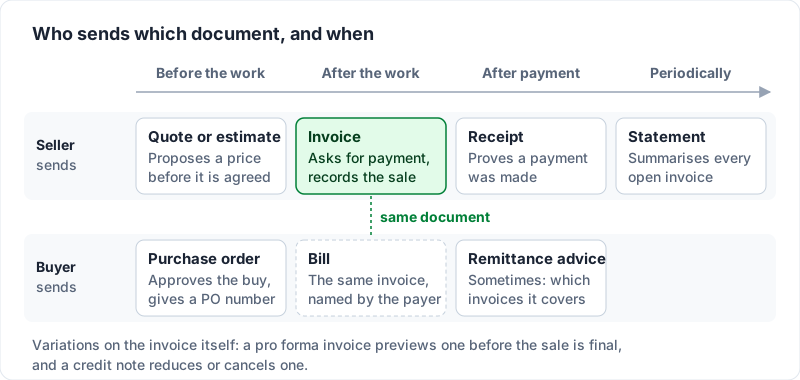
A few one-line expansions:
- Invoice vs receipt: an invoice says “please pay”, a receipt says “you paid”.
- Invoice vs statement: an invoice covers one sale; a statement covers the whole account.
- Invoice vs purchase order: the PO comes from the buyer and authorises the purchase; your invoice quotes its number back.
- Invoice vs quote: a quote is an offer that can be accepted or declined. Once it is accepted and the work is done, the invoice follows, and the two should match.
- Invoice vs bill: no real difference in the document. In everyday use, “bill” is more common for consumers (a phone bill), “invoice” for business-to-business work. Invoice vs bill covers the other meanings of “bill” and what to title your own document.
There are also variations on the invoice itself: a pro forma invoice (a preview of an invoice, sent before the sale is final, not a demand for payment; see pro forma invoices explained), a tax invoice (an invoice that meets a tax authority's rules; see what a tax invoice is), a credit note (a document that reduces or cancels an invoice), and recurring invoices (the same invoice issued on a schedule for ongoing work). Our guide to the types of invoices sorts all of them by when you send them.
Invoice vocabulary you will meet#
Invoice, the noun. The document. “I sent the invoice on Monday.”
Invoice, the verb. To send someone an invoice, or to bill for something. The American Heritage Dictionary gives both senses: “to send an invoice to; bill” and “to make an invoice of (goods or services)”. “We will invoice you monthly.” “Invoice the client for the extra revisions.”
Invoicing. The ongoing activity of creating, sending and tracking invoices.
Line item. One row on the invoice: a description, a quantity, a rate and an amount.
Issue date and due date. The day the invoice is issued, and the day payment must arrive.
Net 30 (or Net 7, Net 14, Net 60). Payment is due that many days after the issue date. “Due on receipt” means pay as soon as you get it.
Outstanding. Sent and not yet fully paid, whether or not it is late.
Overdue (or past due). Still unpaid after the due date.
Accounts receivable and accounts payable. Money owed to you on invoices you sent, and money you owe on invoices you received.
Remittance. The American Heritage Dictionary defines it as “the sending of money to someone at a distance” or “the sum of money sent”. A remittance advice is the note telling you which invoices a payment covers. The address or bank details for payment are sometimes labelled “remit to”. Remittance on an invoice covers both in full.
PO number. The buyer's purchase order reference, quoted on your invoice.
Sales invoice and service invoice. An invoice for goods sold, and one for work done. Service invoice vs sales invoice sets out where they differ.
Invoice synonyms. “Bill” is the closest; the American Heritage Dictionary defines a bill as “an itemized list or statement of fees or charges”. You will also see “statement of charges”, “account” and, for a restaurant, “check” in American English. They overlap but are not always interchangeable: “statement” in particular usually means the account summary described above.
Common questions people ask#
Do I need a registered business to send an invoice? Many freelancers and sole traders invoice under their own name. Whether you need to register for tax, or show a tax number, is a question for your own tax authority's guidance or an accountant.
Is an invoice the same as asking for payment upfront? It can be. A deposit invoice asks for part of the price before the work starts, if you agreed that up front.
Can I change an invoice after I send it? Treat a sent invoice as fixed. If something was wrong, issue a corrected invoice or a credit note and tell the client, so both records stay consistent.
What happens if nobody pays? The invoice becomes overdue and you follow up, politely and in writing. The due date and the invoice number are what make that follow-up specific.
Does an invoice have to be on paper? A PDF or a link is common practice, and the European Commission's page quoted above says “Electronic invoices are equivalent to paper invoices.” Where tax rules specify a format, such as structured electronic invoices for some business-to-business or government work, follow those rules.
Where Charming fits, and where it stops#
If you would rather not track the lifecycle above by hand, this is the part invoicing software actually does. In Charming Invoices, an invoice shows the statuses described in this guide, with Issued in place of Sent: Draft, Issued, Partially paid, Overdue, Paid and Void. You issue the invoice, then download the PDF or copy its private link and send it however you like. Overdue and Partially paid are worked out from the due date and the payments you record, so you never set them by hand.
The catch: Charming is not a payment processor. Your client pays you directly by whatever method you print on the invoice, and Charming only knows an invoice is paid when you tell it: you record each payment, or mark the invoice paid in one click. It does not do quotes or estimates either, it does not email invoices or reminders, and free-plan invoices carry a small “Sent with Charming Invoices” line in the footer.
So, to come back to the question: what is an invoice? A request for payment and a record of a sale, sent by the seller once the deal is agreed. Whatever you use to make one, a plain invoice with the right fields, sent promptly and matter of fact, does the job. If you want to see one built for you, create a free invoice, download the PDF and send it your way when it looks right.