Proforma invoice: meaning and examples

Nnabuike Okoroafor ·
On this page · 12 sections
A client has said yes, and then their finance team asks for “a proforma invoice before we can pay”. Or you want money before you start, and someone suggests sending a pro forma. Either way, you are being asked for a document that looks like an invoice, but is not quite one, and nobody explains the difference.
This guide does. It covers what a proforma invoice is, when freelancers and small businesses actually use one, how it differs from a quote, a deposit invoice and a commercial invoice, what to put on it, a full worked example, how to adapt a free template, and how to turn it into the final invoice without leaving a mess in your records.
In short#
- A proforma invoice is a preliminary document. It shows what the client will be asked to pay, on what terms, before the sale or the work is final.
- It previews the bill rather than billing for work done. In the UK, HMRC’s VAT manual says a pro forma “cannot be considered to be an accounting document” in normal circumstances.
- Clients ask for one to get internal approval, to pay in advance, or to arrange things like an import licence or a bank transfer.
- When the client pays or the work is delivered, you issue a real invoice. The proforma never becomes the invoice; it is replaced by one.
- Give proformas their own numbering (PF-0001, PF-0002), separate from your invoice numbers.
This is general information, not legal or tax advice. Rules differ by country, by state and by whether you are registered for VAT, GST or sales tax, and they change. The official pages quoted below were read on 28 October 2026 and show how one tax authority treats proformas, not a rule for everywhere; ask your accountant about your own situation.
What is a pro forma invoice?#
A pro forma invoice is a document in the shape of an invoice, sent before the sale is final, that sets out the goods or services, the prices, the total and the terms. It lets the buyer see exactly what they will be asked to pay and decide, approve or arrange payment.
The US International Trade Administration describes it in one line: “A pro forma invoice is a quote in an invoice format” (trade.gov, Pro forma invoice). That is the most useful way to hold it in your head. It has the detail and layout of an invoice, and the status of a quote.
Spelling varies: proforma, pro forma and pro-forma all mean the same thing. You will see all three, sometimes in the same email.
What a proforma is not#
- Not a bill for work done. The work has not been done or the sale has not been made yet, so the proforma shows what will be billed rather than recording what is owed.
- Not a VAT invoice, in HMRC’s view. HMRC’s VAT manual says “Pro-forma or similar invoices are not, therefore, acceptable evidence” to support a VAT reclaim. More on that below.
- Not an entry in your books. You do not record a proforma as income or as money owed to you. HMRC’s manual says that, in normal circumstances, a pro forma “has no place in the books of account” of the business issuing it or the one receiving it.
- Not a receipt. Nothing has been paid yet. The difference between invoice and receipt covers the document that comes after payment.
When freelancers and small businesses use one#
Proformas are common in exporting, but they come up in service work too. For people billing their own clients, four situations account for almost every request.
1. The client needs approval before they can commit. Larger companies often cannot raise a purchase order or release money without a formal document showing the exact amount. A quote in a PDF may not be enough for their system; a proforma with your business details, line items and totals usually is.
2. You want payment in full before you start. Some work is paid upfront by default: event bookings, small fixed-price jobs, new clients you do not know yet. HMRC’s manual describes a pro forma as setting out goods or services that “will be supplied if payment is made”, and notes they are often used with buyers who are unknown to the supplier or “of doubtful creditworthiness”. You send the proforma, the client pays, and then you issue the invoice.
In public discussions about getting paid, the upfront model came up often. In one videography thread about whether clients pay before or after delivery, a commenter put the HMRC point in plain words:
I think that you should be wary of taking payment after. If you don't know the company's rep you should take money up front.
The people we quote here are not Charming customers. Their words come from public online discussions we read while building the product.
3. You want a deposit, and the client wants to see the full price first. A proforma can show the whole job and state the deposit due now. But if you want the deposit paid and properly recorded, a deposit invoice is usually the cleaner document (see the comparison below).
4. Goods are crossing a border. If you sell physical products abroad, a buyer may need a proforma to apply for an import licence, open a letter of credit or arrange a currency transfer, according to the International Trade Administration. Customs is a separate case again, covered in its own section.
Proforma vs quote, deposit invoice and commercial invoice#
These documents get mixed up because they can carry the same line items. What separates them is timing and what each one does. The table compares them side by side:
| Document | When it is sent | What it does | Payment due? | In your books? |
|---|---|---|---|---|
| Quote or estimate | Before the client has agreed | Offers a price, often open to negotiation | No | No |
| Proforma invoice | After agreement, before the sale or work is final | Confirms the expected bill and terms in invoice form | Sometimes paid in advance, but it does not record a debt | No |
| Deposit invoice | At booking, before the work | Bills part of the agreed price now | Yes, the deposit | Yes |
| Invoice | When the work is done or the goods are supplied (or when an advance is paid) | Records what the client owes | Yes | Yes |
| Commercial invoice | When goods are shipped internationally | The sale invoice customs uses to assess duties and taxes | Yes | Yes |
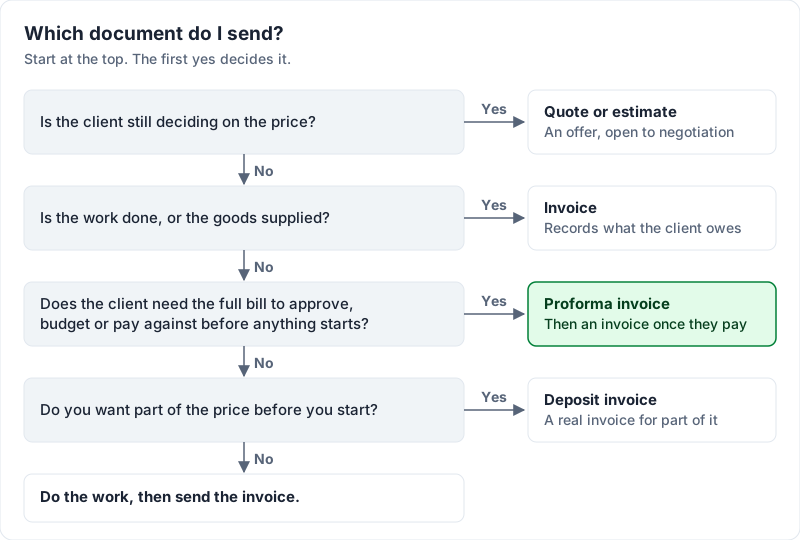
If you are not sure which one a situation calls for, four questions settle it, in this order:
Proforma invoice vs quote#
A quote is an offer: here is what it would cost. A proforma comes after the client has agreed in principle and confirms the bill in its final shape: the exact lines, quantities, totals, taxes and payment terms. The International Trade Administration says a pro forma should carry much of the same information as a formal quotation, with as much detail about the order as possible.
In practice, if the client is still deciding, send a quote. If they have decided and need a document to approve, budget or pay against, send a proforma. How a quote, an estimate and an invoice differ, and when each one is used, is covered in invoice vs estimate vs quote.
Proforma invoice vs invoice#
This is the difference most people are searching for. An invoice records a sale or completed work and asks to be paid for it. It goes in both sides’ accounts and, if you are registered for VAT or GST, it is usually the document your client looks for to reclaim tax. A proforma does none of those things. It previews the invoice.
The practical test: if the client could reasonably file your document as a bill they owe, it should be an invoice. If it is a preview for them to approve or pay against, it is a proforma, and it should say so clearly. What actually belongs on an invoice has the full field list for the real thing.
Proforma invoice vs deposit invoice#
This is the comparison that matters most for freelancers. Both can come before the work. The difference is what happens to the money.
- A proforma asks the client to approve or pay against a preview. If they pay, you still owe them an invoice.
- A deposit invoice is a real invoice for part of the price. It has an invoice number, a due date and a place in your books from day one.
If what you want is part of the money now, a deposit invoice does the job in one step. Deposit invoices: how they actually work shows the deposit and balance invoices line by line. A proforma earns its place when the client needs to see and approve the whole bill before anything is paid, or their system insists on one.
Proforma vs commercial invoice#
A commercial invoice is the actual sale invoice for goods shipped internationally. The International Trade Administration calls it “a required document for the export and import clearance process” and notes that in the buyer’s country it is the document customs officials use “to assess import duties and taxes”. A proforma comes before it, while the sale is still being arranged.
If you sell services only, you will probably never need a commercial invoice. If a courier or customs form asks for one, it means the real invoice for the goods in the box. For what customs needs on it and a filled example, see the commercial invoice guide. For every other kind of invoice and when each is sent, see the types of invoices.
Is a proforma invoice a tax invoice?#
Each tax authority answers this for itself. Here is what HMRC’s VAT manual says for the UK, quoted as read on 28 October 2026.
HMRC says to label it clearly. Its VAT manual (VATREC9010, updated 16 January 2025) says pro-forma invoices “should always be clearly described as such” and recommends the words “This is not a VAT invoice”.
HMRC does not accept it as evidence for a VAT reclaim. The next page of the manual (VATREC9020, updated 16 January 2025) says: “Pro-forma or similar invoices are not, therefore, acceptable evidence.” On what happens once the issuer of a pro forma receives payment or makes the supply, it says “a full VAT invoice must be issued within 30 days.”
Elsewhere, check the rules on advance payments. In some tax systems, a payment received before the work or the goods can itself create a tax point or call for an invoice. If you are registered for VAT or GST and a client pays against a proforma, check your tax authority’s guidance on advance payments, or ask an accountant, before you treat the proforma as the end of it.
If you are not registered for VAT, GST or sales tax, leave tax off the proforma, just as you would on the invoice. What a tax invoice is explains what changes once you are registered.
In the US, sales tax is set by each state, and when a payment counts as income depends on your accounting method. IRS Publication 538 covers accounting methods; your accountant can tell you how a payment against a proforma should be recorded.
What to put on a proforma invoice#
Use the same layout as your invoice, so the client sees exactly what the final document will look like, with these differences:
- The title “Proforma invoice” at the top, where “Invoice” would normally go. Not small print.
- A clear status line. For example: “This is a proforma invoice, not a VAT invoice. An invoice will be issued when payment is received.” Adjust to your situation.
- A proforma number from its own series, such as PF-0007. Not the next invoice number.
- Your business details and the client’s, with the client’s legal entity name. Their finance team will check it.
- The issue date and a “valid until” date. Prices and availability hold until then. There is no standard length; pick one you can honour.
- Line items exactly as they will appear on the invoice: description, quantity, rate and amount.
- Subtotal, any discount, any tax and the total, with the tax rate stated if you charge tax.
- Payment terms: what is payable now (all, a deposit, or nothing yet), by when, and what happens after payment.
- How to pay, if you are asking for money upfront: bank details or a payment link, plus the proforma number as the reference.
- The client’s purchase order number, if they have given you one.
- For goods going abroad, add what the International Trade Administration lists: weights and dimensions, the sale terms or Incoterm, the delivery point and an estimated shipping date.
Two things to leave off: a due date that reads like a bill (“Payment due 30 days from invoice date”) if nothing is owed yet, and the word “Invoice” on its own.
A worked example#
The figures below are invented for illustration. The tax rate of 10% is an example, not the rate anywhere in particular; use your own, or no tax line if you are not registered.
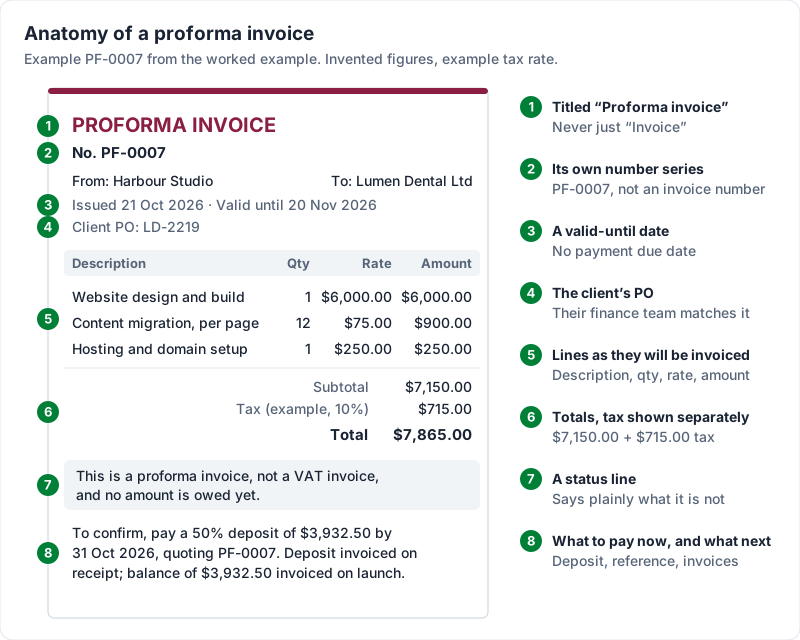
Harbour Studio, a two-person web design business, has agreed a new website with Lumen Dental Ltd. Lumen’s finance team cannot pay without an approved document, and Harbour Studio wants half upfront from a new client. Harbour sends this:
PROFORMA INVOICE PF-0007 — Harbour Studio to Lumen Dental Ltd. Issued 21 October 2026, valid until 20 November 2026. Client PO: LD-2219.
| Description | Qty | Rate | Amount |
|---|---|---|---|
| Website design and build — 8 page templates, two revision rounds | 1 | $6,000.00 | $6,000.00 |
| Content migration from the current site, per page | 12 | $75.00 | $900.00 |
| Hosting and domain setup | 1 | $250.00 | $250.00 |
| Subtotal | $7,150.00 | ||
| Tax (example rate, 10%) | $715.00 | ||
| Total | $7,865.00 |
Under the table, the terms read:
This is a proforma invoice, not a VAT invoice, and no amount is owed yet. To confirm the project, please pay a 50% deposit of $3,932.50 by 31 October 2026, quoting PF-0007. We will issue an invoice for the deposit when it is received. The balance of $3,932.50 will be invoiced on launch. Prices are valid until 20 November 2026.
That paragraph is our own sample wording, so adapt it freely. Notice what it does: says what the document is, what to pay, how to reference it, and what the client will receive next.
Here is the same proforma with each part labelled:
Turning a proforma into the final invoice#
The proforma never changes into the invoice. You issue a new invoice, with a new number from your normal invoice sequence, and the proforma is closed. In the example, Lumen pays the deposit on 28 October 2026. Harbour then sends two invoices.
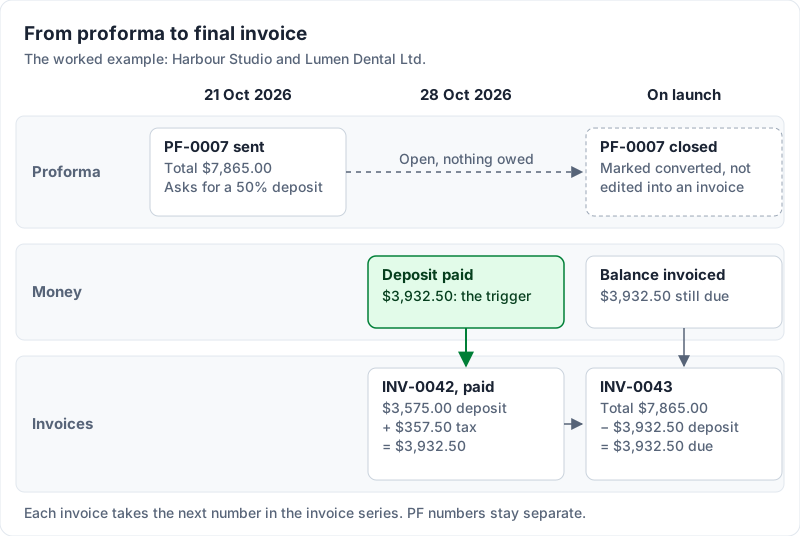
Invoice INV-0042, issued 28 October 2026, marked paid:
| Description | Qty | Rate | Amount |
|---|---|---|---|
| Website project for Lumen Dental Ltd — 50% deposit (ref. PF-0007, PO LD-2219) | 1 | $3,575.00 | $3,575.00 |
| Tax (example rate, 10%) | $357.50 | ||
| Total paid 28 October 2026 | $3,932.50 |
The deposit line is net of tax, so the tax is shown on the deposit too. If your tax rules treat an advance payment as taxable when it is received, this is the invoice that shows it; check with your tax authority or accountant.
Invoice INV-0043, issued on launch:
| Description | Qty | Rate | Amount |
|---|---|---|---|
| Website design and build — 8 page templates, two revision rounds | 1 | $6,000.00 | $6,000.00 |
| Content migration from the current site, per page | 12 | $75.00 | $900.00 |
| Hosting and domain setup | 1 | $250.00 | $250.00 |
| Subtotal | $7,150.00 | ||
| Tax (example rate, 10%) | $715.00 | ||
| Total | $7,865.00 | ||
| Deposit received (INV-0042, paid 28 October 2026) | −$3,932.50 | ||
| Balance due | $3,932.50 |
How the balance invoice handles tax on a deposit already invoiced differs by country and by accounting method. Some systems show only the remaining net and tax on the balance invoice. If you are registered, check the method your tax authority expects, or ask an accountant once and reuse the answer.
Put the proforma next to the balance invoice and the differences are easy to see:
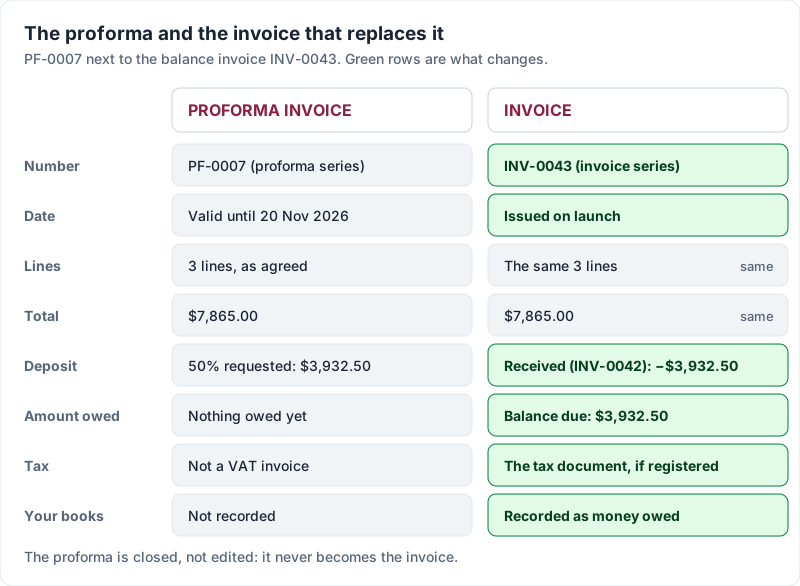
If the client pays the full amount upfront instead, it is simpler: one invoice for the whole job, issued when the payment arrives, marked paid, referencing the proforma.
The conversion checklist#
- Wait for the trigger: the payment arrives, or the work or goods are delivered.
- Issue a new invoice with the next number in your invoice sequence. Do not reuse the proforma number.
- Copy the lines and prices from the proforma, then fix anything that changed. If the scope moved, the invoice shows what was actually supplied.
- Reference the proforma (and the client’s PO) on the invoice, so their finance team can match the two.
- Show any payment already received as its own line, with the date, so the balance is obvious.
- Check your invoicing deadline if you are registered for VAT or GST. For the UK, see the HMRC manual quoted above.
- Close the proforma in your records: mark it converted or superseded, and note which invoice replaced it.
For the numbering side, invoice numbers: formats, gaps and examples explains why proformas should stay out of your invoice sequence: a proforma that is never paid would otherwise leave a gap.
The step people skip is the last invoice. One person in a small business discussion described being on the receiving end of a deal where it never came:
I paid for a $5,000 product and put half down. The item was delivered to me and since it was a mobility scooter I was unfamiliar with, the rep and I spent a lot of time together. He never gave me an invoice, and I promptly forgot about it.
They went on to describe being asked about the money two years later. A proforma and a deposit do not replace the invoice that follows. Put the final invoice in your calendar the day the proforma goes out.
Proformas for customs and shipping#
If you ship physical goods abroad, you may meet “proforma” in a second sense: a document declaring the value of goods for customs when there is no commercial invoice, such as samples, gifts or replacements sent at no charge.
What that document has to show is set by the destination country. For goods entering the US, CBP’s import and export pages are the place to start; elsewhere, look up the destination’s customs authority. Carriers often supply their own forms. Follow the carrier’s instructions and the destination country’s rules, and keep a customs proforma separate from your invoicing: it declares a value, it does not bill your client.
Proforma invoice template#
There is no single official proforma layout. Any invoice template becomes one once it carries the changes listed under what to put on a proforma: the title, its own number, a valid-until date and a status line.
We do not publish a proforma template. What we do publish are free, blank invoice templates on the free templates page, with no sign-up: Excel files (invoice-template.xlsx and hourly-invoice-template.xlsx), whose totals are formulas, and Word files (invoice-template.docx and service-invoice-template.docx), where you type the totals. Each one is headed “INVOICE”, so it needs five edits to work as a proforma:
- Retitle it. The heading is ordinary text in each of these files, and none of them is locked or password-protected, so type “PROFORMA INVOICE” over “INVOICE”. Check it still fits on one line.
- Renumber it. Change the “Invoice number” label to “Proforma number” and replace INV-0001 with a number from your PF series.
- Swap the due date for a valid-until date. In the Word files, retype the “Due date” label and the date. In the Excel files the due date is a formula (invoice date plus payment terms in days), so relabel it “Valid until” and set the terms to how many days your prices hold, such as 30.
- Add the status line to the notes box. The wording under the worked example above is a starting point.
- Leave “Amount paid” blank (“Less deposit paid” in the service file). It is for money already received. If you want a deposit, put the amount and the deadline in the notes, as PF-0007 does.
Save the edited file as a proforma master, separate from your invoice master, so the two number series never mix. Every file also ends with a small “Made with a free Charming Invoices template · charminginvoices.com · Free to use and share, not for resale.” line, which you can delete. For how each file works, see the Excel invoice template guide and the Word invoice template guide; to use one in Google Drive, see the invoice template for Google Docs and Sheets.
Proforma invoice meaning and common questions#
What does proforma invoice mean?#
A proforma invoice is an advance version of an invoice: the goods or services, prices, total and terms, sent before the sale or the work is final so the buyer can approve it or pay against it. “Pro forma” comes from Latin and is usually translated as “as a matter of form”. The document has the form of an invoice without being the final bill.
What is the definition of a pro forma invoice?#
In one line: a preliminary bill of sale, in invoice format, that sets out what the buyer will be asked to pay and on what terms. The International Trade Administration’s own phrasing is “a quote in an invoice format”. Proforma, pro forma and pro-forma are the same document.
What’s a pro forma invoice used for?#
Mostly for four things: getting a purchase approved inside the client’s company, asking for payment before you start, showing the full price when you want a deposit, and, for goods sold abroad, letting the buyer arrange an import licence, a letter of credit or a currency transfer. Each is covered under when freelancers and small businesses use one, above.
Can a client pay a proforma invoice?#
Yes, and that is often the point: pay first, then receive the invoice. What the payment does not do is turn the proforma into an invoice. You still issue one.
Is a proforma invoice legally binding?#
That is a legal question, and the answer depends on what you agreed and where, so ask a lawyer if it matters. In business terms, a proforma sets out the terms you expect to trade on. Do not rely on it as your contract; if the terms matter, put them in a written agreement.
Does a proforma invoice need a number?#
In practice, give it one, from a separate series. Clients quote it when they pay, and it links the proforma to the invoice that follows.
What if the price changes after the proforma?#
Send a revised proforma with a new number (PF-0008) and say it replaces the earlier one, or invoice the actual amount and explain the difference on the invoice. Do not edit a proforma the client has already approved.
What Charming does and does not do here#
Charming Invoices has no proforma, quote or estimate document. Every invoice you issue from it takes the next number in that business’s invoice sequence, so it is the wrong tool for a proforma: an unpaid “proforma” issued that way would sit in your invoice records as a real invoice. If a client needs a proforma, make it separately with its own PF numbering, for example from one of the downloads above.
Two features look like a way round this, and neither is one:
- Renaming the title. The Labels tab of the Template Studio, in Charming’s business settings, can rename the document title from “Invoice” to anything you type. But the setting belongs to the business, so it renames every invoice that business issues, and each one still takes the next invoice number.
- A draft’s PDF. You can preview a draft that has not been issued as a PDF. It prints “DRAFT” where the number goes, still shows a due date, and is a preview of the invoice it will become, not a proforma.
If you need quotes or estimates as well as invoices, quote and invoice software compares tools that do both.
For the most common reason freelancers reach for a proforma, getting part of the money before the work starts, a deposit invoice is the practical alternative. How deposit invoices work walks through the deposit and balance invoices step by step.