Invoice vs estimate vs quote: what each one commits you to

Nnabuike Okoroafor ·
On this page · 10 sections
A client asks for “a quote”, another asks for “an estimate”, a third wants “a proposal by Friday”, and a council tender calls it a bid. Then the job ends, you send the invoice, and the client points at the number you gave them three weeks ago. Which of those documents tied you to a price, and which one is the bill?
This guide answers the invoice vs estimate question properly, and the quote vs invoice one with it. It covers what each of the five documents promises, who is bound by it in general terms (with sourced examples from the UK and the US), how to get from an accepted quote to an invoice without surprises, what to do when the final price will be higher than the estimate, and a worked example you can copy, line by line.
In short#
- An estimate is your best guess at the price. It can move, within reason, as the job reveals itself.
- A quote is a price you have committed to for a defined scope. In practice, clients expect the work for that price once they accept it.
- A bid is a quote submitted in competition, usually against a buyer’s specification and deadline.
- A proposal is a sales document that usually contains a quote or an estimate, plus scope, approach and terms.
- An invoice is the bill. It comes after the work (or at an agreed milestone) and asks for payment of an amount the client owes.
- The quote or estimate sets the expectation; the invoice should match it, or explain exactly why it does not. Put the quote reference on the invoice and list approved changes as separate lines.
General information, not legal advice. Whether a quote or estimate binds you depends on your country or state, on whether your client is a consumer or a business, and on what you and the client agreed. The official wording quoted below is an example, and rules change. For a large or disputed job, ask a lawyer or local adviser.
Estimate vs quote vs bid vs proposal vs invoice#
People use these words loosely, and plenty of businesses call every price “a quote”. The words matter less than what the document actually says. Still, each one has a usual meaning, and clients tend to read them that way.
The table below compares the five documents on the questions people actually argue about.
| Document | When it is sent | What it promises | Can the price change? | Asks for payment? |
|---|---|---|---|---|
| Estimate | Before the work, often early | A reasoned guess at the cost | Yes, within reason, ideally with notice | No |
| Quote (quotation) | Before the work, once scope is clear | A set price for a defined scope | In practice, only for changes the client agrees | No |
| Bid | Before the work, in a competition | A set price against the buyer’s specification | Usually no, once accepted | No |
| Proposal | Before the work, to win it | Scope, approach, timeline and a price (quote or estimate) | Depends on the price it contains | No |
| Invoice | After the work or at a milestone | The amount the client owes and when | Only by a correction or credit | Yes |
A few things the table hides:
- A “fixed estimate” is a quote in everything but name. Citizens Advice’s consumer guidance for England, quoted below, says a quote is “sometimes called a ‘quotation’ or 'fixed estimate'”.
- A proposal is not a separate price type. Look inside it: if it says “Total: $4,800.00, fixed”, it contains a quote; if it says “approximately $4,000 to $5,000”, it contains an estimate.
- A pro forma invoice sits between a quote and an invoice. It is a full bill the client can approve or pay against before anything is owed. Our guide to the proforma invoice and how it differs from a quote covers it in depth.
- Your client may send their own document back. A purchase order or a signed sales order is the buyer saying yes. See what to do with a PO number on an invoice and how a sales order differs from a sales invoice.
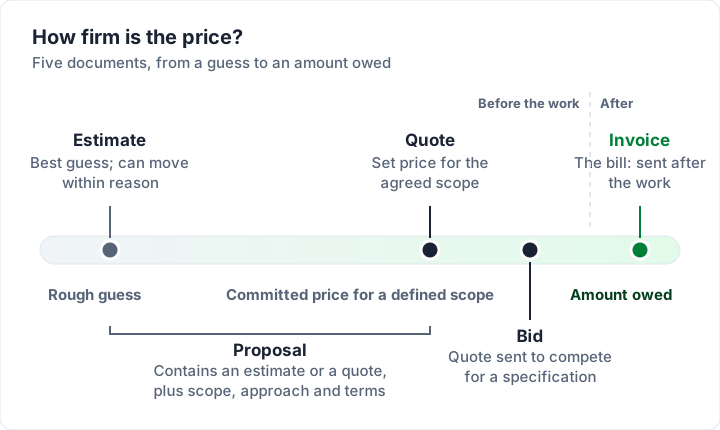
The picture below puts the five documents on one line: how firm the price is, from a guess to an amount owed.
What is the difference between a quote and an invoice?#
The short answer: a quote is an offer to do the work for a price, and an invoice is a request to be paid for work done. One looks forward, the other looks back.
In practice they differ on four things:
- Timing. The quote comes before the client decides. The invoice comes after the work, or at a milestone you agreed (a deposit, a stage, a monthly cycle).
- What it is for. A quote is what the client says yes to. An invoice asks for the amount owed under what was agreed. As a plain definition, the Legal Information Institute at Cornell says “An offer gives the offeree the ability to accept and form an enforceable contract.” Whether a particular quote works that way is a question for a lawyer where you are.
- What it asks. A quote asks “do you want this, at this price?”. An invoice asks for payment, by a date, to an account.
- What goes on it. A quote needs a validity period (“valid for 30 days”) and the scope. An invoice needs an invoice number, an issue date, a due date and payment details. Our checklist of what actually belongs on an invoice lists every field.
Does an invoice itself make a contract? We go into that question, and why it is one for a lawyer, in is an invoice a contract?.
Is an estimate or a quote legally binding?#
The honest answer is that it is a legal question, and the answer depends on where you work, who your client is and what you wrote. We will not answer it for you. Here is how two official sources word it for the public, quoted as of 23 October 2026:
Consumers in England. Citizens Advice, the UK consumer advice charity, in its guidance for England on problems with home improvements: “A quote (sometimes called a ‘quotation’ or 'fixed estimate') is a promise to do work at an agreed price. An estimate is the trader's best guess as to how much the work will cost.” On estimates it adds: “If you were given an estimate and the final bill is a lot more than what you were expecting, you can dispute it.” Scotland, Wales and Northern Ireland have their own pages.
California car repairs. The Superior Court of California, County of San Mateo, in its self-help page on automotive repair rights: “If the technician later determines that the work will cost more than estimated, the additional work may not be done without your consent”. That is a court's plain-language summary for the public; if you run a repair shop, check the details with California's Bureau of Automotive Repair or a lawyer.
Other trades and countries have their own rules, and some industries have specific ones. If you are unsure, ask before you quote.
What these have in common is more useful than any one rule:
- Words on the page count. Write “quote, fixed price” or “estimate, final price may vary” explicitly, so neither of you has to guess.
- Scope is what makes a price fixed. A quote is a price for something specific. Anything outside that scope is a change.
- Consent before the extra work, not after. Both sources above, and most client relationships, turn on whether the client agreed before you did more.
- Consumers and businesses can be treated differently. Check which rules apply to your clients, and put your terms in writing either way. Our guide to contract invoices covers billing under a signed agreement.
How to write a quote or estimate that invoices cleanly#
Most invoice disputes about price start with a vague quote. A good one makes the eventual invoice obvious. Include:
- A reference number (Q-0031) in its own series, separate from your invoice numbers. Our guide to numbering invoices explains why invoice numbers should not have gaps.
- The word “quote” or “estimate” in the title, and a line saying which it is: “Fixed price for the work described” or “Estimate: final cost depends on time and materials used”.
- Scope in plain words, including what is not included (“does not include plaster repair beyond 5 hours”).
- The same line items you will invoice, in the same order and wording.
- How estimated parts will be billed: a rate and an estimated quantity, such as “Plaster repair, estimated 5 hours at $60.00 an hour”.
- A change rule: “Extra work is quoted and approved in writing before it starts.”
- A validity date: “Valid until 4 November 2026.”
- Deposit and payment terms: how much up front, when the balance is due, and how to pay.
One commenter’s rule for revisions, from a public thread about a first freelance invoice that we read while researching invoicing (the people quoted here are not Charming customers), shows the same idea applied to creative work:
Include 3 rounds of revisions in your estimate, anything beyond that will be billed hourly on top of the original estimate. This is important as it forces the client to make smart decisions, and not just keep requesting infinite rounds of changes without really putting any thought into it.
From accepted quote to invoice without surprises#
Once the client says yes, the quote becomes your plan for invoicing. These steps keep the final invoice unsurprising:
- Get the acceptance in writing. A signature, a reply saying “approved”, or the client’s purchase order. Keep it with the quote.
- Send a deposit invoice if the quote asks for one. It is a real invoice for part of the price, with its own invoice number. Our guide to how deposit invoices work covers the wording and the maths.
- Log every change as it happens, with a reference (CO-1), a price and the client’s written approval.
- Warn the client the moment an estimated part will run over, before you do the extra work.
- Invoice in the quote’s structure: the quoted lines first, then estimated lines at actual quantities, then approved changes, then the deposit received.
- Put the quote reference on the invoice, so the client’s accounts team can match the two.
- Show the reconciliation in one sentence: “Quote Q-0031: $4,800.00. Approved changes: +$770.00.”
On longer jobs billed in stages, the same logic applies to each stage; progress invoicing explains how to show the contract value and what has been billed so far. For one trade’s version, the moving company invoice guide shows a local move billed by crew hours.
What to do when the final price exceeds the estimate#
It happens to everyone: walls hide damage, clients add rooms, a two-day job becomes four. What matters is when the client hears about it. One freelancer in a public thread described the end state many people want to avoid:
No, this was the final invoice, it ended up being about 20-30% over-budget as the client kept changing things I did inform him that the hours are adding up and that my initial time and budget estimates were going to be way off.
The order of operations below is what separates a normal change from a dispute.
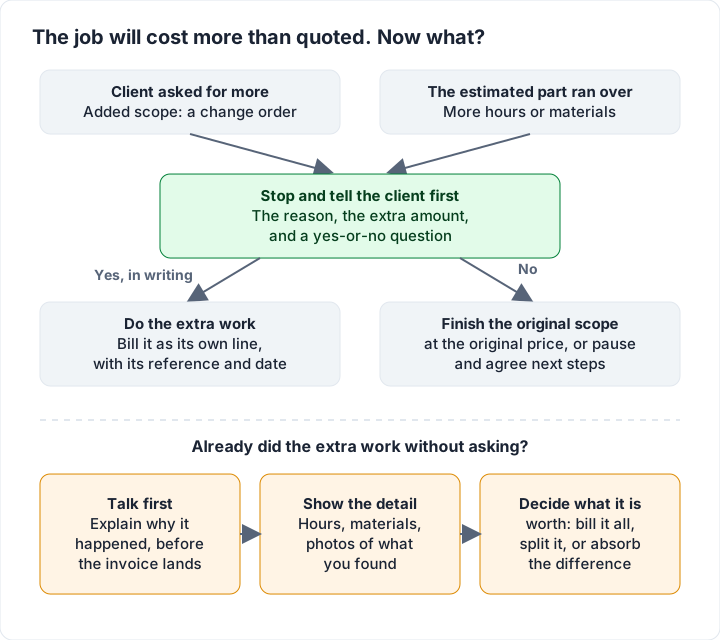
If you can still ask first, send a short message with the reason, the extra amount and a question. For example:
Hi Dana, the plaster behind the old shelving in the back bedroom is worse than it looked. The quote estimated 5 hours of repair at $60.00 an hour; it will be about 7, so roughly $120.00 more. Shall I go ahead? Reply yes and I will add it to the final invoice as its own line.
If the extra work is already done without approval, expect pushback, especially from consumers: Citizens Advice’s guidance for England, quoted above, tells them they can dispute a final bill that is a lot more than an estimate. Explain the reason calmly, show the hours or materials, and decide what the relationship is worth: billing the full amount, part of it, or absorbing it. If the client refuses, our guide to a disputed invoice walks through the next steps.
Never quietly fold a change into an existing line. A hallway that appears as “Walls and ceilings: $3,350.00” instead of the quoted $2,700.00 looks like overcharging, even when it is not.
A worked example: from quote Q-0031 to final invoice#
Here is one job from start to finish. The business, client and figures are invented for illustration, and tax is left out to keep the arithmetic easy to follow; add your own tax lines where they apply.
Ridgeline Painting quotes Dana Whitfield for an interior repaint of three rooms. Most of the job is a fixed price. One part, plaster repair, cannot be known until the old shelving comes down, so it is estimated at an hourly rate.
Quote Q-0031, sent 5 October 2026, valid until 4 November 2026:
| Line | Type | Amount |
|---|---|---|
| Preparation and minor filling, 3 rooms | Fixed | $700.00 |
| Walls and ceilings, 3 rooms, two coats | Fixed | $2,700.00 |
| Trim and doors | Fixed | $600.00 |
| Paint and materials | Fixed | $500.00 |
| Plaster repair, estimated 5 hours at $60.00 an hour | Estimate | $300.00 |
| Quote total | $4,800.00 | |
| Deposit due on acceptance, 25% | $1,200.00 |
The timeline shows what happened next, and when each document went out.
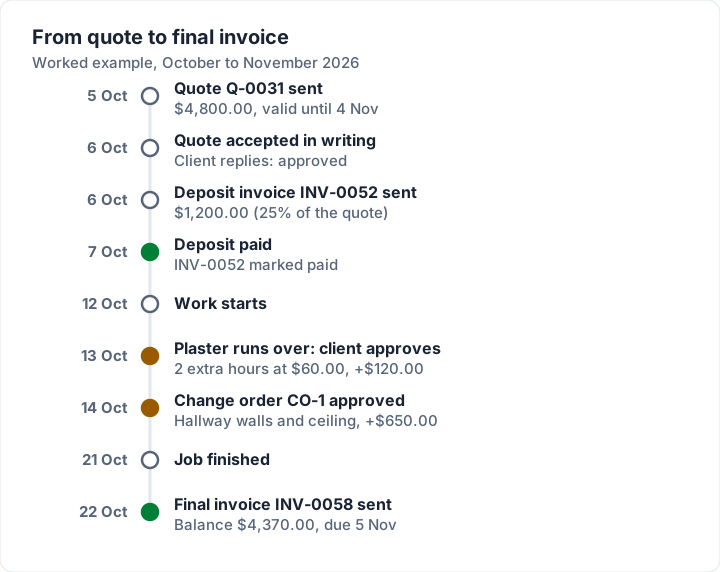
Two things changed the price, and both were approved before the work:
- The estimated part ran over: plaster repair took 7 hours, not 5. That is $420.00 instead of $300.00, so $120.00 more, approved by text on 13 October.
- The client added work: change order CO-1 added the hallway for $650.00, approved by email on 14 October.
Final invoice INV-0058, issued 22 October 2026, due 5 November 2026 (14 days):
| Description | Qty | Rate | Amount |
|---|---|---|---|
| As quoted (Q-0031) | |||
| Preparation and minor filling, 3 rooms | 1 | $700.00 | $700.00 |
| Walls and ceilings, 3 rooms, two coats | 1 | $2,700.00 | $2,700.00 |
| Trim and doors | 1 | $600.00 | $600.00 |
| Paint and materials | 1 | $500.00 | $500.00 |
| Plaster repair (estimated 5 hours; 7 used, 2 extra approved 13 Oct) | 7 hrs | $60.00 | $420.00 |
| Approved changes | |||
| CO-1: hallway walls and ceiling, approved 14 Oct | 1 | $650.00 | $650.00 |
| Invoice total | $5,570.00 | ||
| Deposit received (INV-0052, paid 7 Oct) | −$1,200.00 | ||
| Balance due | $4,370.00 |
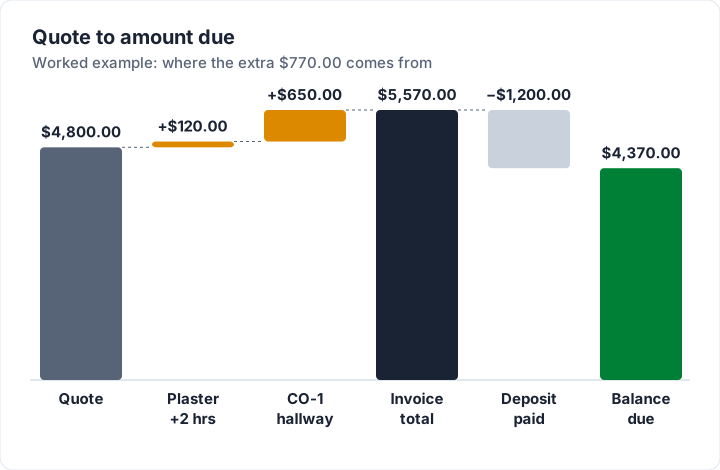
The final price is $770.00 above the quote, about 16% more. Here is where that difference comes from, and how the deposit brings the amount due down:
And this is how the parts of the final invoice do the explaining for you. Grouping the lines gives the “As quoted” section a subtotal of $4,920.00 (the quoted lines with the plaster at actual hours) and the “Approved changes” section $650.00, so the client can see both halves at a glance:
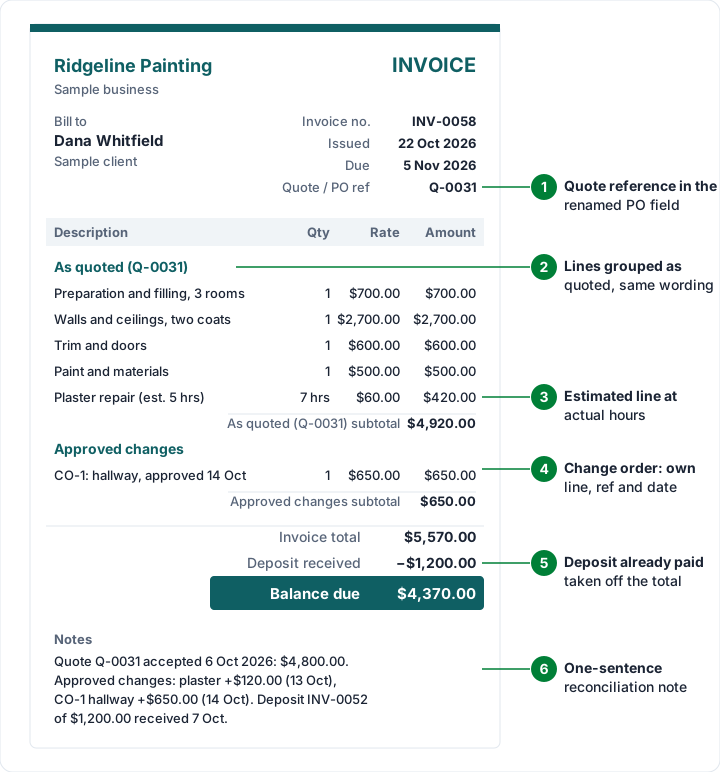
The note at the bottom of the invoice can say it in one sentence, which is often all an accounts team reads:
Quote Q-0031 accepted 6 October 2026: $4,800.00. Approved changes: plaster repair +$120.00 (13 Oct), CO-1 hallway +$650.00 (14 Oct). Deposit INV-0052 of $1,200.00 received 7 October. Balance due: $4,370.00.
If you want to see a full painting invoice with colour codes and preparation lines, our painting invoice sample shows one. To work out the due date for terms like these, use the invoice due date calculator.
Charming does not do estimates or quotes#
We want to be plain about this: the Charming Invoices app has no estimate or quote document. You cannot create, send or track a quote in Charming, convert one into an invoice, or ask a client to accept one. If quoting is central to how you win work, use a tool or a document template built for quotes, such as our free estimate template in Excel or Word (it has a scope of work, a valid-until date, an optional deposit and acceptance lines, and you can retitle it Quote), or a word processor with your own quote layout, and keep the accepted quote on file. Quote and invoice software compared lists nine tools that turn an accepted quote into an invoice, with what their free plans include. Our quote and invoice template walks through that estimate file filled in, and the matching invoice it becomes once the work is done.
What Charming does do is the invoicing side of everything above, on every plan including Free:
- A reference on the invoice. Each invoice has an optional PO number field that prints in the header beside the invoice number and dates. You can rename its label in your template, for example to “Quote / PO ref”, and type Q-0031 there. The catch: a renamed label applies to every invoice that business issues from then on (invoices already issued keep the label they went out with), and Charming does not link the invoice to a quote or check it against one.
- Sections that mirror the quote. Turn on “Group lines by section” in your template, then give lines a section label such as “As quoted” or “Approved changes”; consecutive lines with the same label print under one heading with their own subtotal. The catch: grouping is off by default and, like the label, it is a template setting for the whole business.
- The deposit taken off. Send the deposit as its own invoice, then on the final invoice add the deposit already received; it prints as a “Deposit received” line and the amount due becomes the balance. The catch: you type that figure yourself, and you mark the deposit invoice paid when the money arrives, because Charming does not take card payments or see your bank account.
- Notes and terms per invoice for the reconciliation sentence above and your change rule.
On the free plan, invoices carry a small “Sent with Charming Invoices” line at the bottom. If that sounds like the missing half of your quoting workflow, you can create a free invoice from your accepted quote.
Frequently asked questions#
Does a quote come before an invoice?#
Yes. The quote (or estimate) is sent before the work so the client can decide. The invoice is sent after the work, or at a milestone such as a deposit, once the client has agreed.
Can I turn an estimate into an invoice?#
You can reuse its lines, but issue a new document with an invoice number, an issue date, a due date and the actual quantities. Do not just retitle the estimate: the invoice should show what was actually done, including any approved changes.
Can a final invoice be higher than the quote?#
In practice, keep any increase to work the client agreed to on top of the quoted scope, or to a part the quote clearly marked as an estimate, and show each increase as its own line with its approval date. Whether you can charge more in a particular case is a question for a lawyer where you work.
What if the final cost is lower than the estimate?#
Invoice the actual amount. An estimate is a guess, not a minimum, and a client who is billed less than expected rarely objects.
Is a bid the same as a quote?#
Close. A bid is a quote submitted to compete for work, usually against the buyer’s own specification and deadline. Buyers compare bids on price, so treat yours as a firm price for the specification, and check the tender’s own rules on changing or withdrawing it.
How long should a quote be valid?#
There is no single rule. Pick a period that matches how quickly your material prices and your calendar change, such as 14 or 30 days, and print the expiry date on the quote so nobody accepts a stale price months later.
Every invoice that goes out cleanly is backed by a quote that said exactly what it covered. When the job is done and approved, create a free invoice that shows the quote reference, the approved changes and the deposit, and send it the same day.
Free downloads
No sign-up and no email address. More on the free templates page.
- Download .xlsx: Estimate or quote template for Excel
Estimate or quote template for Excel
Excel .xlsxPrice a job before you start: scope, line items, a valid-until date and an optional deposit.
- Download .docx: Estimate or quote template for Word
Estimate or quote template for Word
Word .docxThe estimate as a Word document: scope of work, prices, deposit and acceptance lines.