Sales order vs sales invoice: the paper trail of a sale

Nnabuike Okoroafor ·
On this page · 9 sections
A client has said yes, and now the paperwork starts to multiply. They want an order confirmation. Their accounts team sent a purchase order. A courier wants a delivery note. And somewhere in all of it you still have to get paid. If you are wondering whether a sales order and a sales invoice are the same thing, or whether you need both, the answer is short.
A sales order confirms what you will deliver. A sales invoice asks to be paid for what you delivered. The sales order comes first, it does not ask for money, and many small businesses never write one. The invoice comes later, it asks for a set amount by a due date, and nobody gets to skip it.
This post walks the whole paper trail of a sale, from quote to receipt, says what each document does for you and for your client, shows one real-looking order going through every step with numbers, and ends with a decision flow for whether you need a sales order at all. It is general information, not legal or tax advice; rules differ by country and state, and they change.
Sales order vs sales invoice: the short answer#
The two documents carry many of the same lines (items, quantities, prices, the client's name), which is why they get mixed up. What differs is the job each one does.
| Sales order | Sales invoice | |
|---|---|---|
| When | After the client agrees, before you deliver | When you deliver, or after |
| Who it is for | Mainly you (and the client, if you send it as a confirmation) | The client and their accounts team |
| What it says | “This is what we will supply, at this price, by this date” | “Pay this amount by this date” |
| Asks for payment? | No | Yes, with a due date and how to pay |
| In your books | Usually nothing is recorded | Recorded as a sale and money owed to you (on accrual accounting) |
| Can it change? | Yes, until you fulfil it | Correct it with a credit note or a void, not an edit |
| Do you need one? | Only for some kinds of work (see below) | Always, if you want to be paid on credit |
If you only remember one row, make it the fourth. (On the sixth: how to fix a sent invoice properly is covered in how to void or cancel an invoice and credit note vs invoice.) A sales order never asks for money. If you need money before you start, that is a deposit invoice or a proforma invoice, covered further down.
The paper trail of a sale, from quote to receipt#
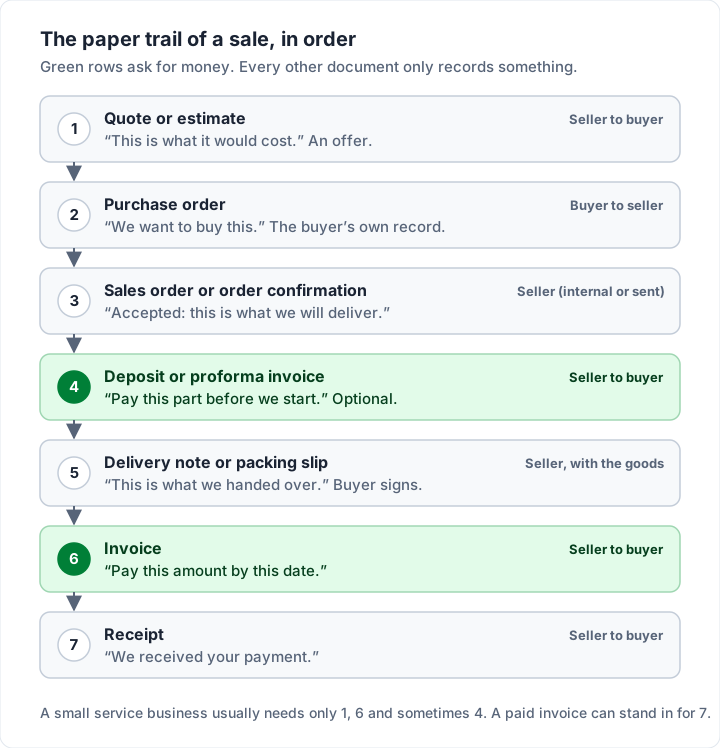
A full sale between two businesses can produce seven documents. Most small businesses use three of them. Here is the full set, in the order they usually appear:
- Quote or estimate (you send it). An offer: what the work or goods would cost, usually with an expiry date. The client can say yes, no or “can you do it for less”.
- Purchase order (the client sends it). The buyer's own record that they approved the spend. Some larger clients will not pay an invoice without one.
- Sales order or order confirmation (you write it). Your record that the deal is on: what you will deliver, when, at what price, on what payment terms. Sent to the client, it is usually called an order confirmation or order acknowledgement.
- Deposit or proforma invoice (you send it, optional). A request for part or all of the money before you start or ship.
- Delivery note or packing slip (it travels with the goods). Lists what was handed over, usually without prices. The client signs it, or checks the box against it. Goods shipped abroad also travel with a commercial invoice for customs.
- Invoice (you send it). The request for payment: amount, due date, how to pay.
- Receipt (you send it, if asked). Proof the money arrived.
Someone in a public freelancing discussion put the point of all this neatly. The people we quote here are strangers in public online forums, not Charming customers:
Invoices are just paper trails; a formal document to outline payment details and expectations between two parties.
The same is true of every document in the list. Each one is a record that a particular thing happened. You only need the records that something in your business actually depends on.
What each document does for the seller and for the buyer#
The same piece of paper does a different job on each side of the sale. This table is the part most guides leave out.
| Document | Issued by | What it does for you (seller) | What it does for the buyer | Asks for money? |
|---|---|---|---|---|
| Quote | Seller | Sets your price before you commit | Lets them compare and get approval | No |
| Purchase order | Buyer | Gives you the reference their accounts team will look for | Records that the spend was approved | No |
| Sales order | Seller | Reserves stock, books production, sets the delivery date | Confirms you accepted the order as they placed it | No |
| Deposit or proforma invoice | Seller | Gets money in before you spend on materials | Lets them pay up front, or clear customs or funding | Yes |
| Delivery note | Seller | Proves what you handed over and when | Lets them check the delivery before they pay | No |
| Invoice | Seller | Asks for payment, with a due date | Tells them what to pay, by when and how | Yes |
| Receipt | Seller | Closes the sale | Proves they paid | No |
Quote vs sales order#
A quote is an offer; a sales order is the offer accepted. The quote can expire, be renegotiated or go unanswered. Once the client says yes, the agreed version becomes the sales order, often with the same lines and a new number. The fuller comparison of quotes, estimates and invoices is in invoice vs estimate or quote.
Purchase order vs invoice#
This is the pair people mix up most, so here is the difference between a purchase order and an invoice in one line each. The purchase order is the buyer saying “we will pay for this”. The invoice is you saying “now pay for it”. They come from opposite sides of the sale.
Many accounts teams check one against the other before paying. A university procurement page describes a “three-way match” for goods (the receiving report, the purchase order and the invoice) and a two-way match for services, “when there is no receiving report” (The Rockefeller University). That is why a missing PO number can hold up your payment. How to put one on your invoice is covered in the PO number guide.
A sales order and a purchase order often hold the same lines. They are mirror images: the buyer's purchase order says what they want to buy, and your sales order says what you agreed to sell.
Order confirmation vs invoice#
An order confirmation is a sales order you send to the client. It can matter more than it looks. Whether an order plus your confirmation forms a contract, and whether terms you add in the confirmation become part of it, are legal questions that depend on where you are and what you sell, so ask a lawyer if the deal is large.
The practical point: if your confirmation adds terms the client did not ask for (a deposit, a delivery charge, a cancellation fee), say so plainly, and do not wait for the invoice to mention them. Whether the invoice itself binds anyone is a separate question, answered in is an invoice a contract.
Delivery note (or packing slip) vs invoice#
A delivery note says what arrived. An invoice says what is owed. The delivery note usually has no prices, so a warehouse can check the boxes without seeing the deal. It is still a useful record: accounts teams that run a three-way match, as described above, check the receiving or delivery record against the purchase order and the invoice before they pay.
A packing slip and a delivery note do the same job; the name depends on the industry and the country. Neither replaces the invoice, and an invoice does not need to repeat every carton on the slip. For services there is usually no delivery note at all: the finished work, the sign-off email or a timesheet does that job.
Sales order and proforma invoice: not the same thing#
Both arrive before delivery, so they get mixed up. A sales order confirms the deal and asks for nothing. A proforma invoice looks like an invoice and shows what the client will be asked to pay, often so they can pay in advance or arrange funding. In the UK, HMRC says that where pro-forma invoices are used to offer goods or services, they “cannot be used as evidence to reclaim input tax, even if they show all the details required for a VAT invoice” (HMRC, VAT Notice 700, section 17.3, read 23 October 2026). More on when to use one in the proforma invoice guide.
A worked example: one order, seven documents#
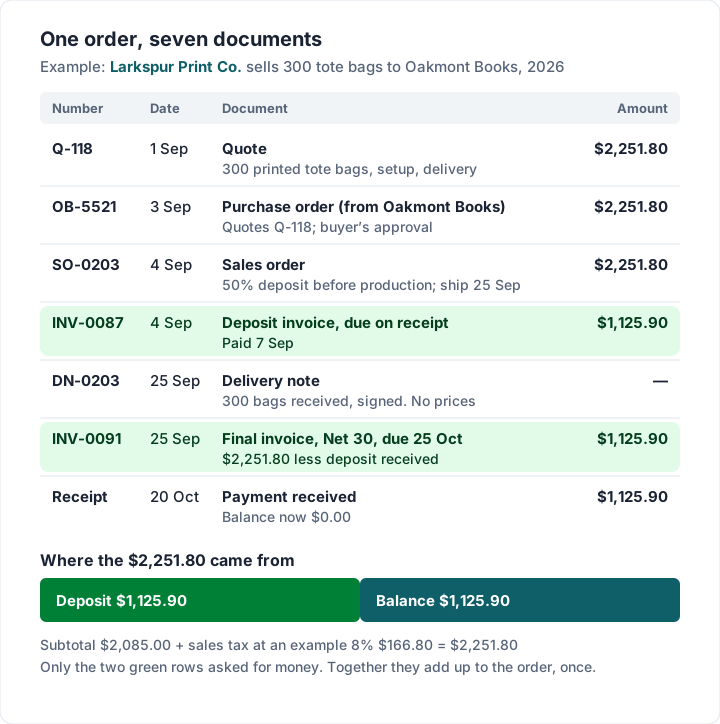
Here is one order going through every step. Larkspur Print Co., a small screen-printing studio, sells 300 printed tote bags to a bookshop, Oakmont Books. The businesses, numbers and dates are made up for this example, and the 8% sales tax rate is an example rate only.
The order, as quoted:
| Description | Qty | Rate | Amount |
|---|---|---|---|
| Tote bag, natural cotton, 2-colour print, artwork as approved | 300 | $6.40 | $1,920.00 |
| Screen setup, 2 colours | 1 | $120.00 | $120.00 |
| Delivery to 22 Mill Lane | 1 | $45.00 | $45.00 |
| Subtotal | $2,085.00 | ||
| Sales tax (example rate 8.00%) | $166.80 | ||
| Total (USD) | $2,251.80 |
What happened next, document by document:
| Date (2026) | Document | Number | What it says | Amount |
|---|---|---|---|---|
| 1 Sep | Quote | Q-118 | The table above, valid 30 days | $2,251.80 |
| 3 Sep | Purchase order (from Oakmont) | OB-5521 | Approves Q-118 | $2,251.80 |
| 4 Sep | Sales order, sent as a confirmation | SO-0203 | 50% deposit before printing, delivery 25 Sep | $2,251.80 |
| 4 Sep | Deposit invoice, due on receipt | INV-0087 | 50% deposit on SO-0203, quoting PO OB-5521; paid 7 Sep | $1,125.90 |
| 25 Sep | Delivery note | DN-0203 | 300 bags, signed for. No prices | none |
| 25 Sep | Final invoice, Net 30 | INV-0091 | $2,251.80 less deposit received $1,125.90 | $1,125.90 |
| 20 Oct | Receipt | for INV-0091 | Paid in full, balance $0.00 | $1,125.90 |
Look at the amount column. The full order value appears three times before a single bag is printed, and none of those three asks for a cent. Only the two invoices do, and together they add up to the order exactly once: $1,125.90 + $1,125.90 = $2,251.80.
Three details in the example are worth copying:
- The final invoice shows the deposit as a credit, not as a fresh line of work. The client sees the full order, what they already paid and what is left. That is how deposit invoices are meant to close.
- Both invoices quote the client's PO number, so the accounts team can match them without writing back.
- The tax on a deposit can have its own timing. For UK VAT, for example, HMRC’s VAT guide says: “Most deposits serve primarily as advance payments and will create tax points under paragraph 14.2.2(a) when you receive them” (VAT Notice 700, section 14.2.3, read 23 October 2026). Other places, including US states, have their own rules, so check yours or ask an accountant before you copy the split above.
If the bookshop had paid on the day of delivery, the final invoice could have been due upon receipt instead of Net 30. And the receipt could simply have been the final invoice marked paid; the difference is explained in invoice vs receipt.
Which documents a small service business can skip#
Most of the paper trail was built for goods: things that sit in a warehouse, ship in boxes and get counted at the loading dock. If you sell your time or skill, most of it does not apply.
| Document | Selling goods | Selling a service | Why |
|---|---|---|---|
| Quote or estimate | Usually | Usually | Agrees the price before you start |
| Purchase order | Only if the client issues one | Only if the client issues one | It is the client's document, not yours |
| Sales order | Often | Rarely | A signed quote, proposal or contract does the same job |
| Deposit invoice | When you buy materials up front | When the job is large or the client is new | Shares the risk of starting |
| Delivery note | Yes | No | The finished work or sign-off is the proof |
| Invoice | Always | Always | Nothing else asks for payment |
| Receipt | If asked | If asked | A paid invoice usually does the job |
For a designer, a tutor, a cleaner or a consultant, the working set is a quote, an invoice and sometimes a deposit invoice. A quote that sets out your terms does the work of a sales order. As one person in a public design discussion advised:
Create a quote/invoice form that lays out your terms (payment, scope of work, etc).
If your invoice is for services rather than goods, the difference in wording and tax is covered in sales invoice vs service invoice.
When a sales order earns its place#
A sales order is not bureaucracy for its own sake. It is worth writing when something in your business needs a firm record of what was promised before the invoice exists:
- You hold stock. The order reserves those items so you do not sell the same last 40 units twice.
- You make or order in to fit the order. Printing, custom furniture, catering, bulk ordering from a supplier: once you have spent on materials, you want the agreed quantity and spec on paper.
- You take a deposit. The sales order (or the accepted quote) is what the deposit is a deposit on. Without it, the deposit invoice points at nothing.
- Lead times are long. A job that ships in six weeks needs a record of the agreed date and price that both sides can look at in week five.
- Delivery comes in parts. If 200 bags ship now and 100 next month, the sales order tracks what is still owed to the client, and each delivery can have its own invoice. For work billed in stages against a contract total, see progress invoicing.
- More than one person handles the order. Whoever packs the boxes, books the courier or does the printing works from the sales order, not from an email thread.
- The client sent a purchase order. Many buyers expect it acknowledged. A short reply confirming the PO number, quantities, price and delivery date is an order confirmation, even if you never call it one.
Do you need a sales order? A decision flow#
Answer all four questions. Each “yes” adds one document or step. Four “no” answers mean you can skip the sales order entirely.
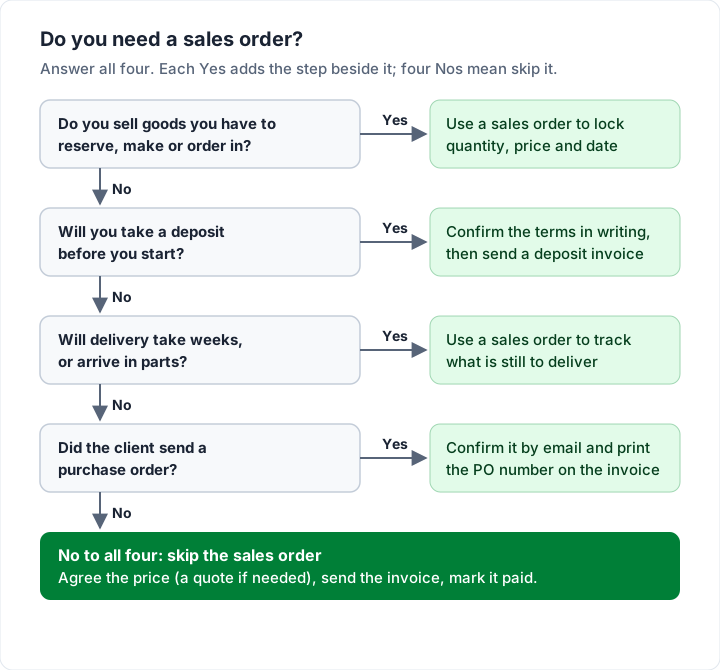
The same flow, in words:
- Goods you must reserve, make or order in? Write a sales order with quantity, spec, price and delivery date.
- Deposit before you start? Put the terms in writing (accepted quote, contract or order confirmation), then send a deposit invoice.
- Long lead time or split deliveries? Keep a sales order so you can see what is still to deliver and bill.
- Client sent a PO? Confirm it by email, and put the PO number on every invoice for that order.
- None of the above? Agree the price, do the work, send the invoice.
What Charming covers, and what to use for the rest#
Charming Invoices does steps 4, 6 and part of 7 of the paper trail. It does not do quotes, estimates, sales orders, delivery notes or stock. If you need those, a word-processor or spreadsheet document works well for a small business (a quote and an order confirmation are mostly a well-laid-out list and your terms), and a business that ships a lot of stock will want order or inventory software built for it.
What it does do, on every plan, including Free:
- The invoice itself, with your logo, colours and fonts, numbered automatically per business when you issue it, with a PDF and a private link you send however you like. If you number by hand elsewhere, the invoice number generator helps you pick a scheme.
- An optional PO number field that prints in the invoice header beside the invoice number, only when you fill it in.
- Deposits. On the balance invoice you choose “Add a deposit received” and type the amount; it prints as a “Deposit received” line taken off the total, exactly like INV-0091 above. You can also issue the deposit invoice itself as an ordinary invoice.
- Payment tracking and client statements. You record payments and mark invoices paid, and you can download a client statement PDF listing their open invoices with ageing. How a statement differs from an invoice is covered in invoice vs statement.
The catches, plainly. Charming does not link the deposit figure to the deposit invoice you sent earlier: you type it in. It does not email invoices or take card payments, and payment tracking is manual, because Charming never sees your bank account. It does not issue a separate receipt document; a paid invoice shows as paid on its private link and PDF, and you send it yourself if the client wants proof. It has one tax rate per invoice. The free plan covers 1 business, and its invoices carry a small “Sent with Charming Invoices” line in the footer.
If the invoice is the part of the paper trail you need to get right, you can create a free invoice, download the PDF and send it your way today.
Frequently asked questions#
Is a sales order legally binding?#
That is a legal question, and the answer depends on how the deal was made and where, so ask a lawyer if it matters. In business terms, a sales order the client never sees is your own internal record. If the amount matters, write the key terms down and get the client's yes in writing.
Is a sales order the same as a purchase order?#
No. The buyer writes the purchase order; the seller writes the sales order. They often list the same items, which is why they get mixed up.
Can you send an invoice before delivery?#
Yes. Deposit invoices, proforma invoices and invoices due before work starts are all normal, as long as the client agreed to pay that way. Just say clearly what the invoice is for, and credit the deposit on the final invoice.
Is a packing slip an invoice?#
No. A packing slip lists what is in the box and usually has no prices or due date. It helps the client check the delivery; the invoice is what they pay.
Does a sales order go in the accounts?#
Usually not on its own. A sales order is a promise, not a sale, so small-business bookkeeping normally records the sale at the invoice or the delivery, depending on your accounting method. A deposit you receive is still money in, and how to record it depends on your accounting method, so ask your accountant once.