Progress invoicing, with a worked example

Nnabuike Okoroafor ·
On this page · 7 sections
A kitchen renovation, a shop fit-out, a build that runs for months: you do not want to wait until the last day to be paid for all of it, and few clients want to pay for all of it on the first. Progress invoicing is the middle path. You bill the job in parts as the work gets done, and each invoice shows what the contract is worth, what you have billed before, what you are billing now and what is left.
It is mostly arithmetic. The disputes start when the arithmetic is invisible. This guide explains how progress billing works, walks one example job through three invoices with every figure on the page, explains retainage in plain language, and lists the mistakes that most often turn a routine progress payment invoice into an argument.
General information, not legal or tax advice. Payment stages and retainage are set by your contract, and in some places by law, so check your own contract and ask a construction lawyer before relying on any figure here.
What progress invoicing is#
Progress invoicing (also called progress billing, or a progressive invoice) means billing a fixed-price job in stages against an agreed contract total, instead of sending one invoice at the end. Each invoice bills the work completed since the last one. Together, the invoices add up to the contract.
It suits work that runs for weeks or months and ties up real money in labour and materials: construction and the trades first, but also larger creative projects, such as a video shoot billed at pre-production, production and post-production. Our guide to the types of invoices shows how progress invoices compare with deposit, final and other invoices. Designers and architects often bill a project in phases too; the interior design invoice template shows how that looks on the invoice.
The quote later in this post comes from a public online discussion we collected while researching invoicing. The person quoted is not a Charming customer.
Progress invoicing is not the same as a deposit. A deposit is money paid before the work starts and credited against an invoice later; a progress invoice bills work that is already done. Plenty of jobs use both, and a photographer's guide to invoicing covers deposits that hold a date.
Three ways to decide what each invoice bills#
Billing by milestones. The contract names events and the amount due at each one: “25% on completion of demolition and framing, 35% at rough-in inspection, 40% at handover.” It is easy to read. The risk sits in the wording of the milestone: “when framing is done” invites a debate, while “on passing the framing inspection” does not. Some invoicing tools build this in; the Square invoice guide, for example, explains its milestone payment schedules, which sit on the paid Plus plan.
Percentage complete. You estimate how far through the job you are, bill that share of the contract, and subtract what you billed before. A percentage complete invoice at 60% on a $48,000.00 job brings the total billed to date to $28,800.00. It is flexible, but the percentage is a judgement, so be ready to show what it rests on.
A schedule of values. The contract total is split into lines of work, each with its own value, and each invoice reports progress line by line. It is the most detailed of the three and the hardest to argue with, because the client can walk the site and check each line against what they see. On contracts that call for AIA forms, this breakdown goes on the G703 continuation sheet; how AIA G702 and G703 pay applications work explains the forms.
Which progress invoicing method applies is a contract question, not an invoicing one. Agree it in writing before the work starts, along with the payment terms for each stage.
An example schedule of values#
The rest of this post follows one invented job: a renovation with a contract total of $48,000.00, 10% retainage, and no tax, to keep the arithmetic visible. Every figure here is illustrative.
| Line of work | Scheduled value |
|---|---|
| Demolition and site preparation | $4,000.00 |
| Framing | $12,000.00 |
| Electrical and plumbing rough-in | $10,000.00 |
| Drywall and finishes | $14,000.00 |
| Fixtures and final clean | $8,000.00 |
| Contract total | $48,000.00 |
Progress invoicing across three invoices#
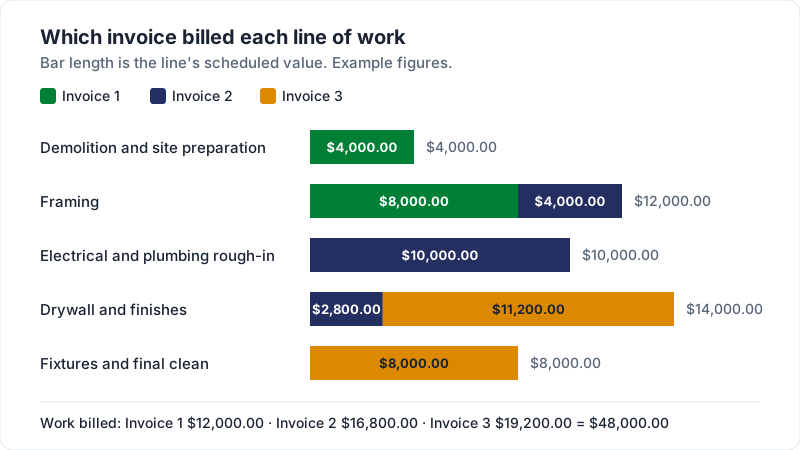
Here is the job billed in three invoices. Each one bills only the work done since the one before.
- Invoice 1 bills demolition in full ($4,000.00) and two-thirds of framing ($8,000.00): $12,000.00 of work.
- Invoice 2 bills the rest of framing ($4,000.00), all of the rough-in ($10,000.00) and 20% of drywall and finishes ($2,800.00): $16,800.00 of work.
- Invoice 3 bills the rest of drywall and finishes ($11,200.00) and the fixtures and final clean ($8,000.00): $19,200.00 of work.
Line by line, that split looks like this:
This is the contract summary that belongs on each invoice, usually beside the totals:
| Figure | Invoice 1 | Invoice 2 | Invoice 3 |
|---|---|---|---|
| Contract total | $48,000.00 | $48,000.00 | $48,000.00 |
| Previously billed | $0.00 | $12,000.00 | $28,800.00 |
| This invoice (work) | $12,000.00 | $16,800.00 | $19,200.00 |
| Completed to date | $12,000.00 | $28,800.00 | $48,000.00 |
| Percent complete | 25% | 60% | 100% |
| Retainage held (10%) | −$1,200.00 | −$1,680.00 | −$1,920.00 |
| Due this invoice | $10,800.00 | $15,120.00 | $17,280.00 |
| Balance to complete | $36,000.00 | $19,200.00 | $0.00 |
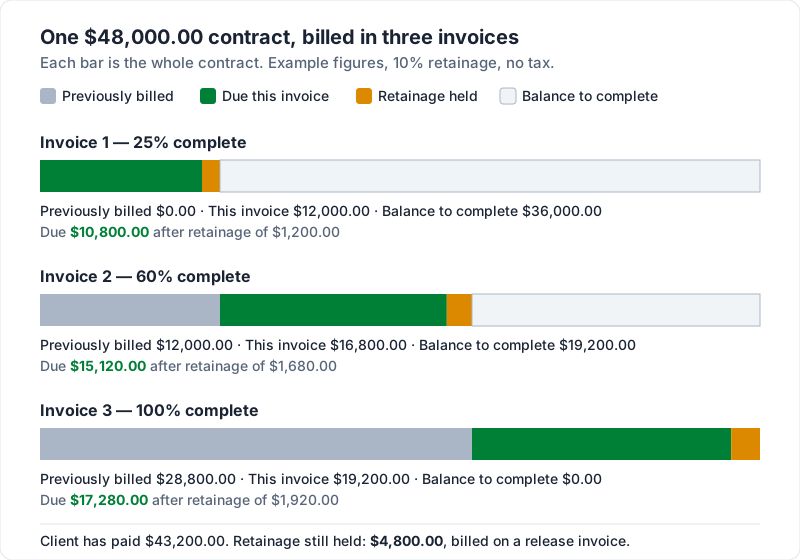
The same three invoices, drawn against the contract total:
Three things worth noticing:
- Previously billed always equals the last invoice's completed to date. If those two numbers ever disagree, the client's accounts team will stop and ask why, and the payment waits until they get an answer.
- Percent complete comes from the money. It is completed to date divided by the contract total, not a second figure typed in separately that can drift away from the lines.
- The job is finished, but not fully paid. After invoice 3 the client has paid $43,200.00. The other $4,800.00 is retainage, and it needs an invoice of its own.
The line items carry the detail. On invoice 2 they might read:
| Description | Qty | Rate | Amount |
|---|---|---|---|
| Framing — remaining third of $12,000.00 scheduled value | 1 | $4,000.00 | $4,000.00 |
| Electrical and plumbing rough-in — 100%, passed rough-in inspection | 1 | $10,000.00 | $10,000.00 |
| Drywall and finishes — 20% of $14,000.00 scheduled value | 1 | $2,800.00 | $2,800.00 |
Each line names the scheduled item, the share billed and the evidence. A client reading it can tick each line off without phoning you.
Retainage, in plain language#
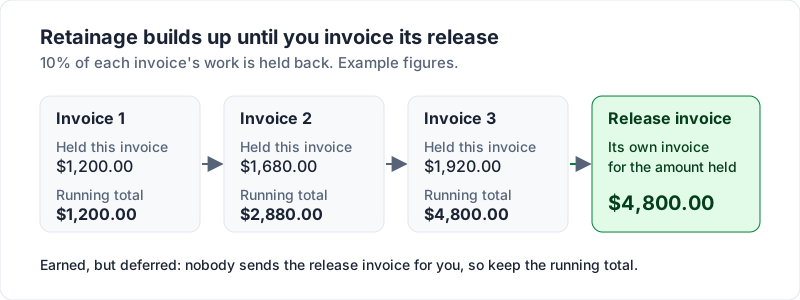
Retainage (also called retention or a holdback) is common in progress invoicing for construction work. It is a share of each progress payment that the client keeps back until the job is finished. It is security: an incentive for you to come back, fix defects and finish the snag list. In the example, 10% of each invoice's work is held, which comes to $4,800.00 by the end.
It is your money, earned but deferred. Three practical points:
- The contract sets it, and some places have rules about it. As one example, for US federal construction contracts, FAR 32.103 says, as of 23 October 2026: “When satisfactory progress has not been achieved by a contractor during any period for which a progress payment is to be made, a percentage of the progress payment may be retained.” Private contracts, states and other countries have their own terms and rules; ask a construction lawyer how they apply to your job.
- Agree what it is calculated on. Retainage on the work value before tax and retainage on a total that includes tax are different numbers. The contract should say which.
- Releasing it takes an invoice. Retainage rarely arrives by itself when the job ends. Send a separate invoice for the released amount and name the invoices it was held on.
A release line can be as plain as this:
| Description | Qty | Rate | Amount |
|---|---|---|---|
| Retainage release — 10% held on invoices 1 to 3, contract total $48,000.00 | 1 | $4,800.00 | $4,800.00 |
Some contracts release part of the retainage at practical completion and the rest after a defects period. Bill each release as its own invoice, when the contract says it is due.
Mistakes that turn progress invoicing into a dispute#
-
Billing ahead of the work. Front-loading the early invoices looks good for cash flow until someone compares your percent complete with the site. Bill what is done, and the next invoice is easier to approve.
-
Milestones nobody can check. “Framing substantially complete” is an opinion. “Framing inspection passed” is a fact with a date. Write milestones as events both of you can point to.
-
A previously billed figure that does not match. This usually comes from retyping numbers, or from counting a draft or cancelled invoice as billed. Carry the figure forward from the last invoice you actually sent.
-
Change orders folded into the original lines. Extra work agreed mid-job belongs on its own line, labelled with the change order, not buried inside “drywall and finishes”. Otherwise the schedule of values stops adding up to the contract, and nobody can tell which figure moved.
-
An invoice that arrives as a surprise. A milestone invoice the client did not expect tends to get questioned. One person in the research described a short heads-up before billing:
I typically send a reminder email a few days before I invoice telling them that we hit a milestone laid out in the contract and that the invoice is coming next week. I feel this gives them a chance to tell me if they feel otherwise or argue the milestone. So far things have gone well with this approach and I just get an "Okay".
If that email is the hard part, asking for money without the awkwardness has wording for it.
-
Forgetting the retainage. At the end of a long job the release invoice is easy to forget, and nobody else is going to remind you.
-
Counting a deposit twice. If the client paid a deposit, credit it once, on the invoice the contract names, as its own line separate from the work.
Progress invoicing does not replace the basics. Each invoice still needs everything an ordinary invoice needs: your details, the client's, a unique number, an issue date, a due date and how to pay. What actually belongs on an invoice is the field-by-field checklist, and what to include on a contractor invoice covers the trade-specific lines. For a smaller job billed once, contractor invoice templates for Word and Excel work through a filled example with a deposit.
Progress billing in Charming Invoices, and what it does not do#
Charming Invoices has a Progress Billing template that prints a contract summary beside the totals: contract value, percent complete, retainage held and balance to complete, with the total labelled “Due this period”. On the invoice you enter the contract value, the amount previously billed and a retainage percentage, and your line items are the work for this period. Completed to date, percent complete and balance to complete are worked out from those lines rather than typed, so they cannot disagree with them. Retainage is calculated on the work before tax.
If you bill by percentage, enter a “% complete to date” and Charming replaces the line items with one line for the difference between that and what was previously billed. Duplicating an invoice you have issued carries its figures forward, so the copy starts as the next stage. All of this is on the free plan.
The catch: retainage is not tracked as a receivable. The amount withheld shows on each invoice, but it is not counted in outstanding, overdue or statement figures, there is no release step, and nothing adds up the retainage held across a contract. You keep that running total yourself and bill the release as a separate invoice, like the example line above. Payment tracking is manual too: you record what the client pays and mark it paid. And Charming has no estimates or quotes, so the contract and the schedule of values live outside it.
If the summary table above is the part you would rather not keep by hand, create a free invoice and choose the Progress Billing template.