Interior design invoice template, with sample invoices

Nnabuike Okoroafor ·
On this page · 9 sections
An interior design invoice has more moving parts than most. One page may carry a flat design fee, hours of site meetings, a sofa and a rug bought for the client, a fee for sourcing them, delivery costs and a retainer paid weeks ago. If the client cannot see how each number was reached, the invoice becomes the place where the fee structure gets argued about.
That is not a hypothetical. In the public online discussions we read while researching invoicing (the people quoted are not Charming customers), a freelance interior designer described an agreement on a daily rate:
We agreed on a daily rate since the client mentioned "from 1/2 to 3/4 days per week."
Then the first monthly invoice went out:
Last Friday I sent the february invoice, and I received a long email this afternoon saying that daily billing wasn't appropriate or "fair" since, "according to her," some tasks could be completed in half a day.
This post gives you a free interior design invoice template, explains the four common ways designers charge and how each looks on the page, and walks through two sample interior design invoices with numbers that add up: a living room project with furnishings and a retainer, and an architect's invoice billed by phase. If your work is brand and logo design rather than rooms, our graphic design invoice template covers revisions and usage licences instead.
General information, not legal or tax advice. This post is about the format of the invoice. Licensing, professional rules and contract terms for designers and architects vary by place; ask a lawyer or an accountant where you work.
Free interior design invoice template: which file to use#
There is no interior-design-specific download on our free Word and Excel invoice templates page, and we would rather say so than relabel a generic file. Two of the free invoice files there fit design work well, with no sign-up:
| File | Calculates? | Fits an interior design invoice when... |
|---|---|---|
| invoice-template.xlsx (Excel) | Yes: line amounts, a discount, one tax rate, the total, amount paid, balance due and the due date | You bill design fees and furnishings on one page and want the arithmetic done for you (15 lines) |
| service-invoice-template.docx (Word) | No, you type every total | You want a “Description of work” box for the project and site address, and a “Less deposit paid” line before the “Balance due” |
The Excel file is the safer choice for furnishings-heavy invoices, because it adds up the lines for you. The Word file looks tidy for a fee-only invoice, but Word does not calculate, so check every total by hand before you send it.
If you would rather the invoice looked like your studio than a spreadsheet, Charming's templates do that; the details are near the end.
What an interior design invoice should show#
Start with the basics in the field-by-field invoice checklist: your details, the client's, an invoice number, the invoice and due dates, the totals and how to pay. On top of those, an interior design invoice is easier to check when it shows the following.
| Line or field | Example wording | Why it helps |
|---|---|---|
| Project and rooms | “Living room, ground floor” | Ties every line to a part of the job |
| Fee type | “Design concept and space plan (flat fee)” | The client sees which agreement the line follows |
| Hours, if hourly | “Site meetings and procurement management, 6.5 hours at 125.00” | Hours and rate are checkable; a lump sum is not |
| Furnishings | Item, size or finish, quantity and client price; a vendor or SKU if you choose to share it | One line per item, so a returned lamp is easy to credit |
| Procurement fee | “Procurement fee: 15% of 4,998.00” | The percentage and its base on the same line |
| Reimbursables | “Delivery and receiving (at cost)” | Costs passed on, kept apart from your fees |
| Retainer or deposit | “Deposit received” with a minus sign | A credit, not a charge |
| Terms | Due date, payment details, what happens to ordered items | The answer to “how and when do I pay?” |
Sections help. Grouping the lines under “Design”, “Furnishings” and “Reimbursables”, each with its own subtotal, lets a client read a long invoice in three parts instead of one list.
Four ways designers charge, and how each looks on the invoice#
Most interior designers use one of four fee structures, or a mix. The table shows how each one reads on the page.
| Fee structure | How it works in practice | How the invoice line reads |
|---|---|---|
| Flat design fee | One price for a defined scope, often per room or per phase | “Design concept and space plan, living room (flat fee)”, qty 1 |
| Hourly | Time billed at an agreed rate | “Site meetings, 6.5 hours”, qty 6.5 at the hourly rate |
| Percentage of project or furnishings cost | The fee is a share of what is spent | “Design fee: 10% of furnishings cost of 20,000.00” (example figures), with the base stated |
| Cost-plus procurement | Furnishings billed at cost plus a fee or markup | Either a visible fee line, or marked-up prices on each item |
Flat fees suit a defined scope. The risk is scope creep, so name what the fee covers on the line itself.
Hourly billing is the easiest to check and the easiest to dispute line by line. The designer quoted above was moving from a daily rate to an hourly one after the client objected. Whichever unit you agree, put it in writing before the first invoice, and keep the time record; our guide to turning tracked hours into an invoice covers the habits that make hourly invoices easy to defend. Another commenter in the same thread put the order of events bluntly:
You never start work without a signed piece of paper.
That is one commenter's view, not legal advice, but it matches the point of this section: the invoice should repeat an agreement, not introduce one.
A percentage of the project ties your fee to the budget. Always show the base the percentage is taken from, or the client cannot check the line.
Cost-plus procurement is where most disputes start. Some designers mark up each item's price; others bill items at the client price they agreed and add a separate procurement fee. Both are used in practice. We suggest the visible fee line, as in sample 1 below, because the client can check it in one step, and a returned item leaves no markup to unpick.
Whichever you choose, price it properly. Our piece on how designers undercut their own rate is written for graphic designers, but the pricing mistakes are the same for interiors.
Sample interior design invoice: a living room project#
Saltgrass Interiors (sample business) is billing the Hartwell household (sample client) for a living room. The agreement was a flat design fee, hourly site meetings, furnishings at an agreed client price plus a 15% procurement fee, and reimbursables at cost. The client paid a 2,500.00 retainer on Monday 14 September 2026. The invoice is dated Monday 2 November 2026, due in 14 days: Monday 16 November 2026.
| Section | Line | Qty | Rate | Amount |
|---|---|---|---|---|
| Design | Design concept and space plan, living room (flat fee) | 1 | 2,400.00 | 2,400.00 |
| Design | Site meetings and procurement management (hours) | 6.5 | 125.00 | 812.50 |
| Furnishings | Three-seat sofa, performance linen (client price) | 1 | 3,180.00 | 3,180.00 |
| Furnishings | Wool rug, 8 x 10 ft | 1 | 1,240.00 | 1,240.00 |
| Furnishings | Table lamps | 2 | 289.00 | 578.00 |
| Furnishings | Procurement fee: 15% of 4,998.00 | 1 | 749.70 | 749.70 |
| Reimbursables | Delivery and receiving (at cost) | 1 | 185.00 | 185.00 |
| Reimbursables | Fabric and finish samples (at cost) | 1 | 64.50 | 64.50 |
| Subtotal | 9,209.70 | |||
| Deposit received (retainer, 14 Sep 2026) | −2,500.00 | |||
| Total due | 6,709.70 |
The arithmetic, checked: 6.5 × 125.00 = 812.50. Furnishings before the fee: 3,180.00 + 1,240.00 + 578.00 = 4,998.00, and 15% of that is 749.70. Section subtotals: Design 3,212.50, Furnishings 5,747.70 (with the fee), Reimbursables 249.50, which add up to 9,209.70. Less the 2,500.00 retainer, 6,709.70 is due. The 15% is this sample's agreed fee, not a norm, and every name and price is illustrative.
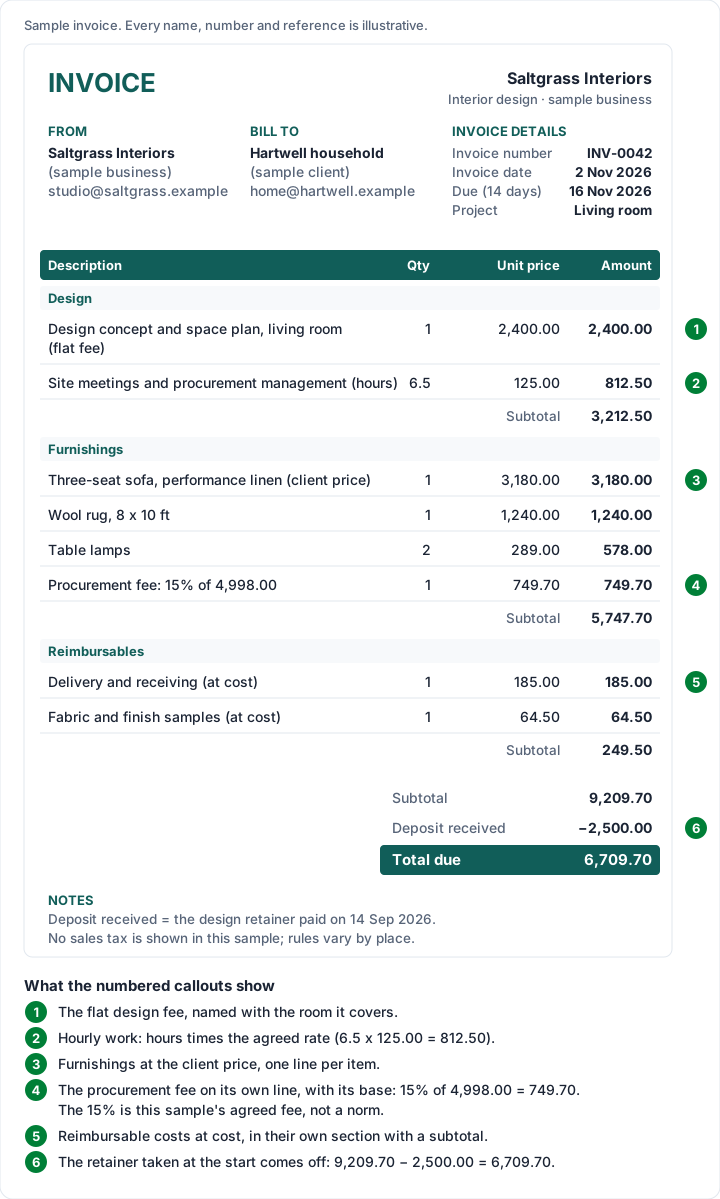
No sales tax line. Whether sales tax applies to furnishings, design fees or both depends on your state or country and on whether you resell the items. Rules vary; check your state or country's tax agency, or ask an accountant, before you add a rate.
The retainer. Here it is credited in full against this invoice. Some designers hold a retainer to the end of the project instead, or draw it down month by month; our guide on how to bill each type of retainer covers the options.
Furnishings, reimbursables, deposits and cancelled orders#
Deposits on furnishings. Many designers ask the client to pay for large orders before placing them, so the studio is never carrying the cost of someone else's sofa. That is a separate invoice for the order (or a share of it), then the final invoice credits it. Our guide to deposit and balance invoices shows both invoices with the credit.
Reimbursables. Delivery, receiving, samples, printing and travel are costs you pass on. Keep them in their own section, at cost unless your agreement says otherwise, and keep the receipts. Our guide to how to bill expenses to a client covers markups, receipts and wording. Event planners face the same split between a fee and vendor costs; see the event planner invoice template.
Trade discounts. If you pass a trade discount on to the client, the cleanest way is to bill the item at the agreed client price, as in the sample. If you would rather show the list price and the discount, our guide on how to show a discount on an invoice has the layouts.
When an order changes. If a client cancels an item after you have invoiced it, do not edit the sent invoice. Issue a credit or a corrected invoice, as described in our guide on when to delete, void or cancel an invoice. What a vendor will refund on a cancelled order is between you and the vendor; say on your terms what happens to items already ordered.
Architect invoices: billing by phase#
Architects and many interior design studios bill a fixed fee in stages. Common phase names are schematic design, design development, construction documents, bidding and construction administration; each invoice bills the share of a phase completed since the last one. Our guide on how progress billing works explains the method and retainage in detail. This section shows one phase invoice that adds up.
Some clients and lenders ask for their own billing forms instead, such as the AIA documents published through AIA Contract Documents. Those forms are licensed and we do not reproduce them; our guide to the AIA invoice and the G702 and G703 forms explains how they compare with a plain progress invoice.
Millrace Studio Architects (sample business) has a fixed fee of 24,000.00 for a house extension for the Thornbury household (sample client). The phase split below is illustrative, not a standard.
| Phase | Share of fee | Value |
|---|---|---|
| Schematic design | 15% | 3,600.00 |
| Design development | 20% | 4,800.00 |
| Construction documents | 40% | 9,600.00 |
| Bidding | 5% | 1,200.00 |
| Construction administration | 20% | 4,800.00 |
| Total | 100% | 24,000.00 |
Invoice 1, dated Thursday 1 October 2026, billed schematic design in full: 3,600.00. Invoice 2 is dated Monday 2 November 2026 on Net 30 terms, so it is due Wednesday 2 December 2026, and bills half of design development.
| Line or summary row | Amount |
|---|---|
| Design development: 50% of 4,800.00 | 2,400.00 |
| Due this period | 2,400.00 |
| Contract value | 24,000.00 |
| Previously billed | 3,600.00 |
| This period | 2,400.00 |
| Completed to date (25%) | 6,000.00 |
| Balance to complete | 18,000.00 |
The arithmetic, checked: 50% of 4,800.00 = 2,400.00; 3,600.00 + 2,400.00 = 6,000.00, which is 25% of 24,000.00; 24,000.00 − 6,000.00 = 18,000.00 left to bill. There is no retainage in this sample.
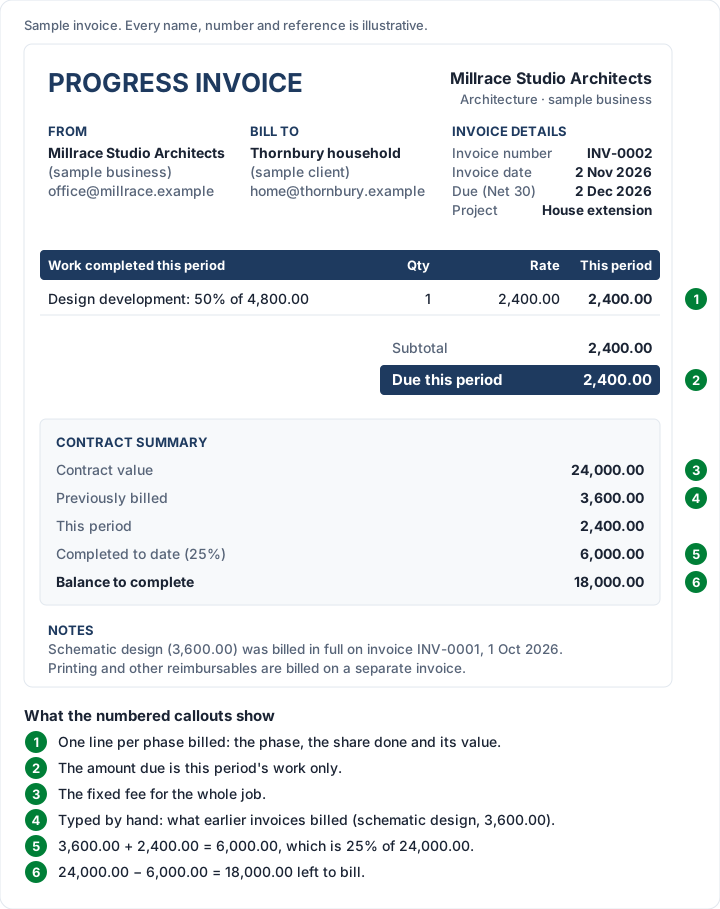
Keep reimbursables off the phase invoice. In the sample, printing and other costs go on a separate invoice. The reason is the contract summary: if a reimbursable line sat on the same invoice, it would count towards “This period” and make the fee look further along than it is (the catch is explained in the next section).
Interior design and architect invoices in Charming#
We make Charming Invoices, so here is what it does for design studios and small practices, with the limits next to each feature.
- Templates that suit a studio. Elegant (“Centred Garamond letterhead with fine rules and warm tones.”), Editorial (“Magazine-style serif display type with a two-column header.”) and Minimal (“Generous whitespace, hairlines and a single quiet accent.”) are 3 of the 60 templates on every plan, including the free one. Your logo, any brand colour, 30 fonts and a full-page letterhead replace the samples.
- Sections with subtotals. Group lines under “Design”, “Furnishings” and “Reimbursables”, as in sample 1; the section field also suggests “Phase 1” and “Phase 2”. Sections and the Unit column are off by default, so turn them on for the business.
- A percentage fee is typed, not calculated. Charming multiplies quantity by unit price; it has no automatic “15% of furnishings” line. Work out the fee and write the base in the description, as in sample 1.
- Retainers and deposits. Enter the amount received and the invoice credits it as “Deposit received” with a minus sign, then shows the total due. You can rename that label (for example to “Retainer applied”), but the label applies to the whole business. For work drawn down from a prepaid retainer, the Retainer template prints “Paid from retainer”, the opening balance and the remaining balance. You type these amounts; Charming does not hold the client's money.
- Progress Billing. The Progress Billing template, on every plan, prints a contract summary: contract value, previously billed, this period, completed to date with the percentage, and balance to complete, plus optional retainage. A “% complete to date” helper can write the line for you, as one line for the whole contract; type the phase line yourself if you want it named as in sample 2. The catch: “This period” is the invoice's line items after any discount, so every line counts, including a reimbursable; bill those separately, as in sample 2. “Previously billed” is typed by hand, not added up from your earlier invoices. The template's total row reads “Due this period”.
- Sharing and getting paid. A PDF to download or print and a private link your client opens without an account, with your bank details and a payment link of your own. You issue the invoice and send it however you like, and you can see when the client viewed it. Charming does not email invoices or send reminders, so set a calendar reminder for the due date.
- Monthly design retainers. Recurring invoices create a ready-to-review draft each cycle, on Individual and above. On the free plan you create each one yourself.
The limits. Charming does not take card payments: clients pay you directly, and you record the payment or mark the invoice paid yourself. It does not track time, raise purchase orders to vendors, run client approval or proposal portals, clip products from the web or do project accounting. For those, interior design or architecture practice-management software is the category to look at; use Charming for the invoice itself. There is no interior design or architecture starter kit, so you type your own lines the first time.
Plans. Free is $0 forever, with no invoice limit, for 1 business, and its invoices carry a small “Sent with Charming Invoices” line; paid plans hide it by default. Individual is $29 once, Team $79 once (up to 5 teammates) and Pro $12 a month or $99 a year; the lifetime plans are final sale. Our page on invoicing for designers and other creative freelancers has more, the pricing page compares plans, and you can create a free invoice and rebuild sample 1 with your own prices.
Questions about interior design invoices#
What should an interior design invoice include?#
Your details and the client's, an invoice number, the invoice and due dates, the project and rooms, each fee with its type (flat, hourly or a percentage with its base), each furnishing item at the client price, any procurement fee on its own line, reimbursables at cost, any retainer or deposit credited, the total due and how to pay.
How do I show a markup on furnishings?#
Either bill each item at a marked-up price, or bill items at the agreed client price and add a separate procurement fee line that shows the percentage and its base. Both are used in practice. The separate line is easier for a client to check, and it is what our sample shows.
Should I take a retainer?#
Many designers take one before starting and credit it on a later invoice, as in sample 1. How much, when it is due and whether it is refundable are business terms for your agreement, not your invoice. See how to bill each type of retainer.
How do architects bill by phase?#
They split a fixed fee across the project's phases and invoice the share of each phase completed since the last invoice, with a summary showing the contract value, what was billed before, this period and the balance. Sample 2 shows one such invoice; the phase split is illustrative.
Is there a free interior design invoice template?#
There is no interior-design-specific file on our downloads page. The Excel invoice template calculates and suits design fees plus furnishings; the Word service invoice template has a description-of-work box and a deposit line. Both are free with no sign-up, and Charming's free plan makes branded PDF invoices.
Can I use the same invoice for decorating work?#
If you mean painting and decorating as a trade (labour, paint and materials), our painting and decorating invoice template page is the better fit. This post is for design fees and furnishings.
The short version#
Name the fee type on every fee line, put each furnishing on its own line at the client price, show any procurement fee with its percentage and base, keep reimbursables in their own section, and credit the retainer. Architects billing by phase should show the contract summary and keep reimbursables on a separate invoice. Rules on tax and licensing vary; ask an accountant or a lawyer where you work.