Event planner and florist invoice template, with samples

Nnabuike Okoroafor ·
On this page · 10 sections
A wedding is three weeks away. The planner needs the balance of the planning fee and the cost of the welcome bags they already paid for; the florist needs the balance on the bouquets, the arch and twelve centrepieces. Both invoices land with the same couple in the same week, and both have to make sense to people who are paying for a lot of things at once. An event planner invoice template that shows the fee, the vendor costs and the deposit in separate, totalled blocks does most of that explaining for you.
This guide covers the planner's invoice and the florist's, with one shared sample wedding and both invoices worked through to the cent. It also sets out the common ways planners charge, how vendor costs show on the bill, and when the balance is usually due.
General information, not legal or tax advice. Your agreement sets the deposit, cancellation and substitution terms; have it drafted or checked by a lawyer. This post covers how the invoice shows those terms, not what they should say. This post does not cover sales tax on flowers, rentals, delivery or planning fees, so the samples leave tax out; check your state's tax agency or ask an accountant.
Event planner invoice template: which file to use#
There is a free event planner invoice template for Excel and one for Word, no sign-up needed. Both have planner lines printed in advance (a planning package, event-day hours for a lead planner and an assistant, vendor costs at cost and a handling fee) with every rate left blank. There is no florist-specific file: florists can use the event planner Excel file, whose How to use tab says which lines to swap in, or the general files on the free Word and Excel invoice templates page. This table matches the file to the job:
| Your situation | Best file | Why it fits |
|---|---|---|
| A fee and a few vendor lines, typed by hand | event-planner-invoice-template.docx (Word) | A description-of-work box and a planning and vendor costs table, ending in “Less deposit paid” and “Balance due”. You add up the totals yourself |
| Many lines (centrepieces, rentals, vendor costs) that must add up | event-planner-invoice-template.xlsx (Excel) | Lines that multiply quantity by rate, then subtotal, discount, one tax rate, total, a “Less deposit paid” row and balance due |
| A branded PDF with each part of the job subtotalled | Charming's Elegant or Creative Studio template, with sections switched on | Planning, vendor costs, flowers and rentals each get a heading and a subtotal (more below) |
A florist invoice runs to more lines than most, so an Excel file is the safer free choice: it does the arithmetic. In the event planner Excel file, replace the starter lines with your design fee, personal flowers, ceremony and reception pieces, rentals and delivery; the general invoice-template.xlsx works too. Our guide to the Excel invoice template with formulas walks through it field by field.
How event planners bill: four fee models#
Planners charge in a handful of ways, and each prints differently on the invoice. Whatever the model, the invoice should use the same words as the agreement, so the client can see the fee matches what they signed.
| Fee model | How it works | How it prints on the invoice |
|---|---|---|
| Flat package | One agreed price for a defined scope (full, partial or month-of planning) | One line: “Partial planning package (flat fee, per agreement)”, quantity 1 |
| Percentage of the event budget | A fee worked out as a share of what the client spends on the event | One line naming the percentage and the budget it applies to, so the client can check the figure |
| Hourly | A rate for time spent, often with an estimate up front | Hours times rate, one line per role or per stage |
| Day-of coordination | A fee for running the day itself, priced flat or by the hour | Its own line, separate from planning, with the hours and the people on site |
Many planners combine them: a flat fee for the planning months plus hours for the wedding day, as in the sample below. We do not quote typical percentages or rates here; they vary too widely by place and by event for one range to be useful.
Vendor costs: paid direct, billed at cost, or with a fee#
The caterer, the band and the venue usually invoice the client directly. Smaller purchases (welcome bags, signage, favours) often go through the planner. There are three common ways to handle them, and the choice belongs in your agreement before any money is spent:
- The client pays the vendor directly. Nothing appears on your invoice. Simple, and nobody can question a markup that does not exist.
- You pay and bill at cost. Each purchase becomes a line at the price you paid, in its own section, and you keep the receipts in case the client asks. That is how the sample below works. Our guide on how to bill expenses to a client covers receipts and wording.
- You pay and add a fee. You bill the cost plus a handling or procurement fee for sourcing, ordering and managing it. Show the fee as its own line rather than hiding it in the prices; interior designers do the same, and our guide to a procurement fee on an invoice shows the layout.
Whichever you choose, say it on the section heading. “Vendor costs at cost” tells the client, in four words, that you are not making money on those lines.
Event planner invoice sample: the balance before the wedding#
Here is the planner's balance invoice for a sample wedding. Every name and rate below is illustrative, not a market rate.
- From: Thistlecombe Events (sample business), 5 Sample Street
- To: the Keane wedding (sample clients), 22 Sample Street
- Event: Saturday 21 November 2026, at a sample venue
- Booking deposit: 1,600.00 (half the flat fee), received at signing
- Invoice date: Monday 26 October 2026; due Friday 6 November 2026, 15 days before the event
| Section | Description | Qty | Unit | Rate | Amount |
|---|---|---|---|---|---|
| Planning | Partial planning package (flat fee, per agreement) | 1 | package | 3,200.00 | 3,200.00 |
| Planning | Wedding-day coordination: lead planner | 10 | hrs | 85.00 | 850.00 |
| Planning | Wedding-day coordination: assistant | 8 | hrs | 40.00 | 320.00 |
| Subtotal | 4,370.00 | ||||
| Vendor costs at cost | Welcome bags, assembled | 60 | each | 6.75 | 405.00 |
| Vendor costs at cost | Ceremony and table signage printing | 1 | order | 142.60 | 142.60 |
| Subtotal | 547.60 | ||||
| Subtotal | 4,917.60 | ||||
| Deposit received | −1,600.00 | ||||
| Total due | 3,317.60 |
The arithmetic:
- Planning: the 3,200.00 flat fee, plus 10 hours × 85.00 = 850.00 and 8 hours × 40.00 = 320.00 of wedding-day coordination, makes 4,370.00.
- Vendor costs: 60 welcome bags × 6.75 = 405.00, plus 142.60 for printing, makes 547.60.
- Subtotal: 4,370.00 + 547.60 = 4,917.60.
- Balance: take off the 1,600.00 deposit and 3,317.60 is due.
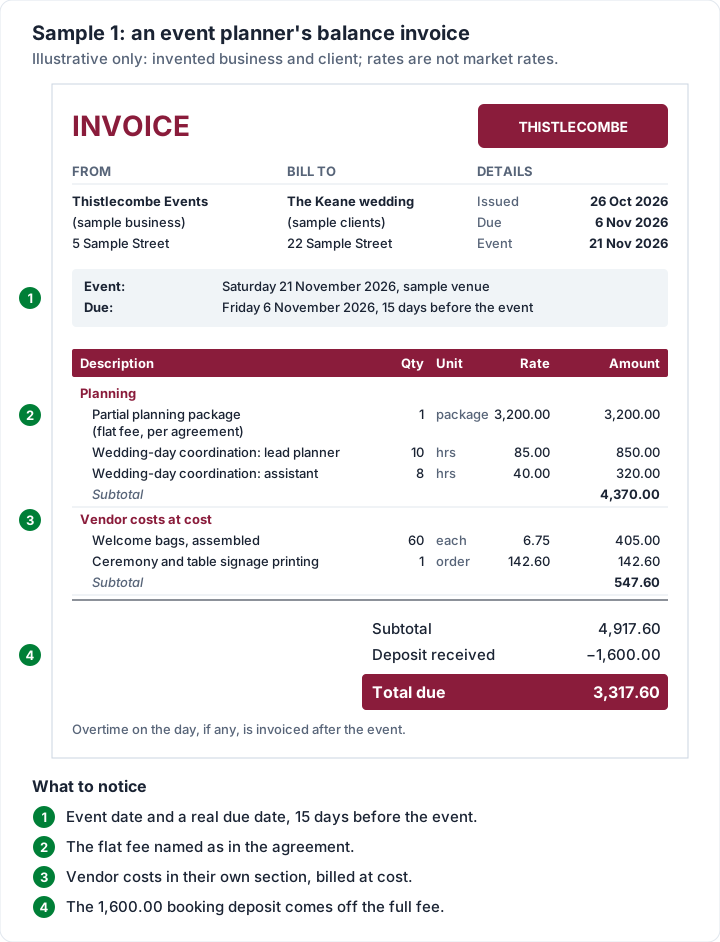
Two points about this sample. The wedding-day hours are billed in advance at the agreed figure, because the balance is due before the event; if the day runs over, many planners invoice the extra time afterwards on a short second invoice. And the full fee stays visible above the deposit credit, so the client can see the deposit was taken off the price they signed for, not added to it.
Florist invoice: design fee, flowers, rentals and delivery#
A florist invoice is a long one. A wedding can run to a dozen kinds of arrangement, and the client will want to match every line to the proposal they approved. Group the lines the way the client thinks about the day:
- Design fee. Consultation, design and sourcing, as one line if you charge it separately.
- Personal flowers. Bouquets, boutonnieres and corsages, each with a quantity and a per-piece price.
- Ceremony and reception pieces. The arch or altar piece, aisle arrangements and table centrepieces.
- Rentals. Vases, stands and arches you lend and take back, marked as rentals so the client knows they are not theirs to keep. If you take a refundable deposit on rented items, that is a different thing from the booking deposit; our guide on the booking deposit vs security deposit on a rental invoice explains the difference.
- Delivery, setup and strike. Taking everything to the venue, setting it up and taking it down after the event (strike), as one line or three.
Many florists price per arrangement on the invoice, even if they cost the flowers per stem. Per-arrangement lines are easier for a couple to check against the proposal; per-stem detail is useful to you, and rarely to them. Our guide on how much detail to show on an invoice covers that trade-off.
Flowers are perishable and seasonal, so many florists include a substitution note in the terms. Example wording (not a legal clause, and only if your agreement says the same) might read: “Flowers of similar colour and value may be substituted if a variety is unavailable, as set out in our agreement.”
Florist invoice sample: the same wedding's flowers#
The florist for the same sample wedding is Hollyhock Lane Flowers (sample business), billing the Keane wedding (sample clients). A 700.00 deposit was received at booking. Prices are illustrative, not market rates.
- Invoice date: Monday 26 October 2026; due Monday 9 November 2026, 12 days before the event on Saturday 21 November 2026
| Section | Description | Qty | Unit | Rate | Amount |
|---|---|---|---|---|---|
| Design | Floral design and consultation | 1 | fee | 350.00 | 350.00 |
| Subtotal | 350.00 | ||||
| Personal flowers | Bridal bouquet | 1 | each | 185.00 | 185.00 |
| Personal flowers | Bridesmaid bouquets | 4 | each | 75.00 | 300.00 |
| Personal flowers | Boutonnieres | 6 | each | 18.00 | 108.00 |
| Subtotal | 593.00 | ||||
| Ceremony and reception | Ceremony arch arrangement | 1 | each | 420.00 | 420.00 |
| Ceremony and reception | Table centrepieces | 12 | each | 65.00 | 780.00 |
| Subtotal | 1,200.00 | ||||
| Rentals | Glass cylinder vases (rental; returned after the event) | 12 | each | 4.50 | 54.00 |
| Subtotal | 54.00 | ||||
| Delivery and setup | Delivery, setup and strike | 1 | job | 225.00 | 225.00 |
| Subtotal | 225.00 | ||||
| Subtotal | 2,422.00 | ||||
| Deposit received | −700.00 | ||||
| Total due | 1,722.00 |
Personal flowers come to 185.00 + 4 × 75.00 + 6 × 18.00 = 593.00. The ceremony and reception pieces are 420.00 + 12 × 65.00 = 1,200.00, and the vases are 12 × 4.50 = 54.00. With the 350.00 design fee and 225.00 for delivery, setup and strike, the subtotal is 2,422.00. Less the 700.00 deposit, 1,722.00 is due.
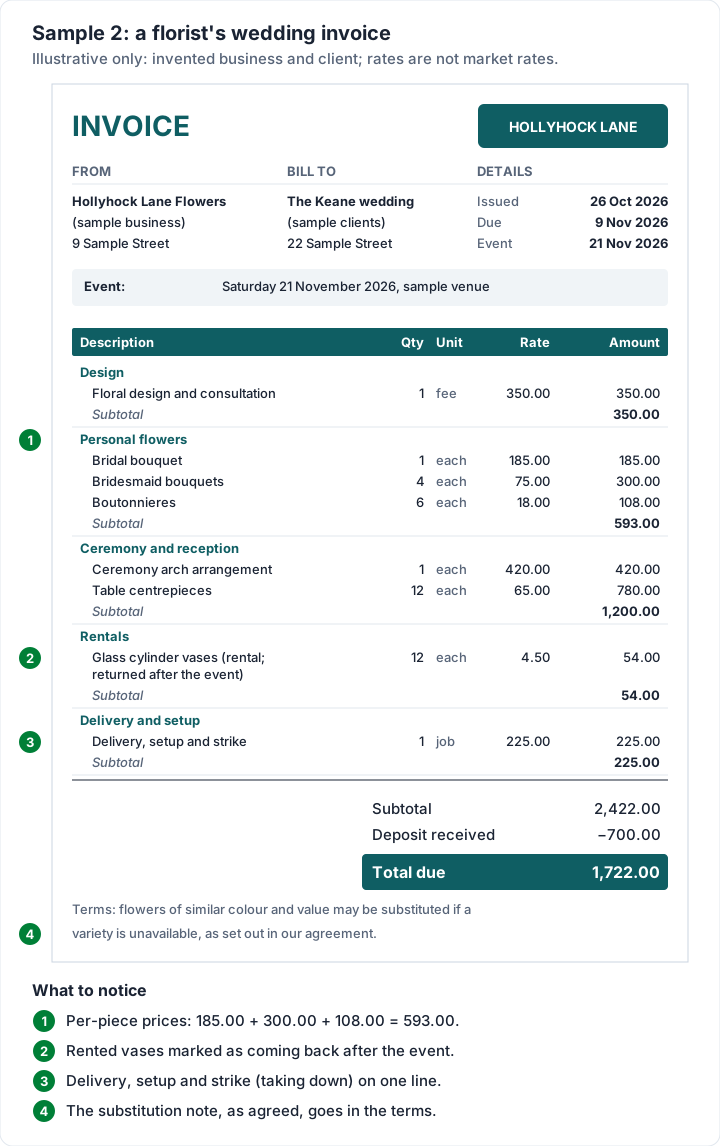
Deposits and the balance date#
Event work is booked months ahead and delivered on one day, which is why deposits are common in this trade. The usual shape is two invoices: a deposit invoice at booking, which secures the date, and a balance invoice like the samples above, due before the event. Our guide to deposit and balance invoices covers the wording for both.
Getting paid before the day is a common position among event and creative freelancers. In a public online discussion among videographers about clients who pay late, one commenter (not a Charming customer, like everyone we quote) set out their rule:
They need to be paid up before I start shooting and I clearly define those terms in my contracts.
The same applies to the deposit itself. In a wedding photography forum, replying to a photographer whose couple had not yet signed and paid to secure their date, another commenter advised:
In the future, I think you need to set a deadline date.
On the invoice, that means a real due date, not “before the wedding”: Friday 6 November 2026, not “two weeks before”. Both samples put the balance 12 to 15 days ahead of the event, which leaves time to chase a late payment before the flowers are ordered and the staff are booked. What happens if the client cancels, or pays late, is for your agreement, not your invoice. Our guide to the habit that matters most: agree the late fee before the work explains why those terms need agreeing up front.
Other wedding vendors' invoices#
The same couple will get invoices from other vendors, and each trade has its own quirks. If you work alongside them or offer a second service, these guides cover the rest of the day:
- Catering: per-head pricing, the final headcount and service charges, in a catering invoice, line by line.
- DJ: performance hours, travel and overtime, in the DJ invoice sample.
- Photography: coverage, editing, prints and licences, in the photography invoice template.
- Live music: a band or soloist billing a set list, in a gig invoice.
- Video: shoot days, edits and deliverables, in the videographer invoice guide.
Event and florist invoices in Charming#
If you send a deposit invoice and a balance invoice for every booking, retyping them gets old. Charming Invoices is a web app for making invoices you download as a PDF or share by private link, and this is what it does for an event or a florist, checked in the code:
- 60 templates on every plan, including Free. Elegant (a centred Garamond letterhead with fine rules and warm tones) and Creative Studio suit events; the samples above would also sit well on Playful for a birthday or party business.
- Sections and subtotals. Type a section on each line (“Planning”, “Vendor costs at cost”, “Personal flowers”, “Rentals”, up to 80 characters) and consecutive lines with the same section print under one heading with its own subtotal. Grouping is off by default on most templates: switch on “Group lines by section” in the Template Studio.
- The deposit credited. Type the deposit into “Deposit already received” and it prints as “Deposit received” above “Total due”. The deposit invoice and the balance invoice are two separate invoices, each tracked as issued and paid.
- An event date or venue on the invoice. There is no dedicated event-date field. Rename the PO number field to “Event date” (the label then applies to every invoice you issue from that business), or put the date, venue and guest count in the notes.
- Terms on the PDF. Your deposit, balance date and substitution wording, as agreed, in a terms section of up to 5,000 characters.
- Status and records. An issued invoice past its due date shows as Overdue, a “Viewed by the client” entry appears on the invoice's timeline, and “Record a payment” handles a couple who pays the balance in two transfers. Charming does not email invoices or send reminders: you send the PDF or link yourself.
On the paid plans (from Individual, $29 once), you can save your standard lines (a planning package, a bridal bouquet, delivery and setup) to reuse, and AI drafting can turn a sentence into line items. AI drafting leaves any price it does not know at 0 and never sends anything; you check every line.
The catches, plainly:
- No contracts, proposals or e-signatures, no client portal for mood boards, and no vendor management. If you want those with your invoices, see our guide to a CRM that sends invoices.
- No card payments through Charming. Your bank details or your own payment link print on the invoice; you record each payment or mark it paid yourself.
- No automatic payment schedule. You create the deposit and balance invoices yourself, and the deposit credit is typed by hand rather than linked to the deposit invoice.
- Free invoices carry a small “Sent with Charming Invoices” line in the footer. Paid plans hide it by default and can switch it back on. The lifetime plans are final sale.
If that suits your bookings, create a free invoice and rebuild the Thistlecombe sample with your own fee.
Event planner and florist invoice questions#
What should an event planner invoice include?#
Your details and the client's, an invoice number and date, the event date and venue, the planning fee as agreed, any day-of coordination hours, vendor costs in their own section (saying whether they are at cost or with a fee), the deposit already received, the balance due with a real due date, and how to pay.
How do planners charge for vendor costs?#
Three common ways: the client pays vendors directly, the planner pays and bills at cost, or the planner pays and adds a handling fee shown on its own line. Choose one in your agreement and label the invoice section to match.
When should the balance be due?#
Whenever your agreement says. Many event businesses set the balance due a week or more before the event, so there is time to follow up before the day. Put an actual date on the invoice rather than “before the event”.
What goes on a florist invoice?#
A design fee if you charge one, then personal flowers, ceremony and reception pieces, rentals and delivery, setup and strike, each with quantities and prices, then the deposit received and the balance due. A substitution note, as agreed, can go in the terms.
Do florists charge for vase rentals?#
Many do, as a separate rental line marked as returned after the event. Some include vases in the arrangement price instead. Either way, say which on the invoice so the client knows whether the vases are theirs to keep.
Is there a free event planner invoice template?#
Yes. There is a free event planner invoice template for Excel, which adds up the totals, and one for Word, which does not, with no sign-up. There is no florist-specific file, but florists can replace the starter lines in the Excel file with their own. For a branded PDF with planning, vendor costs and the deposit already laid out, create a free invoice in Charming.
Free downloads
No sign-up and no email address. More on the free templates page.
- Download .xlsx: Event planner invoice template for Excel
Event planner invoice template for Excel
Excel .xlsxFor event planners: a planning fee, event-day hours and vendor costs passed on.
- Download .docx: Event planner invoice template for Word
Event planner invoice template for Word
Word .docxFor event planners: a planning fee, event-day hours and vendor costs passed on.