Catering invoice template and example, line by line

Nnabuike Okoroafor ·
On this page · 10 sections
A catering job is priced weeks before anyone eats. The client books for 120 guests, confirms 112 a week out, asks for an extra hour of service on the night and wants to know why there is an 18% charge that is not a tip. A catering invoice has to carry all of that on one page, in a form the client can check against the quote and pay before the event.
This guide covers how to invoice for catering services: pricing method, itemising, service charge versus gratuity, deposits, final headcount, when the balance is due, and tax on food in general terms. Then come two catering invoice examples with every figure added up (a wedding billed per head and a corporate lunch billed as a package), a blank catering invoice template to copy, and where to download a free file to fill in. All businesses, prices and rates in the examples are invented for illustration.
General information, not legal or tax advice. Where a rule is mentioned, we quote and link the official page; ask an accountant or lawyer about your own situation.
What a catering invoice has to show#
Start with what every invoice needs: the word “Invoice”, your business name and contact details, the client’s name, a unique invoice number, the issue date, the due date, the line items, the total and how to pay you. What actually belongs on an invoice has the field-by-field list.
Catering adds event details that a generic invoice has no box for. Put them near the top, under the client’s name:
- Event name and date. “Rivera–Okafor wedding reception, Saturday 14 November 2026.”
- Venue and service address. Where the food is going, if it is not where the invoice is going.
- Service times. “Guest arrival 6:00 pm, dinner 7:00 pm, service ends 11:00 pm.” Overtime charges only make sense against stated times.
- Guest count, and which count it is. “Final confirmed headcount: 112 (confirmed 4 November).”
- The quote or contract it relates to. “Per catering agreement dated 2 June 2026.”
The last line matters most. Whatever catering invoice format you use, it should never be the first place a price appears; it records what the client already agreed to.
Per-head or package pricing: pick one and say which#
Catering is usually priced in one of two ways, and the invoice should make the method obvious.
| Per-head pricing | Package pricing | |
|---|---|---|
| How it reads | Buffet dinner, 112 guests at $38.00 | Wedding package for up to 120 guests, $5,400.00 |
| The total moves when | The headcount changes | The package changes, or the count passes its limit |
| Good for | Weddings, corporate lunches, anything where numbers shift | Fixed-size events, drop-off platters, set menus |
| What to state | The headcount and the date it was confirmed | What the package includes, and the price per extra guest |
A package reads simply, but it causes queries when the client cannot see what is inside it. List the contents under the package line with no price against them (“Includes: three canapés per guest, two-course buffet, soft drinks, linens and four servers”) and give anything outside the package its own priced line. Mixing the two is fine, as long as each line says which it is.
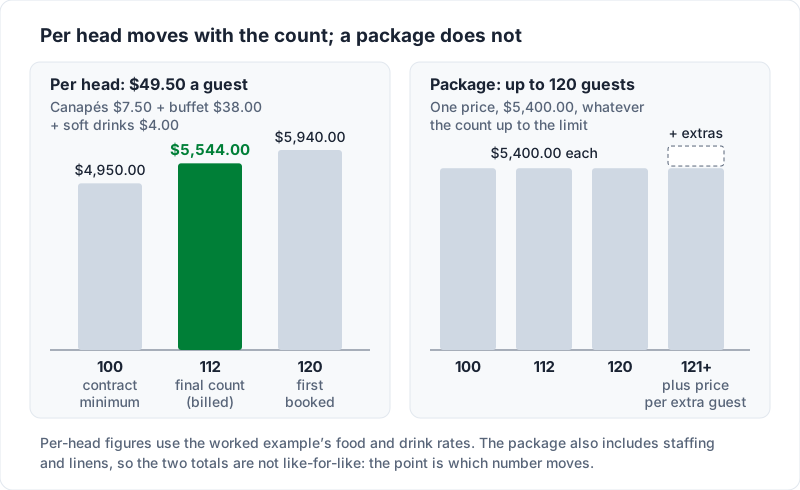
The difference shows when the count changes. Using the per-head food and drink rates from the worked example below:
Itemise the menu, staffing, equipment hire and delivery#
One line reading “Catering services — $8,751.21” is how a catering invoice gets queried. Split it into the groups the client thinks in:
- Food and drink. One line per menu item or course, with the headcount as the quantity: “Canapé reception, 3 pieces per guest — 112 guests at $7.50”. Bar packages go here too, priced per head or per hour.
- Staffing. Servers, bartenders, a chef on site, a carver. Show people and hours: “Servers, 4 staff × 6 hours = 24 hours at $32.00”. This is the line most likely to change on the night, so the hours must be clear.
- Equipment hire. Chafing dishes, linens, glassware, tables, chairs, a portable bar. Use quantities: “Linen tablecloths, round, 14 at $12.00”.
- Delivery, setup and collection. A separate line: “Delivery, setup and collection, venue 18 miles”. Some places tax a separately stated delivery charge differently from food (see the tax section).
- Anything after the event. Overtime, extra bar time, breakages. These usually go on a separate, later invoice, because they are not known until the event is over.
A subtotal per group helps: a client reading “Staffing subtotal: $1,083.00” can compare it with the quote in a second.
Service charge and gratuity are not the same line#
This causes the most confusion on catering invoices. In plain terms:
- A service charge is a fixed amount or percentage you add as part of the price, and the client has to pay it. It may cover staff, admin, planning or overheads. It is your revenue.
- A gratuity or tip is an amount the client chooses to give, if they want to, usually for the staff.
| Service charge | Gratuity or tip | |
|---|---|---|
| Who sets the amount | You, in the agreement | The client, if they choose to give one |
| Does the client have to pay it? | Yes | No |
| Whose money it is | Your revenue | Usually meant for the staff |
| In the invoice total? | Yes, as its own labelled line | No; mention it in a note if you like |
| IRS wording (US federal) | Its list of service charges includes “Required gratuities included in a contract or invoice” | “A payment is a tip only if the customer voluntarily decides to pay it and determines the amount.” |
The rules on service charges and gratuities vary by place, and they affect income tax, payroll and sales tax differently. One example: in the US, the IRS’s tip recordkeeping and reporting page says, as of 28 October 2026: “A payment is a tip only if the customer voluntarily decides to pay it and determines the amount.” It lists “Required gratuities included in a contract or invoice” among its examples of service charges, and says: “Service charges distributed to employees must be treated as wages to those employees.”
Other places draw the line differently. In the UK, HMRC’s VAT manual says compulsory service charges “will follow the same liability as the meal” (HMRC, VATSC06130, as of 28 October 2026). US states set their own sales tax rules.
What this means for the invoice, wherever you are:
- Call a mandatory charge what it is. “Service charge, 18% of food and drink” is honest. Calling a compulsory charge a gratuity confuses the client and, in some places, the tax treatment.
- Say what it covers. “Covers event planning and service administration. It is not a gratuity.” If part of it goes to staff, say so, and make sure the wording matches what you actually do.
- Keep optional gratuity off the total. If you want to invite a tip, a note works: “Gratuity for the service team is optional and not included in this invoice.”
If you employ staff, ask an accountant how service charges and tips are reported where you are.
Deposits, the final headcount and the balance#
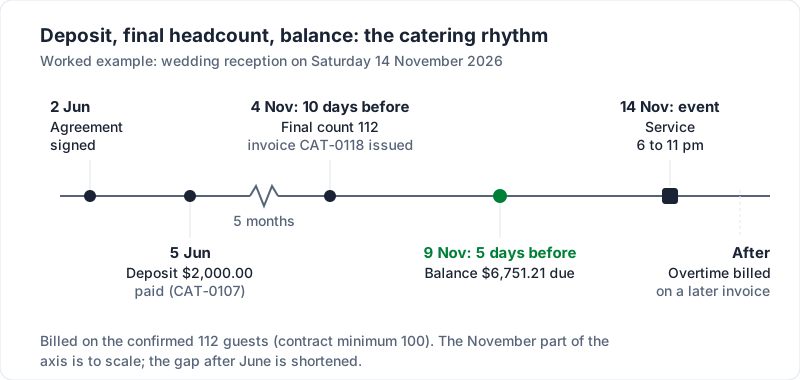
Catering has its own payment rhythm: a deposit at booking, a final headcount shortly before the event, and the balance before anyone arrives.
The deposit#
The deposit holds the date and covers early costs. Send it as its own invoice at booking, with a short due date and a line that says what it is for: “Deposit to reserve 14 November 2026, per catering agreement dated 2 June 2026 — $2,000.00.” State in the agreement whether it is refundable. How deposit invoices work covers deposit amounts, refund wording and how the deposit shows on the final invoice.
The final headcount#
Put a headcount deadline in the agreement, then put the confirmed figure on the invoice. The common rules are:
- Minimum guarantee. You bill at least a set number of guests, even if fewer come.
- Final count by a date. For example, 7 or 10 days before the event. After that, the count can go up (if you can supply it) but not down.
- Greater of the two. You bill the confirmed count or the actual attendance, whichever is higher.
Tufts University’s catering service, for example, publishes that rule: the “Final invoice price will be calculated on the guest count guarantee number or the actual guest attendance, whichever is greater” (Tufts Catering, order confirmation and payment). Yours does not have to match, but write it down before the client confirms numbers, not on the invoice.
If the count drops after the client has already paid in full, your agreement decides whether money goes back. If it does, record it with a refund or a credit note rather than a new invoice.
When the balance is due#
For private events, caterers commonly ask for the balance before the event: food is bought and staff are booked days ahead, and chasing a family the week after a wedding is nobody’s idea of a good time. One person in a public videography discussion described the same rule for event work:
My clients have to pay in advance for that very reason. If it is an event, wedding, or something like that my contract states 2 weeks prior to date.
That comes from public online discussions we read while building this product; the person quoted is not a Charming customer.
Corporate clients often pay on their own terms, after the event. If you accept that, agree it in writing first; what Net 30 actually means explains the common terms. Either way, put the due date and its reason on the invoice: “Balance due 9 November 2026, five days before the event, per catering agreement.”
Tax on catered food, in general terms#
Food tax rules vary widely, and catering can be taxed differently from groceries. Ask your tax authority or an accountant how your lines are treated. Two official examples, quoted as of 28 October 2026:
- UK VAT. HMRC’s VAT Notice 709/1 says: “Any supply of food or drink as part of a contract for catering is standard-rated”.
- Maryland. The state’s Business Tax Tip #27 says: “In general, all charges by caterers related to service of food and beverage at a customer's event are taxable”. Its list of examples includes “Mandatory gratuity charges for groups of more than 10”.
Other states publish their own guidance, such as Missouri’s catering tax matrix, and the answer for the same staffing line can differ between them. If you are registered to collect sales tax or VAT, show the rate and the tax as their own lines, and keep differently taxed items on separate lines. If you are not registered, do not add tax. What a tax invoice is explains the extra fields some countries require when you are registered.
Rules differ by country, state and city, and they change, so check your own tax authority’s current guidance.
Catering invoice example: a wedding billed per head#
Here is an invoice catering sample laid out as it would print, for a wedding reception billed per head. The business, client, prices and the 7% tax rate are illustrative examples. We assume, for the example only, that local rules tax everything except the separately stated delivery line.
- Invoice: CAT-0118. Issued: 4 November 2026. Due: 9 November 2026
- Billed to: Sam Rivera
- Event: Wedding reception, Saturday 14 November 2026, Alder Barn. Service 6:00 pm to 11:00 pm
- Final confirmed headcount: 112 guests (confirmed 4 November; contract minimum 100)
- Reference: Catering agreement dated 2 June 2026
| Description | Qty | Rate | Amount |
|---|---|---|---|
| Food and drink | |||
| Canapé reception, 3 pieces per guest | 112 | $7.50 | $840.00 |
| Buffet dinner, two courses | 112 | $38.00 | $4,256.00 |
| Soft drinks package | 112 | $4.00 | $448.00 |
| Cake cutting and plating | 1 | $150.00 | $150.00 |
| Staffing | |||
| Servers, 4 staff × 6 hours | 24 | $32.00 | $768.00 |
| Chef on site, 7 hours | 7 | $45.00 | $315.00 |
| Equipment hire | |||
| Chafing dishes | 8 | $15.00 | $120.00 |
| Linen tablecloths, round | 14 | $12.00 | $168.00 |
| Delivery | |||
| Delivery, setup and collection, venue 18 miles | 1 | $95.00 | $95.00 |
| Subtotal | $7,160.00 | ||
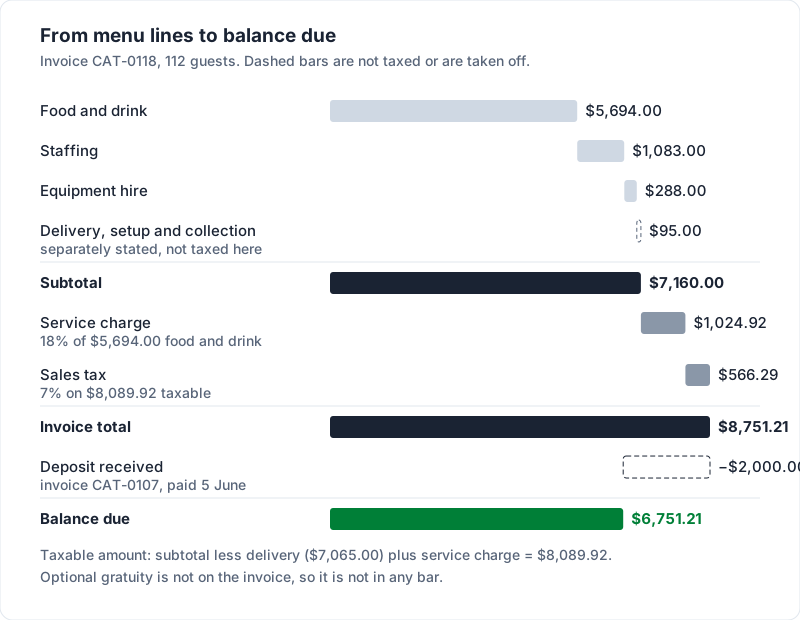
| Service charge, 18% of food and drink ($5,694.00) | $1,024.92 | ||
| Sales tax, 7% on taxable lines ($8,089.92) | $566.29 | ||
| Invoice total | $8,751.21 | ||
| Deposit received (invoice CAT-0107, paid 5 June) | −$2,000.00 | ||
| Balance due | $6,751.21 |
Notes on the invoice: “The service charge covers event planning and service administration; it is not a gratuity. Gratuity for the service team is optional and not included. Any overtime after 11:00 pm is billed separately after the event at $32.00 per server hour.”
To check the arithmetic: 18% of the $5,694.00 food and drink is $1,024.92. The taxable amount is the subtotal less delivery, plus the service charge: $7,065.00 + $1,024.92 = $8,089.92, and 7% of that rounds to $566.29. The total is $7,160.00 + $1,024.92 + $566.29 = $8,751.21, and the deposit leaves $6,751.21.
Catering invoice template, with a filled-in sample#
A catering invoice template is the layout above with the blanks left in. Copy these blocks, in this order, into whatever you invoice with, and fill them from your agreement.
| Block | What to fill in |
|---|---|
| Header | Your business name, logo and contact details, and the word “Invoice” |
| Invoice details | Invoice number, issue date and due date |
| Bill to | The client’s name, company and billing address |
| Event details | Event name and date, venue, service times, the final headcount with the date it was confirmed, and the agreement or quote it relates to |
| Food and drink | One line per menu item, course or package, with guests as the quantity |
| Staffing | Role, people × hours, hourly rate |
| Equipment hire | Item, quantity, rate |
| Delivery | Delivery, setup and collection, as one line or two |
| Totals | Subtotal, service charge if agreed, tax if you are registered, invoice total, deposit received, balance due |
| Payment and notes | How to pay, why the balance is due when it is, what any service charge covers, an optional-gratuity note and any overtime rate |
Leave out the blocks a job does not need: a drop-off lunch has no equipment hire, and a client who paid no deposit has no deposit line.
Catering invoice sample: a corporate lunch package#
A smaller job shows the same template with package pricing. The business, client, prices and the 6% tax rate are illustrative examples. For this one, we assume a single tax rate applies to every line.
- From: Thistledown Kitchen. Invoice: TK-0042. Issued: Friday 20 November 2026. Due: Friday 4 December 2026 (14 days, as agreed)
- Billed to: Ostrander Labs, accounts payable
- Event: Quarterly planning lunch, Thursday 19 November 2026, at the client’s office. Server on site 11:30 am to 2:30 pm
- Final confirmed headcount: 46 guests (confirmed Friday 13 November). The package covers up to 40; extra guests at $18.00 each, as quoted
- Reference: Catering quote accepted 30 October 2026
| Description | Qty | Rate | Amount |
|---|---|---|---|
| Food and drink | |||
| Working lunch package, up to 40 guests. Includes: sandwich platters, two salads, fruit, soft drinks, plates and napkins | 1 | $720.00 | $720.00 |
| Extra guests over the package | 6 | $18.00 | $108.00 |
| Coffee and tea service | 46 | $3.50 | $161.00 |
| Staffing | |||
| Server, 1 staff × 3 hours | 3 | $30.00 | $90.00 |
| Delivery | |||
| Delivery, setup and collection | 1 | $45.00 | $45.00 |
| Subtotal | $1,124.00 | ||
| Sales tax, 6% | $67.44 | ||
| Total due | $1,191.44 |
The arithmetic: $720.00 + $108.00 + $161.00 + $90.00 + $45.00 = $1,124.00, 6% of that is $67.44, and the total is $1,191.44. There is no deposit line because this client pays after the event on agreed terms, and no service charge because the quote did not include one.
With one tax rate on every line and no percentage service charge, this sample fits a single-rate template file, and Charming, as it stands. The wedding example above does not, because its delivery line is untaxed.
Download a free catering invoice template file#
There is a free catering invoice template for Excel and one for Word, with no sign-up. Both have catering lines printed in advance (food and drink per guest, servers, equipment hire, delivery and a service charge) and every rate left blank, so you type your own prices and delete the lines you do not need.
- The catering invoice template for Excel suits menus priced by quantity. Each line is quantity × rate, and the subtotal, tax, total, deposit and balance due are formulas; the deposit goes in the “Less deposit received” row. It has one tax rate for the whole invoice and a fixed discount, but no percentage service-charge calculation: the service-charge line is there, but you work out the amount and type it in. Like Charming, it cannot leave one line untaxed, so the corporate lunch above fits it and the wedding example does not.
- The catering invoice template for Word suits a typed event description: it has a description-of-work box for the event, venue and dates, a food and drink, staffing, hire and delivery table, and a “Less deposit received” line. Word does not add up the totals for you.
More free files, including general invoice templates, are on the free invoice templates page. The Excel invoice template guide and the Word invoice template guide walk through filling in each kind of file. Whichever you use, send the client a PDF rather than the editable file.
Catering invoices in Charming, and where it falls short#
Charming Invoices covers the itemising and the deposit on every plan, including Free, and the layout comes from your choice of 60 invoice templates, all available on Free. Each line has a quantity and rate, with an optional unit column (“guests”, “hrs”), and you can switch on section grouping in a template so Food and drink, Staffing and Equipment hire each print with their own subtotal. On the balance invoice you choose “Add a deposit received”, type the amount, and the invoice prints a “Deposit received” line and a lower amount due.
Where it falls short for caterers, plainly. Charming applies one tax rate to the whole invoice, so it cannot leave some lines untaxed: the worked example above, with untaxed delivery, would not fit on one Charming invoice. There is no percentage service-charge line, so you work out the 18% and enter it as a line yourself. The deposit figure is typed by hand, not linked to the deposit invoice. Clients cannot pay by card from the invoice, so you mark it paid when the money arrives. And free-plan invoices carry a small “Sent with Charming Invoices” line in the footer.
Before you send a catering invoice#
- Reference the agreement; every price on the invoice should be in it.
- Add the event date, venue, service times and the confirmed headcount with its date.
- Group lines into food and drink, staffing, equipment hire and delivery.
- Label a mandatory service charge as one; keep optional gratuity off the total.
- Check your local tax rules, and show tax only if you are registered.
- Take off the deposit received, with the deposit invoice’s number.
- Set the balance due before the event, unless agreed otherwise, and bill post-event extras separately.
Catering invoices look complicated because events are. If you plan the whole event rather than cook for it, the event planner invoice template shows a planning fee with vendor costs passed on at cost. If you want to try the layout above with your own menu, you can create a free invoice in Charming.
Free downloads
No sign-up and no email address. More on the free templates page.
- Download .xlsx: Catering invoice template for Excel
Catering invoice template for Excel
Excel .xlsxFor caterers: food and drink per guest, staffing, equipment hire and delivery.
- Download .docx: Catering invoice template for Word
Catering invoice template for Word
Word .docxFor caterers: food and drink per guest, staffing, equipment hire and delivery.