Deposit invoices: how they actually work

Nnabuike Okoroafor ·
On this page · 10 sections
You have agreed a job, the date is in the diary, and nothing has been paid. If the client disappears next week, you have lost the booking and the other work you turned down for it. That gap is what deposit invoices are for: a small, clear document that asks for part of the price before the work starts, and makes the booking real.
This guide covers when to ask for a deposit, how much to ask for, whether to send a deposit invoice and then a balance invoice or one invoice with both, how the deposit shows on the final invoice, which free invoice and estimate files already have a deposit line, and how to word refundable and non-refundable deposits. The examples use invented figures, labelled as examples.
General information, not legal or tax advice. Where a rule is mentioned, we quote and link the official page; ask an accountant or lawyer about your own situation.
What deposit invoices are, and what they are not#
Whether you call it a deposit invoice or an invoice for deposit, it is an ordinary invoice for part of the agreed price, sent before the work is done. It has its own number, its own due date and a line that says plainly what it is for. The rest of the price is billed later, on a separate balance invoice or as the remainder of one larger invoice.
People use several words for nearby things, and it helps to keep them apart:
- Deposit. Part of the price of one specific job, paid in advance. It comes off the final bill.
- Down payment. The same idea, more common for goods, large purchases and building work. A down payment invoice works exactly like a deposit invoice.
- Retainer. Two meanings. Sometimes it is a deposit by another name (wedding photographers often say retainer). Sometimes it is an amount paid in advance that ongoing work is drawn down from, month by month. If you send an invoice for retainer work, say which kind it is. Retainer invoices explained shows how to bill each kind.
- Prepayment. The whole price, paid before any work. Not a deposit, because there is no balance.
- Proforma invoice. A preview of the whole bill, sent before the sale is final. It can state a deposit due now, but it is not the document the deposit is recorded against. Proforma invoices explained compares the two side by side.
So what is a deposit invoice, in one line? A real invoice, with its own number, for the agreed share of the price that is paid before the work starts.
A deposit invoice is a request for payment, so it should carry the word “Invoice” and everything else an invoice needs. If you are unsure what that is, the field-by-field invoice checklist has the full list. The types of invoices shows where a deposit invoice sits among the others.
When to ask for a deposit#
You do not need one for every job. A deposit earns its place when you would lose something real if the client walked away:
- You are reserving a date or a slot. Weddings, events, shoot days, a block of your calendar. Turning other work away has a cost.
- You spend money before you are paid. Materials, prints, hire, travel, a second shooter or a subcontractor.
- The job is long. A three-month project billed only at the end means three months of unpaid work at risk.
- The client is new to you. Neither of you has a payment history to go on.
- The work is custom. Something made for one client is hard to resell if they cancel.
In public discussions about getting paid, this came up bluntly. One commenter, in a videography thread about a large two-day shoot, put it like this:
Like, I wouldn't tell you how to do your job... but no contract and no deposit means no thanks.
The people quoted in this post are not Charming customers; their words come from public online discussions we read while building the product.
Two trades where deposits and dates meet: a catering invoice, line by line covers the final headcount and the balance, and the rental invoice guide separates a booking deposit from a security deposit. If a business client wants to pay on terms instead, our guide to offering pay by invoice without too much risk explains where a deposit on first or large orders fits. A moving company invoice shows a booking deposit credited on a local move. An event planner invoice credits a booking deposit against the planning fee and vendor costs.
How much to ask for#
There is no standard figure. We looked for reliable data on typical deposit percentages and did not find any we would put our name to. In public discussions, people mention figures such as 30% to hold a wedding date or half the project price up front, which tells you what some people do, not what you should do. A 50% deposit invoice works exactly like the 30% example below; only the figures change. On the same $4,800.00 project, the deposit and the balance would each be $2,400.00.
What genuinely decides the amount:
- Your costs before the work starts. At the very least, the deposit should cover what you will spend in advance.
- What you lose if they cancel. A date you could have sold to someone else is worth more than an afternoon you can fill with other work.
- What is normal in your trade and area. Ask peers, or look at what others publish on their booking pages.
- Whether the deposit is refundable. If it is non-refundable, keeping it proportionate matters more (see below).
One person in a small business discussion described what changed when they started asking for more up front:
I found that when I started requiring half or more of the estimated project cost up front as a retainer, I don't chase after the rest very often.
That is one person’s experience, not a promise, but a client who has already paid part of the price has a reason to see the job through.
Deposit and balance invoice, or one invoice with a deposit line#
There are two common ways to bill a deposit. This table compares them:
| Deposit invoice, then a balance invoice | One invoice with a deposit line | |
|---|---|---|
| Documents | Two, each with its own number and due date | One |
| When it is sent | Deposit at booking, balance on completion | At booking, showing the full price and what is due now |
| Tracking | Each invoice is paid or unpaid on its own | One invoice stays partly paid for weeks or months |
| Good for | Bookings, projects with a clear end, most freelance work | Short jobs, or a client who wants one document for their records |
| Risk | Forgetting to send the balance invoice | The invoice looks overdue or unclear while you wait for the balance |
For most freelance and small-business work, two invoices are cleaner. Each one has a clear amount, a clear due date and a clear status.
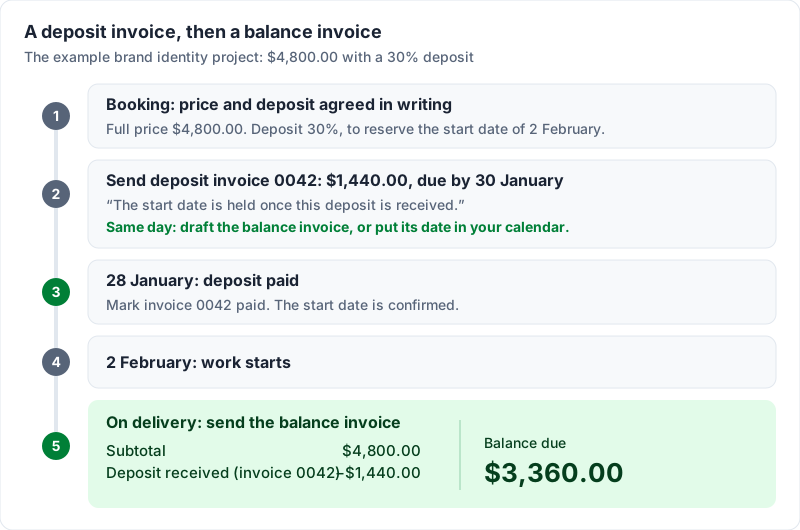
Option 1: a deposit invoice, then a balance invoice#
The deposit invoice can be one line. An example, for an invented brand identity project worth $4,800.00 with a 30% deposit:
| Description | Qty | Rate | Amount |
|---|---|---|---|
| Brand identity project — 30% deposit to reserve start date of 2 February | 1 | $1,440.00 | $1,440.00 |
Give it a short due date, a few days rather than 30, and say what happens if it is not paid: “The start date is held once this deposit is received.”
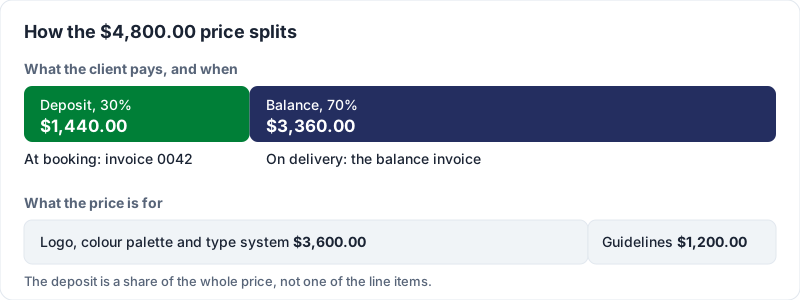
Option 2: one invoice with the deposit as a line or a note#
Here the invoice lists the full work, then states what is due now: “Deposit due on booking: $1,440.00. Balance of $3,360.00 due on delivery.” The weakness is that most invoicing, on paper or in software, has one due date per invoice. When the deposit arrives, you record it as a partial payment, and the invoice sits there half paid until the end of the job.
How the deposit shows on the final invoice#
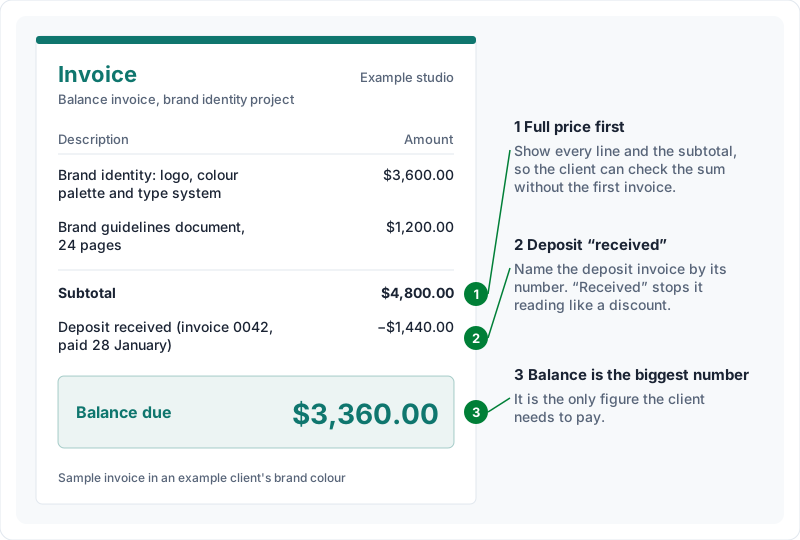
The balance invoice should show the whole price and then take the deposit off it, so the client can check the arithmetic without digging out the first invoice. For the difference between a draft and the final invoice you send, see draft invoice vs final invoice. An example, continuing the project above:
| Description | Qty | Rate | Amount |
|---|---|---|---|
| Brand identity — logo, colour palette and type system | 1 | $3,600.00 | $3,600.00 |
| Brand guidelines document, 24 pages | 1 | $1,200.00 | $1,200.00 |
| Subtotal | $4,800.00 | ||
| Deposit received (invoice 0042, paid 28 January) | −$1,440.00 | ||
| Balance due | $3,360.00 |
Refer to the deposit invoice by its number. Use the word “received” so nobody thinks it is a discount. And make the balance the biggest number on the page, because it is the only one the client needs to pay. Two filled-in examples follow the same pattern: the musician invoice template credits a band’s booking deposit on the balance invoice, and the medical invoice template shows a payment taken at the visit as a credit.
A common way for deposits to go wrong is the balance invoice that never gets sent. One person in a small business discussion, billing in stages, described it plainly:
Yup I'm horrible at it. We bill 30/30/30/10. And I suck at invoicing that last 10% invoice.
The fix is boring: when you send the deposit invoice, create the balance invoice as a draft or put its date in your calendar. If the job runs in more than two stages, progress invoicing handles each stage against the contract total. If your clients pay by card, Square’s invoices can request a deposit on the invoice itself, as a percentage or an amount with its own due date, according to Square’s help page Manage invoice deposits and payment schedules (read 28 October 2026); our Square invoice guide covers its card fees. If you would rather one tool tracked the quote, the deposit and the final invoice together, our comparison of quote and invoice software covers nine tools that do both.
Charming Invoices has a field for this on every plan, including Free. On the balance invoice you choose “Add a deposit received” and type the amount the client already paid; the invoice prints a “Deposit received” line taken off the total, and the amount due, the PDF and the private invoice link all use the balance. If you type more than the invoice is worth, the form says so and credits only what is owed. The catch: Charming does not connect that figure to the deposit invoice you sent earlier. You type it in yourself, and you mark the deposit invoice paid when the money lands, because Charming does not take card payments or see your bank account.
Deposit invoice template: free files with a deposit line#
If you would rather start from a file than an app, our free downloads already have the rows a deposit needs. We read each file by script on 28 October 2026 to describe what it contains:
| File | The deposit row | What the file works out |
|---|---|---|
| Invoice template for Excel | “Amount paid”, under the total | Balance due = total − amount paid |
| Invoice template for Word | “Amount paid” | Nothing: Word does not calculate, so you type the balance in yourself |
| Estimate or quote template for Excel | “Deposit to start”, as a percentage or an amount | The deposit, rounded to the cent and never more than the total, and the “Balance on completion” |
| Estimate or quote template for Word | “Deposit to start” | Nothing: you fill in the figures |
| The cleaning, moving, photography and event planner invoices, and the service invoice for Word | “Less deposit paid” | Balance due = total − the deposit row (the Excel versions) |
| The catering and bookkeeping invoices | “Less deposit received” and “Deposit received” | The same subtraction (the Excel versions) |
All of them are on the free downloads page. Here is the example from this post in two of them:
- Balance invoice, in the invoice template for Excel. Two lines, $3,600.00 and $1,200.00, no tax, and 1,440.00 typed into “Amount paid”. The total shows 4,800.00 and “Balance due” shows 3,360.00, the same figures as the balance invoice above. Put the deposit invoice’s number and the date it was paid in the notes, so the client can match it.
- Deposit at the quote stage, in the estimate template for Excel. A 4,800.00 estimate total with 30 typed into “Deposit to start (%)” shows a deposit of 1,440.00 and a balance on completion of 3,360.00. The estimate states the deposit; you still send a deposit invoice for it. Invoice vs estimate or quote covers when each document is sent, and the quote and invoice template guide walks through the estimate file.
Two catches. The invoice files take the amount you type and do not stop at the total, so a figure larger than the invoice shows a negative balance: type only the deposit actually received. And the files are not connected, so nothing carries the deposit from the estimate to the invoice; you copy it across. Creating an invoice in Excel explains how that file handles discounts and tax. If the client wants a receipt for the deposit, the receipt template for Excel has a row for money paid before, such as a deposit, and shows the balance still due.
Refundable or non-refundable: say which, in writing#
Unstated terms leave the hard conversation for the day the client cancels. Say on the invoice, and in your contract if you have one, whether the deposit comes back.
Some plain wording you can adapt:
- Non-refundable: “This deposit reserves your date and is non-refundable if you cancel. It will be deducted from your final invoice.”
- Refundable up to a point: “This deposit is refundable if you cancel at least 30 days before the start date. After that it is non-refundable.”
- Refundable less costs: “If you cancel, we will refund this deposit less any costs already incurred, such as materials ordered for your project.”
Example wording for a deposit and balance in your invoice terms, with other terms and notes to adapt, is in a free Word file and a plain text file.
Whether a non-refundable deposit holds up is a legal question that depends on where you are, the contract and who the client is, and consumer law may be relevant when the client is a person rather than a business. In the UK, for example, Schedule 2 of the Consumer Rights Act 2015 lists consumer contract terms that may be regarded as unfair. One, as worded on 28 October 2026, is “A term which has the object or effect of requiring that, where the consumer decides not to conclude or perform the contract, the consumer must pay the trader a disproportionately high sum in compensation or for services which have not been supplied.” Other countries, and US states, have their own rules. If a deposit matters to your business, have a lawyer look at the wording once.
When the job changes: a prorated invoice#
Plans change after the deposit is paid: the scope shrinks, or ongoing work stops partway through a month. A prorated invoice bills only the share of the price that was actually used or delivered.
For example, an invented monthly retainer of $2,000.00 that ends after 10 working days of a 20-day month could be billed as: “Monthly design retainer, 1 to 12 February 2027 (10 of 20 working days) — $1,000.00.” If a deposit was paid, take it off this invoice the same way as above, and if the deposit is more than the prorated amount, your written refund terms decide what happens to the difference.
Write down how you prorate before you need to: by days, by hours or by deliverables. A method agreed in advance is arithmetic. A method invented after a cancellation is an argument.
Wording for the email that carries it#
The invoice does the formal work; the email can be short. A sample you can copy and edit:
Hi Sam, thanks for booking. Attached is the deposit invoice for 30% of the project ($1,440.00), due by 30 January. Once it is paid, your start date of 2 February is confirmed. The balance of $3,360.00 will be invoiced on delivery.
The free invoice email templates for Word include two more for this job: “Deposit before work starts” and “Final invoice after a deposit”, which names the deposit invoice in the email as well as on the invoice.
If writing that still feels uncomfortable, asking for money without the awkwardness goes into why, and what to say. Photographers will find trade-specific detail in a photographer’s guide to invoicing, and videographers in the videographer invoice guide, which credits the deposit by invoice number on the final bill. For the email that goes with the final invoice, and other situations, see these invoice email examples.
Before you send a deposit invoice#
- Agree the full price and the deposit amount with the client first, in writing.
- Put the word “Invoice”, a unique number and a short due date on it.
- Say what the deposit is for: the date, the start slot or the materials it covers.
- State whether it is refundable, and on what terms.
- Note when the balance will be invoiced, and put that date in your calendar.
- On the balance invoice, show the full price, the deposit received with the deposit invoice’s number, and the balance due.
A deposit is not a sign of distrust. It is the point where both of you commit to the job. If you want somewhere to make the first one, you can create a free invoice with Charming, download the PDF and send it your way.
Free downloads
No sign-up and no email address. More on the free templates page.
- Download .xlsx: Invoice template for Excel
Invoice template for Excel
Excel .xlsxThe general-purpose invoice: products, services or a mix, priced by quantity and rate.
- Download .xlsx: Estimate or quote template for Excel
Estimate or quote template for Excel
Excel .xlsxPrice a job before you start: scope, line items, a valid-until date and an optional deposit.
- Download .docx: Invoice terms and notes examples for Word
Invoice terms and notes examples for Word
Word .docxExample wording to adapt for the Terms and Notes boxes on your invoice. General information, not legal or tax advice.