Retainer invoice: what it is and how to bill each type

Nnabuike Okoroafor ·
On this page · 16 sections
A client has agreed to keep you on, and now you have to bill for it. The trouble is that “retainer” means at least four different arrangements, and the invoice for each one looks different. Send the wrong kind and the client either cannot reconcile it or assumes something you never agreed, such as unused hours rolling over forever.
A retainer invoice is an invoice for an ongoing arrangement where the client pays in advance: for a block of work each month, for a balance you draw down as you work, or simply for your availability. This guide explains each type, how it differs from a deposit and a prepayment, what to put on the invoice, and how to handle the end of a retainer and any refund. Every type has a worked example with illustrative numbers.
In short:
- Decide which kind of retainer you have before you design the invoice. The invoice follows the agreement, not the other way round.
- A monthly retainer invoice bills the month ahead, plus any overage from the month just finished.
- A drawdown invoice prints four figures every time: the opening balance, the work done, the amount paid from the retainer and the remaining balance.
- Write down what happens to unused hours and to unspent money at the end. Most disputes start there.
- Lawyers and some other regulated professions have their own rules about advance fees. If that is you, check with your regulator or state bar before anything here.
General information, not legal or tax advice.
What is a retainer invoice?#
A retainer invoice asks the client to pay for something before you deliver it. That is the one thing every retainer has in common. What the client is paying for varies. In legal practice, Cornell Law School's Legal Information Institute defines the term like this (as of 23 October 2026): "Retainers are a type of compensation agreement with lawyers either for reserving their employment or as compensation for future services." Its entry goes on to describe general, security and advance-fee retainers.
Outside law, the same three ideas show up in plainer clothes. A designer on “12 hours a month” has a monthly retainer. A developer whose client paid $5,000.00 up front to be worked down has a drawdown retainer. A consultant paid a small monthly fee to answer the phone within two days has an availability retainer. For worked examples, the interior design invoice template covers taking a retainer before a project, and the therapy invoice template covers prepaid massage packages. A bookkeeper’s fixed monthly package is another kind of monthly fee; the bookkeeping invoice template bills one in advance, with extras in arrears.
The word also gets used loosely for a deposit. Wedding photographers in particular often call the booking payment a retainer. That is a deposit by another name, and how deposit invoices work covers it properly.
Retainer vs deposit vs prepayment#
These three terms overlap, which is why invoices go wrong. The table below shows how they usually differ in practice. Your agreement can define them differently; if it does, go by the agreement.
| Deposit | Prepayment | Retainer | |
|---|---|---|---|
| What it pays for | Part of one specific job | All or part of a defined job, before delivery | Ongoing work, a balance to draw on, or availability |
| How many invoices | Usually two: deposit, then balance | One, before the work | A series, often monthly |
| What the later invoice shows | The deposit taken off the final total | Often nothing more is due | The draw, the remaining balance, any overage |
| When it ends | When the job is paid | When the job is delivered | When either side ends the arrangement |
| Unused money | Refund terms in the contract decide | Usually refunded if the work does not happen | Rollover, refund or expiry, as agreed |
The practical difference is time. A deposit and a prepayment belong to a single job. A retainer runs across many invoices, so the invoice has to carry a running story: what was paid, what was used and what is left.
If you are sending a prepayment request for one defined job, a proforma invoice or a deposit invoice is often the clearer document. Use a retainer invoice when the relationship continues. The types of invoices sets out which document fits each stage of the work.
The four types of retainer, and how each one is billed#
Here is the short version, before the worked examples.
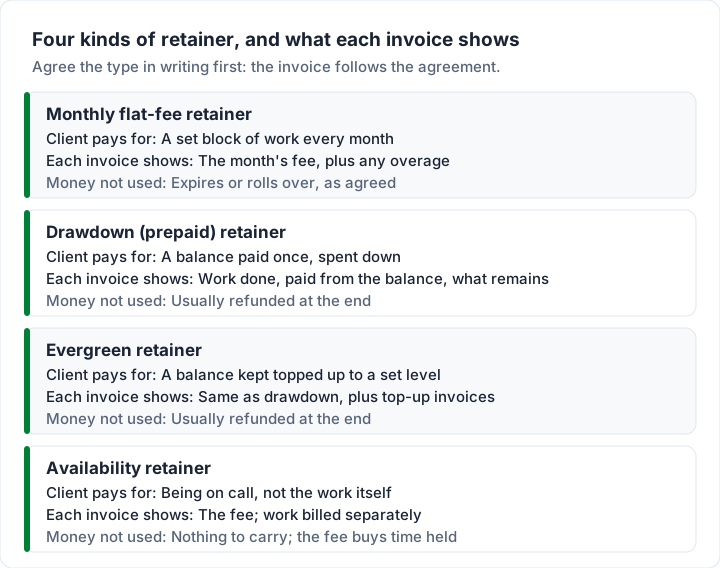
- Monthly flat-fee retainer. The client pays a fixed amount each month for a defined amount of work: hours, deliverables or both. You invoice in advance, usually on the first of the month.
- Drawdown retainer. The client pays a lump sum once. Each invoice records the work done and takes it off that balance until it runs out.
- Evergreen retainer. A drawdown retainer that is topped back up to an agreed level, so the balance never runs dry. The term is used loosely, so define it in your agreement rather than relying on the word.
- Availability retainer. The client pays for your time to be held: priority response, a reserved day, first call on your calendar. The work itself is billed separately.
Monthly retainer invoice: a worked example#
Take an invented copywriter, Fernhill Studio, on a content retainer: 12 hours a month for $1,800.00, which works out at $150.00 an hour. Hours beyond the 12 are billed at $165.00 an hour, and up to 4 unused hours roll into the next month only.
The invoice for April goes out on 1 April. It bills April in advance and March's overage in arrears, because March's hours are only known once March is over.
| Description | Qty | Rate | Amount |
|---|---|---|---|
| Content retainer, April 2027: up to 12 hours | 1 | $1,800.00 | $1,800.00 |
| Overage, March 2027: hours beyond the 13.00 available | 3.00 hrs | $165.00 | $495.00 |
| Total due | $2,295.00 |
Add one plain note under the lines: “March: 16.00 hours used of 13.00 available (12 included, 1 rolled over from February). Rolled-over hours expire after one month.” The client can check that sentence against your timesheet without asking you anything. If those hours come from a timer, time tracking and invoicing software compares tools that carry them onto the invoice.
Two habits make monthly retainers easier to collect. Bill in advance, so the retainer is actually prepaid. And keep the same date and the same wording every month, so the client's accounts team stops treating it as a surprise. Billing on a schedule, and why it is not the same as a subscription, is covered in recurring invoices vs subscriptions. To have the monthly invoice drafted or sent for you, recurring invoice software compares what each tool automates.
Unused hours: rollover, expiry or a cap#
Unused hours are the most common argument on a monthly retainer, and the fix is to put the rule on every invoice, not just in the contract. There are three usual choices:
- Expire at the end of the month. The simplest to run. The client is paying for your time being reserved, used or not.
- Roll over without limit. Generous, but it builds a pile of owed hours that can swallow a future month.
- Roll over with a cap. A middle ground: a set number of hours carries forward for a set time, then expires.
Here is how Fernhill's cap of 4 hours for one month plays out over a quarter. Rolled-over hours are used first.
| Month | Included | Rolled in | Available | Used | Result |
|---|---|---|---|---|---|
| January | 12.00 | 0.00 | 12.00 | 7.00 | 5 unused: 4 roll on, 1 expires |
| February | 12.00 | 4.00 | 16.00 | 15.00 | 1 unused: rolls on |
| March | 12.00 | 1.00 | 13.00 | 16.00 | 3.00 hours over: $495.00 overage |
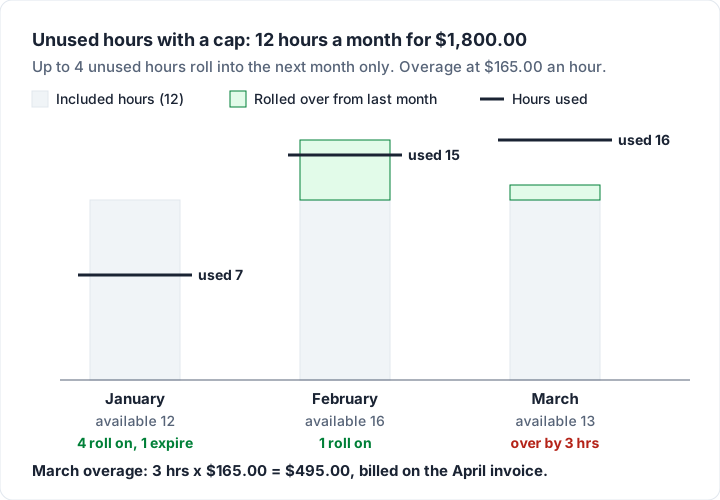
Whichever rule you choose, print it. A one-line note such as “Unused hours roll over for one month, up to 4 hours” prevents the client from assuming the most generous version.
Drawdown retainer invoice: a worked example#
An invented developer, Ashgrove Web, agrees a $5,000.00 retainer with a client, Linden Physio, at $125.00 an hour. Billing the site build that comes before a retainer like this is covered in how to invoice a website build by milestone.
Step 1: the funding invoice. Ashgrove sends one invoice for the retainer itself, before any work starts:
| Description | Qty | Rate | Amount |
|---|---|---|---|
| Retainer funding: prepaid development time, drawn down at $125.00 an hour | 1 | $5,000.00 | $5,000.00 |
| Total due | $5,000.00 |
Step 2: the monthly draw invoices. Each month, Ashgrove invoices the work done and takes it off the balance. In May, 18.00 hours come to $2,250.00. In June, 26.00 hours come to $3,250.00, which is more than the $2,750.00 left.
| May | June | |
|---|---|---|
| Work this month | 18.00 hrs, $2,250.00 | 26.00 hrs, $3,250.00 |
| Opening balance | $5,000.00 | $2,750.00 |
| Paid from retainer | -$2,250.00 | -$2,750.00 |
| Remaining balance | $2,750.00 | $0.00 |
| Amount due | $0.00 | $500.00 |
May's invoice asks for nothing, because the balance covers it, but it is still the client's record of what their money bought. June's asks for $500.00, the part the balance could not cover.
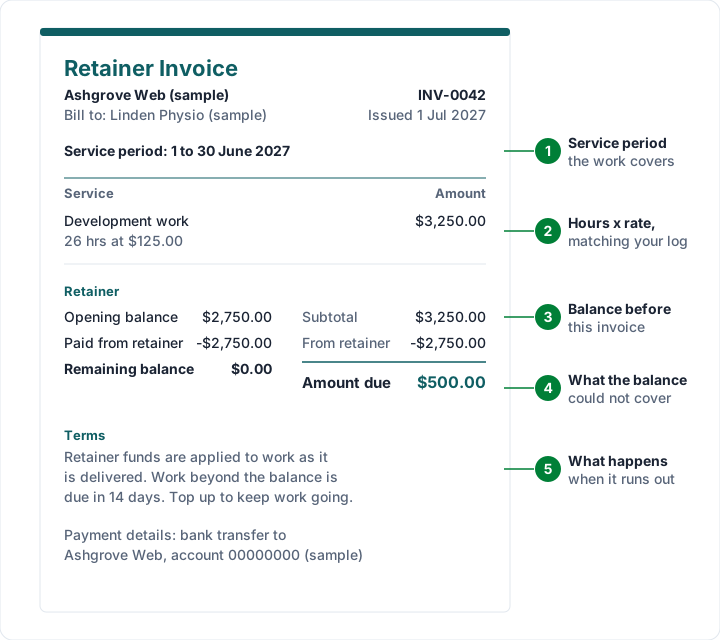
The figures to print, in this order, are the service period, the hours and rate, the opening balance, the amount paid from the retainer, the remaining balance and the amount due. Our guide to invoicing for consulting walks through the same four-figure draw for consultants, with hourly detail and expenses, and the consulting invoice template fills in a monthly retainer draw-down in Excel and Word.
Evergreen retainers: topping the balance back up#
The $500.00 surprise in June is what an evergreen retainer is designed to avoid. Under an evergreen arrangement, the agreement says the balance is topped back up to a set level, for example at the start of each month or whenever it falls below a floor.
If Ashgrove's agreement had said “topped back up to $5,000.00 on the first of each month”, the sequence would have been:
- 1 June: top-up invoice for $2,250.00, the amount May used. It is a plain invoice with one line, such as “Retainer top-up to $5,000.00, after May drawdown”.
- 1 July: June draw invoice. Opening balance $5,000.00, paid from retainer $3,250.00, remaining balance $1,750.00, amount due $0.00.
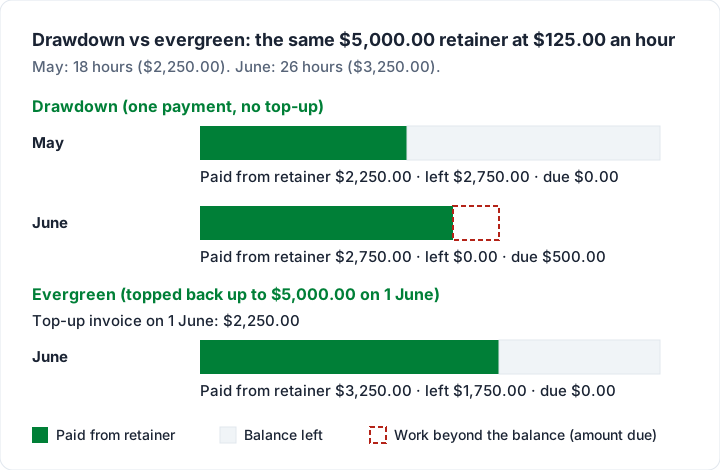
Keep the top-up invoice and the draw invoice separate: one asks for money to go into the balance, the other reports money coming out of it. To see the balance between invoices, our free retainer tracker for Excel keeps a running balance of money paid in, work drawn from it and anything refunded, with a low-balance alert. It is a record for your own use, not trust or client-money accounting.
Availability retainer: paying for time held#
An availability retainer pays for being on call, not for any work. An invented example: a consultant charges $500.00 a month to guarantee a reply within two working days and a reserved day each quarter. Any work is billed at $150.00 an hour on top.
| Description | Qty | Rate | Amount |
|---|---|---|---|
| Availability retainer, June 2027: priority response and reserved day | 1 | $500.00 | $500.00 |
| Advisory work, June 2027 (see attached log) | 6.00 hrs | $150.00 | $900.00 |
| Total due | $1,400.00 |
Keep the two lines apart. If the availability fee and the work merge into one figure, the client cannot tell what they are paying just to keep you, and that is the line that gets questioned when budgets are cut.
Retainer agreement invoice wording you can copy#
The invoice is not the contract, but it should point to it and repeat the terms that matter when someone in accounts reads it cold. Whether an invoice itself binds anyone is a separate question, covered in whether an invoice is a contract. Sample lines you can adapt:
- Reference: “Retainer agreement dated 3 March 2027, clause 4 (fees and billing).”
- Period: “Service period: 1 to 30 June 2027.”
- Monthly scope: “Includes up to 12 hours of writing and editing. Additional hours at $165.00 an hour.”
- Rollover: “Unused hours roll over for one month, up to 4 hours, then expire.”
- Drawdown: “Retainer funds are applied to work as it is delivered. Work beyond the remaining balance is due within 14 days.”
- Top-up: “The retainer is topped back up to $5,000.00 on the first of each month.”
- Ending: “Either party may end this retainer with 30 days' written notice. Any unused balance is refunded within 14 days of the final invoice.”
If you are billing against a larger fixed-price contract rather than a retainer, contract invoices covers referencing clauses and payment schedules in more depth. The rest of what any invoice needs (numbers, dates, both parties' details) is in the field-by-field invoice checklist.
What to put on a retainer invoice: a checklist#
| Field | Monthly | Drawdown or evergreen | Availability |
|---|---|---|---|
| Service period | Yes | Yes | Yes |
| Reference to the agreement | Yes | Yes | Yes |
| Included hours or deliverables | Yes | No | What is held (response time, days) |
| Hours used and rate | For overage | Yes, every invoice | For work billed on top |
| Opening balance, paid from retainer, remaining balance | No | Yes, every invoice | No |
| Rollover or top-up rule | Rollover rule | Top-up rule (evergreen) | No |
| Due date and how to pay | Yes | Yes, when anything is due | Yes |
Payment terms on retainers are often shorter than on project work, because the arrangement only works if the money arrives first. Payment terms such as net 30 explains the options, and the invoice due date calculator gives you the exact date for any term.
Ending a retainer and handling refunds#
Retainers end: the project winds down, budgets change, or the client moves work in-house. Decide in the agreement what happens to money that has been paid but not used. In general terms the options are:
- Refund the unused balance. The usual outcome for a drawdown or evergreen retainer, because that money was paid for work that has not happened.
- Apply it to final work. The last invoice draws down the balance and refunds whatever is left.
- Keep it. Usually only where the agreement clearly says the money bought something already delivered, such as availability for a period that has passed. Whether a “non-refundable” label holds up is a legal question that differs by country and state, so ask a lawyer before you rely on one.
An example, with Ashgrove's illustrative numbers. Suppose Linden Physio had ended the retainer after May, with $2,750.00 left, and asked for 3.00 hours of handover work in early June. The final invoice would show work of $375.00, an opening balance of $2,750.00, $375.00 paid from the retainer and a remaining balance of $2,375.00, with $0.00 due. The note would say: “Final invoice. The remaining retainer balance of $2,375.00 will be refunded by bank transfer within 14 days.”
The refund itself is a payment from you to the client, not a negative invoice. Some businesses issue a credit note to document it; credit notes vs invoices explains when that is the right document. If a final invoice was issued with the wrong balance, correct it properly rather than editing a sent invoice: how to void or cancel an invoice covers that.
A warning for lawyers and other regulated professions#
Professional rules can change everything above. For lawyers in the United States, the rules on retainers and advance fees vary by state, so check your state bar. Two state documents, quoted as they read on 23 October 2026, show how far apart they can be:
- Colorado. The Colorado Supreme Court's 2002 amendment to Rule 1.5 says: “Fees are not earned until the lawyer confers a benefit on the client or performs a legal service for the client” and “Nonrefundable fees and nonrefundable retainers are prohibited” (Colorado Rules of Professional Conduct, Rule Change 2002(4)). Rules are amended over time, so check the current rule with the Colorado bar.
- California. Rule 1.5(d) of the California Rules of Professional Conduct (effective 1 November 2018) says a lawyer may charge a fee “that is denominated as “earned on receipt” or “non-refundable,” or in similar terms, only if the fee is a true retainer and the client agrees in writing”, and continues: “A true retainer is a fee that a client pays to a lawyer to ensure the lawyer’s availability to the client during a specified period or on a specified matter, but not to any extent as compensation for legal services performed or to be performed.”
If you are a lawyer, accountant or another professional with a regulator, your profession's rules decide how a retainer is held, invoiced and refunded. Check them with your regulator or bar before you invoice. The examples in this guide are for freelancers and small businesses outside those rules. For the layout of a law firm's invoice itself, with time entries, disbursements and a retainer draw, see our legal invoice template.
Tax: when a retainer counts as income#
How an advance payment is taxed depends on where you are and how you keep your books, so ask an accountant or your tax authority. The timing of a retainer invoice can matter. Two official pages, quoted as they read on 23 October 2026:
- United States, income tax. IRS Publication 538 says: “Under the cash method, you include in your gross income all items of income you actually or constructively received during the tax year.” The same publication has separate rules for the accrual method and for advance payments.
- United Kingdom, VAT. HMRC's guidance on deposits and advance payments says: “The tax point will be either the date you issue a VAT invoice for the advance payment, or the date you receive the advance payment, whichever happens first.”
Rules differ in other countries and change over time. If you are registered for sales tax or VAT, ask how your tax authority treats prepayments before your first retainer invoice. What a tax invoice is covers the extra fields some tax systems require.
Why clients and freelancers like prepaid work#
Retainers are popular with freelancers partly because they move the payment before the work. One small-business owner, in a public online discussion about unpaid invoices (not a Charming customer), put the motive plainly:
I won’t even tell you how much I’m owed. Let’s just say we switched to pre-paid services at the end of the year because of had enough.
A retainer does not guarantee payment. It changes the order: the client pays first, and your invoices report what that money bought. That only works if the client can follow those invoices.
How to bill a retainer in Charming Invoices#
Charming Invoices has a Retainer template, one of the 60 templates available on every plan, including Free. Choosing it adds a “Retainer balance before this invoice” field to the invoice form. Charming then takes the work off that balance first and prints a Retainer section with the opening balance, the amount paid from the retainer and the remaining balance. Only what the balance cannot cover is due, and the total never goes below zero. An invoice that the balance covers in full is marked paid when you issue it, so it never shows as overdue.
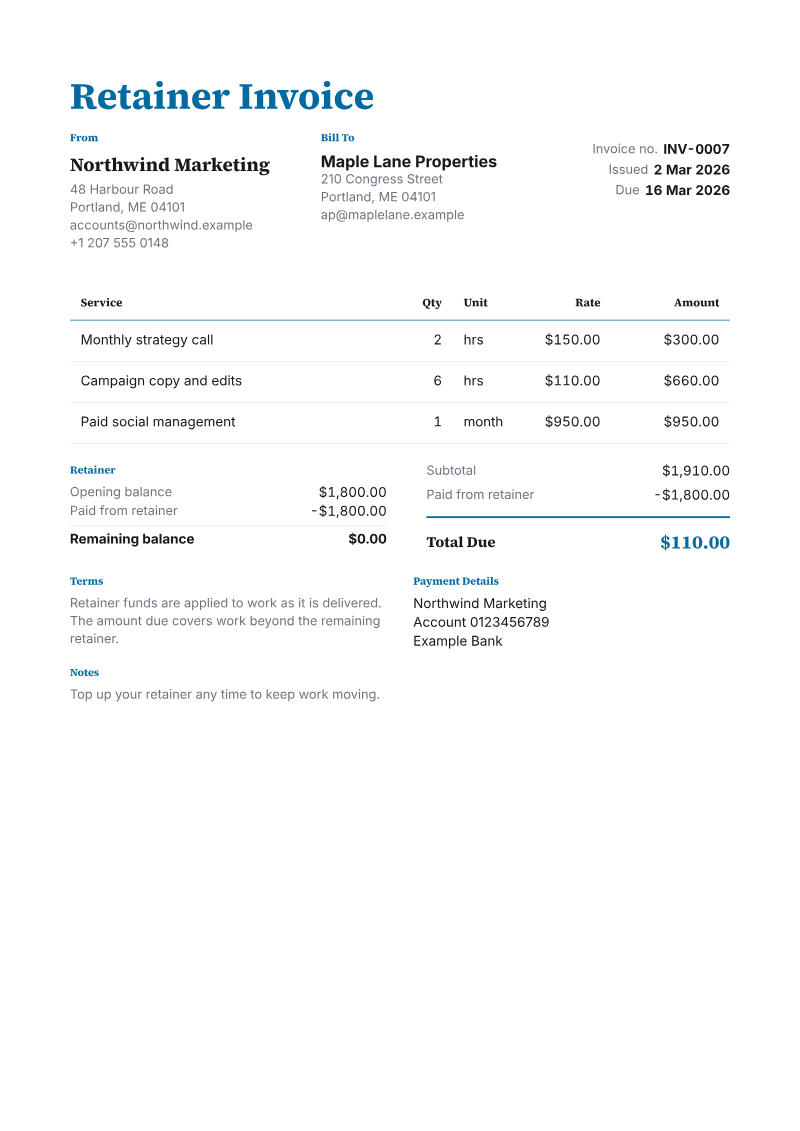
Duplicating an issued or paid retainer invoice starts the copy with the balance the previous invoice left, so month two opens at month one's remaining balance without retyping. For a deposit on a single job, there is a separate “Deposit already received” field that credits the deposit against the total.
The catches, stated plainly:
- The balance is typed, not linked. The first opening balance, and any top-up, is entered by hand. Charming does not connect the funding invoice to the draw invoices, so check the figure when a top-up arrives.
- Charming does not hold the money. There are no card payments through Charming. The client pays you directly, by the method on the invoice, and you mark the invoice paid yourself.
- No refund or credit-note feature. A refund at the end of a retainer is something you pay and record outside Charming.
- Recurring invoices are on paid plans, and they are drafts. On Individual ($29 once), Team ($79 once) or Pro ($12 a month or $99 a year), a recurring schedule (weekly, monthly, quarterly or yearly) raises a draft with the same lines each cycle. A draft is never issued or sent for you: you issue it, download the PDF or copy its link, and send it yourself. That suits a monthly flat-fee retainer, but recurring drafts do not carry a retainer balance forward, so for drawdowns duplicate the last issued invoice instead.
- The Retainer section belongs to the template. The balance prints when the business uses the Retainer template, or has the Retainer section switched on in its template settings.
- Free invoices carry a footer line reading “Sent with Charming Invoices”. Paid plans hide it by default.
If you want to see the layout with your own numbers, create a free invoice and pick the Retainer template, or browse every layout on the templates page. Plans and prices are on the pricing page.
Frequently asked questions#
Is a retainer the same as a deposit?#
Not usually. A deposit is part payment for one specific job and is taken off that job's final invoice. A retainer covers an ongoing arrangement. Some trades use the words interchangeably, so the agreement should say which one you mean.
Do I invoice a retainer before or after the work?#
A retainer is normally invoiced before the period it covers: the monthly fee at the start of the month, the drawdown funding before any work starts. Overage and work beyond a balance are billed after the work.
Should a drawdown invoice show $0.00 due?#
Yes, when the balance covers the work. Send it anyway: it is the client's record of what their prepayment bought.
Can I make a retainer non-refundable?#
That is a question for a lawyer where you and the client are, and the answer depends on the agreement and the type of retainer. In practice, a fee for availability that has already been provided is easier to explain to a client than an advance for work that never happened. For legal services, rules vary by state; check your state bar (the Colorado and California rules quoted above are two examples).
Whichever type you run, the method is the same: agree the type in writing, print the period and the rule on every invoice, and show the balance every time money moves. For other trades that bill on a schedule, cleaning and home service invoices covers per-visit and recurring billing, and how to invoice as a freelancer covers the basics behind all of it.
Free download
No sign-up and no email address. More on the free templates page.
- Download .xlsx: Retainer tracker
Retainer tracker
Excel .xlsxFor prepaid and drawdown retainers: a running balance of money paid in, work drawn from it and anything refunded, with a low-balance alert.