Web development invoice: milestones, scope and hosting

Nnabuike Okoroafor ·
On this page · 12 sections
You built the site, or you are about to. The client signed off on a price, and now you need a web development invoice that bills the right amount at the right moment, covers the extra page they asked for in week three, and passes on the hosting bill without looking like a mark-up. A plain “Website — $12,000.00” line does none of that, and it is usually the start of a long email thread.
This guide covers how freelance web developers and small dev shops actually bill: fixed price versus hourly versus retainer, a milestone schedule (deposit, design approval, build, launch), change-request lines that stop scope creep turning into free work, hosting, domain and licence pass-through costs, pointing to the ownership clause in your contract, where to check sales tax and VAT, and clients abroad. There is a worked example with real figures you can copy.
The business, client and figures in the examples are invented. This is general information, not legal or tax advice. Rules differ by country and state, and they change.
What a web development invoice needs (the short list)#
Every invoice needs the basics: your business name and contact details, the client's name, a unique invoice number, the issue date, a due date, line items, the total and how to pay. What actually belongs on an invoice covers those in detail. Web work adds five things clients look for:
- The project and the agreement it belongs to. “Website rebuild, agreement HPD-2026-03.” Accounts teams match invoices to a contract or purchase order before they pay.
- Which milestone this is, and its share. “Milestone 2 of 4: design approval (30% of $12,000.00).” The client can check it against the schedule without opening the contract.
- Change requests as separate lines. Each with its own reference and approval date, never folded into a milestone.
- Third-party costs, labelled as such. Hosting, domains, plugin and font licences, with the period covered and whether you charged them at cost.
- What happens on final payment. If your contract deals with ownership of the site and code, a one-line note pointing to that clause.
Fixed price, hourly or retainer: choosing how to bill#
Most web development is billed in one of three ways, and many projects use two of them in sequence: a fixed-price build, then a monthly care plan.
| Model | Best for | What the invoice shows | The risk |
|---|---|---|---|
| Fixed price by milestone | A site with a written, signed-off scope | Milestone name, its % of the fee, change requests as extra lines | You carry the risk if the estimate was wrong |
| Hourly (time and materials) | Fuzzy scope, bug fixing, work on someone else's codebase | Dated tasks, hours, rate, a running total against any cap | The client carries the risk, so they watch every hour |
| Monthly retainer or care plan | Updates, security patches, backups, small changes after launch | The monthly fee, what it includes, extra hours beyond it | Unused hours become a debate unless the rules are written down |
If you are unsure which applies, this decision tree covers most projects:
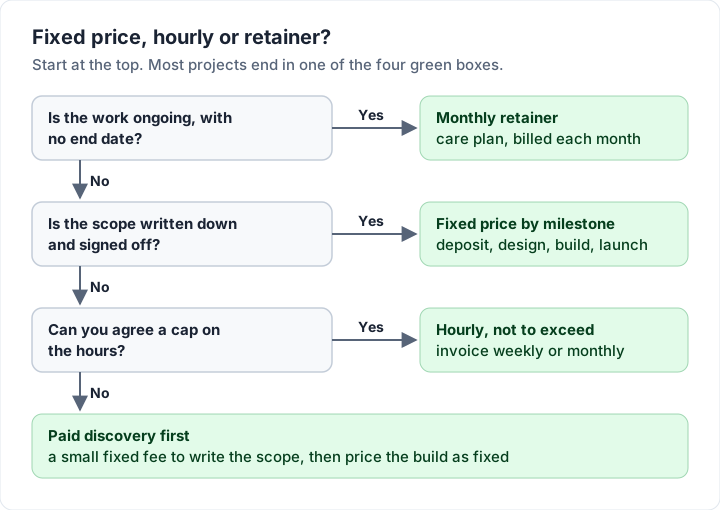
Paid discovery is the answer people skip. When a client cannot describe what they want, a small fixed fee to write the scope, sitemap and feature list turns an unpriceable project into a fixed-price one. It is also a cheap test of whether the client pays on time.
If you bill by the hour, the invoice has to show where the time went: dated tasks, hours per task, your rounding increment and the cap. How to invoice for consulting covers hourly billing and caps in depth, and the hourly invoice template shows a time-grouped layout with weekly subtotals.
A milestone payment schedule for a website build#
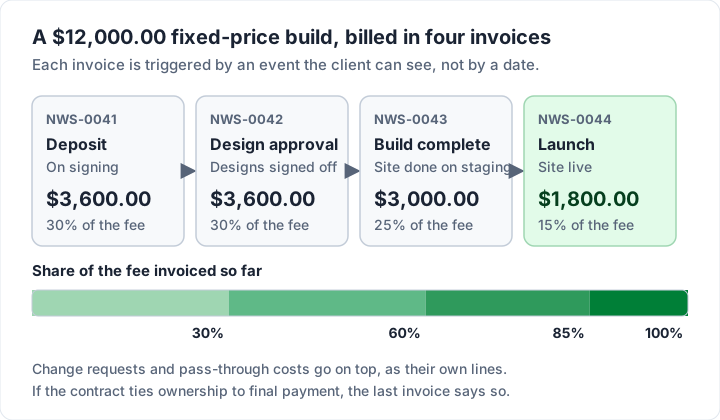
For a fixed-price build, tie each invoice to an event the client can see, not to a calendar date. “Designs signed off” is hard to argue with; “1 March” is not, if the client was three weeks late with the content.
Here is a common four-stage schedule, with the worked example's figures for a $12,000.00 build:
| Invoice | Milestone | Triggered by | Share | Amount |
|---|---|---|---|---|
| NWS-0041 | Deposit | Signed agreement | 30% | $3,600.00 |
| NWS-0042 | Design approval | Homepage and inner-page designs signed off | 30% | $3,600.00 |
| NWS-0043 | Build complete | Site finished on a staging server | 25% | $3,000.00 |
| NWS-0044 | Launch | Site live on the client's domain | 15% | $1,800.00 |
| 100% | $12,000.00 |
A few choices are worth making deliberately:
- The deposit. It pays for your time before the first deliverable and confirms the client is serious. Do not start work until it clears. How a deposit invoice works explains how to show it and credit it later.
- Keep something meaningful for launch. If 100% is paid before go-live, you lose the moment that gets the last fixes approved. If launch carries 50%, a client who stalls on content leaves you unpaid for months. Somewhere between 10% and 25% is a common compromise.
- Write an acceptance window into the agreement. For example, “Deliverables are treated as approved if no written feedback is received within 5 business days.” Without one, a milestone invoice can wait indefinitely for a sign-off nobody gives.
- Decide what “launch” means if the client delays it. A clause such as “If launch is delayed by the client for more than 30 days after the site is ready on staging, the launch milestone becomes due” keeps the final invoice from depending on their marketing calendar.
Billing a long project in stages has its own vocabulary and maths (percentage complete, previously billed, balance to complete). Progress invoicing explained walks through it, and contract invoices covers how to reference the agreement on each one.
Change requests: how to bill scope creep#
Scope creep rarely arrives as one big request. It is an extra page, a “quick” integration, one more round of revisions. Each is small enough to feel awkward to charge for, and together they can eat the margin on a fixed-price job. Saying no to each one in turn is hard, especially when you depend on the client for work.
The fix is a process, agreed in the contract before the project starts, so “out of scope” is not a judgement you defend each time but a step everyone already signed up to:
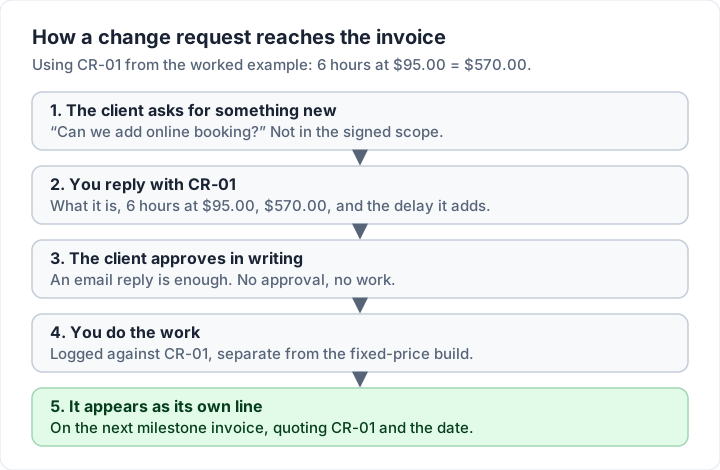
On the invoice, a change request line should say what it was, quote its reference and show how it was priced. Either of these works:
- “CR-01 Booking integration, approved 3 Sep — 6 h × $95.00 = $570.00” (hourly)
- “CR-02 Extra landing page template, approved 17 Sep — $350.00” (fixed)
A change-request quote is a short estimate, sent before the work. If you are unsure which document is which, invoice vs estimate or quote explains the difference.
Do not hide the extra work inside a milestone (“Build complete, including booking”). The client cannot see what they are paying for, and the next time they ask for something you have taught them it was included.
Hosting, domains and licences: passing costs through#
Most web projects carry third-party costs: hosting, the domain name, premium plugins or themes, font licences, email services, stock images, API usage. There are three honest ways to handle them, and the right one depends on how much responsibility you want to keep.
| Approach | How it looks on the invoice | Good for | Watch out for |
|---|---|---|---|
| Client owns the account | Nothing, or a one-off setup fee | Most small business sites | You need the client to set up and keep the login |
| You pay, re-bill at cost | “Hosting, 12 months, at cost (receipt attached) — $240.00” | Clients who want one bill | Renewals you must remember and chase |
| You pay, re-bill with a margin, or bundle it | “Managed hosting and monitoring, monthly — $45.00” | When you add real work: updates, backups, uptime checks | Say it is a managed service, not “hosting at cost” |
The domain is a special case. Register it in the client's name, on an account they control, even if you set it up. A domain held in a developer's personal account is a common source of painful disputes years later, after the developer has moved on.
Two habits keep pass-through lines trouble-free. First, label the period covered (“12 months from 1 Oct 2026”), so the renewal is no surprise. Second, if you add a margin, describe what the client gets for it; a line that says “at cost” should actually be at cost. Card fees work the same way: if you plan to recover them, see what card payment fees really cost on an invoice first.
Who owns the code: transfer on final payment#
Clients often assume that paying for a website means owning it. Who owns the code is a legal question, answered by your contract and the copyright law where you and the client are, and an invoice cannot settle it on its own. The official starting points are the US Copyright Office and GOV.UK's copyright pages; for the contract itself, ask a lawyer.
In practice, developers commonly handle it like this:
- Deal with ownership in the contract. For example, a clause saying what passes to the client on payment in full, and what does not (third-party components, your own pre-existing tools). Have a lawyer write or check the wording for your country.
- Point to it on the final invoice. “On payment in full, ownership of the site and code passes to the client, as set out in clause 9 of the agreement.” The invoice repeats what the contract says; it does not add new terms.
- List what comes from third parties. Open-source libraries, licensed plugins and themes come with their own licences, so tell the client which ones the site uses and where to find the terms.
Some contracts let the developer hold back credentials or a staging site until final payment. Taking down a live site the client already uses is a different matter: ask a lawyer before you do anything like that. Is an invoice a contract? explains why the agreement, not the invoice, carries these terms, and what to do when a client is not paying covers the escalation steps.
Sales tax and VAT on web development#
Whether you charge tax on a web development invoice depends on where you are, where the client is, whether they are a business, and exactly what you sold. Building a site, hosting it and selling a software licence can each be treated differently, and the rules change. The questions to take to your accountant:
- Is web development taxed where I work, and is hosting treated the same way? In the US this is set state by state.
- Does it matter that my client is a business, or abroad? Business and consumer clients, and clients in other countries, can be treated differently for VAT.
- What does my invoice need to show if a special rule, such as a reverse charge, applies?
Where to read the official guidance:
- US states: your state's tax authority, for example the Texas Comptroller's tax publications.
- EU: the Your Europe page on cross-border VAT.
- UK: HMRC's VAT Notice 741A on the place of supply of services.
Whatever the answer, separate lines for build, hosting and licences make it easier to apply the right treatment to each. What is a tax invoice? covers VAT-registered invoicing in general terms.
Invoicing international clients#
Remote clients are normal for developers, and they add three decisions to the invoice:
- Currency. Agree it in the contract and invoice in that currency. If you bill in the client's currency, you carry the exchange-rate risk between invoice and payment; if you bill in yours, they do. If clients pay by card through an invoicing platform, check its currency-conversion fee as well; our Bonsai invoices guide shows one at work.
- Who pays the transfer fees. International bank transfers can arrive short. Say who covers fees in your payment terms, for example “Payments must arrive in full; sender pays all transfer charges.”
- Tax identity. Ask business clients for their registered name, address and VAT or tax number before the first invoice, and show them on it. Your accountant may need them to work out the VAT treatment.
Payment terms matter more across borders, because chasing is harder. Fourteen days from the invoice date is common for freelancers; Net 30 and other payment terms explains the options, and the invoice due date calculator works out the date for you.
Worked example: the launch invoice, line by line#
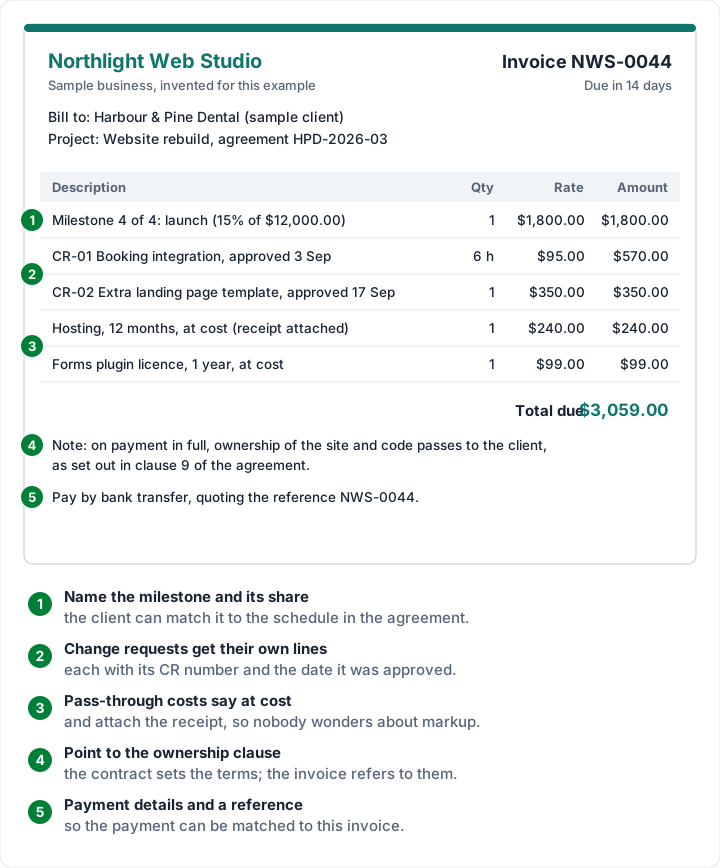
Northlight Web Studio (invented) is building a new site for Harbour & Pine Dental (an invented client) for a fixed $12,000.00, using the four-stage schedule above. During the build the client approved two change requests and asked Northlight to pay for a year of hosting and a premium forms plugin. Here is the final invoice, NWS-0044, due in 14 days:
| Description | Qty | Rate | Amount |
|---|---|---|---|
| Milestone 4 of 4: launch (15% of $12,000.00) | 1 | $1,800.00 | $1,800.00 |
| CR-01 Booking integration, approved 3 Sep | 6 h | $95.00 | $570.00 |
| CR-02 Extra landing page template, approved 17 Sep | 1 | $350.00 | $350.00 |
| Hosting, 12 months, at cost (receipt attached) | 1 | $240.00 | $240.00 |
| Forms plugin licence, 1 year, at cost | 1 | $99.00 | $99.00 |
| Total due | $3,059.00 |
The example assumes no sales tax or VAT applies; add a tax line if yours does. Across the four invoices the client paid $13,259.00: the $12,000.00 fee, $920.00 of approved change requests and $339.00 of third-party costs. Every dollar above the agreed fee traces to a line with a reference.
After launch: billing a maintenance retainer#
Once the site is live, most developers offer a monthly care plan: updates, security patches, backups, uptime monitoring and a small allowance of hours for changes. The invoice should make the boundary of the allowance obvious. A sample month:
| Description | Qty | Rate | Amount |
|---|---|---|---|
| Care plan, October: updates, backups, monitoring, up to 3 hours of changes | 1 | $350.00 | $350.00 |
| Changes beyond the plan: new staff page and booking form edits | 2 h | $95.00 | $190.00 |
| Total | $540.00 |
Write down what happens to unused hours (most plans say they do not roll over) and whether the plan is billed in advance or in arrears. How a retainer invoice works covers prepaid retainers that are drawn down over time, which suit larger clients who buy a block of hours. If the monthly fee is the same every month, recurring invoices save you rebuilding it each time.
Doing this in Charming Invoices#
We make Charming Invoices, so here is exactly what it does for this kind of billing, and where it falls short.
- Starting points, not prices. When you start a new invoice, “Start from a kit” offers a “Product build milestone” kit (lines for “Discovery and scoping” and “Build — milestone deliverable”) and a “Web design retainer” kit (one line, “Monthly retainer — design & development”). Prices are left at 0 on purpose, and a kit replaces the lines, so it is only offered on a blank invoice.
- Layouts that suit the work. All 60 templates are on the free plan, including Mono / Tech (monospaced, described in the app as made for developers), Timesheet (time grouped by week or project, with an hours total), Progress Billing, Retainer and Creative Studio. You can rename labels and group lines under headings such as “Milestone”, “Change requests” and “Pass-through costs”, each with a subtotal, once section grouping is on for the business in the Template Studio (Timesheet and Contractor have it on already).
- Deposits and stages. A deposit received before the invoice is credited against the total, and a progress invoice tracks contract value, previously billed and balance to complete. Duplicating an issued progress invoice rolls those figures forward for the next stage.
- Care plans on repeat (paid plans). A recurring invoice raises a draft every week, month, quarter or year for you to review. It is never issued or sent for you: you issue it, then download the PDF or copy its link and send it yourself.
- AI drafting (paid plans). Describe the work in a sentence and Charming suggests line items. It leaves prices it was not told at 0, and it never creates a client or sends anything.
The catches. Charming has no time tracker (Timesheet is a layout, so you type in the hours from wherever you track them) and no estimates or quotes, so change-request quotes go out by email or document. It does not email invoices or send reminders either. Clients cannot pay by card from the invoice: your bank details or payment link print on it, and you mark it paid yourself. Each invoice has one tax rate applied to the whole subtotal, so if some lines are taxable and others are not, put them on separate invoices. Currency is set per business, one at a time: you can switch it on any plan (issued invoices keep theirs), but billing one client in euros and another in dollars side by side needs a second business, and Free includes 1 business. Free invoices carry a small “Sent with Charming Invoices” line. Paid plans are Individual at $29 once, Team at $79 once, or Pro at $12 a month or $99 a year; the one-time plans are final sale.
If that fits how you bill, create a free invoice and try the milestone kit on your next project, or compare plans if you need recurring care-plan drafts.
Frequently asked questions#
Should a web developer charge a deposit?#
For a fixed-price build, yes in most cases. A deposit of 25% to 50% is common; the right figure covers your work up to the first deliverable. How to invoice as a freelancer covers deposits alongside the other first-invoice decisions.
Can I mark up hosting I resell to a client?#
You can, if the client agreed to it and the line does not say “at cost”. Most developers either pass hosting through at cost or bundle it into a managed plan that includes real work, such as updates and monitoring, and price that work.
What do I put on an invoice for software development rather than a website?#
The same structure: the agreement reference, milestone or sprint, hours or fixed amounts, change requests and third-party costs as separate lines. For ongoing product work billed per sprint, name the sprint and its dates on each invoice.
Do I invoice the client for revisions?#
Only for revisions beyond what the contract includes. State the number of revision rounds in the agreement, then bill extra rounds as change requests. Designers face the same problem; your invoice is arguing against your rate shows how vague line items undercut a price. Our graphic design invoice template shows an extra revision round billed on a filled-in sample.