Invoicing as a freelancer, end to end

Nnabuike Okoroafor ·
On this page · 12 sections
Invoicing as a freelancer, in short
- Agree the price, the billing schedule, the payment terms and the currency before you start. Most invoice trouble is a conversation that never happened.
- Put your legal name on the invoice, plus your trading name if you use one. Add a tax number only if you actually have one.
- Invoice at the points you agreed: upfront, at milestones, at the end, or on a regular cycle for hourly and retainer work.
- Bill a foreign client in the currency you agreed, written as a three-letter code, and say who pays the transfer fees.
- Keep every invoice and a note of every payment. That pair is your income record at tax time.
- Tax rules depend on your country. Below are a few official pages, quoted and linked. General information, not legal or tax advice.
Invoicing as a freelancer usually starts with a small shock. A client says “send me an invoice”, and you realise nobody has ever shown you how. One person in a public discussion we read while researching this product put it plainly (the people quoted in our research are strangers on public forums, not Charming customers):
A client asked me to send an invoice, and I realized I've never had to create one before. I've always been on payroll, so this side of things is completely new to me.
On payroll, someone else handled all of this. Now it is yours: the document, the timing, the follow-up and the records. None of it is hard, but it does come in a particular order. This guide walks through that order, from agreeing terms to getting paid, with example invoice lines, a full worked project and a filled-in freelance invoice you can copy.
If this is your very first invoice and you want the shortest, gentlest version, read your first invoice: what actually has to be on it first. This post is the whole workflow around it.
Invoicing as a freelancer: the workflow in seven steps#
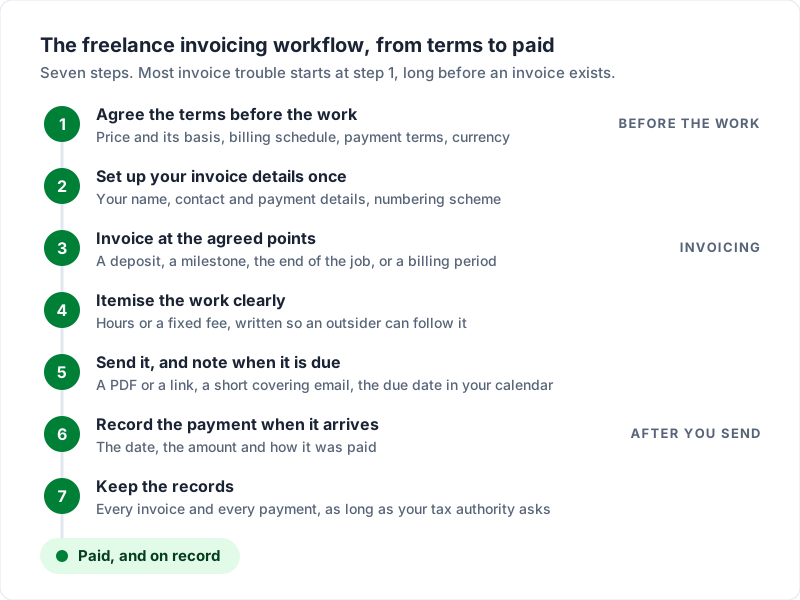
Here is the full loop. Each step has its own section below.
- Agree the terms before the work. Price, how it is calculated, when you will bill, when payment is due, and in what currency.
- Set up your invoice details once. Your name, contact details, payment details and numbering scheme.
- Invoice at the agreed points. A deposit, a milestone, the end of the job, or the end of a billing period.
- Itemise the work clearly. Hours or a fixed fee, written so someone outside the project can follow it.
- Send it, and note when it is due. A PDF or a link, with a short covering email.
- Record the payment when it arrives. The date, the amount and how it was paid.
- Keep the records. Every invoice and every payment, kept for as long as your tax authority says.
Before any invoice: agree four things in writing#
The invoice is the last document in a conversation. If that conversation skipped a step, the invoice is where it surfaces, usually as “I thought this was included” or “we pay on 60-day terms”.
Agree these four things before you start, in an email if there is no contract:
- The price and its basis. A fixed fee for a defined scope, or an hourly or day rate with an estimate. If it is hourly, say whether you bill in quarter hours, half hours or whole hours.
- The billing schedule. All upfront, a deposit then the balance, milestones, or monthly in arrears.
- The payment terms. When each invoice is due, for example 14 days from the invoice date. Net 14 and Net 30 (due 14 or 30 days after the invoice date) are the usual choices.
- The currency. Especially if the client is in another country. More on that below.

A short confirmation email does the job. Copy and adapt this:
Hi Dana, thanks for the call. To confirm what we agreed:

- Scope: homepage and four inner pages, two rounds of revisions
- Fee: $4,800.00 (USD), fixed
- Billing: 40% on signing, 30% when designs are approved,
  30% on launch
- Payment terms: each invoice due 14 days from its date,
  by bank transfer
- Extra work outside this scope: $85.00 an hour, agreed in
  writing before I start it

If that all looks right, a quick reply is enough and I will
send the first invoice today.
The reply is your agreement. When the final invoice goes out, nothing on it is news.
What to put on an invoice as a sole trader or freelancer#
The general list of invoice fields is covered in the field-by-field invoice checklist. The questions freelancers actually ask are narrower: whose name goes on it, which numbers go on it, and what to leave off. To check an invoice on paper, print the free invoice fields checklist (A4, or US Letter), or the shorter first-invoice checklist (A4, or US Letter) if this is your first.
Your name or your business name#
If you work for yourself without a company, you are usually invoicing as an individual. Different countries call this a sole trader, a sole proprietor or self-employed. The invoice goes out in your own legal name.
If you also use a trading name, show both. A common pattern is “Alex Rivera, trading as Rivera Studio”. In the UK, GOV.UK’s invoicing guidance says that a sole trader’s invoice “must also include” “your name and any business name being used” and “an address where any legal documents can be delivered to you if you are using a business name” (as of 28 October 2026).
If you have formed a company, the company is the one invoicing, and the company’s registered name goes on the invoice instead.
Tax and registration numbers#
Add a number only if you have one and it belongs there:
| Your situation | What goes on the invoice |
|---|---|
| Registered for VAT, GST or sales tax | Your registration number, the tax line and any wording your tax authority requires |
| Not registered for any sales tax | No tax number, no tax line, no tax charged |
| You have a business or company number | Check your country’s official invoicing guidance on whether it belongs there |
| Your client asks for your taxpayer number | Give it the way they ask for it (in the US, usually a form), not printed on every invoice |
That last row matters. In the US, the IRS page for businesses that pay contractors says Form W-9 “can be used to request the correct name and taxpayer identification number, or TIN, of the payee” (IRS, Forms and associated taxes for independent contractors, as of 28 October 2026). That form goes to the client, usually once. Think twice before also printing your Social Security number on every invoice you send, where anyone who handles it can read it. Our free independent contractor invoice template shows where the W-9 and 1099-NEC fit.
The same rule applies to inventing numbers. An empty field is fine. A plausible-looking number you do not have is a real problem. If you are registered and are not sure what the extra fields are, what a tax invoice is walks through them.
What to leave off#
- Personal details the client does not need. You may need to give an address, but your date of birth and personal ID numbers do not belong on an invoice.
- Internal notes. Your margin, your estimate of hours you did not bill, your nickname for the client.
- Anything you did not agree. A new fee appearing for the first time on an invoice reads as a surprise, not a charge.
When to invoice: upfront, at milestones or at the end#
When you invoice as a freelancer, there is no single right moment. What matters is that the timing was agreed, and that the money arrives roughly as the work goes out.
| Schedule | How it works | Suits |
|---|---|---|
| Full payment upfront | One invoice before work starts | Small, fixed jobs; new clients you do not know |
| Deposit, then balance | One invoice at booking, one at delivery | Bookings with a date, such as events or shoots |
| Milestones | An invoice at each agreed stage | Projects longer than a few weeks |
| End of the job | One invoice on delivery | Short jobs with clients you already trust |
| Regular cycle | Weekly, fortnightly or monthly, in arrears | Hourly work and ongoing retainers |
A few practical rules sit underneath that table.
The longer the project, the more often you should bill. Waiting until the end of a three-month project means three months of unpaid work, and one invoice large enough to need someone’s approval. Milestones break that into amounts that get paid in a normal cycle.
Ask for something upfront from new clients. A deposit is not an accusation. It tells you the client is real and committed, and it pays for the time you set aside. Deposit invoices: how they actually work covers the wording and how the deposit shows on the final invoice.
Tie each milestone to something both of you can see. “Designs approved” or “first draft delivered” works. “Halfway through” does not, because nobody agrees where halfway is.
For hourly work, bill on a fixed day. The last working day of each month, or every other Friday. Hours that sit unbilled for weeks get harder to explain and easier to dispute.
Send it promptly. An invoice sent the day the milestone is reached is about the work. The same invoice sent three weeks later is about a memory.
Hourly or project: how each looks on the invoice#
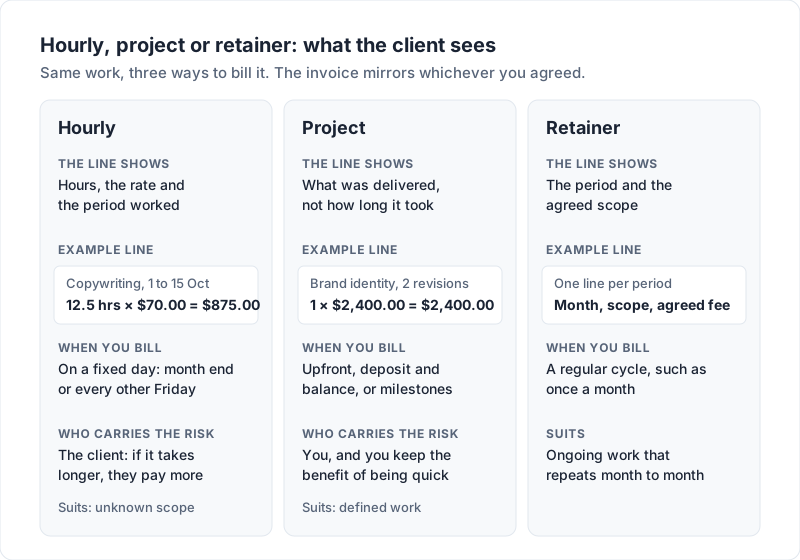
Both are normal, and both can be invoiced clearly. The difference is what the client sees.
Hourly billing#
Show the hours, the rate and the period. If several kinds of work are involved, use one line for each so the total can be checked.
| Description | Qty | Rate | Amount |
|---|---|---|---|
| Copywriting, product pages (1 to 15 October) | 12.5 hrs | $70.00 | $875.00 |
| Client calls and revisions (1 to 15 October) | 2 hrs | $70.00 | $140.00 |
| Total | $1,015.00 |
Keep your own timesheet behind these lines, even if the client never asks for it. If they query the total, you can answer with dates rather than a feeling.
Project billing#
Show what was delivered, not how long it took. A fixed fee is a price for an outcome, and itemising your hours invites the client to argue with each one.
| Description | Qty | Rate | Amount |
|---|---|---|---|
| Brand identity: logo, colour palette and type system, two revision rounds | 1 | $2,400.00 | $2,400.00 |
| Total | $2,400.00 |
Choosing between them#
- Hourly suits work where the scope is genuinely unknown: maintenance, consulting, open-ended edits. The client carries the risk that it takes longer.
- Project suits work you can define: a logo, a website, a set of articles. You carry the risk, and you keep the benefit of being quick.
- A mix is common and fine: a fixed fee for the defined scope, plus an hourly rate for anything outside it. That is the pattern in the confirmation email above.
- A retainer is the third option: an agreed fee for ongoing work, billed on a regular cycle, one line per period naming the period and what it covers. How to invoice for consulting services shows how a prepaid retainer is drawn down on paper.
Side by side, the three look like this on the invoice:
Invoicing a client in another country#
Currency is where small misunderstandings with a client abroad cost real money.
- Agree the currency before the work. Either you take the exchange risk (you bill in their currency) or they do (you bill in yours). Both are legitimate. Pick one and write it down.
- Write the currency as a code. USD, CAD, AUD, GBP, EUR. The dollar sign alone is used by several currencies, and “$2,000” means very different amounts in New York and Sydney.
- Show one amount due. If you want to show a conversion for the client’s convenience, label it clearly as for reference only, with the rate and its date. The amount due stays in the agreed currency.
- Say who pays transfer fees. International transfers can lose money in transit. If you want the full amount to arrive, say so on the invoice: “Please ensure the full amount arrives; transfer charges are paid by the sender.”
- Give payment details that work from abroad. An IBAN and BIC or SWIFT code for many countries, or a payment link the client can use from where they are.
Tax across borders is its own question, and it is covered with the tax section below.
A worked example: one freelance project, three invoices#
Here is the whole workflow on one invented project, a complete invoice example for self-employed work, from first invoice to last. The names and figures are examples, not a real client.
Alex Rivera is a freelance web designer working as a sole trader under the name Rivera Studio. Alex is not registered for any sales tax. The client, Northfield Bakery Ltd, wants a five-page website. They agree the terms in the confirmation email shown earlier: $4,800.00 fixed, split 40%, 30% and 30%, each invoice due in 14 days.
| Invoice | Trigger | Amount | Due |
|---|---|---|---|
| 2026-007 | Agreement signed, 2 November | $1,920.00 | 16 November |
| 2026-009 | Designs approved, 23 November | $1,440.00 plus extra work | 7 December |
| 2026-012 | Site launched, 14 December | $1,440.00 | 28 December |
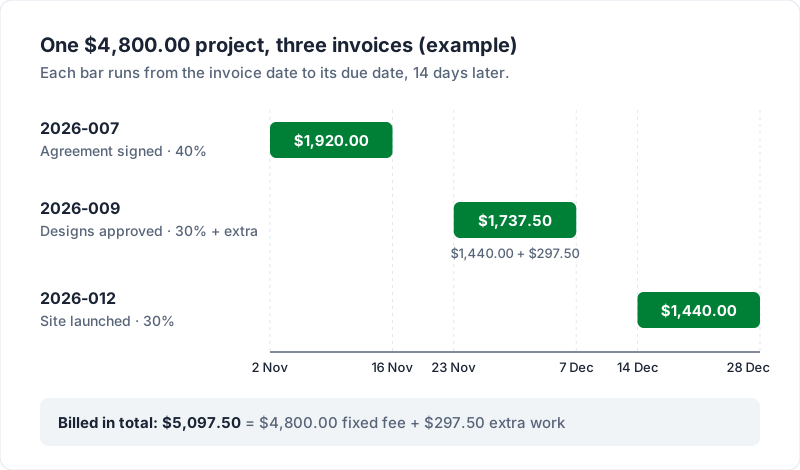
The gaps in the numbers are not missing invoices. Alex invoices other clients in between, and the numbers run in one sequence across all of them. One sequence for all your freelance invoices keeps your income record easy to follow.
During design, the client asked for an extra landing page. Alex quoted 3.5 hours at the agreed $85.00 an hour, the client said yes by email, and it goes on the second invoice. That invoice looks like this:
Invoice 2026-009
- From: Alex Rivera, trading as Rivera Studio, [email protected]
- To: Accounts, Northfield Bakery Ltd
- Invoice date: 23 November 2026
- Due: 7 December 2026 (14 days)
- Reference: Website project, stage 2 of 3
| Description | Qty | Rate | Amount |
|---|---|---|---|
| Website design, stage 2: designs approved (30% of $4,800.00 fixed fee) | 1 | $1,440.00 | $1,440.00 |
| Additional landing page, agreed by email 18 November | 3.5 hrs | $85.00 | $297.50 |
| Total due (USD) | $1,737.50 |
- Payment: Bank transfer to Alex Rivera, account details below. Please quote 2026-009 as the reference.
- Note: Not registered for sales tax; no tax charged.
Here is the same invoice laid out as a client would see it, with the points below marked:
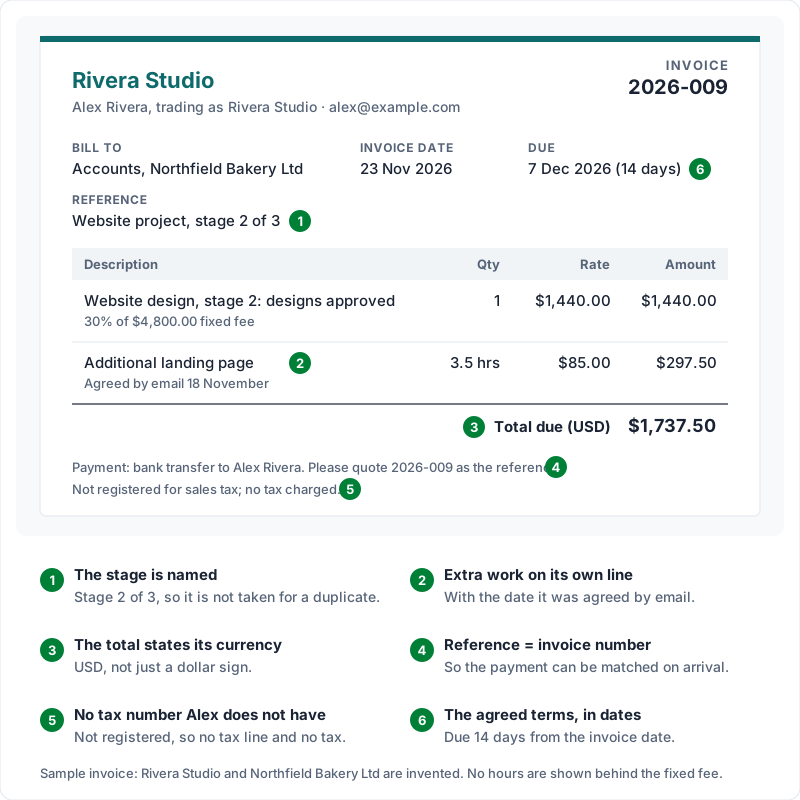
Notice what is on it. The stage is named, so the client’s accounts team knows this is the second of three and not a duplicate. The fixed fee and the extra work are on separate lines, and the extra line says when it was agreed. The total states its currency. The payment reference is the invoice number, so the payment can be matched when it arrives.
And notice what is not on it: no tax number Alex does not have, no hours behind the fixed fee, no apology.
Running total for the project: $1,920.00 plus $1,737.50 plus $1,440.00 makes $5,097.50 billed. That is the $4,800.00 fee plus the $297.50 of extra work.
Freelance invoice: a worked sample#
The project above runs on a fixed fee. A lot of freelance work is priced by the day instead, so here is a second freelancer invoice, complete and filled in, on a day rate with an expense passed on at cost. The names and figures are invented for this example.
Tomasz Pembury is a freelance motion designer, trading as Pembury Motion and not registered for any sales tax. Fernhollow Cycles Inc. booked him at $650.00 a day to animate a product launch video, on 30-day terms. He worked six full days, from Monday 2 to Monday 9 November 2026, and a half day on Tuesday 10 November. At the client’s request he also bought a stock music track for the video.
Invoice PM-0031
- From: Tomasz Pembury, trading as Pembury Motion, [email protected]
- Bill to: Accounts Payable, Fernhollow Cycles Inc.
- Invoice date: Monday 16 November 2026
- Due: Wednesday 16 December 2026 (30 days)
- Reference: Product launch video, motion design
| Description | Qty | Rate | Amount |
|---|---|---|---|
| Motion design, 2 to 9 November (6 days) | 6 | $650.00 | $3,900.00 |
| Motion design, 10 November (half day) | 0.5 | $650.00 | $325.00 |
| Stock music licence for the launch video, at cost (receipt attached) | 1 | $49.00 | $49.00 |
| Total due (USD) | $4,274.00 |
- Payment: Bank transfer to Tomasz Pembury, with the account name, account number and routing number written out in full. Please quote PM-0031 as the reference.
- Note: Not registered for sales tax; no tax charged.
The sample, field by field#
- From. The legal name first, then the trading name, as in the sole trader section above. An email address is enough contact detail for most clients.
- Bill to. The accounts payable team, not the marketing manager who booked the work. The person who approved the job is rarely the person who pays it.
- Invoice number. PM-0031 is the next number in the one sequence Tomasz uses for every client, with PM for Pembury Motion as the prefix.
- Invoice date and due date. The due date is 30 days after the invoice date, exactly the terms agreed at booking, so nothing on the invoice is new to the client.
- Day-rate lines. The dates sit in the description, so the client can check each day against their own calendar. The half day is its own line with a quantity of 0.5, not a full day rounded up.
- The expense. The music track is billed at what it cost, says so, and goes out with its receipt. How to bill expenses to a client covers markups and receipts in more detail.
- Total. One amount due, with its currency code: $3,900.00 plus $325.00 plus $49.00 is $4,274.00.
- Payment and note. The payment line asks for the invoice number as the reference, so the transfer can be matched when it lands. The note says why there is no tax line.
Compared with invoice 2026-009 above, there is no stage reference and no share of a fixed fee: a day-rate invoice bills days already worked. In Charming Invoices the half day is entered as a quantity of 0.5 (the quantity field takes up to 3 decimal places), and the rate is kept to whole cents because unit prices print with 2 decimals on the PDF and the client’s page.
If you would rather start from a blank file than build this from scratch, the independent contractor invoice template gives you free files made for Excel and Word, with its own filled-in sample. Google Sheets and Docs can open them after conversion: check the totals.
After you send it#
Send the invoice as a PDF attachment or a link, with a two-line email: what it is for, the amount, the due date. Put the due date in your calendar. Something like: “Hi Dana, invoice 2026-009 for stage 2 of the website is attached: $1,737.50, due 7 December. Thanks again.”
If the due date passes, follow up the next working day, politely and briefly. Most late invoices are forgotten, not disputed. The first nudge rarely needs to say more than the invoice number and the date it was due.
Keeping records you can hand to an accountant#
Your freelance invoices are your income record. When your tax return comes round, you or your accountant will want to see what you billed, what was paid and when. Keep these for every invoice:
- The invoice itself, as sent, with its number and date.
- The payment: the date it arrived, the amount, and how it was paid. Note part payments separately.
- Anything that changed the amount: a discount you agreed, a credit, an extra line.
- The exchange rate, if you were paid in another currency and need to report the income in yours.
- Your business costs, with receipts. Whether and how they reduce your tax depends on your country’s rules, but you cannot claim what you cannot show.
How long to keep them depends on where you file, so read your tax authority’s own page. Two examples, quoted as of 28 October 2026: the IRS page How long should I keep records? starts with “Keep records for 3 years if situations (4), (5), and (6) below do not apply to you” and lists the longer periods. GOV.UK’s page for the self-employed says: “You must keep your records for at least 5 years after the 31 January submission deadline of the relevant tax year.”
A spreadsheet works for the first handful of clients. If you would rather not maintain one by hand, Charming Invoices keeps every issued invoice exactly as it was issued, lets you record each payment against it (including part payments and the payment method) and exports your invoices as a CSV with the amount paid and balance due on each, on the free plan. The catch: payment tracking is manual, so you record payments yourself and mark the invoice paid. Charming is not accounting software and does not work out your tax. Each business also has a single currency, and the free plan covers 1 business. If you are still choosing a tool, the best invoicing software for freelancers compares nine on client caps, branding and cost.
Taxes for freelancers: what to know in a few countries#
Rules differ by country, and by state or province inside some countries, and they change. Use the official pages linked below, and an accountant if your situation is anything but simple.
The common thread: usually no employer is taking tax out of your freelance income before it reaches you, so you set money aside and pay it yourself. How and when depends on where you are.
The official pages below are quoted as they read on 28 October 2026. Thresholds change, so check the live page before you rely on a figure.
United States. The IRS’s self-employed individuals tax centre says: “You have to file an income tax return if your net earnings from self-employment were $400 or more.” It also says: “As a self-employed individual, generally you are required to file an annual income tax return and pay estimated taxes quarterly.” The IRS page on estimated taxes explains when those payments apply.
United Kingdom. GOV.UK’s Register for VAT page says: “You must register if your total taxable turnover for the last 12 months goes over £90,000.” The same page covers expected turnover and voluntary registration. Whether you charge VAT, and what the invoice then shows, follows from your registration; what a tax invoice is covers the extra fields.
Canada. GST/HST registration has a “small supplier” test. The Canada Revenue Agency’s page on when to register explains it; read it, or ask an accountant, if you are unsure whether you need to register.
Ireland, as an EU example. Ireland’s Revenue lists what a VAT invoice must show, including “in the case of a reverse charge, the customer’s VAT number and a notation that a ‘reverse charge applies’” (Revenue, information required on a VAT invoice). Other EU countries have their own versions of these rules, so check your own tax authority’s wording.
The country you are in is not the only thing that matters. Sometimes the client’s country does too, especially for VAT and GST on cross-border services. Someone in our research, freelancing for two different places in Berlin, described what happens when you guess:
I tried to do it the correct way by looking up online how to, but I keep being told I didn't do it right.
If a client’s accounts team sends an invoice back, ask them exactly which field they need. They usually know, and the fix is usually one line.
Where this guide stops#
This covers invoicing as a freelancer: the invoice and the workflow around it. It does not cover choosing a business structure, registering a company, or filing your return, and it is not a substitute for advice on your own tax position. It also does not cover legal action when a client will not pay. For the stage before that, the overdue invoice email, step by step has the wording for each follow-up. It does not compare tools either; if you want proposals, contracts and invoices in one app, our guide to Bonsai invoices sets out what that costs.
If you are a photographer, videographer or designer, invoicing for creative freelancers shows the templates and line items made for that work. If you write for a living, the freelance writer invoice, line by line covers per-word rates, kill fees and rights lines. If you play gigs or session work, the musician invoice template has a band’s balance invoice and a per-track session invoice filled in. Otherwise, the next step is the first invoice itself. Create a free invoice with your name, your terms and your first line item, and send it the day the work is ready.
Free downloads
No sign-up and no email address. More on the free templates page.
- Download .pdf: What belongs on an invoice: field checklist (A4)
What belongs on an invoice: field checklist (A4)
PDFCheck any invoice against the 11 essentials before it goes out.
- Download .pdf: What belongs on an invoice: field checklist (US Letter)
What belongs on an invoice: field checklist (US Letter)
PDFCheck any invoice against the 11 essentials before it goes out.
- Download .pdf: First-invoice checklist (A4)
First-invoice checklist (A4)
PDFFor your very first invoice: the seven things it needs, ticked off one by one.
- Download .pdf: First-invoice checklist (US Letter)
First-invoice checklist (US Letter)
PDFFor your very first invoice: the seven things it needs, ticked off one by one.