The overdue invoice email, step by step

Nnabuike Okoroafor ·
On this page · 14 sections
The due date has passed, the money has not arrived, and you are staring at a blank reply window trying to work out how to sound firm without sounding rude. Writing an overdue invoice email is a small job that feels large, mostly because you are not sure how many you are allowed to send or what the last one should say.
The question comes up again and again in the public online discussions we read while building Charming. Everyone quoted here wrote in those threads, and none of them is a Charming customer. One of them put the whole dilemma in five lines:
When a client misses an invoice deadline, what do you usually do? Do you remind them immediately? Wait a few days? Charge late fees? Just awkwardly follow up?
This post answers it with a sequence: a first nudge, a second follow-up, a firmer third message and a final notice, each with wording you can copy and adapt. After the sequence come a fill-in past due invoice email template, one email for a client with several outstanding invoices, and the final notice laid out as a past due invoice letter. The same emails are in a free Word file and a plain text file, if you would rather keep them outside this page. If the feeling of asking is the harder part for you, asking for money without the awkwardness covers that side. This one is about the emails themselves. If you want wording for the first email, not the chase, invoice email examples has templates for sending the invoice itself.
Before you write anything, check three things#
Most overdue invoices are not refusals. They went to the wrong inbox, are missing something the client’s accounts system needs, or are waiting for a payment run. Two minutes of checking can save an awkward chase.
- Look for the money first. Check your bank account, your payment link and any partial payment. Nothing undermines a follow-up like a client replying “we paid on Monday”.
- Re-read the invoice. Is the due date printed as a real date? Are your payment details on it, and correct? Did the client give you a purchase order number that is missing? The field-by-field invoice checklist is the quick way to check.
- Confirm who it went to. The person who hired you is often not the one who pays. If you sent it to your contact and nobody in accounts, that alone can explain the delay.
The sequence at a glance#
Days are counted from the due date. They are a common pattern, not a rule: shorten them for a small one-off job, stretch them for a large company with monthly payment runs. To plan the dates on paper, print the late-payment follow-up schedule (A4, or US Letter), which has a table to write in the date of each step and tick it off.
| Step | When (example timing) | Tone | What it asks for |
|---|---|---|---|
| First nudge | 1 to 3 days overdue | Friendly, assumes a mix-up | Confirmation it arrived |
| Second follow-up | About 7 to 10 days overdue | Polite, more direct | A payment date |
| Third follow-up | About 21 days overdue | Firm, names the next step | Payment or a call |
| Final notice | About 30 to 45 days overdue | Calm, formal, a deadline | Payment by a specific date |
Here is the same ladder applied to the example invoice used in every email below, with the real dates and day counts.
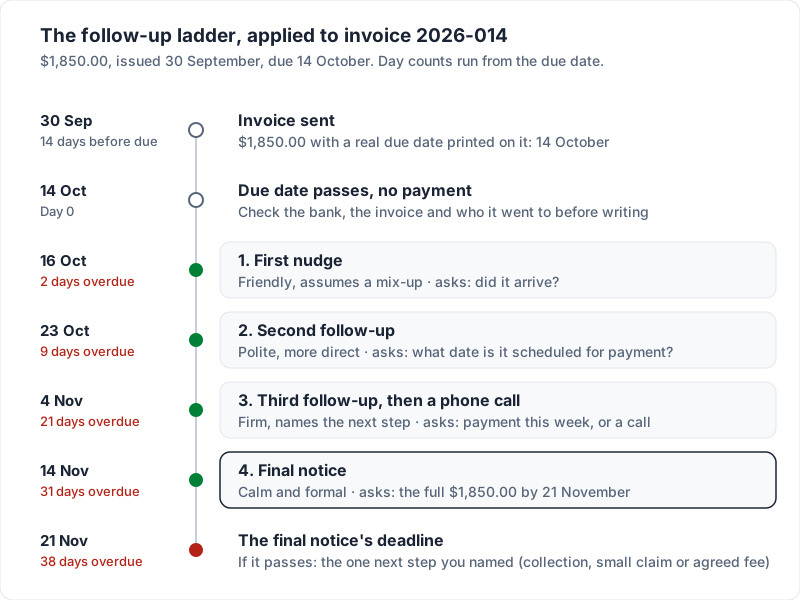
Two rules hold across every step. Each email names the invoice number, the amount and the original due date, so it makes sense to someone who has never seen the earlier messages. And each one replies in the same thread as the original invoice, so the history travels with it.
Step 1: the first overdue invoice email (1 to 3 days late)#
The first nudge confirms the invoice arrived and gives the client a face-saving way to fix whatever went wrong. Keep it short and assume good faith.
Subject: Invoice 2026-014 — due 14 October
Hi Sam,
A quick note that invoice 2026-014 for $1,850.00 was due on 14 October. I have attached it again in case it got buried.
If it needs to go to someone else in accounts, or needs a PO number on it, let me know and I will resend it today.
Thanks, Alex
The last line is the useful part. It turns “why have you not paid?” into “is there anything stopping this?”, and it often surfaces the real problem.
The bigger risk is not sending too many follow-ups. It is sending one and then stopping. One commenter in a public thread about getting paid on time summed up what usually happens instead:
Most freelancers don’t even get to escalation. They just:
- forget to follow up
- delay it because it feels awkward
- or stop after 1–2 emails
A sequence with dates fixes all three. Each step is spaced out so it counts, and each one is already written, so there is nothing to put off.
Step 2: the second follow-up (about a week later)#
If the first nudge got no reply, the second asks a question that is easy to answer and hard to dodge: when will it be paid? “Have you paid yet?” invites a vague reply. “When is it scheduled?” asks for a date.
Subject: Following up: invoice 2026-014, now 9 days overdue
Hi Sam,
Following up on invoice 2026-014 for $1,850.00, which was due on 14 October and is now 9 days overdue.
Could you let me know the date it is scheduled for payment? The bank details are on the invoice, and I have attached a copy again here.
Thanks, Alex
If you have an accounts contact, this is a good point to copy them in, and to say so: “I have copied in accounts in case this is easier for them.”
Step 3: the third follow-up (about three weeks late)#
By now the silence itself is information. The third email stays polite, but it names what happens next, and the next thing is usually a phone call or a pause on new work.
Subject: Invoice 2026-014 — 3 weeks overdue
Hi Sam,
Invoice 2026-014 for $1,850.00 is now three weeks past its due date of 14 October, and I have not had a reply to my last two emails.
Could you arrange payment this week, or let me know if there is a problem with the invoice? If it is easier to talk it through, I can call on Thursday.
I would like to keep things moving, so a quick reply would help.
Thanks, Alex
Then pick up the phone. An email is easy to leave unread; a short, friendly call is not. If you plan to pause new work until this is settled, say so on the call, and only if you mean it. A consequence you do not carry out teaches the client to ignore the next one.
Step 4: the final notice (30 to 45 days late)#
A final notice is not an angry email. It is a calm, formal one with three things in it: what is owed, the dates you have already written, and one date to pay by.
Subject: Final notice: invoice 2026-014, payment due by 21 November
Hi Sam,
This is a final reminder about invoice 2026-014 for $1,850.00, issued on 30 September and due on 14 October. It is now 31 days overdue, and I have written about it on 16 October, 23 October and 4 November.
Please pay the full amount by 21 November.
If something has gone wrong on your side, I am happy to agree a payment plan. Reply to this email and we can sort it out.
Alex
The email names no consequence on purpose. If there is a next step you are genuinely prepared to take, say it plainly and once, after the deadline has passed; demand letter for an unpaid invoice covers that step. The payment-plan line matters too: a client who is genuinely short of money may pay in two parts when they would otherwise go quiet.
Past due invoice email template#
If you would rather fill in one template than adapt four, here is the second follow-up with its details turned into placeholders. Replace everything in square brackets.
Subject: Following up: invoice [number], now [number of days] days overdue
Hi [client name],
Following up on invoice [number] for [amount], which was due on [due date] and is now [number of days] days overdue.
Could you let me know the date it is scheduled for payment? The bank details are on the invoice, and I have attached a copy again here.
Thanks, [your name]
It works at any step up to the final notice: for a first nudge, drop the question about a date; for a third follow-up, add the offer of a call. If the invoice only says “Net 30”, the free invoice due date calculator turns the terms into the calendar date to quote.
Some people looking for a past due invoice template mean the invoice itself, marked as late. You do not need a new document for that. Re-send the original invoice unchanged, with its own number and dates, and put “Past due” in the subject line or the first sentence of the email. If a late fee was agreed before the work started, how to charge invoice late fees fairly covers adding it.
Outstanding invoice email#
When one client has several unpaid invoices, one email that lists them all is clearer than three separate chases. “Outstanding” means still owed, not necessarily late, so say which ones are overdue; what an outstanding invoice means sets out the difference. List each invoice with its number, due date and amount, then give the total.
Subject: Open invoices 2026-014, 2026-019 and 2026-024
Hi Sam,
Here is a summary of the invoices still open on your account:
- 2026-014, due 14 October: $1,850.00 (overdue)
- 2026-019, due 28 October: $620.00 (overdue)
- 2026-024, due 18 November: $735.00 (not yet due)
That is $3,205.00 in total, of which $2,470.00 is overdue. A statement listing all three is attached, and each invoice number is the payment reference for that invoice.
Could you let me know when the two overdue invoices are scheduled for payment?
Thanks, Alex
The statement does the listing for you. If you invoice in a spreadsheet, the free statement of account for Excel totals the open invoices for one client, and the invoice tracker for Excel shows which invoices across all your clients are past their due date. If you invoice with Charming, each client has a Statement PDF on every plan that lists their open invoices, oldest first, with the balance and the days overdue for each; Charming does not email it, so attach it to your own message.
Past due invoice letter#
Some clients only act on paper, and some accounts teams want a letter they can file. A past due invoice letter is the final notice laid out as a letter: your details, the date, the client’s name and address, a short invoice table and then the same words as the Step 4 email. Only two bits of wording change: the greeting becomes “Dear Sam”, and “Reply to this email” becomes “Reply to this letter”.
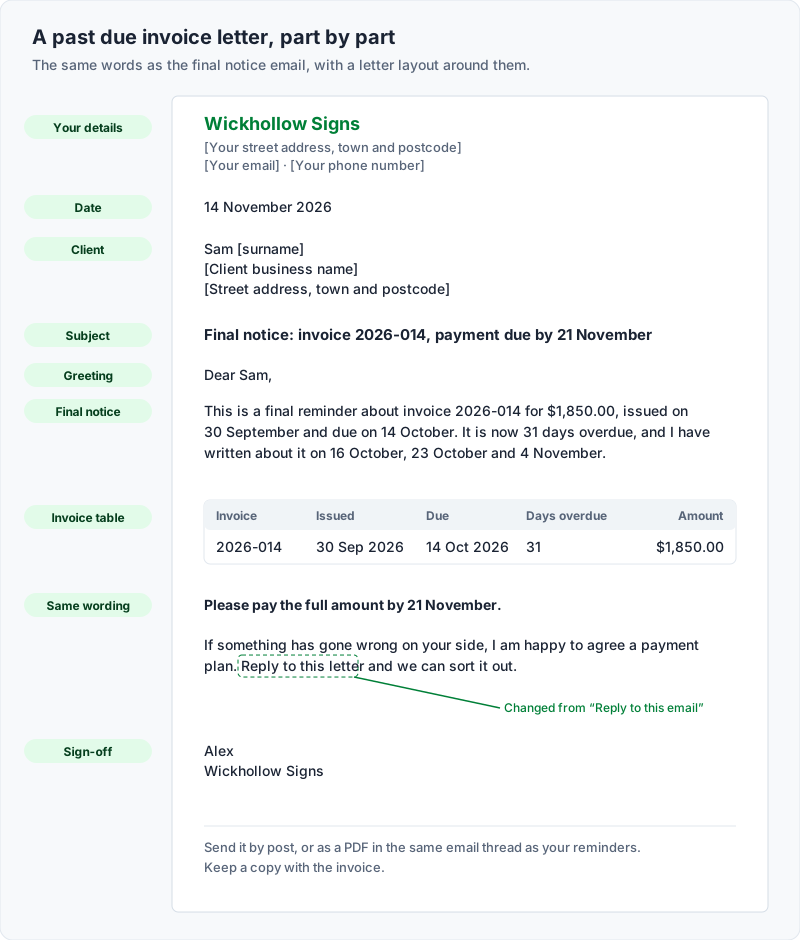
Post it, or save it as a PDF and attach it to the same email thread as your reminders, and keep a copy with the invoice. Keep it to the facts the email already gives. If the letter does not work either, demand letter for an unpaid invoice is the step after it.
What not to say in an overdue reminder#
Most overdue invoice email wording goes wrong in the same few ways. Here are the common ones and what to write instead.
| Avoid | Why it backfires | Write instead |
|---|---|---|
| “Sorry to bother you…” | Apologises for being owed money | “A quick note that…” |
| “Just checking in!” with no details | Gives the reader nothing to act on | Invoice number, amount, due date |
| “As per my last email” | Reads as a reprimand | “Following up on invoice 2026-014” |
| A late fee you never agreed | Looks like a penalty invented after the fact | Only fees that were in your terms before the work started |
| Legal threats in the first email | Escalates before you know the cause | Leave any next step until the final deadline has passed |
| A threat you will not carry out | Teaches the client to ignore you | Name only a step you will take |
| Guilt about your own bills | Moves the topic from the invoice to you | Keep it about the invoice and the date |
When the client replies#
A reply, any reply, is progress. Most fall into one of three types.
- “We paid it.” Thank them and ask for the payment date or reference so you can match it. Then check your account before you reply again.
- “It is being processed” or a payment date. Write the date down, thank them, and send nothing until the day after it passes.
- “We have a problem with the invoice.” Deal with the problem, not the lateness. If one line is disputed, offer to reissue the invoice without it so the rest can be paid now.
Keeping the reminders on schedule#
Writing reminder emails came up repeatedly in those discussions as the chore people put off. The person who started one small-business thread wrote:
I’m honestly considering just building a simple script that sends these reminders from a separate 'accounting' email address so I can pretend it's not me doing it.
The simplest cure for that chore is a schedule you decide once. Set a calendar reminder for each due date and each follow-up step, and send the emails above from your own inbox on those days; the late-payment follow-up schedule has a table for the dates. Reminders are also one of six jobs some invoicing software can automate; automatic invoicing covers which ones are worth it and which to keep an eye on. For the reminders that go out before the due date, with wording for each, see invoice reminders.
If you invoice with Charming Invoices, it does not send reminders or any email to your client. It shows an issued invoice as Overdue once its due date passes, so you can see which ones need a nudge, and the follow-ups go from your own email. Payment tracking is manual, so record each payment as it arrives, or you may chase a client who has already paid. Either way, the hard part stays with you: the phone call, the pause on work and the final notice.
If the final notice does not work#
At this point it is a business decision, not a wording problem. The usual options are a collection agency, a small claims court, or writing the amount off and not working with that client again. The rules on each differ a great deal between countries, and this is general information, not legal advice. What to do when a client is not paying an invoice sets out that escalation step by step.
Some countries have rules on interest for late payments between businesses. GOV.UK’s page on late commercial payments, for example, says: “You can claim interest and debt recovery costs if another business is late paying for goods or a service.” (as of 28 October 2026). That page covers the UK only, and the details change, so read your own government’s guidance, or ask a lawyer, before you mention interest in a final notice. How to charge invoice late fees fairly covers flat fees, percentages and interest, with worked examples.
Making the next invoice easier to chase#
A clear sequence helps, but the follow-up that never needs sending is better, and that comes from the terms you agree before the work starts. One commenter in a small-business thread about a client who kept paying late put it in two lines:
Add a late fee, and/or establish that once an invoice is X days late, their account is "On Hold". If they don't like it, they can just pay up front.
Whatever you decide, the point is to decide it before the work, not after. So for the next job, agree the payment terms and any late fee in writing before you start (the late fee calculator shows what a fee would come to on a given invoice), ask for a deposit on larger work, and put a real date on the invoice rather than only “Net 30”. If you are choosing terms now, what net 30 really means and how to choose payment terms walks through the options.
And when an invoice does go past its date, send the first nudge on schedule, not when you finally feel brave enough.
When you invoice the next job, create a free invoice, download the PDF and send it your way, with the follow-up dates already in your calendar.
Free downloads
No sign-up and no email address. More on the free templates page.
- Download .docx: Invoice email templates for Word
Invoice email templates for Word
Word .docxEmails to send an invoice in 12 situations, and a 4-step follow-up for one that is overdue.
- Download .txt: Invoice email templates as plain text
Invoice email templates as plain text
Text .txtThe same emails as a plain text file, the easiest version to copy into any email app.
- Download .pdf: Late-payment follow-up schedule (A4)
Late-payment follow-up schedule (A4)
PDFPlan every reminder and follow-up from the due date, and write in the dates.
- Download .pdf: Late-payment follow-up schedule (US Letter)
Late-payment follow-up schedule (US Letter)
PDFPlan every reminder and follow-up from the due date, and write in the dates.
- Download .xlsx: Statement of account for Excel
Statement of account for Excel
Excel .xlsxFor a client with several unpaid invoices: one page listing each one, what is left and how late it is.
- Download .xlsx: Invoice tracker for Excel
Invoice tracker for Excel
Excel .xlsxEvery invoice you have sent on one sheet, with its balance, status and how many days late it is.