Client not paying an invoice? What to do

Nnabuike Okoroafor ·
On this page · 12 sections
The work is done, the invoice went out weeks ago, and the client has gone quiet. Or worse, they have replied to say they will not pay. A client not paying an invoice is one of the most stressful things that happens when you work for yourself, partly because of the money and partly because nobody tells you what you are allowed to do next.
This post is what to do when a client does not pay, in order. What to check first, what to do at each stage and roughly when, what to keep as evidence, when to stop and write it off, and how to make the next job safer. It is written for freelancers, contractors and small businesses billing other businesses or people directly.
General information, not legal or tax advice. The rules on collection, courts and time limits differ between countries and states, and they change. Where this post mentions a rule, it quotes the official page and links it; check the rules where you are, and ask a lawyer or accountant before you act on them.
In short#
- Check the facts first. Many unpaid invoices are a wrong inbox or a missing PO number, not a refusal.
- Name the kind of non-payment. Silent, stalling, disputing and unable to pay each need a different next step.
- Escalate in order, only as far as the amount is worth: reminders, a call, a final notice, pausing work, a demand letter, then a collector or a small claim.
- Keep a dated record from the first agreement onwards.
- Decide your stop point in advance, and change your terms for next time.
It is common, and it is not a verdict on you#
If you are reading this at night with your stomach in a knot, start here. Clients not paying invoices is an ordinary business problem, not proof that you priced badly, wrote the invoice wrong or should not be working for yourself.
We read 768 quotes from public online discussions about invoicing while building Charming. The people quoted in this post wrote in those threads; they are not Charming customers. One small-business owner, after listing the steps they take to get paid, added:
Using these techniques there have still been times where I havent been paid. It's part of doing business.
That is the honest framing. You can do everything right and still meet a client who does not pay. What you control is how calmly you respond, and how much time and money you put in before deciding it is finished. Having a plan helps: "which step am I on?" is an easier question at 11 at night than "what do I do?"
Step one: confirm the facts before you escalate#
Before you send anything firmer than a reminder, spend ten minutes checking that the problem is what you think it is.
- Look for the money. Check your bank account and any partial payment. Payments arrive with odd references, or from a parent company with a different name.
- Check the invoice reached someone who pays. The person who hired you is often not the person who pays. Did it go to accounts, or to spam? Does their system need a purchase order number?
- Re-read your invoice. Is the due date a real date? Are your payment details on it and correct? Is the amount what you agreed?
- Re-read what you agreed. Find the contract, proposal or email where the price and payment terms were set. Note the due date and anything about late fees, deposits or stopping work.
- Look for a dispute you missed. Did they raise a concern about the work, even in passing? A client who said "this is not quite what we wanted" three weeks ago may be withholding payment rather than ignoring you.
The Australian government's guidance for small businesses makes the same point about the first step: "A missed payment could just be an oversight" (business.gov.au, as of 23 October 2026). Treat it that way until the facts say otherwise.
Which kind of non-payment is this?#
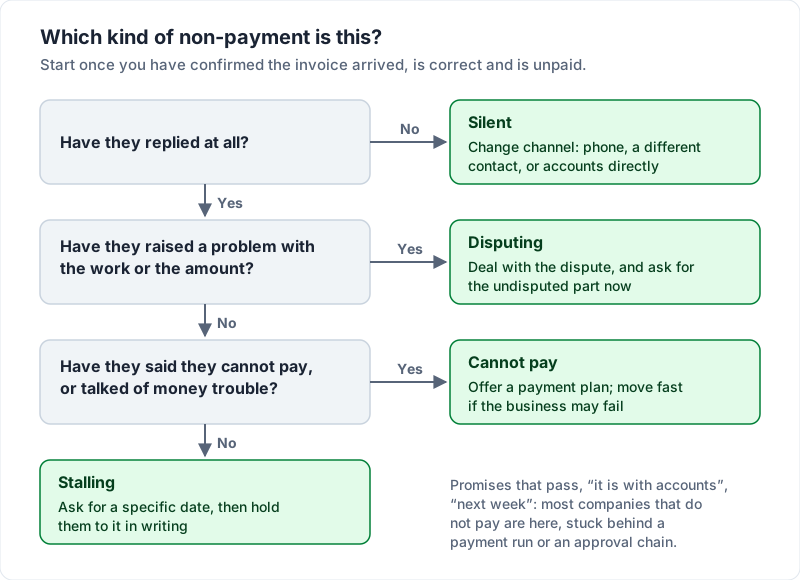
Once the invoice is confirmed as received and correct, a client who does not pay usually falls into one of four patterns. Naming the pattern tells you the next move.
| Pattern | What it looks like | Best next move |
|---|---|---|
| Silent | No reply to emails, invoice possibly unopened | Change channel: phone, a different contact, accounts directly |
| Stalling | "It is with accounts", "next week", promises that pass | Ask for a specific date, then hold them to it in writing |
| Disputing | They say the work is late, wrong or more than agreed | Deal with the dispute, and ask for the undisputed part now |
| Cannot pay | Cash-flow trouble, layoffs, talk of closing | Offer a payment plan; move fast if the business may fail |
A company not paying invoices is often stalling: your invoice is stuck behind a payment run or an approval chain.
Three questions, asked in order, sort almost every case into one of the four:
The escalation ladder for a client not paying an invoice#
Here is the whole sequence on one page. Days are counted from the due date and are an illustrative pattern, not a rule. Shorten them for a small one-off job; stretch them for a large organisation with monthly payment runs.
| Step | Example timing | What you do | What it costs you |
|---|---|---|---|
| 1. Reminders | Days 1 to 21 | Two or three short, polite emails | A few minutes each |
| 2. Phone call | Around day 14 to 21 | Call your contact, then accounts | Ten awkward minutes |
| 3. Final notice | Around day 30 to 45 | A formal email with a pay-by date | A few minutes |
| 4. Pause work | From the final notice | Stop new work; hold back deliverables only if your agreement allows | Possibly the client |
| 5. Demand letter | Around day 45 to 60 | A formal letter setting out the debt and the next step | Time, or a lawyer's fee |
| 6. Collection agency | Around day 60 to 90 | Hand the debt to a collector | A share of what is recovered |
| 7. Small claim | When the rest has failed | File in your local small claims court or tribunal | Fees, preparation, a hearing |
The same ladder drawn against time shows where the steps overlap: the call happens while reminders are still going out, and pausing work runs alongside everything after the final notice.
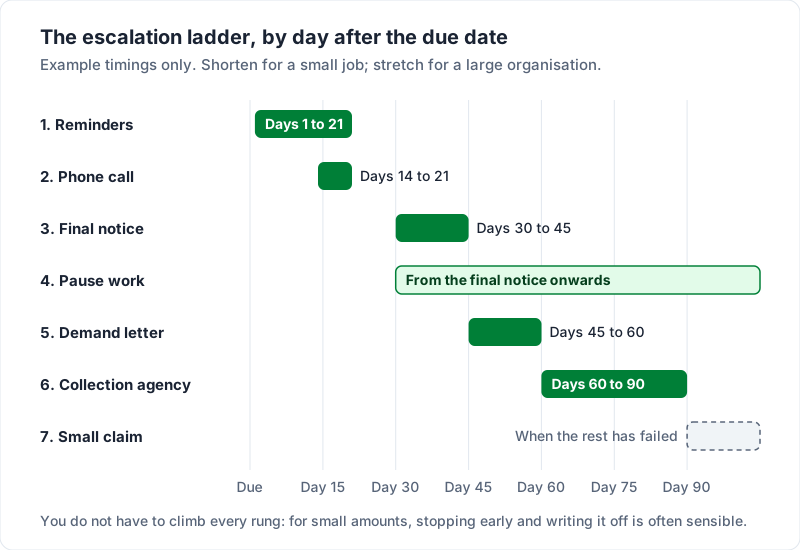
You do not have to climb every rung. For small amounts, stopping early and writing it off is often the sensible choice.
Steps 1 to 3: reminders, a call and a final notice#
The written part of this, from the first nudge to the final notice, is covered with full wording in the overdue invoice email, step by step. The short version: name the invoice number, amount and due date every time, ask for a payment date rather than "have you paid?", and space the messages out. The same emails are in a free Word file and a plain text file, and the late-payment follow-up schedule (A4, or US Letter) is a printable page for writing in the date of each step. To catch it earlier next time, invoice reminders covers the before-due and due-date messages.
The phone call is the step people skip, and it is often the one that works. An unread email is easy to leave; a friendly call is not. Keep it short:
Hi Sam, it is Alex. I am calling about invoice 0042 for $2,400.00, which was due on the 3rd. I wanted to check it reached the right person and see if anything is holding it up. When is it likely to be paid?
Then listen. Agree a date before you hang up, and confirm it in a two-line email: "Thanks for the call. As agreed, invoice 0042 will be paid by Friday 20 November." That email becomes evidence if you need it.
Step 4: pause work, and be careful with deliverables#
If the client still has work in progress with you, pausing it is the most effective lever most freelancers have. Say it as a fact about how you run your business, not as a threat:
Until invoice 0042 is settled, I am pausing work on the next phase. I would like to pick it back up as soon as it is paid.
Holding back finished files, footage or source code is more delicate. Whether you can, and who owns the work before payment, is a question for your agreement and a lawyer, not for this post. If you already handed the work over, do not try to claw it back by taking down a site or locking the client out of a system: that can turn a payment problem into a dispute about you. Get advice first.
Step 5: the demand letter#
A demand letter (also called a letter before action or letter of demand) is the formal written step before a third party gets involved. It states what is owed, why, by when, and what you will do if it is not paid.
Australian government guidance for small businesses gives a useful checklist: keep the letter accurate and polite, attach the contract, invoice and earlier reminders, and "only mention action that you’re prepared to take". It also suggests sending it by registered post with a signed proof of delivery card, and to "Keep this card in case you need it as evidence in court later". On interest, it says to include a late-payment rate only "if it was specified in the contract" (business.gov.au, "Write a letter of demand", as of 23 October 2026). If you want the late-fee side in detail, late fees on invoices covers what you can and cannot add after the fact.
Some places have formal rules for this letter before a court claim, especially when the client is an individual, so check your own court's official guidance. In England and Wales, for example, the Pre-Action Protocol for Debt Claims says in paragraph 1.1: "This Protocol applies to any business (including sole traders and public bodies) claiming payment of a debt from an individual (including a sole trader)." (Pre-Action Protocol for Debt Claims, justice.gov.uk, as of 23 October 2026). If it may apply to you, read the protocol itself or get advice. A full walk-through of the letter, with wording, is in the demand letter for an unpaid invoice.
Step 6: a collection agency#
A collection agency chases the debt for you, often for a share of what it recovers. Australia's business.gov.au says "Most commission rates for debt collection services vary between 5% and 30% of the value of the debt", and warns that using one "could further strain your business relationship" (business.gov.au, "Debt collection services", as of 23 October 2026). Its guidance also suggests telling the client first that you plan to use a debt collector, because "This may prompt them to pay the debt first" (business.gov.au, "What to do when you haven't been paid", as of 23 October 2026).
Before you sign, ask how the agency charges, whether you pay anything if nothing is recovered, and whether it holds any licence or registration needed where you and the client are.
Step 7: small claims court#
Small claims courts are built for modest debts and people representing themselves. The limits and rules vary a great deal by place and change over time, so read the official page for the court that would hear the claim. Two examples, as of 23 October 2026:
- California: the California Courts self-help guide says: "Generally, you can only sue for up to $12,500 in small claims court (or up to $6,250 if you’re a business)."
- England and Wales: GOV.UK, "Make a court claim for money" notes that "A mediation service could be quicker and cheaper than going to court". Citizens Advice's guidance for England says small claims are "never usually for more than £10,000".
The part most guides skip: winning is not the same as being paid. California's guide is blunt: "You have to collect the money if you win your case." GOV.UK's page on enforcing a judgment says: "You must pay a court fee when you ask the court to collect the payment." One videographer who went through the whole process wrote, in a public thread:
Filing a claim and winning it is nothing. That's handed out like candy. Try and collect your judgement. It's a big joke. Defendants can dodge that for years while you spend more and more money trying to collect.
That is one person's experience, not a rule, and many small claims do end in payment. But it is the right question to ask before you file: if I win, can this client actually pay? Citizens Advice puts it plainly: "If the person or company you’re claiming against can’t pay, you’re unlikely to get your money back."
When the client disputes the invoice#
A client who will not pay an invoice because they say something is wrong is a different problem from one who is ignoring you. Chasing harder makes it worse. Resolve the disagreement first.
- Ask exactly what is disputed. "Which part of the work is the problem?" turns a vague complaint into something you can answer.
- Separate the disputed part from the rest. If one line is in question, ask for the rest to be paid now. Offer to reissue the invoice without the disputed line so it can go through their system.
- Go back to what was agreed. Quote the email or contract where the scope and price were set.
- Consider mediation if you are stuck. GOV.UK, quoted above, points to it as an alternative to court.
The full approach, including wording for the reply, is in how to handle a disputed invoice.
What to keep as evidence#
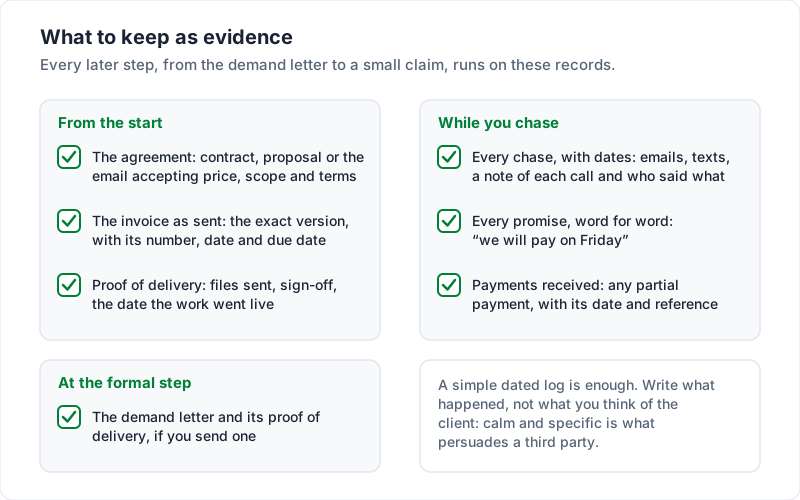
Every later step, from the demand letter to a small claim, runs on records. Start keeping them the day the invoice is late, and keep them even if you hope you will never need them.
- The agreement: the contract, proposal or the email where the client accepted the price, scope and payment terms
- The invoice as sent: the exact version, with its number, date and due date
- Proof of delivery: emails sending the files, sign-off messages, the date the work went live
- Every chase, with dates: emails, texts, and a note of each call (date, who you spoke to, what they said)
- Every promise: "we will pay on Friday" is worth keeping word for word
- Payments received: any partial payment, with its date and reference
- The demand letter and its proof of delivery, if you send one
A simple dated log is enough. Here is what one might look like for an illustrative invoice:
Invoice 0042 · $2,400.00 · issued 20 Oct · due 3 Nov

20 Oct  Invoice emailed to [email protected]
04 Nov  Reminder 1 sent (no reply)
11 Nov  Reminder 2 sent, copied [email protected]
14 Nov  Called Sam. Said it is "with finance", will pay by 20 Nov
14 Nov  Email confirming the call and the 20 Nov date
24 Nov  Not paid. Final notice sent, pay-by date 5 Dec
05 Dec  Not paid. Work on phase 2 paused (email sent)
Laid out on a timeline, the same log shows how the gaps look to anyone reading it later:
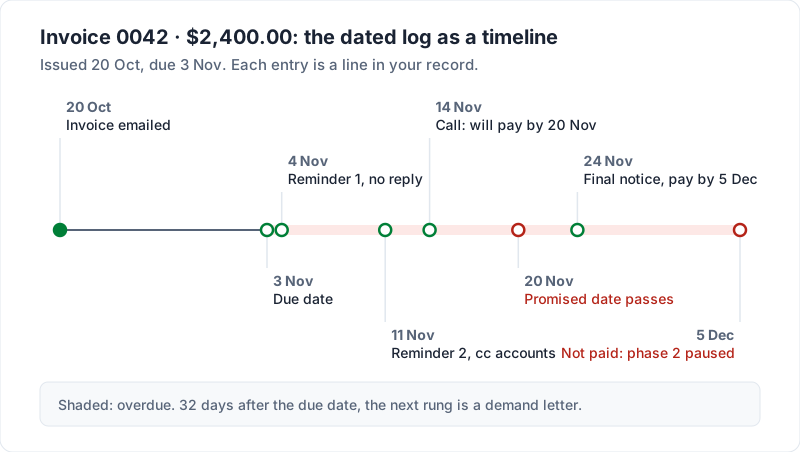
Write what happened, not what you think of the client. If a third party reads it later, calm and specific is what persuades.
When to stop chasing and write it off#
This is the decision nobody likes, and it is a legitimate business decision, not a defeat. Writing off an invoice means you stop actively chasing it and record it as money you do not expect to receive.
Do the arithmetic before you feel your way to it. An illustrative example: a $650.00 invoice, a client who has ignored a final notice, and a small claim that would take a filing fee, a day to prepare and a morning in a hearing, with a real chance the client still does not pay. Against your normal day rate, the claim can cost more than the invoice is worth. The same steps for a $9,000.00 invoice owed by a business that is still trading look very different.
Ask yourself these questions:
- Is the amount worth the next step? Count your hours as well as fees.
- Can the client actually pay? A business that has closed or an individual with no money is unlikely to pay even if you win.
- Is the evidence strong? A written price and proof of delivery make every step easier. A verbal agreement with no emails makes them harder.
- Are you running out of time? Claims can have time limits, and they vary by place. In England and Wales, for example, section 5 of the Limitation Act 1980 reads: "An action founded on simple contract shall not be brought after the expiration of six years from the date on which the cause of action accrued." (legislation.gov.uk, as of 23 October 2026). How that applies to a particular debt is a question for a lawyer, so if a debt is old, get advice.
- What is it costing you to keep it open? Sometimes the time and the worry are the real price.
If you do write it off, tell the client in one plain sentence that you will not take on further work until the balance is paid, and keep your records. Debts are sometimes paid later.
A note on tax#
Whether a written-off invoice affects your tax depends on where you are and how you keep your books, so ask an accountant before you claim anything. Two official pages to start from, as of 23 October 2026: the IRS's Topic 453, Bad debt deduction, which says: "You may deduct business bad debts, in full or in part, only if the amount you were owed is included in your gross income in the current or prior year." The other is HMRC's VAT Notice 700/18, whose conditions for relief include "The debt must have remained unpaid for a period of 6 months".
What not to do, however angry you are#
- Do not post about the client publicly. It rarely gets you paid, and accusations you cannot prove can cause problems of their own.
- Do not add charges you never agreed. A fee that was not in your terms looks invented after the fact.
- Do not keep working on credit. Every week of new work on an unpaid account adds to what you stand to lose.
Protecting yourself on the next job#
The steps above are for after the fact. The changes that make the biggest difference happen before the work starts.
- Get the price and terms in writing. An email the client replies "agreed" to is far better than nothing. Include the due date, how to pay and what happens if payment is late.
- Ask for a deposit on larger jobs. It shares the risk and tests whether the client pays at all. How deposit invoices work covers amounts, wording and how the deposit shows on the final invoice.
- Bill in milestones on long projects, so you are never more than one stage of work exposed.
- Release final files on payment, and put any late fee and pause-work rule in your terms up front. Our late fee calculator shows what a flat fee or interest would come to on a given invoice.
A short block like this, adapted to your work, covers most of it. Have a lawyer check any late-fee or interest line against the rules where you work:
Payment terms
- 50% deposit to book; balance due 14 days after delivery.
- Final files are released once the balance is paid.
- Work on new phases pauses if an invoice is more than 14 days overdue.
- Late payments incur [the late fee or interest you have agreed, if any].
If waiting on slow payers is what strains your cash flow, invoice factoring explained shows what selling an invoice for early cash really costs, and the cheaper options to try first. If you do consider selling invoices, how to choose an invoice factoring service compares provider types and the questions to ask.
Where Charming fits, and where it does not#
Records are the part software can carry for you. Charming Invoices does not send the invoice or the reminders for you: you issue the invoice, download the PDF or copy its private link, and send it and every follow-up from your own inbox with the wording above. What it keeps is the record. An issued invoice past its due date shows as Overdue automatically, each invoice has an activity log with dated entries for when it was issued, viewed by the client through its private link and paid, and you can download a client statement as a PDF that lists every open invoice with its ageing (current, 1 to 30, 31 to 60, 61 to 90 and 90+ days).
The catches, plainly. There are no automatic reminders, so set a calendar reminder for each due date. Payment tracking is manual: you record each payment or mark the invoice paid. "Viewed" only counts opens of the private link, not of a PDF you attached. Statements are downloads you send yourself. Clients cannot pay by card from the invoice, and on the free plan the PDF and the invoice page carry a small "Sent with Charming Invoices" line. None of it does the hard part: the call, the pause on work, the demand letter and the decision to stop are still yours.
The one-paragraph version#
Check the facts, name the kind of non-payment, and climb the ladder one rung at a time, only as far as the amount is worth. Keep a dated record, decide where you will stop, and ask the next client for a deposit. Not being paid once is a cost of doing business. It is not a judgement on your work.
If you want the record-keeping handled from the first invoice, create a free invoice, download the PDF and send it your way.
Free downloads
No sign-up and no email address. More on the free templates page.
- Download .pdf: Late-payment follow-up schedule (A4)
Late-payment follow-up schedule (A4)
PDFPlan every reminder and follow-up from the due date, and write in the dates.
- Download .pdf: Late-payment follow-up schedule (US Letter)
Late-payment follow-up schedule (US Letter)
PDFPlan every reminder and follow-up from the due date, and write in the dates.
- Download .docx: Invoice email templates for Word
Invoice email templates for Word
Word .docxEmails to send an invoice in 12 situations, and a 4-step follow-up for one that is overdue.
- Download .txt: Invoice email templates as plain text
Invoice email templates as plain text
Text .txtThe same emails as a plain text file, the easiest version to copy into any email app.