Invoice factoring services: how to choose a company

Nnabuike Okoroafor ·
On this page · 15 sections
You have decided that waiting 60 days for a client to pay is not an option this quarter, and you are looking at invoice factoring services. Many providers describe their service in similar terms, so what you need is a way to compare them on your own invoice and your own clients.
This guide is that method. It covers the kinds of invoice factoring companies you will meet, how to compare offers on the same invoice so a “2%” and a “3%” mean something, the contract clauses and UCC filing that decide how hard it is to leave, the cost figures to ask for, and the questions to put to any factor before you sign.
Three things up front. This is general information, not legal or financial advice. Laws differ by state and country and change; for how they apply to your contract, ask a lawyer in your state. We do not rank or recommend factoring companies, and every offer in this post is invented to show the arithmetic. And we make Charming Invoices, an invoicing app: Charming does not factor invoices, lend money or hold your money, so we have no factoring product to sell you.
If you are new to factoring itself (advances, reserves, recourse, what it costs as a yearly rate), start with invoice factoring explained. This post assumes you know the basics and want to choose a provider.
In short#
- Compare offers on one invoice, not on headline rates. A fee of “2% per 15 days” can cost more than “3% for 30 days” once the client takes 50 days to pay.
- Ask for the total dollar cost and an estimated APR in writing. Any provider can be asked for both, wherever you are.
- Read six clauses twice: whole ledger, minimum volume, automatic renewal, early termination, the scope of the security interest, and buy-back (recourse).
- Ask whether the factor will file a UCC-1 financing statement, what it will cover, and how it comes off when you leave.
- The best invoice factoring company is the one whose written offer is cheapest for your clients' payment habits, with terms you can live with and leave. No ranking can tell you that.
What an invoice factoring company does#
An invoice factoring company buys your unpaid invoices to business clients. It pays you an advance, collects from your client, then pays you the reserve minus its fees. Factoring agreements often read like loan agreements, with security interests and public filings, so read yours as carefully as you would a loan.
Types of invoice factoring companies#
Factoring services come in a few broad shapes. The labels overlap, and one company can be more than one of these, but asking which kind you are talking to tells you a lot about how the relationship will run. If you run a staffing agency, invoice factoring for staffing agencies covers payroll funding and the contract terms to check.
| Type | What it usually means | Worth checking |
|---|---|---|
| Bank or bank-owned factor | Factoring offered by a bank or a business it owns | Ask for the same written cost figures you would ask any provider for |
| Independent factor | A finance company whose main business is buying receivables | How it funds itself, and who services your account day to day |
| Online platform | Applications, invoice uploads and advances through a website or app | Who the actual funder is, and how you reach a person when a client disputes an invoice |
| Industry specialist | Focuses on one sector, such as freight, staffing or construction | Whether its paperwork rules fit how your clients really pay |
| Broker | Finds a factor for you and is paid by the factor or by you | Who pays the broker, and whether the offer comes from one funder or several |
Two other distinctions cut across all five types:
- Spot (selective) factoring or a facility. Spot factoring sells one invoice, or a few, with no ongoing commitment. A facility is a contract for a term, often with minimum volumes. Compare both: a spot deal can cost more per invoice, while a facility can cost more to leave.
- Recourse or non-recourse. With recourse, you buy back invoices your client does not pay. Non-recourse covers only the losses the contract lists. Invoice factoring explained works through both.
If you run a trucking business, the freight factoring market has its own habits (load paperwork, fuel advances, broker credit checks); trucking invoice factoring covers it on one load.
How to compare factoring offers on one invoice#
Fee structures differ so much that two quotes can look cheap in different ways. The way through is to price every offer against the same invoice and the same payment day, using the one your best client really pays on.
Here are three invented offers on an illustrative $10,000.00 invoice to a business client who pays on day 50. They are not quotes, typical rates or offers from any company.
- Offer A: 90% advance; fee of 2% for each 15 days or part of 15 days; a $25.00 transfer fee on the advance.
- Offer B: 80% advance; 3% for the first 30 days, then 1% for each further 10 days or part.
- Offer C: 85% advance; a flat 4% for up to 60 days; a one-time $300.00 set-up fee.
| Day-50 result | Offer A | Offer B | Offer C |
|---|---|---|---|
| Factoring fee | 4 blocks × 2% = $800.00 | 3% + 1% + 1% = $500.00 | 4% = $400.00 |
| Other fees | $25.00 | $0.00 | $300.00 |
| Total cost | $825.00 | $500.00 | $700.00 |
| Cash in the first days (advance minus up-front fees) | $8,975.00 | $8,000.00 | $8,200.00 |
| Reserve released on day 50 | $200.00 | $1,500.00 | $1,100.00 |
| Total you receive | $9,175.00 | $9,500.00 | $9,300.00 |
| Simple yearly rate | About 66.9% | About 45.6% | About 60.1% |
The yearly rate is the total cost divided by the gross advance, scaled to a year: for Offer A, 825 ÷ 9,000 × 365 ÷ 50 = about 66.9%. It is a simple rate for comparison. A provider's own estimated APR may be worked out a different way, so its figure may differ a little.
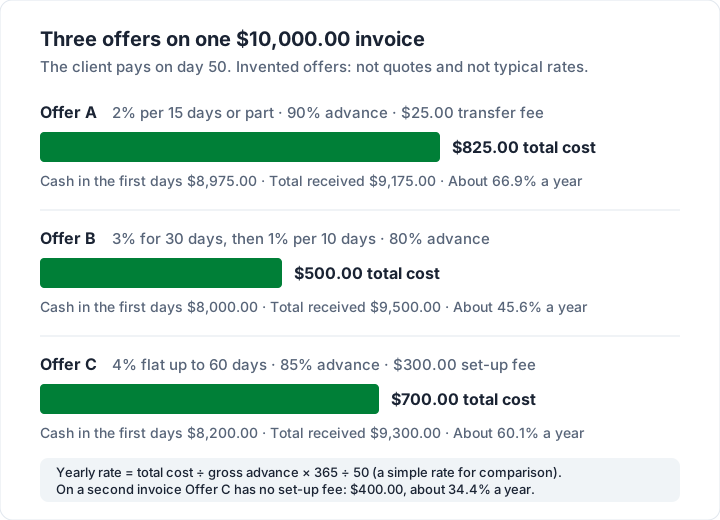
What the comparison shows:
- The block length matters more than the percentage. Offer A's 2% applies to every 15 days, so day 50 falls in its fourth block and costs 8%.
- One-time fees distort a single invoice. Offer C costs more on the first invoice because of the $300.00 set-up fee. On a second invoice without it, the cost is $400.00, about 34.4% a year, the cheapest of the three.
- A higher advance is not free money. Offer A puts the most cash in your hands early, and charges for it.
- Payment day changes the winner. If the client pays on day 70 instead, Offer A costs $1,025.00 (five blocks, plus the transfer fee) and Offer B $700.00 (3% plus four 1% blocks). Offer C's terms above say nothing about day 61 onwards, which is itself the question to ask.
A blank comparison table for your own offers#
Copy this into a spreadsheet and fill one column per written offer. Use the same invoice amount and the same payment day for every column.
| Ask for this in writing | Offer 1 | Offer 2 | Offer 3 |
|---|---|---|---|
| Advance rate, and on which clients | |||
| Fee structure (flat, tiered, daily) and block length | |||
| Every other fee (set-up, transfer, monthly, credit check, exit) | |||
| Total dollar cost on your invoice and payment day | |||
| Estimated APR (if the provider gives one) | |||
| Recourse period, and what a buy-back costs | |||
| Whole ledger or selected invoices | |||
| Minimum volume, term and renewal | |||
| Scope of the security interest and UCC filing |
Contract terms that decide how hard it is to leave#
The rate decides what factoring costs while it works. The contract decides what it costs when it stops working for you. These six clauses matter most, and each has a question that turns it into a number.
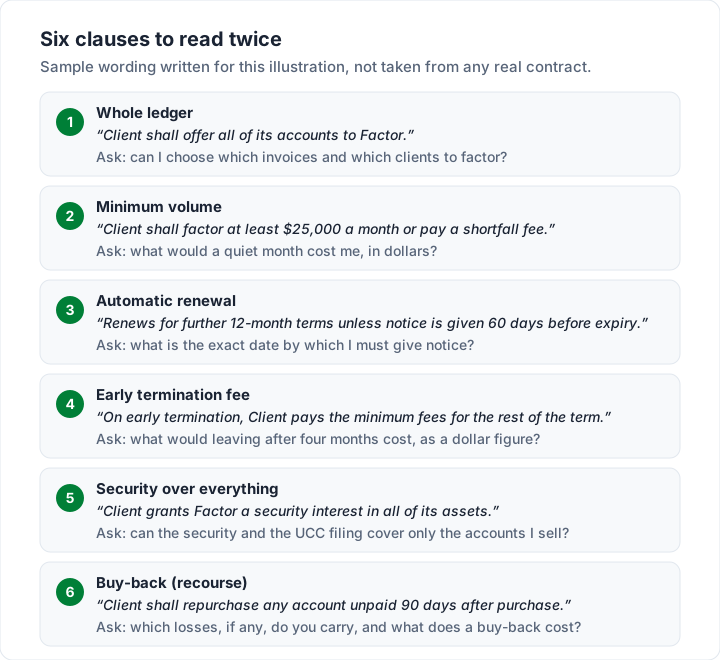
Three of them are worth a few more words:
- Automatic renewal with a notice window. If the window is “60 days before expiry”, put that date in your calendar the day you sign. Under a clause like that, missing it by a week can mean another full term.
- Early termination fees. Ask the factor to show you the fee as a dollar figure for a specific exit date. A formula you cannot calculate is one you cannot compare.
- The security interest. A factor buying your invoices will want rights over them. Some agreements go further and take security over all of your business assets. That affects other borrowing, which brings us to the filing.
The explainer's fuller contract checklist adds reserve release, disputes and personal guarantees.
The UCC-1 filing: what to ask about it#
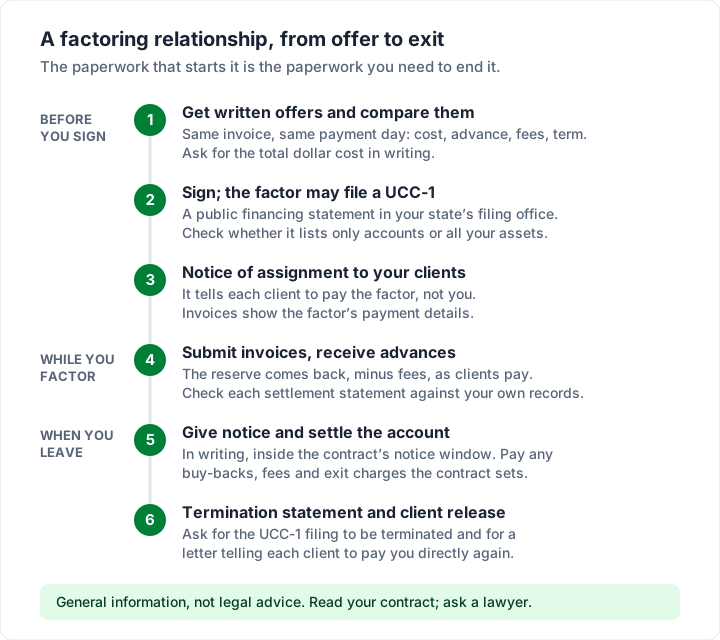
Factors often file a UCC-1 financing statement when you sign; ask whether yours will. In plain terms, it is a short public notice, usually lodged with your state's Secretary of State, that the factor claims an interest in some of your assets.
What to ask and check:
- What the filing will cover. Ask whether it will describe only the accounts you sell or all of your business assets. An all-assets filing can make a bank hesitate to lend against your equipment later, so ask before you sign whether it can be limited to accounts.
- What is already there. Many state filing offices let you search UCC records by business name online. Searching your own name before you sign shows whether an earlier lender's filing is still on record; a factor will find it anyway.
- How it comes off. Ask the factor, in writing and before you sign, how and when it will file a termination when you leave. Afterwards, search your state's UCC records to see that it was done.
The rules behind these filings are set by each state and change. For how they apply to your agreement, ask a lawyer in your state.
Cost disclosures: ask for them anywhere#
Ask every provider for the same two figures, in writing: the total dollar cost on your invoice and an estimated APR. Whether a provider has to disclose them, and in what form, is a question for your state's financial regulator or a lawyer; we do not summarise the rules here.
Wherever you are, you can ask. Get the total dollar cost of factoring your invoice in writing before you sign, so every offer is compared on the same figure.
Questions to ask an invoice factoring company#
These are about the provider, not only the price. Send them by email so the answers are in writing.
- Are you the funder, or a broker? If a broker, who is the funder, and who pays your fee?
- Can I see the full contract before I apply, not only a term sheet?
- What would this invoice cost on day 30, day 50 and day 70, as a dollar figure, with every fee included?
- What will you file? A UCC-1 on accounts only, or on all assets? Do you require a personal guarantee?
- How will you contact my clients, in whose name, and how often? Can I see the notice of assignment you send?
- Can I see a sample settlement statement, the report showing advances, fees and reserves released?
- What happens when a client disputes an invoice, for example over the quality or timing of the work?
- How do I leave? The notice period, the exit fee as a dollar figure, and how fast you send the UCC termination and client release letters.
- Which of my clients will you accept, and at what advance rate each?
- Can you give me references from businesses in my industry that have used you for at least a year? Then call them.
How to check a factoring company before you sign#
Star ratings tell you little about your own contract, so check a few things yourself:
- The legal name. Match the name on the contract to a business registration in your state's or the company's home state's business registry. Brand names and legal names often differ.
- Licences or registrations. Ask your state's financial regulator whether commercial finance providers need one where you are, and check that the provider holds it.
- Public records. Your own UCC search shows any filings already against your business, and your lawyer can advise on any other public records worth checking.
- The people. Talk to the person who will manage your account, not only the salesperson.
The US Federal Trade Commission's advice for small businesses seeking finance applies directly: if there is anything you do not understand, ask and “insist on an answer in writing” (FTC Business Blog, June 2021, read 23 October 2026).
Red flags in a factoring offer#
Any one of these is a reason to slow down:
- No written total cost for your actual invoice, and no estimated APR or dollar figure offered in its place.
- Pressure to sign quickly, for example an offer that “expires today”.
- Fees that appear only in the contract, not in the quote.
- A contract you cannot see until after an application fee is paid.
- An all-assets security interest and a personal guarantee for a small spot deal.
- Vague answers on leaving, especially on the notice window and the exit fee.
Construction invoice factoring: extra questions#
Construction billing raises its own questions for a factor: progress invoices, retainage and approvals make the amount owed less certain than on a one-off invoice. These are questions to ask, not a description of how any provider works:
- Retainage. If your client holds back a percentage until completion, will the factor advance against the retained amount, or only against what is currently payable? Progress invoicing explained shows how retainage builds up across invoices.
- Pay applications. How will the factor verify a pay application that your client's architect or general contractor must approve first? How AIA G702 and G703 pay applications work explains who signs and certifies one.
- Lien waivers. Who signs conditional and unconditional lien waivers, and when, if payments go to the factor?
- Pay-when-paid clauses. If your contract says you are paid when the general contractor is paid, how does the factor treat the delay?
- Joint checks and change orders. How are joint-check arrangements and unapproved change orders handled?
Your contract settles much of this; ask a construction lawyer before you factor a large job. Our guide to what a contractor invoice should include covers the invoice side.
Cheaper fixes to compare first#
Factoring is one answer to slow payment. Before you sign a term contract, compare it with fixes that cost less or nothing:
| Fix | What it does | Where to read more |
|---|---|---|
| Deposit up front | The client funds the start of the job | How deposit invoices work |
| Billing in stages | You are never more than one stage unpaid | Progress invoicing explained |
| Shorter terms | Net 15 instead of Net 60, where clients agree | Invoice payment terms like Net 30 |
| Reminders on a schedule | Catches invoices that were forgotten, not refused | The overdue invoice email, step by step |
| An agreed late fee | Gives clients a reason to pay on time, where allowed | Late fees on invoices |
| A client statement | Shows everything owed, by age, in one document | Invoice vs statement |
If the client is not slow but refusing, factoring will not help: with recourse, the unpaid invoice comes back to you with fees. What to do when a client is not paying covers that situation.
Where Charming fits, and where it does not#
Plainly: Charming Invoices does not factor invoices, advance money, collect debts or connect to factoring companies. If you factor, the factor's portal is where you submit invoices and paperwork.
What Charming does is part of the preventive work in the table above, on every plan including Free:
- Deposits and progress billing: a balance invoice can show a deposit already received, and progress billing tracks a contract value, what has been billed and what is left. You type the deposit amount yourself, and retainage is shown on the invoice but not tracked as a separate receivable.
- Overdue invoices flagged once the due date passes. Charming does not send reminders, so set a calendar reminder and send them from your own email.
- Client statements as a PDF with ageing columns, which you download and send yourself.
- Payment details on the invoice: a free-text bank details box and a payment link. If you factor, you can put the factor's remittance details and assignment wording there, but they are set per business, not per invoice, and Charming does not know an invoice is factored.
The catches: payment tracking is manual (you record payments or mark it paid), Charming does not email invoices (you download the PDF or copy its link and send it yourself), clients cannot pay by card through Charming, and invoices on the free plan carry a small “Sent with Charming Invoices” line. If that fits, you can create a free invoice with deposits, overdue tracking and statements in one place.
Invoice factoring services FAQ#
What is an invoice factoring company?#
A finance company that buys unpaid invoices to business clients, pays most of their value up front, collects from the client and pays you the rest minus its fees. It may be a bank, an independent finance company, an online platform or an industry specialist.
Are invoice financing companies the same as factoring companies?#
Often the same companies, selling different products. “Invoice finance” or “invoice financing” is the umbrella term: it covers factoring, where the provider buys your invoices and collects from your clients, and invoice discounting, where you borrow against them and keep collecting yourself. When an invoice financing company makes you an offer, ask which product it is, who will collect, and whether your clients will be told. Invoice factoring explained sets the products side by side.
How do I find an invoice factoring company?#
Through your bank, your trade association, other businesses in your industry, or a broker. Wherever the name comes from, get at least two written offers on the same invoice and compare them with the table in this post. A broker may show you several funders, but ask how the broker is paid.
Are there “best invoice factoring companies” lists I can trust?#
Treat any ranking as a starting point. The cheapest provider for you depends on your clients, how fast they pay, your volume and the terms you can accept. A list cannot price your invoice; a written offer can.
Do factoring companies contact my clients?#
With standard factoring, yes. Your client receives a notice of assignment telling it to pay the factor. What that notice means for your client, including a payment sent to you by mistake, depends on your agreement and your state's law; ask the factor, and a lawyer if it matters. Ask how often the factor follows up, and in whose name. Invoice discounting, a different product, is often undisclosed.
Can I leave a factoring contract?#
Usually, on the terms the contract sets: a notice period, sometimes an exit fee, and settling any outstanding advances or buy-backs. When you leave, ask for the UCC filing to be terminated and for a release letter to each client, so they start paying you again.
The short version#
Choose an invoice factoring service the way you would choose any finance: on written offers, priced on your own invoice and your clients' real payment days. Ask for the total dollar cost and an estimated APR, read the whole-ledger, minimum, renewal, exit, security and recourse clauses, and know what will be filed against your business and how it comes off.