Trucking invoice factoring: how it works on one load

Nnabuike Okoroafor ·
On this page · 11 sections
You delivered the load on Monday. Fuel, insurance and the truck payment come out this week. The broker pays in 30 days, maybe longer. That gap is why so many owner-operators and small carriers factor their freight invoices, and why so many carriers ask whether it is worth it.
This guide explains trucking invoice factoring (also called freight factoring) from the carrier's side, built on one load: what the broker pays, what the factor advances and keeps, what the notice of assignment changes on your invoice, which papers the factor wants, and how it compares with a broker's quick-pay. For the general mechanics of factoring in any industry, see invoice factoring explained; this post stays with freight. If you are weighing providers, how to choose an invoice factoring service compares provider types, UCC filings and the cost figures to ask for. Staffing agencies, where payroll comes due before clients pay, have their own guide: invoice factoring for staffing agencies.
Two things up front. This is general information, not legal or financial advice. Factoring contracts and state laws vary and change, so read your own agreement and ask a lawyer about your obligations; nothing here recommends using or avoiding any factor. And we make Charming Invoices, an invoicing app. Charming does not factor invoices, lend money, collect from brokers or offer quick-pay. It appears only where the invoice itself is discussed.
In short#
- Factoring sells your freight invoice to a factor for most of its value now. The factor collects from the broker or shipper and pays you the rest, minus its fee.
- On our illustrative $2,600.00 load, a 90% advance and a 3% fee put $2,340.00 in your account within days and $182.00 more when the broker pays: $2,522.00 in total, a cost of $78.00.
- The notice of assignment tells the broker to pay the factor. Your factoring agreement will usually require the broker to be notified and to pay the factor, not you.
- The factor needs the paperwork that proves the load: rate confirmation, bill of lading, signed proof of delivery and your invoice.
- Broker quick-pay is the main alternative. It is load by load, with no contract, but only from brokers who offer it.
How trucking invoice factoring works#
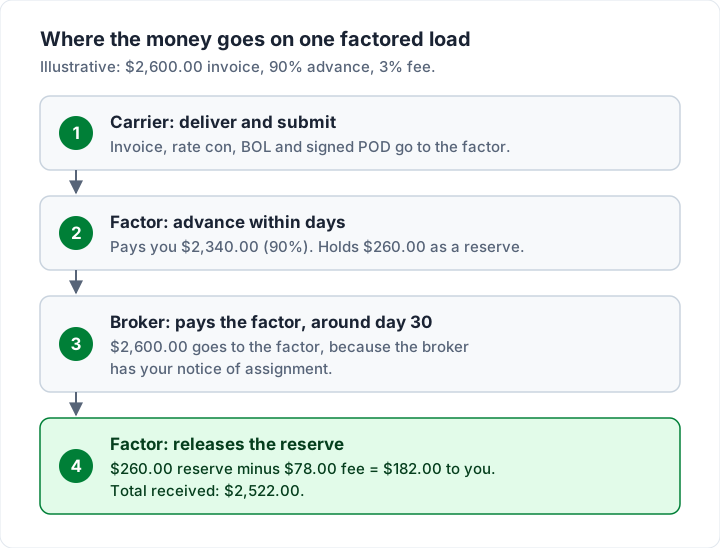
Freight factoring follows the same pattern as any invoice factoring, with trucking's own paperwork:
- You haul the load and collect the signed bill of lading and proof of delivery.
- You invoice the broker and send the invoice and paperwork to your factor, usually through its portal or app.
- The factor checks the load and the broker's credit, then pays you an advance, a percentage of the invoice.
- The broker pays the factor, not you, because a notice of assignment told them to.
- The factor releases the reserve (the part it held back) minus its fee.
The factor is buying the broker's promise to pay, so the broker's payment record matters as much as yours. That is why factors run credit checks on brokers, and why some will not buy invoices from certain brokers at all.
A worked example: factoring one load#
Here is one load, with numbers labelled illustrative. Real advance rates and fees are set by each factor's contract, and some charge a flat fee while others add more for every extra period the broker takes to pay.
| Item | Amount |
|---|---|
| Linehaul, flat rate on the rate confirmation | $2,450.00 |
| Detention, 3 hours at $50.00 an hour | $150.00 |
| Invoice total to the broker | $2,600.00 |
| Advance at 90% (illustrative), paid within days | $2,340.00 |
| Reserve held back (10%) | $260.00 |
| Factoring fee at 3% of the invoice (illustrative, flat for 30 days) | $78.00 |
| Reserve rebate when the broker pays (reserve minus fee) | $182.00 |
| Total you receive | $2,522.00 |
So factoring this load costs $78.00 to have $2,340.00 about four weeks early. Whether that is worth it depends on what the cash is for. If it keeps the truck fuelled and moving, many carriers decide it is. If it simply sits in the account, it is $78.00 a load for nothing.
Watch three things on your own numbers:
- Fees that grow with time. If the fee rises for every extra 10 or 15 days the broker takes, a slow broker costs you more. Ask for the full fee schedule in writing.
- Other charges. Some contracts add charges for transfers, credit checks or paperwork. Add them to the per-load cost before you compare.
- What the fee is charged on. A fee on the full invoice ($2,600.00) costs more than the same rate on the advance ($2,340.00).
For turning a factoring fee into a yearly rate, the worked example in our factoring guide shows the arithmetic.
The notice of assignment and what it changes#
When you factor, the broker is usually told to pay the factor. That notice is the notice of assignment (often shortened to NOA), and it usually comes on the factor's letterhead with your signature.
What it means for you is set out in your factoring agreement, which will usually require the broker to be notified and to pay the factor, and require you to pass on any payment a broker sends you by mistake. In practice:
- Before the broker has the notice, it will normally keep paying you.
- After the broker has the notice, it is expected to pay the factor. If a payment still reaches you, your agreement will usually tell you to forward it straight away.
- A broker may ask for proof of the assignment before it changes where it sends payments, and your factor can usually supply it.
The legal effect of a notice of assignment depends on your contract and your state's law, so read your agreement and ask a lawyer if a payment goes to the wrong place.
Leaving a factor works in reverse. Brokers will usually keep paying the factor until they are told otherwise, so ask your factor for a written release once your account is settled, and send it to each broker before you invoice them directly again.
What your trucking invoice should show when you factor#
Once a broker has your notice of assignment, your invoices will usually need to point payment at the factor. The factoring agreement says exactly what to print. Typically that is:
- Remit-to details: the factor's name, address or bank details, in place of your own. Remittance on an invoice explains remit-to details in general.
- Assignment wording, something like the sample below, if your agreement requires it.
- Everything else as normal: your legal carrier name, MC and USDOT numbers, the broker's load number and rate confirmation reference, BOL number, pickup and delivery details, and each charge.
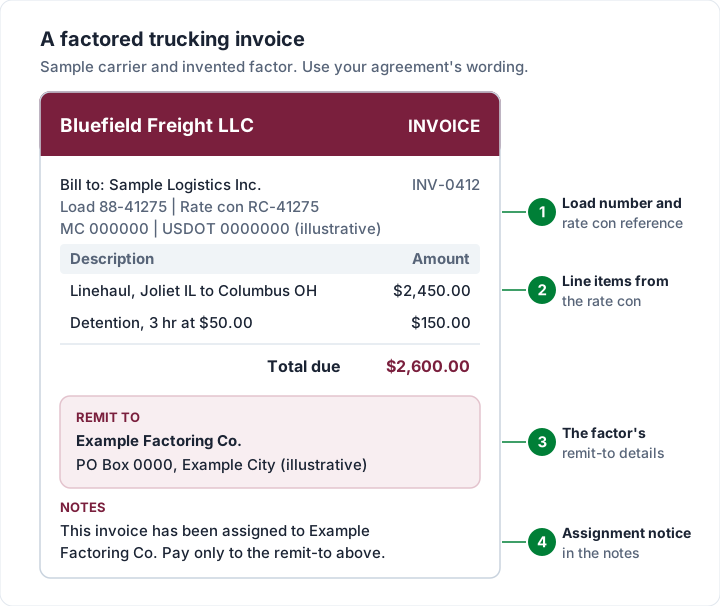
Here is the kind of assignment wording factors ask for, as a sample to compare with your agreement (use theirs, word for word):
This invoice has been assigned to [Factor name]. Please make
payment only to [Factor name], [remittance address or bank details].
Brokers file every payable under their own load number, so print it exactly as it appears on the rate confirmation. Our guide to where to put the PO number on an invoice covers reference numbers in general, and what a contractor invoice should show covers the rest of the fields. The trucking invoice template walks through every field a broker checks.
Paperwork a factor asks for#
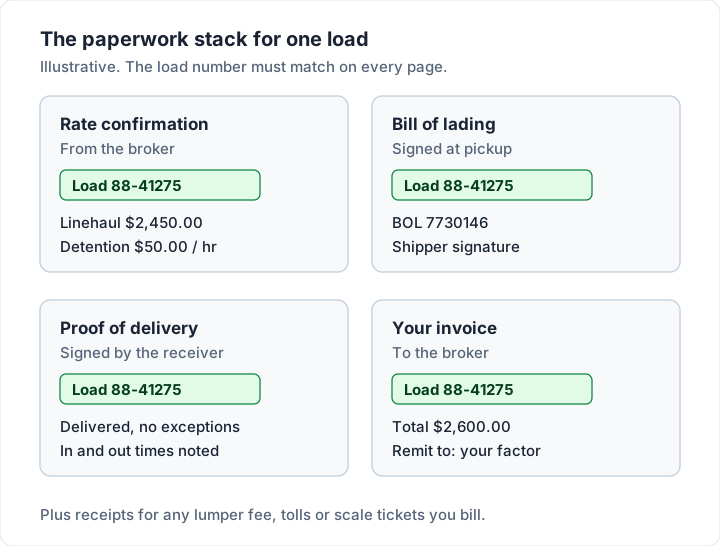
A factor will not advance money on an invoice alone. It wants proof that the load was booked, picked up and delivered. Most ask for the same stack:
| Document | Who issues it | Why the factor needs it |
|---|---|---|
| Rate confirmation (rate con) | The broker | The contract for the load: rate, lane, accessorials agreed |
| Bill of lading (BOL) | The shipper, signed at pickup | Proves what was picked up, and when |
| Proof of delivery (POD), usually the signed BOL | The receiver, signed at delivery | Proves it arrived, clean or with exceptions noted |
| Your invoice | You | The amount the broker owes, with the load number |
| Receipts for lumper fees, tolls or scale tickets | Whoever you paid | Evidence for each accessorial you bill |
| Notice of assignment, signed | You and the factor | Sent to each broker once, before the first factored load |
Before you decide whether a broker is worth the wait, check the payment terms in your carrier agreement and rate confirmation, and keep copies of every document for the load. If a broker has gone quiet, the Federal Motor Carrier Safety Administration (FMCSA) website is the official place to look up federal information about brokers, and a lawyer can tell you what options you have.
Recourse, fees and contract terms to check#
Most of the risk in factoring sits in the contract, not the advance rate. Read these clauses before you sign:
| Term | What to ask |
|---|---|
| Recourse or non-recourse | If the broker does not pay, do I buy the invoice back? If non-recourse, exactly which losses are covered: only broker insolvency, or disputes too? |
| Fee schedule | Is the fee flat, or does it rise every extra 10 or 15 days? What is it charged on, the invoice or the advance? |
| Other charges | Are there fees for transfers, credit checks, paperwork or minimum volume? |
| All loads or some | Must I factor every load, or can I choose loads and brokers? |
| Contract length and exit | How long is the term, does it renew automatically, what notice ends it, and what does leaving cost? |
| Release letter | Will you send a release to my brokers when I leave, and how quickly? |
| Fuel advances | If you advance money at pickup, what does it cost and when is it repaid? |
Recourse is the big one. With recourse factoring, if the broker never pays, you typically repay the advance, often with fees on top. Our guide to recourse and non-recourse factoring explains both with a worked case. If a broker simply stops paying, what to do when a client is not paying an invoice covers the steps on your side.
Factoring vs broker quick-pay#
Many brokers offer quick-pay: they pay your invoice within a few days in exchange for a percentage taken off the amount. It is load by load, with no contract and no notice of assignment. Note that only some brokers offer it, each sets its own fee and timing, and the details are in that broker's carrier packet or agreement.
Here is the same $2,600.00 load three ways. The quick-pay fee is a placeholder for comparison; use the figure from your broker's own terms.
| Factoring (illustrative 90% advance, 3% fee) | Broker quick-pay (illustrative 2% fee) | Waiting on Net 30 terms | |
|---|---|---|---|
| When cash arrives | $2,340.00 within days, $182.00 when the broker pays | $2,548.00 within the broker's quick-pay window | $2,600.00 around day 30, if the broker pays on time |
| Cost on this load | $78.00 | $52.00 | $0.00 |
| Who collects | The factor | The broker pays you | You |
| Contract | Yes, often with a minimum term | Per load, per broker | None |
| Works with every broker? | Only brokers the factor approves | Only brokers who offer it | Yes |
| If the broker does not pay | Depends on recourse terms | Usually no quick-pay; normal terms apply | You chase it |
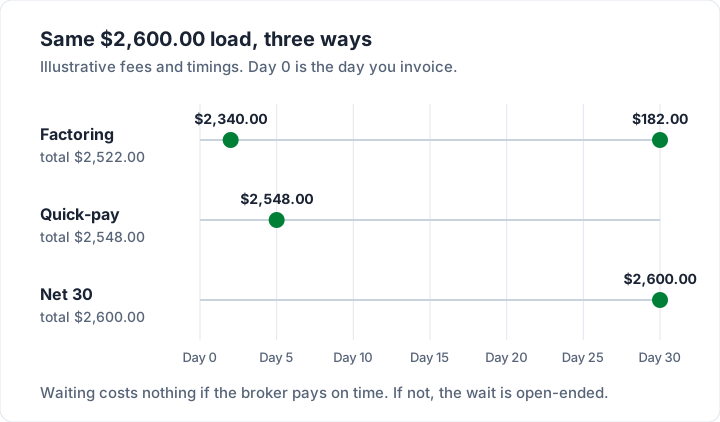
Many carriers mix the three: quick-pay with brokers who offer it at a fair rate, standard terms with brokers who pay reliably, and factoring only when cash is tight. If your broker's terms are Net 30, our guide to what Net 30 actually means explains when the clock starts.
Where Charming fits, and where it does not#
Charming Invoices does not factor, finance, collect or offer quick-pay, and it does not send notices of assignment or submit paperwork to a factor. It is the invoice itself. Here is what it does for a carrier, checked in our code on 22 October 2026:
- A Trucking load starter kit with line items for flat-rate and per-mile linehaul, stop-offs, fuel surcharge, detention, lumper fees, layover, truck ordered not used (TONU), and tolls and scale tickets. Prices start at 0.00 on purpose: you enter the rate from your rate con.
- A PO number field that you can relabel "Load number" in your invoice design, plus terms and notes for your assignment wording.
- Remit-to details in a free-text payment details box, which prints on the PDF.
- A PDF and a private link. Once you issue the invoice, you download the PDF or copy its link and send it to the broker or upload it to your factor's portal yourself. Charming does not email it.
The limits, plainly. Payment details and labels are set per business and copied onto each invoice when you save it, not edited per invoice: if you factor some brokers' loads and not others, you change the business's payment details before saving a factored invoice and change them back afterwards. Charming cannot attach the BOL, POD or receipts to the invoice, so send those through your factor's portal or in the same email as the PDF. It tracks payments only when you record them. Invoices on the free plan carry a "Sent with Charming Invoices" line, and the free plan has unlimited invoices and clients for 1 business.
If that fits how you work, create a free invoice and pick the Trucking load starter kit. If your invoices go to companies outside freight too, how to invoice a company covers what a client's accounts team expects.
Questions people ask#
Do I need a notice of assignment for every load?#
Usually the notice goes to each broker once, before the first factored load, and covers the invoices assigned under your agreement. Your factor's process decides the details.
Can a broker decline to work with my factor?#
A broker can decide who it does business with, and a factor can decline a broker. A broker that receives a notice can usually ask for proof of the assignment before changing where it pays; your factor can tell you how it handles that.
What happens if the broker pays me instead of the factor?#
Expect your factoring agreement to require you to pass the money to the factor straight away. Whether the broker still owes the factor is a legal question for your contract and a lawyer.
Is factoring the same as a loan?#
Not usually in form: you sell the invoice rather than borrow against it, though how a contract is treated can depend on its terms and your state. Our invoice factoring guide covers the difference.
How do I stop factoring?#
Check the contract's term and notice period, settle the account, and get a written release from the factor to send to each broker. Until brokers have it, they will keep paying the factor.
The short version#
Trucking invoice factoring trades a fee for cash now: on our illustrative $2,600.00 load, $2,340.00 within days and $2,522.00 in total, for $78.00. The notice of assignment moves the broker's payment to the factor, as your agreement will spell out. Keep the rate con, BOL, POD and invoice matched by load number, read the recourse, fee and exit terms before you sign, and compare each broker's quick-pay before you factor its loads. Once invoices are out, our guide to keeping track of open invoices helps you see which brokers are slow.