A trucking invoice a broker can match to the rate con

A freight invoice is checked by someone who has never seen your truck. A broker's or shipper's payables clerk opens it next to the rate confirmation, the signed bill of lading and the proof of delivery, and pays only what all three agree on. Anything extra, such as two and a half hours of detention or a lumper receipt, needs its own evidence or it gets short-paid. This trucking invoice template is laid out for that check: the load number at the top, the rate con, BOL and approval references in the terms, linehaul priced the way the rate con priced it, fuel surcharge on its own line, and each accessorial with the times or receipt that justify it. Below the sample are the federal credit and broker-record rules that shape when freight bills are presented and what you can ask to see.

Updated

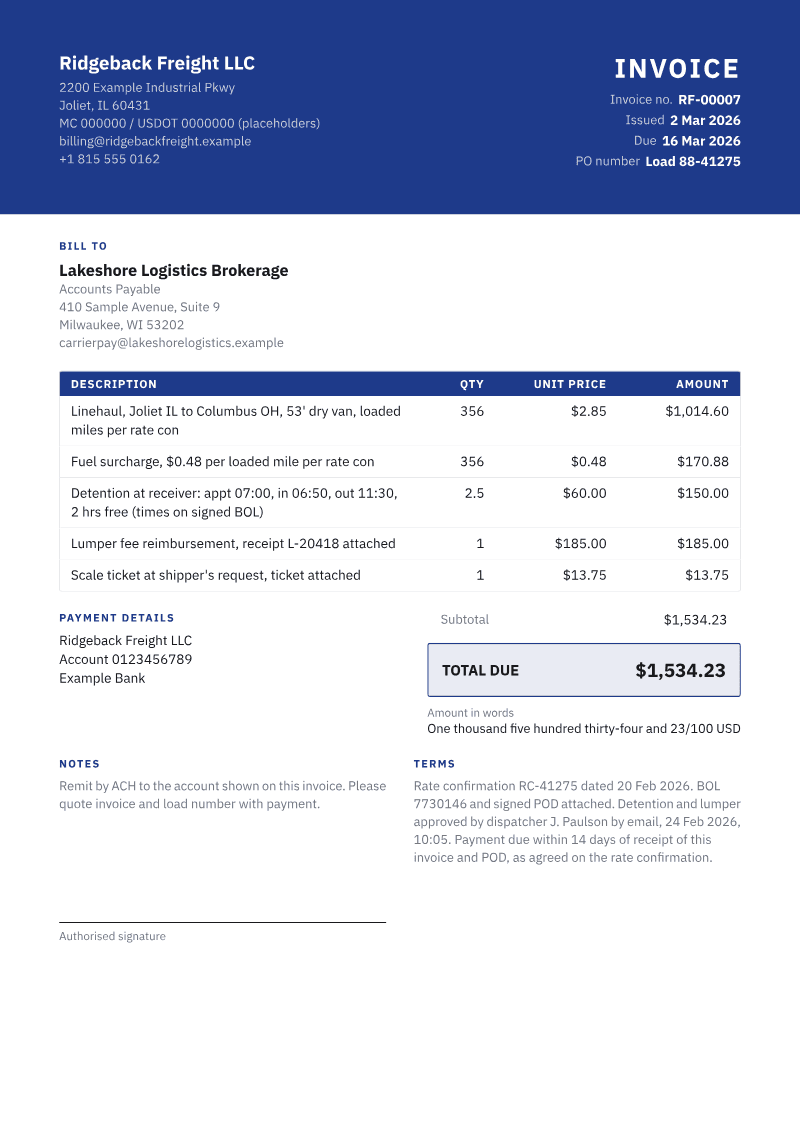
Sample trucking invoice on the Corporate template, with invented business, client and prices

Job details

Load / reference number
Load 88-41275
Rate confirmation
RC-41275, dated 20 Feb 2026
BOL number
7730146 (signed POD attached)
Pickup
Joliet, IL, Mon 23 Feb 2026, 14:00
Delivery
Columbus, OH, Tue 24 Feb 2026, appointment 07:00
MC / USDOT
Placeholder numbers in this invented sample
Shown on the Corporate template. Rendered by the same engine that builds the PDFs Charming sends. Business, client and prices are invented for illustration.

Line items for trucking invoices

Starter line items for trucking invoices, prices left blank
DescriptionQtyUnitPrice
Linehaul
Linehaul, flat rate for the load (origin to destination)1loadLeft blank
Linehaul, per loaded mile1miLeft blank
Stop-off charge, extra pickup or drop1stopLeft blank
Fuel surcharge
Fuel surcharge per loaded mile, as set on the rate con1miLeft blank
Accessorials
Detention after free time (in and out times from the BOL)1hrLeft blank
Lumper fee reimbursement (receipt attached)1eachLeft blank
Layover, driver held overnight1dayLeft blank
Truck ordered not used (TONU)1eachLeft blank
Tolls and scale tickets (copies attached)1lotLeft blank

Prices are left blank on purpose. Use your own rates.

What trucking invoices should include

Load number and rate confirmation reference
Brokers file every payable under their own load number, and the rate con is the contract for that load. An invoice without both goes into a queue while someone searches for it. Print the broker's number exactly as it appears on the rate con, dashes included.
Example: Load 88-41275, rate confirmation RC-41275
BOL number, with the signed BOL and POD attached
The bill of lading proves what was picked up; the signed proof of delivery proves it arrived, clean or with exceptions noted. Most brokers will not release payment without the POD, and a receiver's note of damage or shortage on it is the first thing a claims team reads.
Example: BOL 7730146, POD signed 24 Feb 2026 11:28
Equipment type and lane
The rate was agreed for a specific trailer between two points. Naming the equipment (dry van, reefer, flatbed, step deck) and the lane on the linehaul line lets the clerk confirm it against the rate con without opening a second document.
Example: 53' dry van, Joliet IL to Columbus OH
Evidence for each accessorial
Detention needs arrival and departure times, ideally stamped on the BOL or logged by your ELD, plus the free time from the rate con. Lumper and scale charges need the receipt. Many brokers also want a dispatcher's approval recorded at the time. Put the reference on the line itself, not only in an email.
Example: Detention: appt 07:00, out 11:30, 2 hrs free, approved by J. Paulson
Your MC and USDOT numbers and legal name
The payee on the invoice must match the carrier on the rate con and in the broker's carrier setup. A mismatch, such as a dispatcher's company name in place of the carrier's, holds payment while they check for fraud. If you factor, the factor's remittance details replace yours only as your factoring agreement says.
Example: Ridgeback Freight LLC, MC and USDOT as registered

How trucking work is usually billed

Per loaded mile or a flat rate for the load

Brokered truckload freight is usually agreed as an all-in flat rate or as a rate per mile, and the invoice should follow whichever the rate con used. If it says a flat rate, bill one linehaul line for the load and do not re-derive it from miles. If it says per mile, show the mileage figure the rate con was based on, since your odometer and the broker's routing software will rarely agree. Stop-offs are normally priced per extra stop on top of either.

Fuel surcharge as its own line

Some rate cons fold fuel into an all-in number; others set a fuel surcharge per mile or as a percentage tied to a published diesel index. When it is separate on the rate con, keep it separate on the invoice so the clerk can tick it off. Do not recompute it with today's diesel price if the rate con fixed the figure.

Accessorials and the proof each one needs

Detention is billed per hour, or part hour if agreed, after the free time on the rate con, often counted from the appointment time rather than arrival. Layover is per day when a driver is held overnight. A TONU is a flat charge when a load is cancelled after the truck was dispatched. Lumper fees are reimbursed at the receipt amount. Each of these is the line most often short-paid, so attach the evidence and the approval with the invoice, not after a dispute.

Quick pay, factoring and standard terms

Many brokers offer a quick-pay option for a percentage fee, and many small carriers sell their invoices to a factoring company that advances most of the amount and collects from the broker. Both are agreements between you and those companies; the invoice simply has to carry the remittance details the agreement requires. Charming does not factor invoices or offer quick pay.

Rules and good practice

United States (FMCSA): credit periods and freight bill timing, 49 CFR Part 377
Rule

For for-hire, non-exempt motor carriers that extend credit on tariff charges, Part 377 sets a default credit period of 15 days, starting the day after the freight bill is presented and counting weekends and holidays. A carrier's tariff can set a different period, but not longer than 30 calendar days. On collect shipments the freight bill is to be presented within 7 days of delivery, not counting weekends or legal holidays, and the bill or an accompanying notice must state the credit terms and any late-payment charges. Much brokered and contract freight is billed instead on the terms in a written contract or rate confirmation: federal law lets a carrier and shipper expressly waive rights and remedies in writing for the transportation a contract covers. Check which applies to your loads before relying on either.
United States (FMCSA): what a broker must record, 49 CFR 371.3
Rule

A property broker must keep a record of each transaction for three years, showing among other things the bill of lading or freight bill number, the compensation the broker received for the brokerage service, and any freight charges it collected with the date it paid the carrier. Each party to a brokered transaction has the right to review that record. Carriers sometimes use this to check what the broker was paid on a load; the request goes to the broker, and the invoice's BOL and load numbers are what identify the transaction.

Send the invoice and the paperwork as one package

Most short-pays and slow payments come from a missing document rather than a disputed rate. Scan the signed BOL, the POD and every receipt the day the load delivers, name the files with the load number, and send them with the invoice in one message. If the broker uses a carrier portal, upload the same set there too, because a portal upload is often the only submission their payables team counts.

General information, not tax or legal advice. Rules vary by place and change; check the current official guidance.

Making trucking invoices in Charming

In Charming each line can carry a unit (mi, hr, each) and a section label. Turn on the Unit column and section grouping in the Template Studio and Linehaul, Fuel surcharge and Accessorials print as separate blocks with subtotals; this sample uses the Corporate template as it comes, with both off, so each description says what the quantity counts. The PO number field prints in the header, and the Template Studio lets you rename its label to "Load number". Put the rate con, BOL and approval references in the terms. When a broker hires you on the same lane every week, duplicate last week's invoice and change the load details. The line items above are also a starter kit in the app: on a new invoice with no lines yet, choose Start from a kit, then "Trucking load" under Trades. Prices start at 0.00 for your own rates.

Charming cannot attach the BOL, POD or receipts to the invoice, so send them alongside it or upload them to the broker's portal. It does not calculate mileage or detention for you, does not factor or offer quick pay, cannot take card payments from the invoice, allows one tax rate per invoice, and Free-plan invoices carry a small "Sent with Charming Invoices" footer line.

Questions

What should a trucking invoice include?
Your legal carrier name, MC and USDOT numbers, the broker's or shipper's load number and rate confirmation reference, the BOL number, pickup and delivery dates and places, the linehaul charge as agreed, fuel surcharge, each accessorial with its evidence, payment terms and remittance details. Attach the signed BOL and POD, plus any receipts.
How do I bill detention on a freight invoice?
Put detention on its own line, priced per hour, with the arrival and departure times and the free time stated on the line. Use the times on the signed BOL or from your ELD, note who at the broker approved it and when, and bill only the hours after free time. Unapproved or undocumented detention is the most common short-pay.
Is a freight bill the same as an invoice?
In trucking the terms are used almost interchangeably: a freight bill is the carrier's invoice for transporting a shipment. The federal credit rules in 49 CFR Part 377 use the term freight bill. Brokers usually call it the carrier invoice, and they expect it to arrive with the BOL and proof of delivery.
Can I send a trucking invoice if I factor my loads?
Yes, but follow your factoring agreement. Usually the factoring company either sends the invoice itself or requires a notice of assignment and its remittance address on your invoice, so the broker pays the factor rather than you. Paying the wrong party is a frequent cause of disputes, so confirm the broker has the notice on file.

Template designs

The Corporate invoice template, shown on a sample invoice

Corporate

Navy band, boxed table and a tax summary — procurement-ready.

The Ledger invoice template, shown on a sample invoice

Ledger

Account-ledger look: summary box, compact boxed table and a tax summary.

The Classic invoice template, shown on a sample invoice

Classic

Serif letterhead with a coloured rule — timeless and formal.

Make this invoice with your own details

Add your business, your client and your own rates, then send it to your client as a PDF.