- Vehicle, VIN and odometer
- The VIN identifies the exact car, not just the model, which matters when a warranty claim or a recall check comes later. Odometer in and out shows how far the car was driven during the road test, and in Florida the odometer reading is part of the required invoice content.
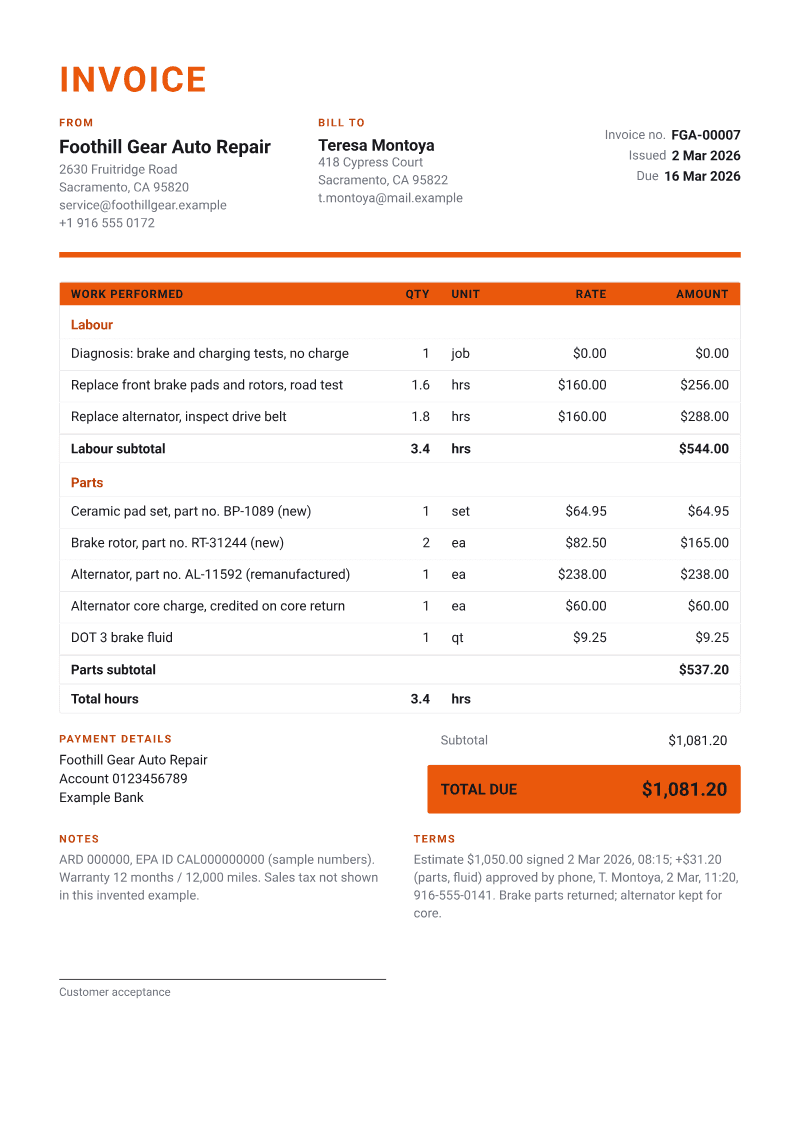
- Example: 2017 Honda CR-V EX, VIN 5XX..., 84,512 in / 84,519 out
- Authorisation record
- The estimate the customer approved, and any extra amount they agreed to by phone, should be traceable from the invoice. Note who approved it, when and on what number; it is the first thing anyone checks when a total is higher than expected.
- Example: Estimate $1,050.00 signed 2 Mar 08:15; +$31.20 by phone 2 Mar 11:20
- Part number and condition for every part
- "Brake pads" could be anything. A part number lets the customer, or the next shop, look up exactly what was fitted, and the condition (new, used, rebuilt, remanufactured, OEM or aftermarket) is a legal requirement in some states, not a courtesy.
- Example: Alternator, part no. AL-11592 (remanufactured)
- What happened to the old parts
- California and Florida both let customers ask for their replaced parts when they authorise the work, and other states have similar rules. Recording whether they were returned, kept for a core return, or sent back under warranty heads off the "how do I know you changed it?" conversation.
- Example: Brake parts returned; alternator kept for core return
- Warranty in time and miles
- A repair guarantee means little without both limits. Florida requires the invoice to say what is guaranteed and for what time and mileage; everywhere else it is the line a customer looks for when the noise comes back.
- Example: 12 months or 12,000 miles, parts and labour