What a contractor invoice should show

Nnabuike Okoroafor ·
On this page · 9 sections
A property manager opens a $4,162.95 invoice for a bathroom refit and asks: what is that for? If the invoice cannot answer on its own, you answer by phone, and the payment waits while you do. A contractor invoice has more moving parts than most: labour, materials, changes agreed mid-job, a deposit already paid, sometimes money held back until sign-off. Each needs to be visible on the page.
This guide covers what a contractor invoice should show so the total explains itself, with a full example at the end. The fields every invoice needs (number, dates, payment details) are in the field-by-field invoice checklist. This post is about what a construction invoice adds on top.

This is general information, not legal or tax advice. Payment rules for construction work, including retainage and how tax applies to labour and materials, differ between countries and often between states or regions.
Billing as a freelance or 1099 independent contractor rather than a builder? The independent contractor invoice template is written for you, with a filled-in sample.
How to invoice as a contractor, step by step#
Contractor invoicing goes wrong at the start of a job more often than at the end. In order:
- Agree the price and scope in writing before you start: a quote or estimate the client accepts, with its own number.
- Log labour, materials and changes as you go, with dates, hours and receipts, so nothing is rebuilt from memory.
- Bill at the agreed stage, on completion or at each stage the contract names, against the quote or contract reference.
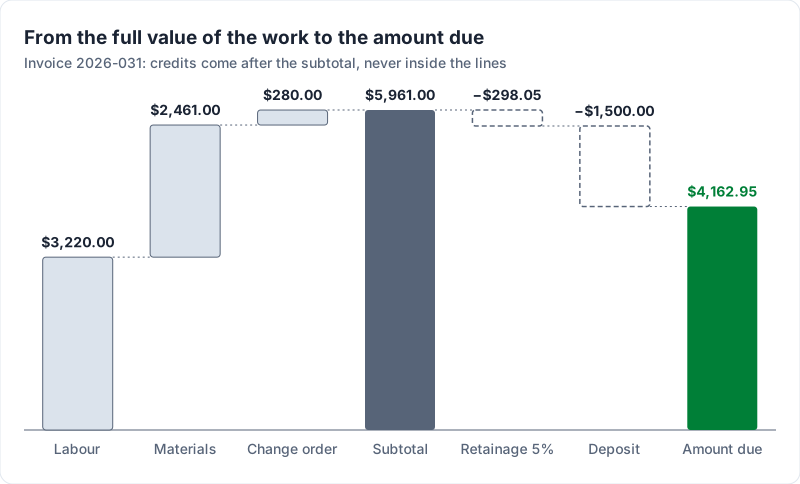
- Put the credits last: the full value of the work first, then any deposit received and any retainage held.
- Follow up on the due date, and keep track of any retainage you are still owed.
Each step has its own section below, and the worked example at the end puts them on one page.
Start with the job, not the amount#
Before any line items, an invoice for construction work should say which job it is for. Property managers and main contractors match invoices to jobs, and one they cannot match goes to the bottom of the pile.
- Job address. The property where the work was done, which is often not the client’s billing address. A property manager billed at their office needs to see “14 Alder Road, main bathroom” to know which unit this is.
- Scope in one line. “Main bathroom refit: strip-out, replumb, tile and fit new vanity” tells the reader what the whole invoice covers before they read a single line.
- Quote or contract reference. The number or date of the quote or contract the client accepted, so the invoice can be checked against it. If you do not have a written quote yet, the free estimate or quote template for Excel or Word numbers each estimate (EST-0001 onwards) so the invoice can quote it, and invoice vs estimate or quote explains how the two documents differ, and quote and invoice template follows one estimate through to its invoice. How to write a contract invoice covers billing against a signed contract’s payment schedule.
- Purchase order or job number, if the client issued one. Some clients cannot pay without it.
- Work period. The dates the invoice covers, which matters most on a job billed in stages.
Itemising labour and materials#
The quickest way to get a total queried is one line that reads “Bathroom works — $5,961.00”. The client cannot tell your time from the tile they picked, so they guess.
Split the invoice into sections:
- Labour, by task or trade, with hours or days and a rate. “Plumbing first and second fix, 12 hours at $75.00” is checkable. “Labour, $3,220.00” is not.
- Materials, by item or by sensible group, with quantities. Name the items the client chose (“Vanity unit with basin, as selected by client”) so the cost is visibly theirs.
- Sundries, grouped. Nobody wants 40 lines of screws and sealant. “Adhesive, grout, sealant and fixings, 1 lot” is honest and readable.
- Equipment hire and disposal, each on its own line.
Section subtotals let the client hold labour and materials against the quote in seconds. Every trade has its own version of this: photographers split coverage, editing and licensing for the same reason, as a photographer’s guide to invoicing sets out.
For one trade’s version filled in, this sample plumbing invoice puts labour, pipe by the foot, fixtures and the permit in their own sections. If you would rather start from a file, free contractor invoice templates for Word and Excel show where labour, materials and a deposit go, with a filled deck-replacement example. For a job with no materials, the job invoice template adds a labour-only version.
One exception: on a fixed-price contract, you agreed a price for an outcome, not a breakdown of your costs, and some argue you should not volunteer one. From a public discussion about a client who asked for a full cost breakdown after the job was finished (the person quoted is not a Charming customer):
If it was a fixed contract, unless you contractually agreed to it, don’t break it down or no more then X labor, Y materials.
On a fixed-price job, itemise by stage instead (“Strip-out complete”, “First fix complete”). Either way, the invoice should mirror whatever the contract priced. Our guide to itemised invoices shows one job invoiced three ways, with the same total each time.
Markup: show it or build it in, but be consistent#
Most contractors charge more for materials than they paid, to cover sourcing, collecting and standing behind them. There are two honest ways to show it:
- Built into the unit price. The tile line reads $6.50 a square foot, and that is the price. This is normal where the client agreed a price per item rather than cost plus.
- As its own line. Materials are listed at cost, followed by a line such as “Materials handling and markup, 15% of $2,140.00”. This is the usual format on a cost-plus contract, where the client agreed to pay your costs plus a set percentage.
What causes trouble is mixing the two: listing materials “at cost” when they are not, or adding a markup line the contract never mentioned. One receipt that contradicts your “cost” line puts every other number in doubt. For costs you paid on the client’s behalf, how to bill expenses on a reimbursement invoice compares passing them through at cost with adding a markup.
Change orders get their own lines#
Changes halfway through a job are normal. Billing them silently inside the original lines is how a fair invoice ends up looking padded. Someone in a public discussion about extra work (again, not a Charming customer) put the case for pricing every change:
I would still price up the change order and extra time needed, becasue if you do the extra and its taking an extra week, and you've not said, they are going to think you're just slow.
On the invoice, each approved change should:
- Sit on its own line or in its own section, apart from the original scope.
- Carry a reference and an approval date, such as “Change order 01, approved 3 October 2026”.
- Describe the change in plain words: “Add recessed shower niche, 12 x 24 inches”.
- Match the price agreed in writing before the work was done.
If a change was never priced or approved, agree the price in writing before it appears on an invoice.
Deposits and retainage: the two credits people muddle#
Both reduce what is due on this invoice, and both belong after the subtotal, never hidden inside the line items.
A deposit is money the client paid before the work started. Show the full value of the work first, then the deposit as a credit with its date: “Less deposit received 15 September 2026, $1,500.00”. The client should see the full price and the money they have already paid, side by side. Asking for the deposit in the first place is its own conversation, and asking for money without the awkwardness covers the wording. How a deposit invoice works covers the invoice you send to collect it. If you invoice from a file, the free invoice template for Excel or Word has an “Amount paid” row above “Balance due” for the deposit.
Retainage (usually called retention outside the US) is a percentage of each payment the client holds back until the job is complete or signed off, as protection against unfinished or defective work. The contract sets it, not the invoice, and some places have rules about it, so ask a construction lawyer if you are unsure. As one example, the US federal government’s standard clause for fixed-price construction contracts, FAR 52.232-5, says in paragraph (e), as of 28 October 2026: “However, if satisfactory progress has not been made, the Contracting Officer may retain a maximum of 10 percent of the amount of the payment until satisfactory progress is achieved.” Your own contract will have its own rate and release terms.
If your contract includes retainage, show it on every invoice:
- The percentage and its base, for example “5% of $5,961.00”.
- The amount held on this invoice.
- The total held to date on the contract, if the job runs over several invoices.
Then keep your own record of it: retainage is money you have earned and not been paid, and it is easy to forget. When it is released, bill it on its own invoice with a clear line such as “Release of retainage, contract 2026-014”.
The two side by side:
| Deposit | Retainage | |
|---|---|---|
| What it is | Money the client paid before the work started | A percentage of each payment the client holds back until the job is complete or signed off |
| Who sets it | You ask for it before the work starts | The contract |
| Where it goes on the invoice | After the subtotal, as a credit with the date it was received | After the subtotal, with the percentage, its base and the amount held |
| Have you been paid it? | Yes | No: it is earned but not yet paid |
| What happens next | Nothing: it is settled on this invoice | You bill it on its own invoice when it is released |
Jobs billed in stages against a contract value follow the same pattern with a few more lines. Progress invoicing, explained walks through them.
A worked contractor invoice example#
Here is a full example for a sample bathroom refit. The business, client, address and every number are invented for illustration, and no tax is shown: whether and how tax applies to construction labour and materials depends on where the work is done, so check your own tax authority’s guidance. If you are VAT-registered in the UK, our UK VAT invoice guide lists the details HMRC asks for, with a worked example.
- Invoice 2026-031. Issued 21 October 2026, due 4 November 2026 (Net 14)
- From: Ridgeback Building and Tile (sample business)
- To: Harbourline Property Management, Accounts Payable (sample client), PO 7781
- Job: Main bathroom refit, Unit 2, 14 Alder Road
- Scope: Strip-out, replumb, tile walls and floor, fit new vanity, per quote Q-118 accepted 8 September 2026
- Work period: 22 September to 17 October 2026
| Description | Qty | Unit | Rate | Amount |
|---|---|---|---|---|
| Labour | ||||
| Strip-out and disposal of existing bathroom, crew of two | 16 | hr | $55.00 | $880.00 |
| Plumbing first and second fix | 12 | hr | $75.00 | $900.00 |
| Tiling, walls and floor | 120 | sq ft | $12.00 | $1,440.00 |
| Labour subtotal | $3,220.00 | |||
| Materials | ||||
| Porcelain tile, walls and floor, including cutting allowance | 130 | sq ft | $6.50 | $845.00 |
| Vanity unit with basin, as selected by client | 1 | each | $640.00 | $640.00 |
| Thermostatic shower valve and fixings | 1 | each | $385.00 | $385.00 |
| Adhesive, grout, sealant and fixings | 1 | lot | $270.00 | $270.00 |
| Materials handling and markup, 15% of $2,140.00 | 1 | $321.00 | $321.00 | |
| Materials subtotal | $2,461.00 | |||
| Change orders | ||||
| Change order 01, approved 3 October 2026: recessed shower niche | 1 | each | $280.00 | $280.00 |
| Totals | Amount |
|---|---|
| Subtotal | $5,961.00 |
| Less retainage, 5% of $5,961.00, released 30 days after sign-off | $298.05 |
| Less deposit received 15 September 2026 | $1,500.00 |
| Amount due on this invoice | $4,162.95 |
Below the totals: bank transfer details, the PO number as the payment reference, and one note: “Retainage of $298.05 will be invoiced separately on release.”
Laid out as it would print, with the parts this guide covers marked:
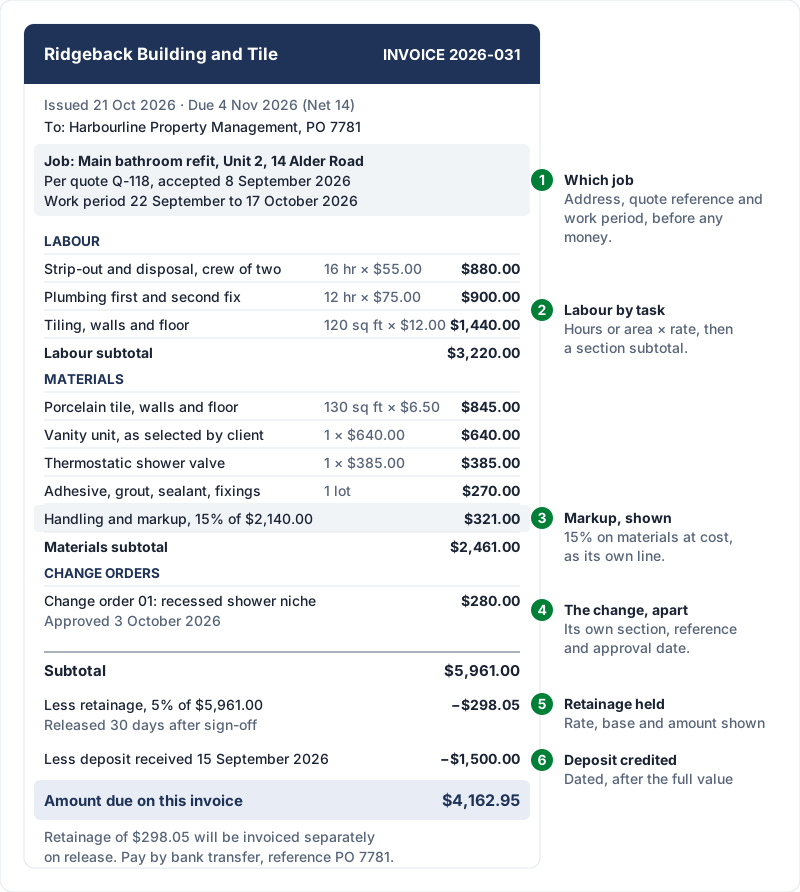
Every line is quantity times rate, the change order can be matched to its written approval, and the credits come last, so the client sees the full value of the work before what was paid and what is held. That is a contractor invoice nobody needs to ring you about.
What a subcontractor invoice needs on top#
When you bill a main contractor rather than the property owner, the reader is an accounts team matching your invoice to a subcontract and their own payment application. Invoicing for contractors at this level is mostly about fitting their paperwork. Add:
- Their project name and number, plus your subcontract or PO number.
- Your scope package in their wording, such as “Package 4: wall and floor tiling, levels 1 to 3”.
- This period against to date: what you are billing now, what you have billed before, and what is left on your subcontract value.
- Retainage held against you, at the rate in your subcontract.
- Any documents they require with each invoice, and their cut-off date, confirmed before you send it.
Your subcontractor invoice often feeds into theirs, so ask the main contractor exactly what their own payment request needs from you, and by when. If the contract names AIA forms, how G702 and G703 pay applications work explains what they ask you to show.
Doing this in Charming Invoices, and where it stops#
Charming Invoices has two templates built for construction work. The Contractor template groups line items under section headings such as Labour and Materials, prints a subtotal under each section, adds a unit column and a total hours line, and includes a sign-off line. The Progress Billing template shows the contract value, percentage complete, retainage held and balance to complete. On an invoice, you can enter a retainage percentage and a deposit: retainage is worked out on the subtotal after any discount and before tax, the deposit is credited, and the amount due is what is left, calculated to the cent. Both templates are on the free plan, alongside the rest of the invoice templates.
Where it falls short:
- Retainage is not tracked as money owed. The withheld amount prints on the invoice but is not counted in your outstanding totals or client statements, and there is no release step. You bill released retainage on a separate invoice, and nothing links it back to the amounts held. Keep your own running total.
- There is no markup setting. Markup goes in as its own line or inside your unit prices.
- There are no quotes, estimates or change order documents. Agree changes outside Charming, then bill them as lines. The free estimate template above covers the quote; if you need quotes and scheduling in the same tool, invoicing software for contractors compares the options.
- Payment tracking is manual, and clients cannot pay by card from the invoice. They pay you directly, and you mark it paid.
- Free invoices carry a small “Sent with Charming Invoices” line in the footer. Paid plans hide it by default.
Whatever you invoice with, the test is the same: could someone who was never on site read the invoice and understand the total? If yes, send it. To try the layout above with your own numbers, create a free invoice.
Free downloads
No sign-up and no email address. More on the free templates page.
- Download .xlsx: Estimate or quote template for Excel
Estimate or quote template for Excel
Excel .xlsxPrice a job before you start: scope, line items, a valid-until date and an optional deposit.
- Download .docx: Estimate or quote template for Word
Estimate or quote template for Word
Word .docxThe estimate as a Word document: scope of work, prices, deposit and acceptance lines.
- Download .xlsx: Invoice template for Excel
Invoice template for Excel
Excel .xlsxThe general-purpose invoice: products, services or a mix, priced by quantity and rate.
- Download .docx: Invoice template for Word
Invoice template for Word
Word .docxThe general invoice as a Word document, for people who would rather type than use cells.