How to write a contract invoice

Nnabuike Okoroafor ·
On this page · 10 sections
The contract is signed, the first stage of work is done, and now you have to bill for it. On most jobs an invoice stands alone. A contract invoice does not. Someone on the client's side, often in a finance team you have never met, will hold it up against the agreement and check that this is a payment the contract says is due, for the amount it says, at the time it says. If they cannot match the two, the invoice waits.
This guide covers how to write an invoice for contract work so that the match is easy, and ends with a worked example: one contract with three milestones, billed in three invoices.
General information, not legal or tax advice. What a contract invoice needs to contain is set mainly by your contract; this post does not cover any legal or tax requirements where you are. Check your own contract and your local guidance before relying on any figure here.
What makes a contract invoice different#
An ordinary invoice proposes an amount. A contract invoice does not get to propose anything: the price, the stages and often the payment terms were agreed before the work started. Its only job is to show that one particular payment under that agreement has now fallen due. So the reader is not asking whether your price is fair. They are asking three narrower questions:
- Which agreement is this under?
- Which payment in that agreement is it?
- Has the thing that triggers it happened?
Billing against a contract well means answering those three questions on the contract invoice itself, so nobody has to email you to ask. Whether an invoice can ever stand in for the contract is a separate question, covered in is an invoice a contract.
Reference the contract, the clause and the schedule#
The single most useful addition to a contract invoice is a block near the top that ties it to the agreement. Put it under the client's details, before the line items:
| Field | Example |
|---|---|
| Contract | Website build agreement, ref SOW-2026-07, signed 3 June 2026 |
| Clause being billed | Schedule B, payment 2 of 3: design approval |
| Trigger | Design approved by email, 17 July 2026 |
| PO number | 4500-1182 (if the client issued one) |
| Work period | 3 June to 17 July 2026 |
Name the clause, not just the contract. “Per our agreement” makes the reader go and find the agreement. “Schedule B, payment 2 of 3” tells them exactly which line to tick.
Large buyers write this into their rules. For US federal contracts, for example, FAR 32.905 says, as of 23 October 2026: “Payment will be based on receipt of a proper invoice and satisfactory contract performance.” It then lists what “A proper invoice must include”, starting with the contractor's name, the invoice date and the contract number. Your client's accounts team is likely to check for similar things.
If the client uses purchase orders, the PO number matters even more than the contract number, because it is what their system matches against. Where a PO number goes on an invoice covers it in detail.
Align each invoice to the payment schedule#
Most contracts for project work carry a payment schedule: a list of amounts and the events that trigger them. Treat it as your invoicing plan. Before the work starts, write it out as a list of invoices you will send:
| Schedule line | Trigger | Amount | Invoice |
|---|---|---|---|
| Payment 1 | On signing | 30% of contract value | Send on signature |
| Payment 2 | Written design approval | 40% | Send the day approval arrives |
| Payment 3 | Site live | 30% | Send on launch |
Three rules keep the invoices and the schedule in step:
- Bill the trigger, not the calendar. An invoice for payment 2 sent before design approval is early, and easy to reject.
- Bill the scheduled amount exactly. If the contract says 40%, the invoice says 40% of the stated value. Any rounding goes on the last invoice, so the total billed equals the contract value to the cent.
- Show the running total: contract value, billed to date and remaining. It proves at a glance that nothing has been billed twice.
A first payment due on signing is, in practice, a deposit: money before the work. How deposit invoices work covers how it should show on the invoices that follow. Long jobs billed by percentage complete or a schedule of values work on the same principle with more lines, and progress invoicing, with a worked example walks through that arithmetic.
Fixed-price vs time-and-materials contract invoicing#
The type of contract decides what the invoice has to prove.
| Fixed-price contract | Time-and-materials contract | |
|---|---|---|
| What each invoice bills | A scheduled share of an agreed price | Hours or days worked, plus agreed costs, for a period |
| Line items | The milestone or stage, by name | Roles or people, hours, the rate from the contract |
| Evidence the reader wants | That the milestone happened | Timesheets or a summary of hours, receipts for costs |
| What to watch | Billing a stage before it is accepted | Going over a cap (“not to exceed”) without written approval |
On a fixed-price contract, you agreed a price for an outcome, so the invoice bills the outcome. You do not usually owe the client a breakdown of your hours. One person in a public discussion, replying to someone whose client asked for an itemised cost breakdown after the job was finished, put it bluntly (the people quoted in this post are from public online discussions and are not Charming customers):
Your contract was for x deliverables at y price. As long as you met your deliverables that’s it.
On a time-and-materials contract, the invoice bills effort, so it has to show it: hours per role, the contract rate for that role, the billing period, and agreed costs on the terms the contract allows. If there is a ceiling, show how much of it is used on every invoice, so the client is never surprised by the fourth one.
Change orders and variations#
Work changes mid-contract. The change is agreed separately, as a change order or a variation, and it amends the contract value. On the invoice:
- Bill each change on its own line, with its reference and approval date: “Variation 1, booking page, approved 12 August 2026”.
- Never fold it into an original milestone. Payment 3 stays at its scheduled figure; the variation sits beside it.
- Show the revised contract value in your running total, so original value plus approved variations still equals everything billed by the end.
A change never approved in writing is the easiest line for a finance team to strike out, so get the approval first. The construction version, with labour and materials, is in what a contractor invoice should show. For a smaller job, the job invoice template has a filled-in sample with labour, materials and a deposit.
Retention and holdbacks, in plain language#
Some contracts let the client keep back a percentage of each payment until the work is finished or a defects period has passed. It is called retention, retainage or a holdback: money you have earned but will be paid later. The contract sets the rate and the release terms. As one example, the US federal clause for fixed-price construction lets the contracting officer retain up to 10 percent of a payment while progress is unsatisfactory, and once the work is substantially complete, to keep only what is adequate to protect the government and release the rest (FAR 52.232-5). Private contracts set their own terms.
If your contract has retention, show it on every invoice as a line after the subtotal: the percentage, what it is calculated on, the amount held now and the total held to date. When it is released, send a separate invoice for it that names the invoices it was held on. Nobody else is going to remind you.
Invoice date versus delivery date#
Two dates get muddled on contract invoices: when the work was delivered and when the invoice was issued. Our guide to the invoice date sets these and the due date side by side, with a late invoice worked through.
- The invoice date is the day you issue it. Do not backdate it to the milestone, even if you are late sending it.
- The delivery or milestone date goes in the contract block (“Trigger: site live, 25 September 2026”) or in the line description.
- The due date follows the contract. Some contracts count from the invoice date, some from receipt of a correct invoice, some from acceptance of the work. Use the contract's wording, and print the actual date.
Dates can also matter for tax. In the UK, for instance, HMRC's VAT Notice 700, section 14 says, as of 23 October 2026: “If you supply services on a continuous basis and receive payments regularly or from time to time, there’s a tax point every time you issue a VAT invoice, or receive a payment, whichever happens first.” The same section sets out the other tax-point rules. Other countries have their own rules; if you are registered for sales tax, VAT or GST, check with your tax authority or an accountant.
Whatever the tax position, send the invoice when the trigger happens. A finance team that budgeted for payment 2 in July does not want to find it in September.
What the client's finance team needs to approve it#
The person who approves your invoice is often not the person who hired you, and they are looking for reasons it does not match. One freelancer in a public discussion described the question to ask of your own invoice:
Can someone doing a bunch of data entry quickly make sense of key fields they’ll fill? Some things to consider adding: service period for ongoing client, you & their legal/o.b.o. business name, tax ref, running balance if drawing from retainer. Payment terms (issue to, how to pay, by when).
A missing reference alone is enough to bounce an invoice. Indiana University's accounts payable team reported in 2025 that more than 1,000 invoices a month were rejected there for one reason: the purchase order number was missing from the invoice document (Indiana University).
Before you send, check:
- Names match the contract: the client's legal entity, and your own name and bank details as you gave them at supplier setup.
- The contract reference, clause and PO number are on the invoice itself, not only in the email subject.
- The trigger is evidenced: who approved the milestone and when.
- The amount matches the schedule, and the running total adds up.
- Required documents are attached: timesheets, acceptance certificates, receipts.
- It goes to the address the contract or PO names, often an accounts payable inbox.
A worked example: one contract, three milestones#
Here is an invented contract billed in full. The business, client and every figure are illustrative, and no tax is shown to keep the arithmetic visible.
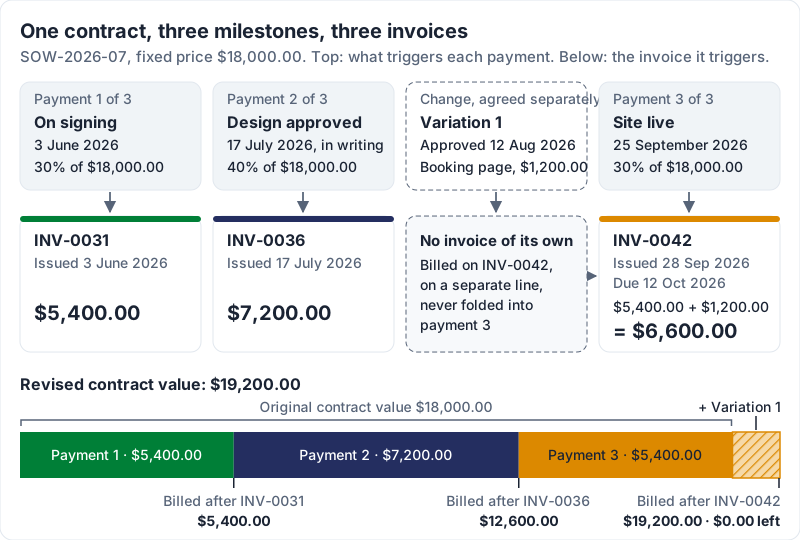
The contract: Fernbrook Studio (sample business) builds a website for Halden & Rowe Ltd (sample client). Fixed price $18,000.00, ref SOW-2026-07, signed 3 June 2026, PO 4500-1182. Payment terms: 14 days from invoice date. Schedule B: 30% on signing, 40% on written design approval, 30% on launch. During the build, the client approves Variation 1, a booking page, for $1,200.00 on 12 August 2026, which makes the revised contract value $19,200.00.
The three invoices:
| Invoice | Issued | Bills | Amount | Billed to date | Remaining |
|---|---|---|---|---|---|
| INV-0031 | 3 June 2026 | Payment 1 of 3, on signing | $5,400.00 | $5,400.00 | $12,600.00 |
| INV-0036 | 17 July 2026 | Payment 2 of 3, design approval | $7,200.00 | $12,600.00 | $5,400.00 |
| INV-0042 | 28 September 2026 | Payment 3 of 3, launch, plus Variation 1 | $6,600.00 | $19,200.00 | $0.00 |
The same schedule as a picture, trigger above and invoice below:
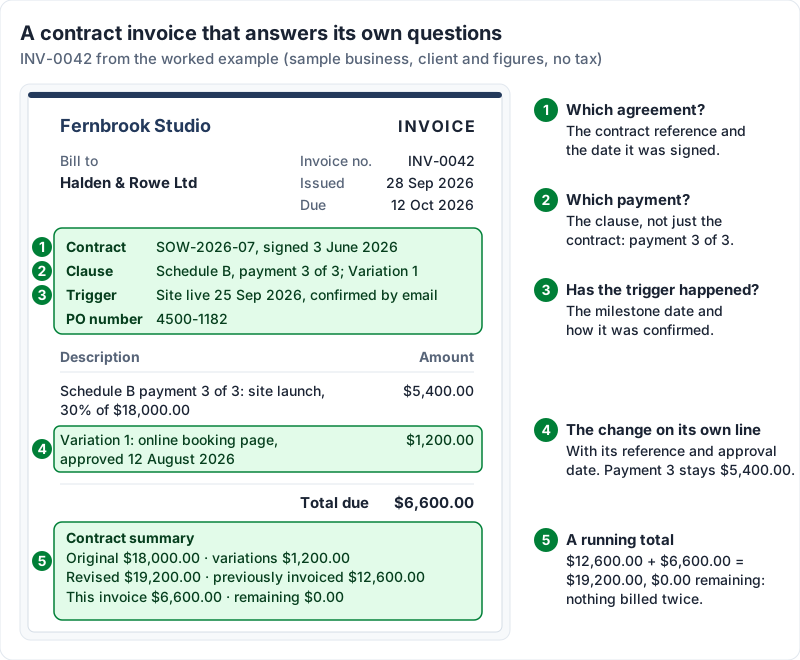
Invoice INV-0042 in full, below the usual business and client details:
- Contract: Website build agreement, ref SOW-2026-07, signed 3 June 2026
- Clause being billed: Schedule B, payment 3 of 3 (launch); Variation 1
- Trigger: Site live 25 September 2026, launch confirmed by email by the client's project lead
- PO number: 4500-1182
- Issued: 28 September 2026. Due: 12 October 2026 (14 days from invoice date, per the contract)
| Description | Qty | Rate | Amount |
|---|---|---|---|
| Schedule B payment 3 of 3: site launch, 30% of $18,000.00 | 1 | $5,400.00 | $5,400.00 |
| Variation 1: online booking page, approved 12 August 2026 | 1 | $1,200.00 | $1,200.00 |
| Total due | $6,600.00 |
And a note to print under the totals:
Contract summary: original value $18,000.00; approved variations $1,200.00; revised value $19,200.00. Previously invoiced $12,600.00 (INV-0031, INV-0036). This invoice $6,600.00. Remaining after this invoice $0.00. Please quote INV-0042 and PO 4500-1182 with payment.
Every figure traces to a clause, an approval or an earlier invoice.
Doing this in Charming Invoices, and where it stops#
Charming Invoices has a PO number field that prints in the invoice header, and you can rename its label in your template settings, so it reads “Contract ref” instead. The catch: the label belongs to the business's template, so it changes on every invoice from that business, and there is only one such field. The clause, trigger and contract summary go in the Notes or Terms sections, which print on the invoice and on the private link your client opens. Invoice terms and conditions has example wording for those boxes. You can also credit a deposit and set a retainage percentage, and the Progress Billing template prints contract value, previously billed and balance to complete. All of it is on the free plan.
Where it falls short: Charming has no contracts, e-signatures, quotes or change order documents, so the agreement and its variations live outside it. Retainage prints on the invoice but is not tracked as money owed, and the deposit figure is typed by hand rather than linked to the earlier invoice. Payment tracking is manual, clients cannot pay by card from the invoice, and free invoices carry a small “Sent with Charming Invoices” line in the footer.
Whatever you use, the test is the same: could a stranger with the contract in one hand approve the invoice in the other without writing to you? If so, send it. To set up the contract block above on your own invoices, create a free invoice.