Invoice date: issue date vs due date vs service date

Nnabuike Okoroafor ·
On this page · 13 sections
You finished the job weeks ago and you are only now sitting down to bill it. The invoice form asks for a date, and suddenly it is not obvious which one: the day you did the work, the day you are writing the invoice, or the day you want to be paid?
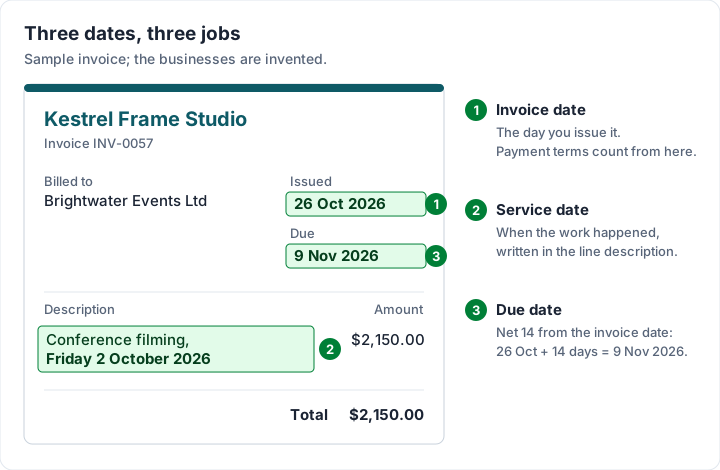
The invoice date is the day you issue the invoice. It is not the day the work was done (that is the service or supply date) and it is not the day payment is due (that is the due date). This guide explains what the invoice date means, sets every date that can appear on an invoice side by side, works through a late invoice with real dates, and covers backdating, future-dated invoices and what UK government guidance lists, quoted word for word.
In short#
- The invoice date is the date of issue: the day the invoice is finished and sent or handed to the client.
- The due date is usually counted from the invoice date, using your payment terms (Net 14, Net 30), unless your contract says otherwise.
- The service date is when the work happened. If it differs from the invoice date, write it in the line description: “Conference filming, Friday 2 October 2026”.
- Invoicing late? Date it today, not the day of the work. A backdated invoice can arrive already overdue, which helps nobody.
What is the invoice date?#
The invoice date, also called the issue date or date of invoice, is the date printed on the invoice to show when it was issued. When people talk about a “dated invoice”, or ask what the date on an invoice means, this is the date they mean.
It does three jobs:
- It starts the payment clock. “Net 30” normally means 30 days from the invoice date.
- It places the invoice in time for both sets of books: yours and your client's.
- It orders your invoices. Dates and invoice numbers should rise together, so a reader can see what was billed when.
Invoice dating is not complicated, but it is easy to blur with the other dates on the page. An invoice often carries several, and a client's accounts team may key on a different one from you.
Every date on an invoice, in one table#
Here are the dates that can appear on an invoice, what each means and who relies on it. Not every invoice needs all of them; the issue date and due date are the two almost every invoice shows.
| Date | What it means | Where it goes | Who relies on it |
|---|---|---|---|
| Invoice date (issue date) | The day the invoice is issued | Invoice header | Both sides; the start of the payment terms |
| Service or supply date | When the work was done or goods delivered; can be a period | Line description, or a separate field | The client checking what they are paying for; tax rules in some countries |
| Due date | The last day payment is expected | Invoice header | Your client's payment run; your chasing |
| PO or order date | When the client ordered the work | Next to the PO number, if given | The client's accounts team, matching invoice to order |
| Sent date | When the invoice actually left you | Your records, not usually printed | You, if a client says it never arrived |
| Payment date | When the money arrived | Your records; a receipt | You and your bookkeeping |
Two notes on the table. If you invoice on receipt, the due date equals the invoice date; what due on receipt really means covers that case. And the dates are only part of the page: the field-by-field invoice checklist covers the rest.
In public discussions about invoicing, the date sits on almost everyone's short list. One commenter in a small-business forum summed up the basics this way (quoted from a public discussion; the people quoted in our research are not Charming customers):
A lot of people just use a simple invoicing system, as long as it’s consistent and looks professional. The main things are: clear client details, invoice number, date, due date, line items, total, and payment terms.
Invoice date vs due date#
The invoice date is when you issue the invoice; the due date is when the client should pay it. The gap between them is your payment terms.
| Terms | Invoice date | Due date |
|---|---|---|
| Due on receipt | Monday 26 October 2026 | Monday 26 October 2026 |
| Net 14 | Monday 26 October 2026 | Monday 9 November 2026 |
| Net 30 | Monday 26 October 2026 | Wednesday 25 November 2026 |
Terms count from the invoice date by default, which is why the invoice date matters so much: move it, and you move the due date with it. There is one exception worth knowing. If your contract defines the invoice date, or says when payment terms start, the contract's wording wins. Some contracts count from delivery, from acceptance of the work or from when the invoice is received.
For the arithmetic itself, including end-of-month terms and weekends, use our invoice due date calculator. For what the terms mean and how to choose them, see how to calculate an invoice due date.
Invoice date vs service date#
The service date (in the UK often called the supply date) is when the work was done or the goods were delivered. For a lot of small businesses it is the same day as the invoice date: you finish the job, you hand over the invoice. When the two differ, show both.
The simplest way is to put the service date in the line description. Here is how it reads in three common cases:
- A one-off job: “Conference filming, Friday 2 October 2026”.
- A multi-day job: “Kitchen tiling, 12 to 16 October 2026”.
- A service period: “Social media management, services 1 to 31 October 2026”.
The last one is how monthly work is usually billed. A retainer invoice dated Monday 2 November 2026, with a line for “services 1 to 31 October 2026”, tells the client exactly which month they are paying for, even though the invoice was issued in November. If you bill the same client every month, how recurring invoices work covers the schedule side.
Work done under a contract can add its own triggers, such as a milestone or a signed-off delivery. Invoicing work done under a contract covers those.
Ambiguity here costs real money. In one public thread about collecting overdue payments, a videographer described this situation:
I currently have 6 invoices to them and 4 of them are overdue (payments should have been made 2 weeks after the event date).
Notice the anchor: “2 weeks after the event date”, not after the invoice date. If your terms run from the service date, say so in the terms on the invoice. If they run from the invoice date, the invoice needs to go out promptly, because every day you wait is a day added to when you get paid.
Invoicing late: a worked example#
Here is an illustrative case. The businesses are invented; the dates and arithmetic are real.
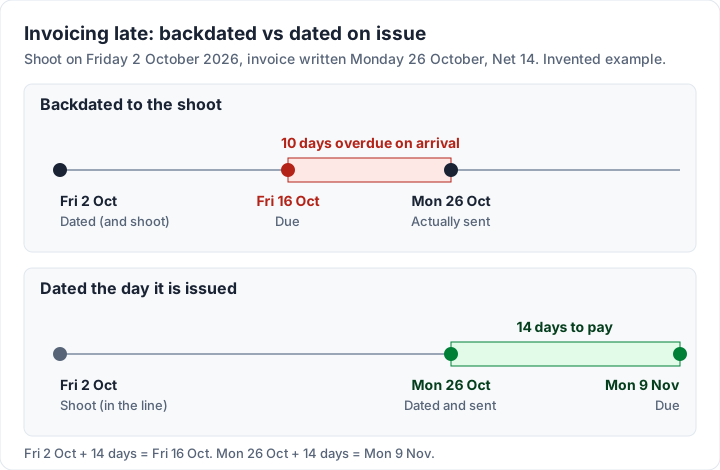
A videographer, Kestrel Frame Studio, films a conference for Brightwater Events Ltd on Friday 2 October 2026. The agreed terms are Net 14 and the fee is $2,150.00. The invoice does not get written until Monday 26 October 2026, more than three weeks later. Which date goes on it?
| Option | Invoice date | Due date (Net 14) | What the client sees |
|---|---|---|---|
| Backdated to the shoot | Friday 2 October 2026 | Friday 16 October 2026 | An invoice that is already 10 days past its due date on the day it arrives |
| Dated the day it is issued | Monday 26 October 2026 | Monday 9 November 2026 | A normal invoice; the line reads “Conference filming, Friday 2 October 2026” |
The backdated version does not get Kestrel paid any sooner. Brightwater's accounts team cannot pay an invoice before it exists, so the 14 days it promises have already gone. What it does create is a document that is overdue on arrival, a client who now has to ask why, and dates in Kestrel's own records that no longer match when things actually happened. Our guide to outstanding vs overdue vs unpaid explains why an invoice's status matters to both sides.
The second version is the one to send. The client gets their full 14 days, the line description records exactly when the work happened, and the invoice sits in the right place in both sets of records.
The lesson is about habit, not dates. Kestrel's real problem was the three-week wait, and the fix is to invoice on the day the work is done, or as close to it as you can.
Can you backdate an invoice?#
Backdating means giving an invoice an earlier date than the day it is actually issued. People ask whether it is legal; the honest answer is that rules vary by country and by tax, and we do not give a verdict here. If a client asks you to date an invoice differently, or you are unsure how a date affects your tax, ask an accountant or a lawyer where you work.
What we can give is the plain business-practice answer:
- Date the invoice the day you issue it. That is what the invoice date means.
- Put the service date in the description, so nobody is in doubt about when the work happened.
- Keep dates and numbers in step. An invoice numbered after last week's but dated a month earlier is the kind of oddity that makes a reader stop. How to number invoices explains why sequence matters.
For VAT-registered businesses in the UK, one sentence of HMRC guidance is worth reading on its own. VAT Notice 700, section 14.2.2 (“Actual tax points”), says:
A tax point cannot be created simply by preparing an invoice.
That sentence is about VAT tax points, so read it in context in VAT Notice 700 (as of 28 October 2026), or ask your accountant how it applies to you.
Future-dated and post-dated invoices#
The mirror-image question is whether you can date an invoice in the future: write it today, date it for the 1st of next month, and send it now.
As a practice, send an invoice on the day it is dated. A post-dated invoice that arrives early leaves the client unsure when terms start, and if the client's system keys on the received date while you key on the printed date, you will disagree about when payment is due. If you want an invoice to go out on a set day, prepare it as a draft and send it on that day. If you need to bill before the work, as with a deposit, the types of invoices sets out which invoice to send at each stage.
UK readers: what GOV.UK and HMRC list#
GOV.UK lists the invoice date and the supply date as two separate items. As of 28 October 2026, GOV.UK's page on what an invoice must include lists, among other items:
- “the date the goods or service were provided (supply date)”
- “the date of the invoice”
For VAT invoices, HMRC's VAT Notice 700, section 16.3.1 (“General”), lists, among other details:
- “the time of the supply (tax point)”
- “the date of issue of the document (where different to the time of supply)”
Section 14.1 of the same notice introduces the term like this: “It explains the rules for working out the time when a supply of goods or services is treated as taking place. This is called the tax point.”
HMRC's VAT Notice 700, sections 14 and 15, set out how the tax point is worked out; read them or ask your accountant. We do not summarise those rules here, because the details and exceptions matter. For the full list of what HMRC expects on a VAT invoice, see what HMRC lists for a UK VAT invoice.
General information, not legal or tax advice. Rules differ between countries and change over time; check the official page for where you work, or ask an accountant.
Changing the date on an invoice you already sent#
Sometimes the wrong date goes out: a typo, a template that kept last month's date, or a due date that does not match what you agreed. Once the client has the invoice, do not quietly edit it. Your copy and theirs would no longer match, and neither of you could tell which is right.
The cleaner route is to void the wrong invoice and issue a corrected one with a new number, then tell the client which one to pay. How to void an invoice walks through that, with wording to send.
Dates in Charming, and what it does not do#
Charming Invoices keeps invoice dates simple. Checked in our code on 28 October 2026, on every plan unless noted:
- Two date fields on every invoice: “Issue date” and “Due date”, each with a date picker. The PDF prints them as “Issued” and “Due”, and you can rename those labels in the Template Studio.
- A new invoice starts with today's date and a due date 14 days later. Both are editable, so set the due date to your own terms.
- The due date cannot be earlier than the issue date. The form stops it.
- Issuing does not change the issue date. Charming records the moment you issue the invoice separately, and assigns the invoice number at that point.
- Dates freeze when the invoice is issued. Only drafts can be edited. To fix a date on an issued invoice, void it (owner or admin) and issue a new one; the voided invoice keeps its number in your records.
- Duplicating an invoice resets its dates to today and today plus 14 days.
- Recurring drafts (paid plans) are dated the day they are created, due 14 days later, and wait for you to check and issue them. Charming does not send them, or any invoice, to your client: you download the PDF or copy its link and send it yourself.
- Overdue status appears once an issued invoice's due date has passed and money is still owed.
- AI drafting (paid plans) can set the due date from explicit wording such as “net 30” or “due on receipt” in your description, and leaves it alone otherwise.
The catches, plainly. There are only those two dates: no separate service-date, supply-date or tax-point field. Put the service date or period in the line description (up to 500 characters per line) or in the notes. Charming does not stop you picking a past or future issue date, so the habit of dating an invoice the day you issue it is yours to keep. Payment tracking is manual: an invoice counts as paid when you record the payment. Clients cannot pay by card through Charming. And on the free plan, invoices carry a small “Sent with Charming Invoices” line.
If you want the dates handled for you, create a free invoice: today's date is filled in, the due date starts 14 days later and is yours to change, and the service date goes in the line where the client will read it.
Questions people ask#
What is the invoice date?#
The day the invoice is issued. It is printed on the invoice, and payment terms are normally counted from it.
Is the invoice date the same as the due date?#
Only on invoices due on receipt. Otherwise the due date is the invoice date plus your payment terms: an invoice dated Monday 26 October 2026 on Net 14 is due Monday 9 November 2026.
Should the invoice date be the date of service?#
Not necessarily. The invoice date is when you issue the invoice; the service date is when the work happened. If they differ, use the issue date as the invoice date and write the service date in the line description.
What is the tax point date on an invoice?#
In UK VAT, HMRC calls it the time of supply. Its VAT Notice 700, section 14.1, says it “explains the rules for working out the time when a supply of goods or services is treated as taking place. This is called the tax point.” How it is worked out is set out in sections 14 and 15 of that notice; ask your accountant if you are unsure.
What is the difference between invoice date and posting date?#
The invoice date is printed on the invoice by the seller. A posting date is the date someone records the invoice in their own books, which can be later. Your client's accounts team may post your invoice days after its invoice date.
Can I change an invoice date after sending it?#
Not by editing it in place. Void the invoice and send a corrected replacement, so both you and the client have one clear version to pay.
The short version#
Date an invoice the day you issue it. Count the due date from that date, unless your contract says otherwise. Put the service date or period in the line description. If you are late invoicing, do not backdate: the client loses their payment window and you gain nothing. And for UK VAT questions, read what HMRC actually says or ask your accountant. For the other documents and their dates, the field-by-field invoice checklist is the next stop.