Invoice due upon receipt: what it really means

Nnabuike Okoroafor ·
On this page · 12 sections
You are about to send an invoice and want the money now, not in a month. Writing “invoice due upon receipt” in the terms box feels like the obvious way to say so. It is short, it is common, and almost every client has seen it before.
The trouble is that “upon receipt” is a moment nobody has pinned down. Is it when you press send, when the email lands, when someone in accounts opens it, or when a manager approves it? Those can be a week apart. This guide explains what the phrase means on paper and in practice, why “receipt” is harder to pin down than it sounds, when it is the right term, and how to word it so there is nothing left to argue about.
General information, not legal advice. Rules on payment periods and late interest vary by country and change; check the official pages linked below, and ask a lawyer or accountant about your own situation.
In short
- “Due upon receipt”, “due on receipt” and “payable on receipt” all mean the same thing: the client should pay as soon as they get the invoice, with no credit period.
- It is clear about intent and vague about the date. Clients with accounts teams usually pay it in their next payment run, whatever the invoice says.
- It suits deposits, booking fees, one-off jobs and individuals who pay their own bills. For companies with payment runs, Net 7 or Net 14 with a printed date usually works better.
- Whatever term you choose, print the actual due date next to it: “Due on receipt (by 22 October 2026)”.
What “due upon receipt” means on an invoice#
An invoice due upon receipt asks the client to pay the full amount as soon as they receive it. There is no credit period, no 7 or 30 days to wait. On paper, the due date and the invoice date are the same day. If you are unsure which date counts as the invoice date, invoice date vs due date vs service date sets them side by side.
“Due on receipt”, “payable on receipt” and “payment due upon receipt of invoice” are the same term in different words. It is not quite cash on delivery (COD), which ties payment to the moment the goods or work are handed over. Due on receipt ties it to the invoice arriving, which can be days after the work is done.
It is also different from the “net” terms. Net 7, Net 14 and Net 30 give the client a set number of calendar days from the invoice date. Our guide to invoice payment terms in plain English covers all of them, with the due dates worked out on a calendar.
What does due on receipt mean in practice?#
In practice, the phrase is read two ways, and which one your client uses decides when you get paid.
- “Pay it the day it arrives.” This is what you mean. Individuals, sole traders and small firms that pay their own bills often read it this way, and many pay within a day or two.
- “Pay it in the normal course.” A company with an accounts team logs the invoice, matches it to a purchase order, gets it approved and pays it in a scheduled payment run. “On receipt” gives that process no date to aim for, so the invoice is paid when the process reaches it.
Neither reading is wrong. The second is simply how organisations pay hundreds of invoices a month. One small business owner, in a public online discussion collected in our research (the people quoted in that research are not Charming customers), described the same pattern with longer terms:
I run a service based startup, and we are finding that the payments we receive are very inconsistent in respect to timing (net 30). Especially with payments from bigger companies. Cheques always take so long to arrive in the mail.
If “net 30” drifts with bigger companies, “on receipt” drifts further, because it gives their system less to work with.
When is an invoice “received”?#
Here is the part most guides skip. “Receipt” sounds like one moment, but one invoice has several candidates:
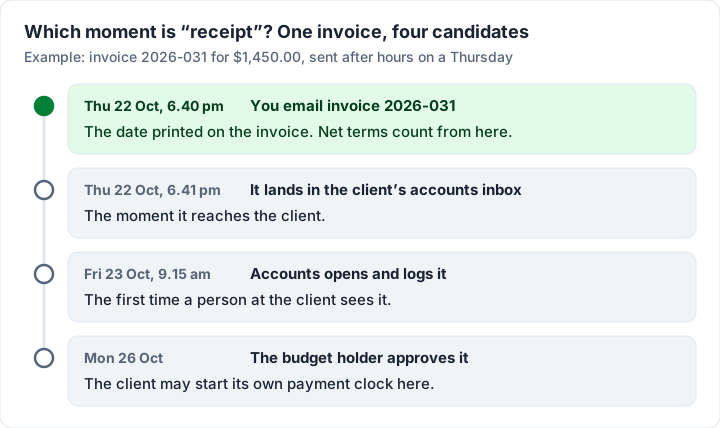
We did not find an official definition of the phrase “due upon receipt” itself. Some laws and official guidance do deal with when an invoice counts as received, or with what happens when no payment date was agreed, but they differ by country and by type of client, so we do not summarise them here. One example, for UK business-to-business payments: GOV.UK's page on when a payment becomes late says, as of 23 October 2026, “If you do not agree a payment date, the law says the payment is late 30 days after either:” “the customer gets the invoice” or “you deliver the goods or provide the service (if this is later)”. For anywhere else, check your own government's guidance or ask a lawyer.
The practical point is simpler. If a phrase on an invoice can be read several ways, a busy client will usually read it the way that suits their process. Whether a term printed on an invoice counts as agreed at all depends on your contract and where you are; is an invoice a contract? explains why agreeing terms before the work matters.
A worked example: one invoice, two ways of writing the terms#
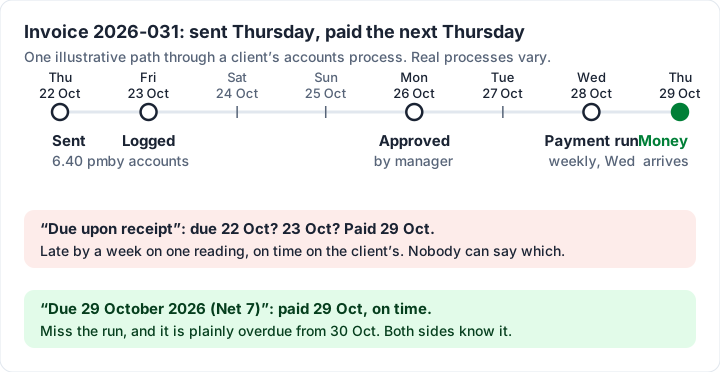
Here is an illustrative example, not a record of any real client. A small studio emails invoice 2026-031 for $1,450.00 to a logistics company at 6.40 pm on Thursday 22 October 2026. The company pays suppliers in a weekly run on Wednesdays, by bank transfer, which arrives the next working day.
This table shows one plausible path through that client’s accounts process:
| Day | What happens | Days since sent |
|---|---|---|
| Thu 22 Oct, 6.40 pm | You send the invoice | 0 |
| Fri 23 Oct | Accounts opens the shared inbox and logs it | 1 |
| Mon 26 Oct | The budget holder approves it | 4 |
| Wed 28 Oct | It goes out in the weekly payment run | 6 |
| Thu 29 Oct | The money reaches your account | 7 |
Now compare the two wordings.
- “Payment due upon receipt.” Was it due on the 22nd, when you sent it, or the 23rd, when accounts saw it? Either way it was paid a week “late”, yet by the client’s process it was paid on time, in the first run after approval. You cannot say exactly when it became overdue.
- “Due 29 October 2026 (Net 7).” The client’s software has a real date to enter, and the payment on the 29th is on time. Had it missed the run, it would be overdue from Friday 30 October, and both of you would know it.
The money arrived on the same day in both cases. Only the dated invoice made the day mean something, so a follow-up has a fact behind it. Our guide to outstanding, overdue and unpaid invoices explains why that label matters when you chase.
Due upon receipt vs Net 7, Net 14 and Net 30#
For an invoice dated Thursday 22 October 2026, this is how the common terms compare. The dates are worked out on a calendar; the free invoice due date calculator does the same count for any date, including due on receipt.
| Term | Due date (invoice dated Thu 22 Oct 2026) | Is the late day clear? | Often suits |
|---|---|---|---|
| Due upon receipt | Thu 22 Oct, in theory | No, unless you print the date | Deposits, booking fees, individuals, one-off jobs |
| Net 7 | Thu 29 Oct | Yes | Small jobs, new clients, firms that pay weekly |
| Net 14 | Thu 5 Nov | Yes | Most freelance and small-business work |
| Net 30 | Sat 21 Nov | Yes, but it is a Saturday | Companies that pay on a monthly cycle |
Two things stand out. First, Net 7 costs you very little time compared with due on receipt when the client pays in runs anyway, and it gives you a firm date. Second, check where the date lands: Net 30 on this invoice falls on a Saturday, and few accounts teams pay on a weekend.
When to use due upon receipt (and when not to)#
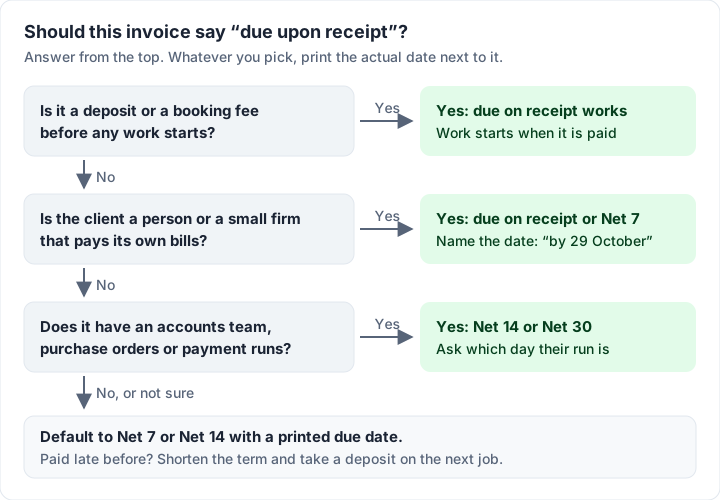
Due upon receipt is a good choice when payment is a condition of the next step, or when the person paying is the person who decided to buy:
- Deposits and booking fees. The work does not start, or the date is not held, until it is paid. That is the one case where “on receipt” is self-enforcing. Our guide to deposit invoices and how they work covers the wording and the maths.
- Individuals and households. A homeowner, a parent booking lessons or a couple booking a photographer usually pays from their own account, often from their phone.
- One-off jobs for clients you do not know. You are not extending credit to a stranger. Make sure they know before the work starts that payment is due when the invoice arrives.
It tends to work poorly with companies that have an accounts team, purchase orders and payment runs. There, “on receipt” is quietly converted into “next run”, and sometimes into the company’s own standard terms. If you are invoicing a company for the first time, a dated Net 7 or Net 14, plus the purchase order number they gave you, usually gets paid more predictably.
This decision guide puts the same questions in order:
How clients’ payment runs treat a due-on-receipt invoice#
Most organisations batch their supplier payments. To get into the right batch, an invoice has to:
- Reach the right inbox, often an accounts address rather than the person you worked with. How to email an invoice covers the subject line and attachments.
- Match an order. An invoice without the purchase order number can sit in a queue; see PO numbers on an invoice.
- Be approved, usually by the person who commissioned the work. If they are away, so is your payment.
- Make the cut-off for a weekly, fortnightly or monthly run. Miss it and it waits for the next one.
So the useful question for a company client is not “will you pay on receipt?” but “when is your payment run, and what is the cut-off?” If they pay on Wednesdays and approve by Monday, a Net 7 invoice sent on a Thursday lines up neatly.
How to word payment due upon receipt of invoice#
Good wording names the term, the date and how to pay. Vague wording names only the term. Here are pairs you can adapt:
| Vague | Clear |
|---|---|
| Due upon receipt | Payment due on receipt, by 22 October 2026. |
| Payable on receipt | Payable on receipt (22 October 2026) by bank transfer to the account below. |
| Payment due immediately | Due 22 October 2026. Please use invoice number 2026-031 as the payment reference. |
| Deposit due on receipt | Deposit of $500.00 due on receipt to hold your date. Balance of $950.00 due on delivery. |
| Due upon receipt (to a company) | Due 29 October 2026 (Net 7). PO 4471. Please pay to the account below. |
For the email itself: “Invoice 2026-031 for $1,450.00 is attached. It is due on receipt, by Thursday 22 October; the payment details are on the invoice.”
The second column wins because a date can go into the client’s accounts software, a reminder and your own records. A phrase cannot. List the ways you accept payment, too; our guide to invoice payment methods compares the usual options.
Late fees and interest on an invoice due on receipt#
A short term does not change how late fees work in practice: they cause least friction when the client agreed to them before the work started. A fee or interest rate that first appears on an overdue invoice is likely to be disputed.
Some governments publish default rules. In the UK, for example, GOV.UK's page on charging interest on commercial debt says, as of 23 October 2026: “The interest you can charge if another business is late paying for goods or a service is ‘statutory interest’ - this is 8% plus the Bank of England base rate for business to business transactions. You cannot claim statutory interest if there’s a different rate of interest in a contract.” Other countries have their own rules; check your government's guidance or ask a lawyer.
For “due upon receipt”, the point is simple: if the due date is unclear, so is the day any late fee or interest could start. A printed date removes that argument. If you plan to charge a late fee at all, our guide to late fees on invoices covers wording, how to calculate one and where to check the rules. For the follow-up itself, start with a calm overdue invoice follow-up email, and if it comes to that, see what to do when a client is not paying.
Setting due upon receipt in Charming, and what it will not do#
In Charming Invoices, every invoice has a due date, and it is a calendar date rather than a phrase. A new invoice starts with the due date 14 days after the issue date. For due on receipt, set the due date to the same day as the issue date; the form will not accept a due date earlier than the issue date. The date prints in the invoice header next to the label “Due”, which you can rename in the template settings.
The Terms field holds your wording, and default terms saved on your business are copied onto each new invoice (if your template hides the Terms section, the form tells you). Once the due date has passed on an issued invoice, it shows as Overdue. Days roll over at midnight UTC, so depending on where you are, that can happen during your evening.
Charming does not send payment reminders. Issue the invoice, download the PDF or copy its private link, and send it however you like; then set a calendar reminder for when you will follow up. With due on receipt, a sensible first nudge is a few days after you send it. Our guide to invoice reminders covers timing for due-on-receipt terms, with wording you can copy and send yourself. If you add a payment link to your business (your own PayPal.me or bank payment page), it prints on the invoice and shows as an “Open payment link” button on the private link page. When the client opens that private link, the invoice shows as “Viewed by the client”, which answers the “did they get it?” question with something firmer than a guess. Opening a PDF attachment does not count as a view.
The catches, plainly:
- Charming does not take card payments or process money. The client pays you directly, and you record the payment and mark it paid yourself.
- It does not read your terms text. Typing “due on receipt” in the terms does not change the due date; you set the date. The one exception is the AI draft on paid plans: if your job description states the timing, inserting the draft sets the due date once.
- It does not email the invoice or send reminders for you.
- It does not calculate or add late fees or interest.
- On the free plan, invoices carry a “Sent with Charming Invoices” line.
If that fits how you work, create a free invoice and set the due date to today. If you would rather start from a layout, browse the invoice templates first.
Questions people ask about due upon receipt#
How many days is due upon receipt?#
Zero, on paper: the invoice is due the day the client receives it. In practice, individuals often pay within a day or two, and companies usually pay in their next payment run. If you want a number, write the date.
Is a due-upon-receipt term legally binding?#
That depends on what the client agreed to and where you both are, which makes it a question for a lawyer. In practice, a payment term agreed before the work started, in a contract, an accepted quote or an email, is far less likely to be disputed than one that first appears on the invoice.
Can I charge a late fee on an invoice due on receipt?#
A fee the client agreed to before the work is far less likely to be disputed, and some places have their own rules on late fees and interest. See the UK example above, our guide to late fees on invoices, or ask a lawyer.
Should my first invoice be due on receipt?#
It can be, if the client knows that before the work starts. For a first invoice to a company, Net 7 or Net 14 with a date is usually smoother. Our checklist for your first invoice covers the rest.
The short version#
“Invoice due upon receipt” tells the client you expect payment now, and tells them nothing about the date. Use it for deposits, bookings, individuals and one-off jobs, and agree it before the work starts. For companies with payment runs, use Net 7 or Net 14 and ask when their run is. In every case, print the actual due date next to the term, so your client, their accounts software and you all read the same day.
When you are ready, create a free invoice with the due date set to the day you send it.