PO number on invoices: a seller’s guide

Nnabuike Okoroafor ·
On this page · 9 sections
A new client, a bigger one than usual, replies to your first invoice with a single line: “Can you resend this with the PO number on it?” You may not know what they mean, or where you were supposed to get the number from. Or you sent the invoice weeks ago, heard nothing, and the missing PO number on the invoice turns out to be the reason.
This guide is written from your side: the person sending the invoice, not the company buying. It covers what a PO number is, why larger clients insist on one, where it goes, what happens when it is missing or wrong, how a PO differs from an invoice and a quote, how to ask for one, and how to bill one purchase order across several invoices.
This is general information, not legal or tax advice. Purchase order rules are set by each client’s own policies and, for public bodies, sometimes by regulation. They differ between countries and organisations and they change, so read your client’s supplier instructions where they have them.
What a purchase order and a PO number are#
A purchase order is the buyer’s document. Before you start work, the client’s organisation writes down what it is buying from you, how much of it, at what price and on what terms, and approves the spend internally. The document it sends you is the purchase order. PO is one of many abbreviations you will see on invoices; invoice abbreviations decodes the rest, from INV to Net 30.
The PO number is the reference on that document. The client creates it, not you. Its job is to let the client’s accounts team match your invoice to a spend someone already approved.
Two practical consequences follow:
- You copy the number; you never invent it. If a client has not given you one, there is nothing to put in the field yet.
- It is not your invoice number. Your invoice number identifies your bill in your own records. The PO number identifies their order in theirs. Both can appear on the same invoice, and both should be easy to find. Invoice numbers: formats, gaps and examples covers your side of that pair.
Why larger clients insist on a PO number#
A sole trader who hires you usually pays from one account when they read your email. A college, a hospital or a company with a finance department pays through a process: someone approves the spend, the order is raised, the work is delivered, and only then does an accounts team release money. Someone in a public discussion about a late-paying wholesale client described what that looks like from the outside:
a large org that has multiple layers of approvals for all payments - and any one person in that chain can delay payment.
The quotes in this post come from public online discussions we collected while researching invoicing. The people quoted are not Charming customers.
The PO number is how your invoice finds its place in that chain. Many organisations run what is called a match before paying. The Rockefeller University’s purchasing pages describe two kinds: a three-way match compares the purchase order, the invoice and a receiving report for goods, and a two-way match compares only the purchase order and the invoice, which it uses for services, consulting and repairs. If you sell services, the two-way match is the one that applies to you: your invoice either lines up with an approved PO or it does not.
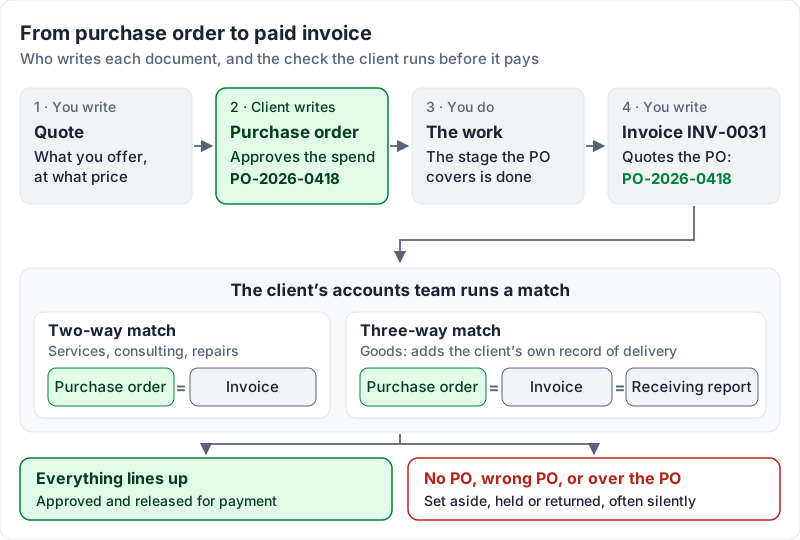
Some organisations make the rule absolute. Some NHS organisations in the UK run a “No PO, No Pay” policy. The Royal National Orthopaedic Hospital’s policy page says, as of 23 October 2026: “Any invoices received without a valid purchase order will not be processed and the invoice will be returned to the supplier unpaid.” US federal contracts are similar in spirit: the standard prompt payment clause, FAR 52.232-25, lists the contract number or other authorisation, “including order number and line item number”, among the items of a proper invoice.
You will meet POs most often with larger companies, universities, hospitals, councils and government buyers. Small clients rarely use them, and that is normal too. Invoicing a company covers the rest of what a larger client’s finance team expects.
Where to put the PO number on an invoice#
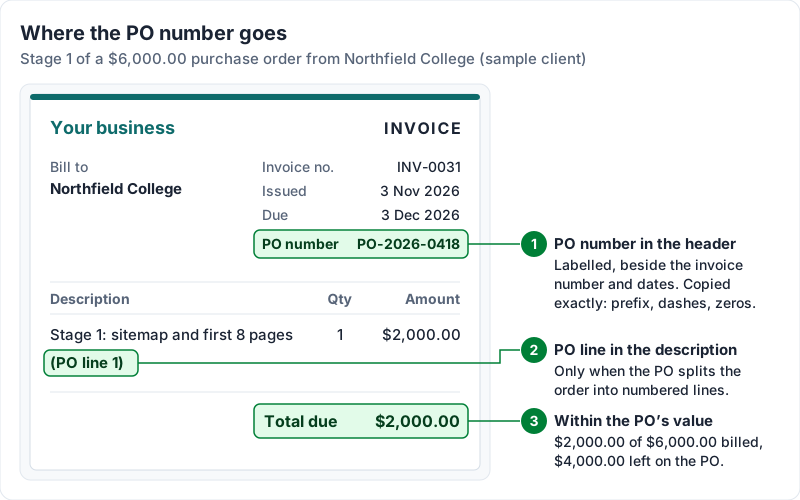
Put it in the header, next to your invoice number and dates, with a plain label. That is where an accounts team looks first, and it is the usual convention.
Here is what that header block can look like on an example invoice:
| Field | Example |
|---|---|
| Invoice no. | INV-0031 |
| Issued | 3 November 2026 |
| Due | 3 December 2026 |
| PO number | PO-2026-0418 |
On the whole invoice, it sits like this:
A few details that prevent most problems:
- Copy it exactly. Same prefix, same dashes, same leading zeros. “PO-2026-0418” and “2026418” may not match in the client’s system, even if a person would see they are the same.
- Label it. “PO number” or “Purchase order” beside the value. A bare number in the header looks like something of yours. In freight, the same field usually carries the broker’s load number under a renamed label, as on this trucking invoice sample.
- Add PO line numbers if the PO has them. Some purchase orders split the order into numbered lines. If yours does, put the line number in each line item description, for example “Stage 1: sitemap and first 8 pages (PO line 1)”.
- Repeat it in the email. Put the PO number in the subject line or the first sentence of the email you send the invoice with. How to send invoices by email has wording for that email.
- Use the client’s portal if they have one. Some organisations ask suppliers to upload invoices to a supplier portal and type the PO number into a form there as well. Follow their route rather than emailing a person.
Where the rest of the invoice fields go is in the field-by-field invoice checklist.
What happens when the PO number is missing or wrong#
Nothing dramatic, usually. That is the problem. An invoice with no PO, or a PO that does not match, tends to be set aside, returned, or held until someone works out who approved it. You may get a rejection email. You may get silence.
The usual causes, and what to do about each:
- No PO on the invoice. Ask for the number and send a corrected invoice.
- A typo in the number. Same fix. Check it character by character against the PO document.
- The invoice total is more than the PO. The PO approved a fixed amount; anything over it needs new approval. Ask for an amended PO before you bill the extra, and ideally before you do the work.
- Prices or quantities differ from the PO. If the PO says 24 pages at $250.00 and your invoice says 26, expect it to be held. Bill what the PO approved, and get the change approved.
- The PO has expired or been closed. POs can have end dates. Ask the person who hired you to raise a new one.
When you correct an invoice, ask the accounts team whether they want the same invoice number reissued or a new invoice. Practice differs between organisations, and your own record-keeping and tax rules may also have a say.
If an invoice to a PO client is already late, check the PO first. The overdue invoice email, step by step suggests a first follow-up that gives the client an easy way to say “we need a PO on it”.
PO vs invoice vs quote#
The difference between a purchase order and an invoice is who writes it and when. The quote comes first, from you; the purchase order comes second, from the client; the invoice comes last, from you again. If the quote stage is where you are unsure, invoice vs estimate vs quote explains what each one commits you to.
| Quote | Purchase order | Invoice | |
|---|---|---|---|
| Who writes it | You (the seller) | The client (the buyer) | You (the seller) |
| When | Before the work is agreed | After they accept your price, before you start | After the work, or each stage, is done |
| What it says | What you offer and at what price | What they are buying and have approved | What they owe you, and by when |
| Its number | Your quote reference | Their PO number | Your invoice number, plus their PO number |
| Asks for payment? | No | No | Yes |
So is a purchase order the same as an invoice? No. A PO is the client’s permission to spend. Your invoice is your request to be paid, and the PO number on an invoice is what points it back to that permission. Going from purchase order to invoice, nothing on the PO changes; you copy its number and bill within it. On a goods order the seller may also confirm it with a sales order first; sales order vs sales invoice walks through the whole paper trail.
One more thing worth knowing: many POs arrive with the buyer’s terms and conditions printed on them or linked from them, including payment terms. Read them before you start. If they say Net 60 and you quoted Net 30, raise it then, not when the invoice is late.
How to ask a client for a PO number#
Ask before the work starts, at the same moment you confirm the price. It reads as organised rather than pushy, and it is much easier than asking after a rejected invoice. A sample you can adapt:
Thanks for confirming. Before I start, do you need to raise a purchase order for this? If so, could you send me the PO number, and let me know who invoices should go to and whether you use a supplier portal? I will put the number on every invoice for this job.
If the answer is “we do not use POs”, that is fine. Leave the field off; do not write “PO: N/A” unless they ask for it. If their accounts team still wants a reference, ask what to use instead: a project code, a cost centre, or the name of the person who approved the work.
The PO number is one of several details to settle with a new company client. The free client onboarding checklist for billing (A4, or US Letter) lists the rest, from the legal name to payment runs, on one printable page.
One PO, several invoices: a worked example#
A single purchase order often covers more than one invoice: a deposit and a balance, monthly instalments, or stages of a project. This is sometimes called partial billing against a PO. Each invoice quotes the same PO number, and together they must not go over the PO’s value.
Example: Northfield College (a sample client) issues PO-2026-0418 for website copy: 24 pages in three stages, $6,000.00 in total, split into three PO lines of $2,000.00 each.
The first invoice, INV-0031, has PO-2026-0418 in the header and one line item:
| Description | Qty | Rate | Amount |
|---|---|---|---|
| Stage 1: sitemap and first 8 pages (PO line 1) | 1 | $2,000.00 | $2,000.00 |
| Total due | $2,000.00 |
Over the project, you keep a simple running record of what you have billed against the PO, in a spreadsheet or a notebook:
| Invoice | Issued | Amount | Billed against PO | Left on PO |
|---|---|---|---|---|
| INV-0031 | 3 Nov 2026 | $2,000.00 | $2,000.00 | $4,000.00 |
| INV-0034 | 1 Dec 2026 | $2,000.00 | $4,000.00 | $2,000.00 |
| INV-0039 | 12 Jan 2027 | $2,000.00 | $6,000.00 | $0.00 |
Then, in December, the college asks for 4 extra pages at $250.00 each. That is $1,000.00 the PO does not cover. Before writing them, ask for the PO to be amended or for a new PO, and invoice the extra pages against whatever number comes back. An invoice for $3,000.00 against a PO with $2,000.00 left on it is exactly the kind that gets held.
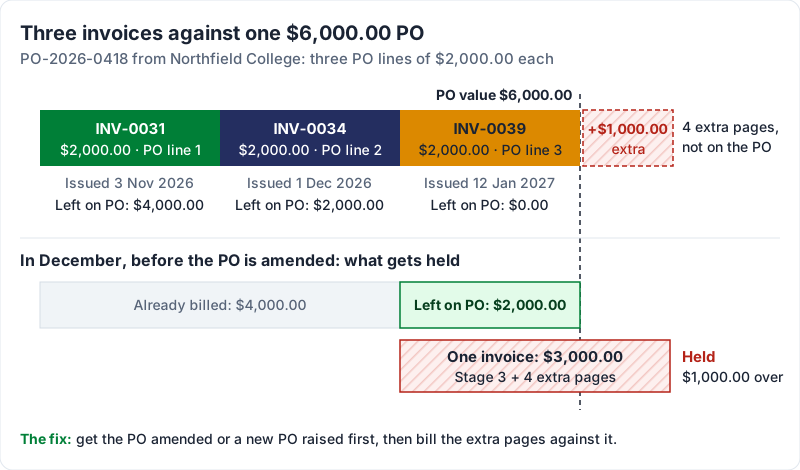
Two habits keep this tidy: put “PO line” references in your descriptions, and note the amount left on the PO in your own records after each invoice. If the stages are percentages of a fixed contract rather than fixed amounts, progress invoicing, with a worked example shows how to lay out the running totals on the invoice itself.
Adding a PO number in Charming#
Charming Invoices has an optional PO number field on every invoice, under the dates, with room for up to 100 characters. It prints in the invoice header beside the invoice number and dates, on the PDF and on the private link your client opens, and only when you have filled it in. The label reads “PO number” by default; you can rename it in your template (to “Purchase order” or “Order ref”, for example), or hide it, on every plan. If your template hides it, the invoice form tucks the field away and says it will not print. You can also find invoices by PO number in your invoice list, and it is a column in the CSV export.
The catches, so you meet them here rather than later:
- One PO per invoice, in the header. There is no per-line PO field; put PO line numbers in the line item descriptions.
- Duplicating an invoice clears the PO number, on purpose, since a PO usually belongs to one order. For the next invoice against the same PO, type it in again.
- Charming does not track how much of a PO you have billed. Keep the running record yourself, as in the example above.
- Charming does not send the email. You download the PDF or copy its link and send it yourself, so put the PO number in your own subject line if the client wants it there.
- Issued invoices cannot be edited. If you issued one without the PO, an owner or admin can void it (if no payment is recorded against it) and issue a new invoice with the number on it, which takes the next invoice number.
The short version#
- Invoices and purchase orders work as a pair: the PO is the client’s approval to spend, and the PO number is their reference for it.
- Ask for it before you start, and copy it exactly into your invoice header, your line descriptions if the PO has lines, and your email.
- An invoice that does not match the PO is usually held or returned, often without anyone telling you.
- Several invoices can share one PO. Keep a running total and get any extra work approved before you bill it.
When you are ready to send one, create a free invoice with the PO number in its own field.
Free downloads
No sign-up and no email address. More on the free templates page.
- Download .pdf: Client onboarding checklist for billing (A4)
Client onboarding checklist for billing (A4)
PDFWhat to settle with a new company client before you send the first invoice.
- Download .pdf: Client onboarding checklist for billing (US Letter)
Client onboarding checklist for billing (US Letter)
PDFWhat to settle with a new company client before you send the first invoice.