Invoice abbreviations: INV, PO, Net 30, EOM and more

Nnabuike Okoroafor ·
On this page · 10 sections
Invoices are written in a shorthand that nobody teaches. You meet it the first time a client asks you for one, or the first time a supplier’s invoice lands with INV, PO, Qty, UOM, Net 30 and E&OE printed across it. In public online discussions we collected for our research (the people quoted are not Charming customers), one new freelancer described the moment it starts:
I recently did some freelance graphic design work for a former coworker for their new employer. The project has wrapped up, and now their asking for the invoice.
This glossary covers the abbreviations you are likely to see on an invoice, grouped by where they appear: the header, the line items, the totals, the payment terms, the payment details, shipping, and the fine print. Each one gets its expansion and a plain meaning, and the ones with two meanings are flagged.
In short#
- INV (or Inv.) is short for invoice. “Inv. no.”, “No.” and “#” all mean invoice number, and INV- is also a common prefix on the number itself, as in INV-0042.
- Most invoice abbreviations fall into a few groups: references (PO, Ref, Attn), line items (Qty, UOM, ea, hrs), totals (Subtotal, Net, Bal), payment terms (Net 30, EOM, COD, CIA, 2/10 net 30), payment methods (ACH, IBAN, BIC) and shipping (FOB, EXW, BOL).
- The practical rule for your own invoices: write the real date or the full word next to any code your client might not know. “Net 30 (due Wednesday 2 December 2026)” cannot be misread.
The abbreviations are one layer of an invoice. For the different documents themselves, from proforma to credit note, see the types of invoices.
What is the abbreviation for invoice?#
The usual abbreviation for invoice is INV, also written Inv. with a full stop. You see it in three places:
- As the document title, on a cramped form or a carbon book: “INV”.
- Next to the number, as “Inv. no. 0042”, “Invoice # 0042” or just “No. 0042”.
- As the prefix of the number itself, as in INV-0042. Here INV- is not an instruction to the reader; it is part of the invoice’s name, and the client should quote the whole thing as their payment reference.
How you build the number after the prefix (sequential, year-prefixed or by client) is a separate choice, covered in how to number invoices.
Invoice abbreviations at a glance#
The tables below group about 40 abbreviations by where they usually sit on an invoice. Tax IDs and trade terms have their own section further down.
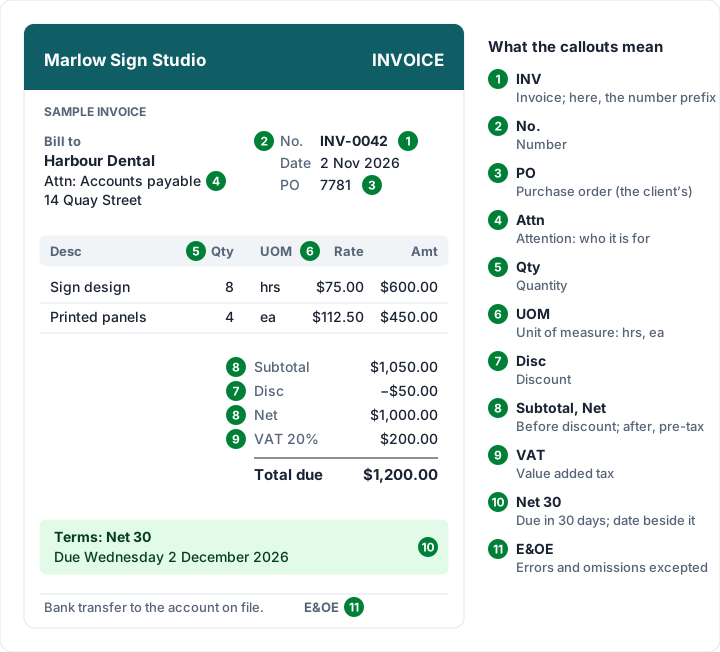
Header and reference abbreviations#
| Abbreviation | Stands for | What it means on an invoice |
|---|---|---|
| INV, Inv. | Invoice | The document title, or the prefix on the number (INV-0042) |
| No., # | Number | The invoice number: “Inv. no. 0042” or “Invoice # 0042” |
| Ref | Reference | A job, project or quote reference that both of you recognise |
| PO | Purchase order | The buyer’s own order number, quoted so their accounts team can match your invoice to it |
| Attn | Attention | The person or team the invoice is addressed to at the client’s company |
| c/o | Care of | The invoice goes to the client at someone else’s address |
| Est. | Estimate | A reference to the estimate or quote the invoice follows |
| Bill to | Not an abbreviation | Who pays the invoice (the client), as opposed to “From”, which is you |
| Ship to | Not an abbreviation | Where goods were delivered, when that differs from the billing address |
If a client gave you a PO, copy it exactly as they wrote it. The PO number on an invoice explains where it goes and what happens when it is missing.
Line item abbreviations#
| Abbreviation | Stands for | What it means on an invoice |
|---|---|---|
| Desc | Description | What you supplied, one line per item or service |
| Qty | Quantity | How many: hours, items, square metres |
| UOM | Unit of measure | How the quantity is counted: hrs, ea, m², kg |
| ea | Each | Priced per single item |
| hr, hrs | Hour, hours | Time billed by the hour |
| pc, pcs | Piece, pieces | Priced per piece, common on parts and print |
| SKU | Stock keeping unit | The seller’s own product code |
| Amt | Amount | The line total: quantity times unit price |
| Disc | Discount | A reduction, on one line or on the whole invoice |
Totals abbreviations#
| Abbreviation | Stands for | What it means on an invoice |
|---|---|---|
| Subtotal | Not an abbreviation | The sum of the line items before tax (and usually before any discount) |
| Net | Net amount | The amount after discounts and before tax. Not the same as Net 30; see below |
| Incl., Excl. | Including, excluding | Whether a price includes tax, as in “incl. VAT” |
| Bal, Bal due | Balance, balance due | What is still owed after any payments or deposits |
| B/F | Brought forward | A balance carried in from an earlier invoice or statement |
| C/F | Carried forward | A balance moved on to the next page or statement |
Payment term abbreviations#
| Abbreviation | Stands for | What it means on an invoice |
|---|---|---|
| Net 30 (Net X) | Net amount due in 30 (X) days | The full amount is due 30 days after the invoice date |
| EOM | End of month | Due at the end of the month, or counted from it; see the next section |
| MFI | Month following invoice | Due on a set day of the next month: 21 MFI is the 21st |
| COD | Cash on delivery | Payment when the goods or work are delivered |
| CIA | Cash in advance | Payment before work starts or goods ship |
| PIA | Payment in advance | Same idea as CIA |
| CWO | Cash with order | Payment at the moment of ordering |
| CBS | Cash before shipment | Payment before the goods leave |
| CND | Cash next delivery | The previous delivery is paid before the next one arrives |
| 2/10 net 30 | 2% discount in 10 days, net in 30 | 2% off if paid within 10 days; otherwise the full amount in 30 |
| T&Cs | Terms and conditions | Your written terms: late fees, ownership, cancellation |
Payment method abbreviations#
| Abbreviation | Stands for | What it means on an invoice |
|---|---|---|
| ACH | Automated Clearing House | A US bank-to-bank transfer |
| EFT | Electronic funds transfer | Any electronic bank payment |
| Bacs | Bankers’ Automated Clearing Services | A UK bank-to-bank transfer |
| IBAN | International Bank Account Number | Your account number in the international format |
| BIC | Bank Identifier Code (also Business Identifier Code) | Identifies your bank for international transfers |
| SWIFT | Society for Worldwide Interbank Financial Telecommunication | The network behind BIC codes; “SWIFT code” usually means the BIC |
| A/C, Acct | Account | Your account number or account name |
Which of these to offer, and how to lay out your bank details so nobody has to ask twice, is covered in what payment methods to offer on an invoice.
Accounting abbreviations#
| Abbreviation | Stands for | What it means on an invoice |
|---|---|---|
| AR | Accounts receivable | Money owed to you: your sent, unpaid invoices |
| AP | Accounts payable | Money you owe: invoices you have received. “Attn: AP” sends an invoice to the client’s payables team |
| CN | Credit note | A document that reduces or cancels an earlier invoice |
| DN | Debit note | A document that increases what is owed, or a buyer’s request for a credit |
| CR | Credit | An amount in the client’s favour, or short for credit note |
| DR | Debit | An amount the client owes |
The same invoice is AR for you and AP for your client; accounts receivable vs accounts payable shows how each side records it. For when to use a CN at all, see credit note vs invoice.
Fine print#
| Abbreviation | Stands for | What it means on an invoice |
|---|---|---|
| E&OE | Errors and omissions excepted | A short footer line that some sellers print on invoices and price lists |
| p.a. | Per annum | Per year, as in a late fee of “8% p.a.” |
E&OE is not a substitute for checking the invoice before you send it. If you see it on an invoice you received, read the figures as carefully as you would anyway.
Payment term abbreviations, worked through with dates#
Term codes are the abbreviations most likely to cause a real problem, because they decide when you get paid. Here is one illustrative invoice for $1,200.00, dated Monday 2 November 2026, under each code (dates checked by script; all fall on weekdays):
| Code on the invoice | When it is due |
|---|---|
| Net 14 | Monday 16 November 2026 |
| Net 30 | Wednesday 2 December 2026 |
| EOM, meaning due at the end of the month | Monday 30 November 2026 |
| Net 30 EOM, counted from the end of the month | Wednesday 30 December 2026 |
| 21 MFI | Monday 21 December 2026 |
| 2/10 net 30 | $1,176.00 if paid by Thursday 12 November 2026 (2% of $1,200.00 is $24.00); otherwise $1,200.00 by Wednesday 2 December 2026 |
| COD or CIA | No date from the invoice: on delivery, or before work starts |
Three of these deserve a closer look:
- EOM is used two ways. Some sellers print EOM alone to mean “due at the end of this month”. Others use it inside a term like Net 30 EOM, where the 30 days start counting from the month end. On this invoice that is a month’s difference, which is why the date belongs next to the code.
- Net 30 and Net 15 are the most common codes, and the full walk-through of every Net term, with a timeline, lives in how to calculate an invoice due date.
- 2/10 net 30 is an early-payment discount. The $24.00 above comes off your income, so work out what 2/10 net 30 really costs before you offer it.
To turn any of these codes into a date for your own invoice, the free invoice due date calculator handles due on receipt, Net 7 to Net 90, EOM, Net 30 EOM, 2/10 Net 30 and a custom number of days. It does not do MFI, COD or CIA.
Abbreviations with two meanings#
A few invoice abbreviations mean different things depending on where they sit. These are the ones most often misread.
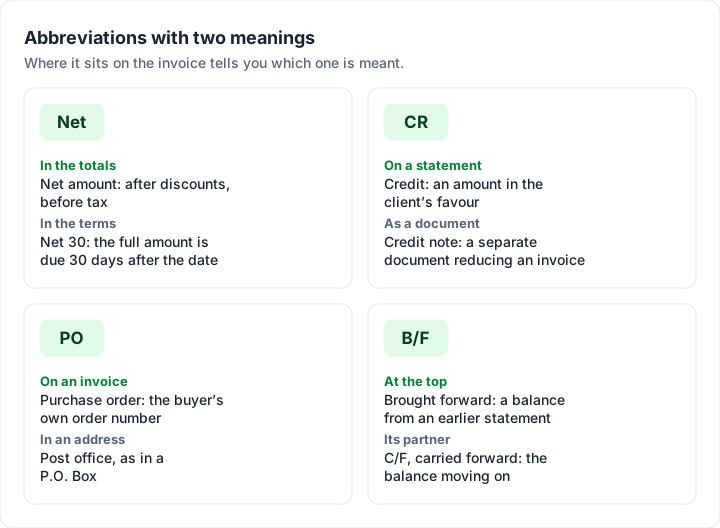
- Net. In the totals, “Net” is the amount after discounts and before tax. In the terms, “Net 30” means the full amount is due in 30 days. The word is the same; the job is different. “Nett” is an alternative spelling of the first meaning.
- CR. On a statement, CR next to an amount means a credit in the client’s favour. On a document title, CR or CN can mean credit note. If you issue one, write “Credit note” in full.
- PO. On an invoice, PO almost always means purchase order. In an address, “P.O. Box” is a post office box. If a client’s billing address has one, keep the full “P.O. Box” so it is not read as an order number.
- B/F. Brought forward: a balance from an earlier period, carried onto this invoice or statement. Its partner is C/F, carried forward, on the page the balance leaves.
Tax, ID and trade-term abbreviations#
This section is general information, not legal or tax advice. It gives expansions only. What each tax or ID means for your business, and whether it has to appear on your invoice, depends on where you and your client are. Rules vary by country; check your tax authority or ask an accountant.
| Abbreviation | Stands for |
|---|---|
| VAT | Value added tax |
| GST | Goods and services tax |
| HST | Harmonized sales tax (Canada) |
| PST | Provincial sales tax (Canada) |
| FET | Federal excise tax (US) |
| TIN | Taxpayer identification number |
| EIN | Employer identification number (US) |
| ABN | Australian Business Number |
For what a tax invoice is and where to find the official rules, start with what a tax invoice is. If you are in the UK and registered for VAT, what HMRC lists for a UK VAT invoice quotes the official list.
Trade terms appear on invoices for goods that are shipped, especially across borders:
| Abbreviation | Stands for |
|---|---|
| FOB | Free on board |
| EXW | Ex works |
| DAP | Delivered at place |
| DDP | Delivered duty paid |
| BOL, B/L | Bill of lading (the carrier’s shipping document) |
| POD | Proof of delivery |
FOB, EXW, DAP and DDP are Incoterms, the standard trade terms published by the International Chamber of Commerce. What a term means for your particular sale depends on your contract and the rules it refers to, so ask the buyer or your shipper rather than reading meaning into the letters. The commercial invoice guide shows where the term, its place and its edition go on an export invoice.
Should you use abbreviations on your own invoices?#
An invoice is read by someone who wants to pay it quickly and correctly. Abbreviations help when both sides know them and hurt when only one side does. A few habits keep them on your side:
- Spell it out for consumers. A homeowner or a private client may not know Net 30 or EOM. “Payment due within 30 days, by Wednesday 2 December 2026” costs one line and saves an email.
- Keep the codes for trade clients who use them. A company’s accounts payable team may expect Net 30 and a PO. Give them the code they expect, and the date as well.
- Always print the actual due date. It is the one line that removes every ambiguity in the terms table above.
- One abbreviation, one meaning. If “Net” appears in your totals, write your terms as “Payment due in 30 days” to avoid the double meaning.
- Copy a client’s PO or reference exactly. Their system matches characters, not intentions.
For the full list of what belongs on an invoice beyond the abbreviations, use the field-by-field invoice checklist.
Invoice labels in Charming, and what it does not do#
If you would rather send invoices that need no glossary, this is how Charming Invoices labels them. The PDF prints full words by default: “Invoice”, “Bill to”, “From”, “Invoice no.”, “Issued”, “Due”, “PO number”, “Tax ID”, “Subtotal”, “Discount”, “Tax”, “Total due”, “Payment details”, “Notes” and “Terms”. The table columns are “Description”, “Qty”, “Unit”, “Unit price” and “Amount”. “Qty” and “Invoice no.” are the only abbreviations in the defaults.
- Every label can be renamed, on all plans, in the Template Studio: header labels up to 60 characters and column headings up to 40. Change “Invoice no.” to “Invoice #” or “Qty” to “Hours” if that suits your clients. Renaming changes the printed word, not the field behind it.
- A Unit column (your UOM) is there, hidden by default. Turn it on in the template’s table settings and each line can carry a unit of up to 20 characters, such as “hrs”, “ea” or “m²”.
- PO number and Tax ID have their own fields, and both are shown by default.
- Invoice numbers use a prefix and a padded number, INV- and 4 digits by default, so the first invoice is INV-0001. You can change the prefix for each business.
The limits, stated plainly. Payment terms are free text: Charming does not read “Net 30” or “EOM” in your terms and work out a date. You set the due date yourself, and a new invoice starts at 14 days after the issue date, so if your terms say Net 30, change the date to match. On paid plans, AI drafting can set the due date from wording such as “net 30” or “due on receipt” in your description, but only when you state it. Charming does not take card payments; clients pay you by the bank details or payment link you add, and you mark the invoice paid yourself. Free invoices carry a small “Sent with Charming Invoices” line, which paid plans hide by default.
Create a free invoice and see how it reads with full-word labels and your own logo and colours.
Questions people ask#
What does INV mean on an invoice?#
INV is short for invoice. It appears as the document title, next to the number (“Inv. no.”), or as the prefix of the number itself, as in INV-0042. When it is part of the number, quote the whole thing as the payment reference.
What does FOB mean on an invoice?#
FOB stands for free on board. It is one of the Incoterms, the trade terms published by the International Chamber of Commerce. What it means for a particular sale depends on the contract, so check with the buyer or your shipper. The commercial invoice guide shows where trade terms go.
What does UOM mean on an invoice?#
UOM means unit of measure: how the quantity on a line is counted. Common units are hrs (hours), ea (each), pcs (pieces), m² and kg. “10 hrs at $75.00” and “10 ea at $75.00” are very different invoices, which is why the unit matters.
What does “bill to” mean on an invoice?#
“Bill to” is not an abbreviation. It labels the person or company responsible for paying the invoice. It sits beside “From” (you) and sometimes “Ship to”, when goods go to a different address.
What does E&OE mean?#
E&OE stands for errors and omissions excepted. Some sellers print it in the footer of invoices and price lists. It is not a substitute for checking the figures before you send or pay.
What does net mean on an invoice?#
It depends on where it sits. In the totals, net is the amount after discounts and before tax. In the terms, “Net 30” or “Net 15” is a payment deadline: the full amount is due 30 or 15 days after the invoice date. Writing the real due date next to the term removes the doubt.
The short version#
INV means invoice, PO is the buyer’s order number, Qty and UOM describe each line, Net 30 and EOM set the deadline, and the tax and trade codes are expansions you look up rather than guess. On your own invoices, keep the codes your clients use and put the real date or word next to everything else.
When you are ready to send one, create a free invoice: the labels print in full words by default, and you can rename any of them.