What is a tax invoice? A plain guide

Nnabuike Okoroafor ·
On this page · 7 sections
A client has asked you for a “tax invoice”, or you have seen the phrase on someone else's paperwork, and you are wondering whether the invoice you already send counts. That is a fair question. So, what is a tax invoice? In general terms, it is an invoice that carries the extra details a tax system uses to record a taxable sale. Which details, and who may issue one, are set nationally, so the honest answer to “is mine one?” starts with another question: which country are you in?
Below: the idea in plain terms, what three official pages say (the UK, Australia and the EU, quoted and linked), and a list of questions to take to your own tax authority's guidance.
General information, not legal or tax advice. Rules vary by country and change; read the linked official pages, or ask an accountant, before you rely on any of it.
What is a tax invoice, in one paragraph#
An ordinary invoice is a request for payment: who did what, for whom, for how much, and by when. A tax invoice is the same kind of document with the extra details a tax system asks for. Commonly that means your tax registration number, the tax rate and tax amount shown separately, and in some places the words “tax invoice” at the top.
Its job is to show how much tax was charged on the sale, which matters to a buyer who may be able to claim that tax back. Australia's government business site puts it in one line (as of 23 October 2026): “To claim GST credits, the buyer must have a valid tax invoice.” (business.gov.au, Invoicing)
That is why a business client may ask you for one, and why their accounts team may send back an invoice that seems to be missing details.
Tax invoice vs invoice: the difference at a glance#
In general terms, the two compare like this. The official pages quoted further down are where the specifics live.
| Ordinary invoice | Tax invoice | |
|---|---|---|
| What it does | Asks to be paid | Asks to be paid and records the tax charged |
| Your tax number | Optional | Commonly shown |
| Tax shown | Only if you charge any | Rate and amount, commonly shown separately |
| What it is called | Invoice | Varies: “tax invoice” in some countries, “VAT invoice” in the UK |
Who may issue a tax invoice is one of the points that catches people out. Two official pages, quoted as of 23 October 2026:
- United Kingdom. HMRC's VAT guide: “Only a VAT-registered person can issue a VAT invoice.” (VAT guide, Notice 700, paragraph 19.5.1)
- Australia. business.gov.au, listing what regular invoices commonly include: “the word ‘invoice’ – you must not use ‘tax invoice’”. (business.gov.au, Invoicing)
If you are not registered, check what your own tax authority says about the invoices you send. What actually belongs on an invoice covers the fields most invoices carry.
What a tax invoice commonly shows#
Across the official pages below, the same kinds of detail keep appearing. Treat this as the typical shape, not a rule for any one country:
- Your tax registration number. For example, a VAT registration number in the UK or an ABN (Australian Business Number) in Australia.
- A unique invoice number. If your numbering has gaps or repeats, how to number invoices walks through a scheme that holds up.
- Dates. The issue date, and in some systems the date of the sale if it differs.
- Both parties. Your name and address, and often the buyer's; in some places the buyer's details depend on the amount.
- What you sold. A description clear enough to identify the goods or services, with the quantity.
- The tax itself. The rate and the amount, shown separately from the price.
- Wording for special cases. For example, reverse-charge or exempt sales, where some systems ask for particular words. Self-billed invoices, raised by the customer on the supplier’s behalf, are another case; see self-billing invoices (UK VAT).
What three official pages say#
United Kingdom: the VAT invoice#
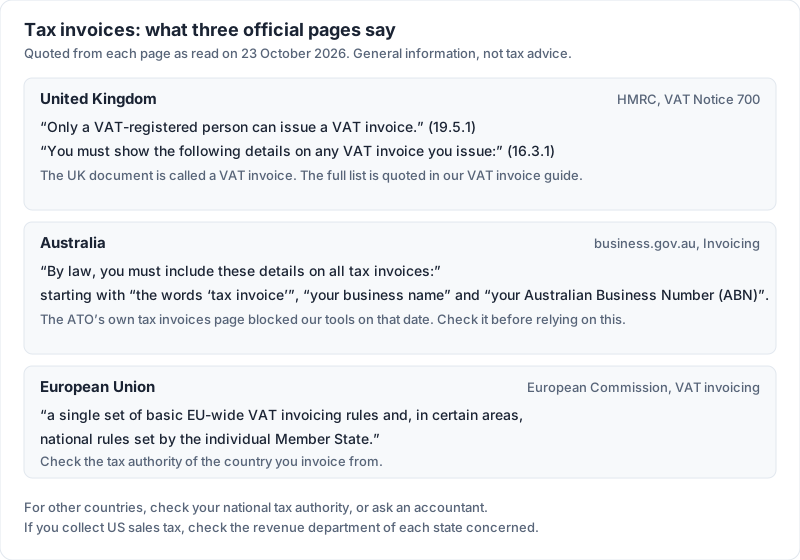
Source: HMRC, VAT guide (VAT Notice 700), section 16, last updated 25 June 2026 and read on 23 October 2026. Two lines from it:
- 16.2.1: “Whenever you supply standard-rated or reduced-rated goods or services to another VAT-registered person, you must give that person a VAT invoice.”
- 16.3.1: “You must show the following details on any VAT invoice you issue:”, followed by an eleven-item list.
Our guide to what HMRC lists for a UK VAT invoice quotes that list in full, with a worked UK example and HMRC's guidance on simplified invoices and the reverse charge.
Australia: the tax invoice#
Source: the Australian Government's business.gov.au invoicing page, read on 23 October 2026. The Australian Taxation Office (ATO) has its own tax invoices page, which blocked our tools on that date, so we quote business.gov.au only. Check the ATO's page, or ask your accountant, before you rely on it.
- “If your business is registered for GST, you must give a tax invoice when:” “a taxable sale is more than $82.50 (including GST)” or “a customer asks for one (regardless of the amount) – you have 28 days to give it to them.”
- “By law, you must include these details on all tax invoices:” “the words ‘tax invoice’”, “your business name”, “your Australian Business Number (ABN)”, “the date you issue the invoice”, “a short description of what you sold (including quantity and price)” and “the amount of GST payable (if any).”
- “You must also include the buyer’s identity or ABN on invoices for sales over $1000.”
Amounts are in Australian dollars. The page lists a unique invoice number under “It’s also a good idea to add:”.
European Union: shared rules and national ones#
Source: the European Commission's VAT invoicing page, read on 23 October 2026. It says: “Taxable persons (VAT-registered businesses) doing business in the EU are subject to a single set of basic EU-wide VAT invoicing rules and, in certain areas, national rules set by the individual Member State.” The page then tabulates what a full and a simplified invoice contain; among its rows are “Unique sequential number identifying the invoice”, “Supplier’s VAT identification number” and “If the customer is liable for tax (i.e. under the reverse-charge procedure): the words ‘reverse charge’”. Read the full table, then check the tax authority of the country you invoice from.
Elsewhere, including the United States#
For other countries, your national tax authority's guidance is the place to look. If you collect US sales tax, check the revenue department of each state concerned for what your invoices should show.
A tax invoice, line by line#
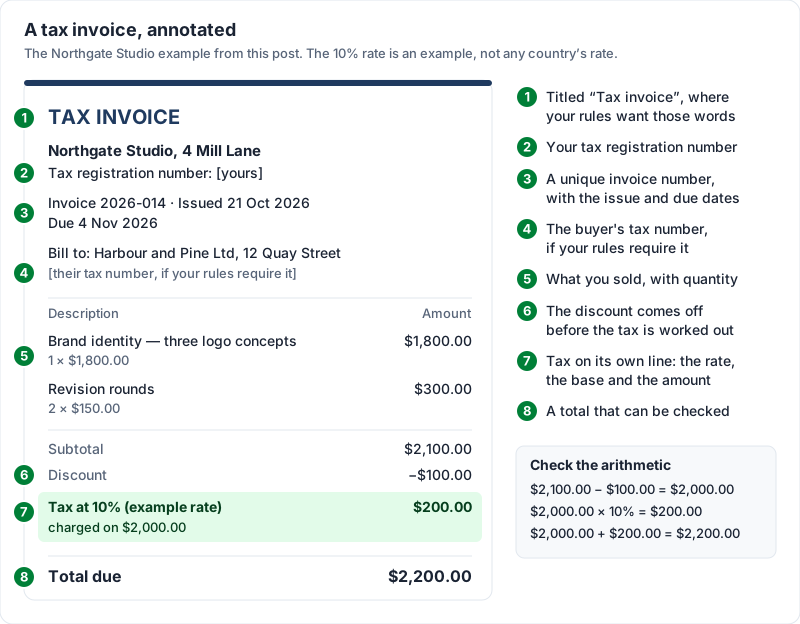
Here is an example for an invented business that is registered for tax. The 10% rate is an illustrative rate only, not the rate in any particular country. The header would read something like this:
- Tax invoice (the document title, where your tax authority's guidance asks for those words)
- Northgate Studio, 4 Mill Lane · Tax registration number: [yours]
- Invoice 2026-014 · Issued 21 October 2026 · Due 4 November 2026
- Bill to: Harbour and Pine Ltd, 12 Quay Street · [their tax number, if your guidance asks for it]
Then the lines and the build of the total:
| Description | Qty | Rate | Amount |
|---|---|---|---|
| Brand identity — three logo concepts | 1 | $1,800.00 | $1,800.00 |
| Revision rounds | 2 | $150.00 | $300.00 |
| Subtotal | $2,100.00 | ||
| Discount | −$100.00 | ||
| Tax at 10% (illustrative rate) on $2,000.00 | $200.00 | ||
| Total due | $2,200.00 |
The tax has its own line with its rate, the amount it is charged on is visible, and every figure in the total can be checked. In this example the discount comes off before the tax is worked out.
Showing tax in Charming, and where it stops#
Charming Invoices handles the arithmetic part on every plan, including the free one. Subtotal, discount and tax calculate as you type, to the cent, with the tax worked out on the amount after the discount. Your tax ID goes in your business details and prints in the invoice header. You can rename the document title to “Tax invoice” if your guidance asks for those words, and a tax summary section can show the taxable amount, the rate and the tax.
What it does not do matters as much:
- It does not decide anything about tax for you. Not whether you need to register, which rate applies, or whether your invoice meets your country's rules. It does not calculate or file tax returns.
- One tax rate per invoice. A sale that mixes rates, such as some lines taxed and some zero-rated, cannot be shown line by line on one invoice.
- No separate field for your client's tax number. If you want it on the invoice, add it to the client's address so it prints under “Bill to”.
- A “Sent with Charming Invoices” line. Invoices on the free plan carry it in the footer.
What to check for your own country#
The confusion here is common. In public online discussions we collected while researching this product (the people quoted are not Charming customers), someone about to bill their first freelance client in Canada wrote:
I'm also seeing a lot of information about GST/HST, business numbers and registration, and I'm not sure which of those applies to someone who's just starting out.
The starting point is the same everywhere. Take these questions to your own tax authority's guidance, or to an accountant:
- Am I registered for VAT, GST or sales tax? If not, what does the guidance say about invoices from unregistered businesses? Sending your first invoice covers invoicing before you have a registered business.
- What does my tax authority call the document? And does it ask for particular words at the top?
- Which details does it list? Look for amounts that add or remove details.
- Does my client's tax number need to appear? Often this depends on the amount, or on whether the sale crosses a border.
- Is there a time limit for issuing one? Some guidance sets one.
- Is there special wording? Reverse-charge, exempt and zero-rated sales often have their own.
- Does my country ask for a structured electronic format for some invoices? Ask before you assume a PDF is enough. Our guide to electronic invoices explains the difference between a PDF and a structured e-invoice.
If the answers are clear, a tax invoice is an ordinary invoice with a few more fields filled in carefully. If they are not, one conversation with an accountant is cheaper than reissuing a year of invoices.
When you are ready to send one, create a free invoice and check it against your list before it goes.