Self-billing invoices (UK VAT): a guide for suppliers

Nnabuike Okoroafor ·
On this page · 11 sections
A customer has sent you a “self-billing agreement” to sign. From now on, they say, they will write your invoices for you and send a copy with each payment. You are used to billing clients yourself, so the obvious questions follow: what exactly are you agreeing to, should you still send your own invoices, and how do you know the invoice they write is right?
This guide answers those questions for UK VAT, from the supplier’s side. Every rule in it is quoted word for word from HMRC’s own guidance, with the section number, rather than paraphrased. The two sources are HMRC’s Self-billing (VAT Notice 700/62) and the VAT guide (VAT Notice 700), both re-read on GOV.UK on 28 October 2026. Where we have not quoted a rule, we point you to the section that covers it.
General information, not legal or tax advice. This post covers UK VAT only. Other countries have their own rules; check your tax authority. For anything about your own VAT position, ask your accountant or HMRC.
In short#
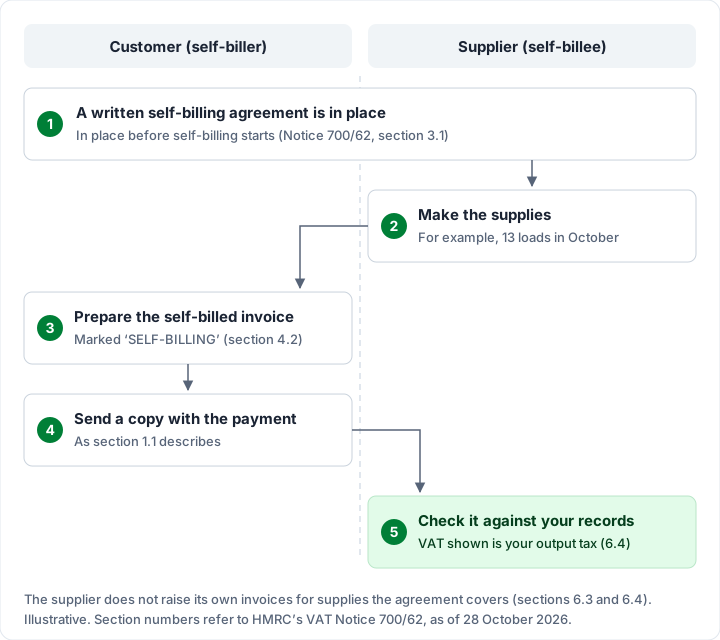
- Your customer writes your invoice. Under self-billing, the customer prepares the invoice for what you supplied and sends you a copy with the payment.
- The agreement comes first. In HMRC’s words, “The agreement must be in place before self-billing commences.” The notice sets out what the agreement must say, quoted below.
- You check each one, and you do not invoice those supplies yourself. HMRC tells the supplier that the VAT shown on a self-billed invoice “is your output tax”, and that “you must not issue your own sales invoices in respect of any transactions covered by the self-billing agreement” (section 6.4).
HMRC’s notice calls the two sides the supplier and the customer, and this post uses the same words so the quotes line up. If you sell to a business that self-bills, you are the supplier, and that business is your customer.
What a self-billing invoice is#
HMRC defines it in section 1.1 of Notice 700/62 (as of 28 October 2026):
Self-billing is a commercial arrangement between a supplier and a customer in which the customer prepares the supplier’s invoice and forwards a copy to the supplier with the payment.
In plain terms: the invoice is for what you supplied, but your customer writes it. The notice gives HMRC’s own labels in section 1.2: the customer is the self-biller and the supplier is the self-billee. Under the heading “If you’re a:”, the section points suppliers to the part of the notice written for them:
supplier and one of your customers issues, or wants to issue, you with self-billed invoices (meaning you are a self-billee) — see sections 6 to 8
Why would a customer want this? Section 2.1, on the advantages for the self-biller, says (as of 28 October 2026) that “it may make invoicing easier if you (rather than your supplier) determine the value of your purchase after the goods have been delivered or the services supplied”. In other words, the customer is the one who works out what was delivered, so the customer writes the invoice.
Self-billing is one of the main invoice types you may meet. For the general idea of an invoice that shows tax, see what a tax invoice is.
Self invoicing, self-billed and self bill: same thing?#
People search for “self invoicing”, “self-billed invoice” and “self bill invoices”. In the UK VAT sense they all describe the arrangement above: the customer prepares the supplier’s invoice. Other countries’ tax systems may use similar phrases with their own meanings; this post does not cover them.
Not the same as a remittance advice or a purchase invoice#
- A remittance advice is a note from the payer saying what it paid and which invoices the payment covers. It is not an invoice. See a remittance advice for how it works.
- A purchase invoice is an invoice you receive for something you bought. A self-billed invoice is not one, even though it arrives from your customer. HMRC says so directly in section 6.4 (as of 28 October 2026): “Self-billees sometimes make the mistake of treating their self-billed invoices as purchase invoices.”
The self-billing agreement: what you are being asked to sign#
The agreement comes first. Section 3.1 of Notice 700/62 says (as of 28 October 2026): “The agreement must be in place before self-billing commences.” The same section lists what the agreement must contain. It begins “VAT regulations say a valid self-billing agreement must:” and, among other points, includes these (section 3.1 is written to the customer, so “you” there is the customer):
- “specify that the supplier agrees not to raise VAT invoices for supplies covered by the agreement”
- “specify that the supplier will accept each self-billed invoice created by the customer for supplies made to them by the supplier”
- “contain a start date and expiry date, though the expiry date can be related to the term of any contract between the supplier and customer”
- “bind both you and your supplier — this means it should be in writing, either on paper or in electronic form”
Read the full list in section 3.1 before you sign; we have quoted only part of it. On reviews, section 3.3.2 says (as of 28 October 2026): “It is advisable to carry out a review every 12 months.” HMRC publishes an example self-billing agreement (PDF, linked from section 8 of the notice).
Can you say no? Section 6.2 answers it (as of 28 October 2026):
HMRC will not insist that you agree to self-billing. But your customer may make self-billing a condition of doing business with you.
What a self-billed invoice must show#
Section 4.2 of Notice 700/62 sets out the information, written to the customer who raises the invoice. As of 28 October 2026 it says:
The following sentence has the force of law.
You must clearly mark each self-billed invoice you raise with the reference: ‘SELF-BILLING’.
It then recommends a statement: “HMRC advises that you should also include the following statement on each self-billed invoice you raise:” followed by “‘The VAT shown is your output tax due to HMRC’.” And for everything else: “The invoices must contain all the data elements listed in paragraph 16.3 VAT guide (VAT Notice 700).” That list is quoted in full in what HMRC lists for a UK VAT invoice.
The two notices word the marking differently#
VAT Notice 700, the general VAT guide, has its own short paragraph on self-billing. Section 17.4.1 says (as of 28 October 2026):
Under a self-billing arrangement, the customer makes out VAT invoices for a VAT-registered supplier and sends a copy to the supplier with the payment. VAT self-billed invoices must include the reference ‘self billing’.
So Notice 700/62 section 4.2 gives the reference as ‘SELF-BILLING’, in capitals with a hyphen, and Notice 700 section 17.4.1 gives it as ‘self billing’, in lower case without one. We have not found HMRC text that reconciles the two. Notice 700 section 17.4.1 itself goes on to say: “If you want to use a self-billing system for supplies made by or to you, you must meet the conditions set out in Self billing (VAT Notice 700/62).” If the form of the marking matters to you, ask your accountant or HMRC.
Notice 700 also mentions self-billing where it says when a VAT invoice is needed. Section 16.2.2, under “You must issue a VAT invoice to a registered person unless:”, lists (as of 28 October 2026): “your customer operates self-billing arrangements (read Self billing (VAT Notice 700/62)) or you issue authenticated receipts (read paragraph 17.4)”.
Your rules as the supplier#
Section 6.3 of Notice 700/62 lists the supplier’s main rules. As of 28 October 2026 it says “If you are a self-billee, you must:”
- “not raise sales invoices for any transactions with your self-billing customer for the period of your self-billing agreement with them — the agreement will last either for a specified period agreed between you or, if you have a contract with your customer which contains a self-billing agreement, for the duration of that contract”
- “agree to accept the invoices your customer raises on your behalf for the duration of the agreement”
- “agree to notify your customer at once if your VAT registration status changes — this is because a new agreement will have to be drawn up”
Section 6.4 repeats the first point (as of 28 October 2026): “Remember, you must not issue your own sales invoices in respect of any transactions covered by the self-billing agreement.”
You keep the agreement, too. Section 6.1 says (as of 28 October 2026, quoted exactly, including the missing apostrophe in “HMRCs”):
You will need to keep a copy of any self-billing agreement you make. You can keep it in either a paper or electronic format, but you must be able to produce it if one of HMRCs visiting officers asks you to.
How to check a self-billed invoice before you accept it#
HMRC’s section 6.4 is the reason to check (as of 28 October 2026):
The self-billed invoice is for supplies you have made to your customer, and the VAT shown on it is your output tax. You should check the invoice is accurate and the correct rate of VAT has been applied.
How you check is up to you. A practical routine, compared against your own job records:
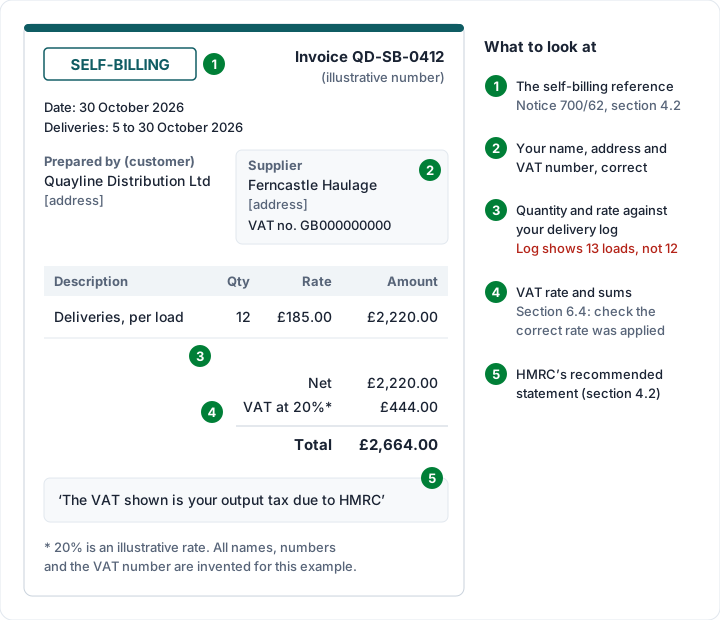
- Your details. Your business name, address and VAT number are yours and correct.
- The marking and statement. The self-billing reference is there, and the recommended statement if your customer uses it.
- Quantities. Loads, hours or items match your delivery notes, timesheets or job log.
- Rates. Each unit price matches the agreed rate.
- VAT. The rate applied is the one that applies to what you supplied, and the sum is right. Check GOV.UK’s VAT rates page or your accountant if unsure.
- Dates. The invoice date and the period covered match the work.
- The agreement. It is still in date for this invoice.
Worked example: a self-bill one load short#
Illustrative only; the businesses, invoice number and figures are invented, and 20% is used as an illustrative VAT rate. Ferncastle Haulage (the supplier, VAT-registered) delivers for Quayline Distribution Ltd (the customer, the self-biller) under a self-billing agreement.
Quayline’s self-billed invoice QD-SB-0412, dated Friday 30 October 2026, covers deliveries from Monday 5 October to Friday 30 October 2026:
| Line | Qty | Rate | Amount |
|---|---|---|---|
| Deliveries, per load | 12 | £185.00 | £2,220.00 |
| VAT at 20% (illustrative) | £444.00 | ||
| Total | £2,664.00 |
Ferncastle’s own delivery log for the same period shows 13 loads. The self-bill is one load short: £185.00 plus £37.00 VAT, so £222.00. With 13 loads, the figures would be £2,405.00 plus £481.00 VAT, a total of £2,886.00.
What Ferncastle does next:
- It does not invoice the missing load itself. Section 6.4 rules that out for supplies covered by the agreement.
- It raises the difference with Quayline, quoting the delivery note for the thirteenth load, and asks Quayline to correct the self-bill. How the correction is made is for Quayline and its accountant; section 4.5, quoted below, covers part of it.
- It treats the VAT shown as its output tax, as section 6.4 says, keeps the copy with its records, and asks its accountant how and when to account for it (section 6.5, quoted below, points to the tax point rules).
When a self-bill is wrong, or your VAT status changes#
If a self-billed invoice is wrong, raise it with the customer who prepared it. Section 4.5 of Notice 700/62, written to the customer, covers corrections. As of 28 October 2026 it says:
You should not reduce the value of a supply for which you have already raised a self-billed invoice by reducing the total you show on a subsequent invoice. Instead, you should issue a debit note for the amount by which the value of the supply has been changed.
That passage is about reducing the value; for any other correction, read section 4.5 in full or ask your accountant. For the general difference between these documents, see debit note vs invoice and when to issue a credit note.
If your VAT registration changes, section 6.3 (quoted above) says you must agree to notify your customer at once. And if the arrangement stops working, section 6.6 says (as of 28 October 2026): “You will have to tell your customers and arrange to issue your own invoices for the supplies you make to them if you:” followed by “are unable to meet the self-billing conditions in this notice” and “fail to meet them”.
Recording self-billed invoices in your books#
Section 6.4 says the self-billed invoice “is for supplies you have made to your customer”, that the VAT on it “is your output tax”, and warns against treating it as a purchase invoice (all quoted above). How you enter it in your books is a question for your accountant.
When to account for that VAT is a tax-point question. Section 6.5 says (as of 28 October 2026): “This is governed by the tax point in the normal way. The rules are described in sections 14 and 15 of VAT guide (VAT Notice 700).” Read those sections or ask your accountant; what the date on an invoice means covers invoice dates in general.
Because the payment arrives with the self-bill, it helps to match payments to invoices as soon as each one lands, so a short payment and a short invoice are spotted together.
If you are the customer#
If you want to self-bill your suppliers, section 1.2 of Notice 700/62 points customers to “sections 2 to 5 and 7 to 8”. Two lines to start with, from section 1.1 and section 3.1 respectively (as of 28 October 2026): “You do not need to seek HMRC authorisation to operate self-billing.” And: “The agreement must be in place before self-billing commences.” Read the sections on agreements, invoice contents, corrections and tax points in full, and set it up with your accountant. Self-billing outside the UK is covered in section 7 of the notice; this post does not cover it.
If you plan to raise self-bills, check whether your accounting or purchasing software supports self-billing; we have not reviewed which tools do.
Where Charming fits, and where it does not#
Charming Invoices does not do self-billing, in either direction:
- It cannot issue a self-bill. Every Charming invoice is from your business to your client, with your business in the From block. It has no self-billing mode: no way to raise an invoice on a supplier’s behalf and no built-in self-billing marking.
- It cannot receive or store one. Charming has no bills or purchases section, so a self-billed invoice your customer sends you cannot be imported, matched or recorded there.
- It does not track agreements, VAT returns or tax points. Keep the agreement on file yourself and ask your accountant about the VAT side. Charming applies one tax rate per invoice and does not work out tax points.
Under a self-billing agreement, do not create Charming invoices for the supplies it covers; section 6.4, quoted above, says you must not issue your own sales invoices for them.
Where it does fit is the rest of your work. If you also invoice other clients yourself, Charming can help there. For those clients, the free plan gives you unlimited invoices for 1 business, client statements and CSV export, in a web app. The catches: payment tracking is manual (you mark invoices paid), Charming does not take card payments, and Free-plan invoices carry a “Sent with Charming Invoices” line, hidden by default on paid plans. If that is the part you need, create a free invoice.
Questions people ask#
What does self-billing mean?#
HMRC’s definition, from Notice 700/62 section 1.1 (as of 28 October 2026): “Self-billing is a commercial arrangement between a supplier and a customer in which the customer prepares the supplier’s invoice and forwards a copy to the supplier with the payment.”
Do I need HMRC approval for self-billing?#
Section 1.1 says (as of 28 October 2026): “You do not need to seek HMRC authorisation to operate self-billing.” The agreement and invoice conditions in the rest of the notice still apply.
Can I say no to a self-billing agreement?#
Section 6.2 says (as of 28 October 2026): “HMRC will not insist that you agree to self-billing. But your customer may make self-billing a condition of doing business with you.”
Do I still send invoices to a customer who self-bills me?#
Not for the supplies the agreement covers. Section 6.4 says (as of 28 October 2026): “Remember, you must not issue your own sales invoices in respect of any transactions covered by the self-billing agreement.” For other clients, you invoice as usual.
What does ‘SELF-BILLING’ on an invoice mean?#
It is the reference that marks an invoice as self-billed. Notice 700/62 section 4.2 gives it as ‘SELF-BILLING’; Notice 700 section 17.4.1 gives it as ‘self billing’. Both are quoted above, under how the two notices word the marking.
Is a self-billed invoice a purchase invoice?#
Not for the supplier. Section 6.4 says (as of 28 October 2026): “Self-billees sometimes make the mistake of treating their self-billed invoices as purchase invoices.” The same section says the VAT shown on it is the supplier’s output tax.