VAT invoice: what it must show, with an example

Nnabuike Okoroafor ·
On this page · 12 sections
A client’s accounts team has sent your invoice back with a note: “Please reissue as a VAT invoice.” Or you have just registered for VAT and the first invoice under your new VAT number is due this week. Either way, you want to know what a VAT invoice is and what goes on it.
This guide answers that by quoting HMRC’s own guidance on GOV.UK, re-read on 23 October 2026 and linked, with section numbers, plus one fully worked example. Where we have not quoted a source, we point you to it rather than summarise it.
General information, not legal or tax advice. VAT rules vary by country and change; check the linked official pages and ask your accountant or HMRC before you rely on any of it.
What a VAT invoice is#
A VAT invoice is an invoice that carries the details a VAT system uses to record a taxable sale, such as your VAT registration number, the VAT rate and the VAT charged. In the UK, HMRC’s VAT guide (VAT Notice 700) describes it this way (paragraph 16.2.1, as of 23 October 2026; the notice was last updated on 25 June 2026):
A VAT invoice is a document containing certain information about what you’re supplying. Paragraph 16.3 sets out the information you need to show. Your customers need VAT invoices as evidence for reclaiming, as input tax, the VAT you have charged them.
That last sentence is why many accounts teams check VAT invoices closely and send back any that look incomplete.
VAT invoice or tax invoice? “Tax invoice” is a general term, and some countries use it as the name of their document. The UK guidance quoted here uses “VAT invoice”. Our guide to what a tax invoice is explains the general idea and where to find each country’s official guidance; this post goes deeper on UK VAT invoices only.
What HMRC says about when to issue one#
These passages are quoted from Notice 700 as of 23 October 2026. Read them in full on the page, because each sits inside conditions and exceptions:
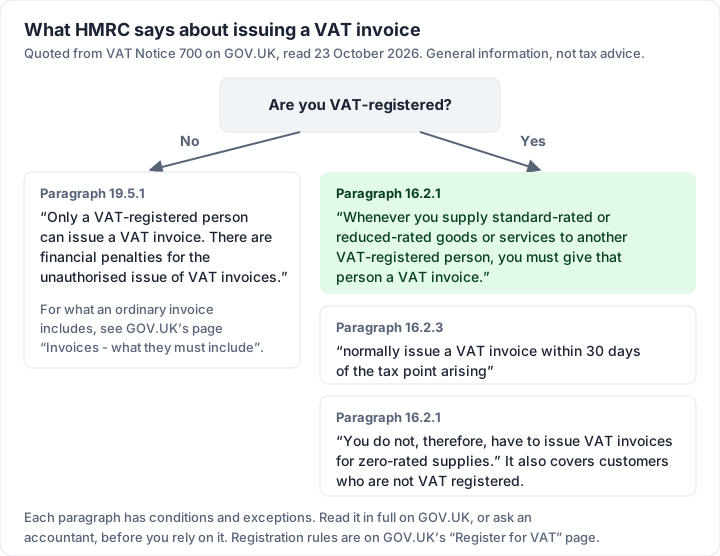
- 16.2.1: “Whenever you supply standard-rated or reduced-rated goods or services to another VAT-registered person, you must give that person a VAT invoice.”
- 16.2.1: “You do not, therefore, have to issue VAT invoices for zero-rated supplies.” And: “You do not need to issue VAT invoices for supplies to customers who are not VAT registered. In practice, this will probably mean issuing a VAT invoice to any customers who ask for one, as you will usually have no way of telling whether they’re VAT registered or not.”
- 16.2.3: unless an earlier invoice already created a tax point, the guidance says “normally issue a VAT invoice within 30 days of the tax point arising (section 14 and section 15 explain when a tax point arises)”.
- 19.5.1: “Only a VAT-registered person can issue a VAT invoice. There are financial penalties for the unauthorised issue of VAT invoices.”
GOV.UK’s shorter page on what an invoice must include puts it in one line (as of 23 October 2026): “You must use VAT invoices if you and your customer are VAT registered.”
What HMRC lists for a UK VAT invoice#
This is the list itself, quoted from paragraph 16.3.1 of VAT Notice 700 as of 23 October 2026. It begins: “You must show the following details on any VAT invoice you issue:”
- “a sequential number based on one or more series which uniquely identifies the document”
- “the time of the supply (tax point)”
- “the date of issue of the document (where different to the time of supply)”
- “your name, address and VAT registration number — you may issue invoices under a trading name, but you must show the name and address under which you’re registered for VAT somewhere on the document”
- “the name and address of the person to whom the goods or services have been supplied (your customer)”
- “a description sufficient to identify the goods or services supplied”
- “for each description, the quantity of the goods or the extent of the services, the rate of VAT, and the amount payable excluding VAT — this can be expressed in any currency”
- “the gross total amount payable, excluding VAT — this can be expressed in any currency”
- “the rate of any cash discount offered”
- “the total amount of VAT chargeable — this must be expressed in sterling”
- “the unit price (read paragraph 16.3.2)”
The paragraphs around the list add detail. A few lines from them, quoted as of 23 October 2026:
- Unit price (16.3.2): “The requirement to include unit price on an invoice applies to countable goods or services.” For services, HMRC’s examples are “an hourly rate” or “a price for standard services”. Itemized invoices covers how much line detail to show, and how to bill expenses to a client covers recharging costs you paid on a client’s behalf.
- Foreign currency (16.4): “If you issue VAT invoices in a foreign currency for supplies of goods or services that take place in the UK, you must convert the total amount of VAT payable into sterling”.
- Language (16.2.4): “You may write your invoices in a language other than English.” The same paragraph says when HMRC may ask for translations.
- Rounding (17.5): “You may round down the total VAT payable on all goods and services shown on a VAT invoice to a whole penny.” The paragraphs that follow cover VAT worked out line by line.
The quoted list does not mention a “VAT invoice” heading, a due date or your client’s VAT number. Many businesses add the heading and a due date anyway; whether your invoices need anything more is a question for HMRC’s guidance or your accountant. For the fields most invoices carry, VAT or not, see what actually belongs on an invoice, and for a numbering scheme that stays sequential, how to number invoices.
A VAT invoice, line by line#
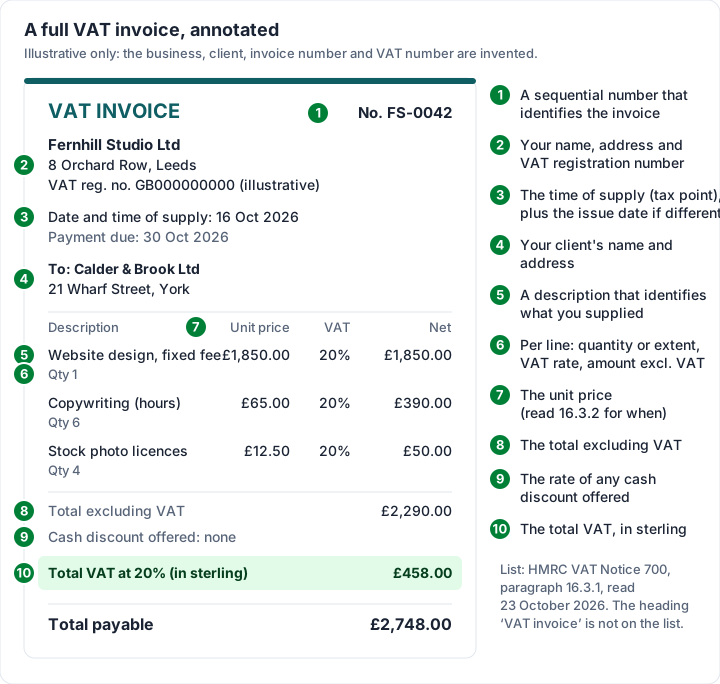
Here is one complete example. Fernhill Studio Ltd, Calder & Brook Ltd, invoice FS-0042 and VAT number GB000000000 are all invented for illustration. The example uses 20% as an illustrative rate. (GOV.UK’s VAT rates page said “The standard VAT rate is 20%” when we read it on 23 October 2026; which rate applies to a sale depends on what you sell, and that page lists the others.)
Fernhill Studio finished a small website project for Calder & Brook on Friday 16 October 2026 and invoiced the same day, so the time of supply and the date of issue are the same date and the invoice shows it once. Notice 700 sections 14 and 15 explain how HMRC works out the tax point when the dates differ; read them, or ask your accountant, before you fill in that line. For how the invoice date differs from the due date and the service date in general, see our invoice date guide.
The header:
- VAT INVOICE · No. FS-0042
- Fernhill Studio Ltd, 8 Orchard Row, Leeds · VAT reg. no. GB000000000 (illustrative)
- Date and time of supply: 16 October 2026 · Payment due: 30 October 2026
- To: Calder & Brook Ltd, 21 Wharf Street, York
The lines:
| Description | Qty | Unit price | VAT rate | Amount excl. VAT |
|---|---|---|---|---|
| Website design, fixed fee | 1 | £1,850.00 | 20% | £1,850.00 |
| Copywriting (hours) | 6 | £65.00 | 20% | £390.00 |
| Stock photo licences | 4 | £12.50 | 20% | £50.00 |
The totals:
| Amount | |
|---|---|
| Total excluding VAT | £2,290.00 |
| Cash discount offered | None |
| Total VAT at 20% | £458.00 |
| Total payable | £2,748.00 |
The VAT checks two ways. On the total: £2,290.00 × 20% = £458.00. Line by line: £370.00 + £78.00 + £10.00 = £458.00. Every line here comes to a whole penny, so the two methods agree; on real invoices they can differ by a penny, and paragraph 17.5 of the notice is where HMRC covers rounding. If you offer a prompt-payment discount, discounts on an invoice quotes HMRC's wording on how it affects the VAT.
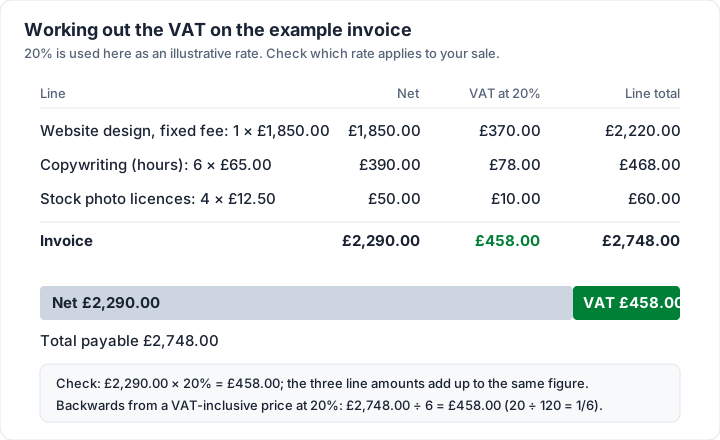
The divide-by-six check is plain arithmetic: at 20%, a VAT-inclusive price is 120 parts, of which 20 (one-sixth) are VAT. It only works at 20%.
Simplified and modified VAT invoices#
HMRC’s guidance also describes shorter forms. Here is what it says, quoted as of 23 October 2026; read the full paragraphs for the conditions.
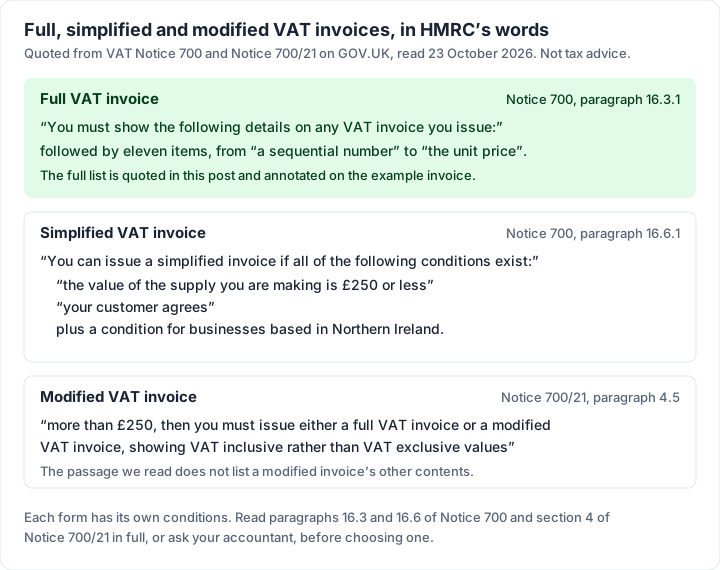
Simplified VAT invoice. Notice 700 paragraph 16.6.1: “You can issue a simplified invoice if all of the following conditions exist:”
- “the value of the supply you are making is £250 or less”
- “your customer agrees”
- “if your business is based in Northern Ireland your customer must not be from an EU member state”
It goes on: “The simplified invoice must include:”
- “your name, address and VAT registration number”
- “the time of supply (tax point)”
- “a description which identifies the goods or services supplied”
- “for each applicable VAT rate, the total amount payable, including VAT, and the VAT rate”
Modified VAT invoice. The term appears in HMRC’s Record keeping (VAT Notice 700/21), last updated 18 March 2024. Paragraph 4.5 says that where the supply is “more than £250, then you must issue either a full VAT invoice or a modified VAT invoice, showing VAT inclusive rather than VAT exclusive values”. The same paragraph, for supplies of “£250 or less (including VAT)”, adds that “exempt supplies must not be included in this type of VAT invoice”.
That is as far as we quote. If a shorter form might suit your business (retailers are the usual case), read sections 16.6 and 4 of the two notices, or ask your accountant. When your customer raises the VAT invoice for you under an agreement, that is self-billing; self-billing invoices (UK VAT) quotes HMRC’s notice on it.
Zero-rated, exempt and reverse-charge lines#
Some sales carry no VAT, or VAT the client accounts for. HMRC has guidance on how those show on an invoice. Quoted as of 23 October 2026:
Zero-rated or exempt items on a VAT invoice. Notice 700 paragraph 16.5: if “you issue a VAT invoice which includes supplies that are zero-rated or exempt”, then “you must make sure that those items show clearly that there’s no VAT payable and you must show a separate total for their values.” It adds: “You can, of course, issue separate invoices for zero-rated or exempt supplies.”
The domestic reverse charge for construction. HMRC’s page on the VAT domestic reverse charge for building and construction services says: “The VAT domestic reverse charge must be used for most supplies of building and construction services.” Its VAT reverse charge technical guide (last updated 18 September 2024) says that, when supplying a service subject to it, “suppliers must:”
- “show all the information required on a VAT invoice”
- “make a note on the invoice to make it clear that the domestic reverse charge applies and that the customer is required to account for the VAT”
- “clearly state how much VAT is due under the reverse charge, or if this amount cannot be shown, state the rate of VAT, but do not include the VAT in the amount charged to the customer”
The same guide lists “examples of wording that meet the legal requirement”: “VAT Act 1994 Section 55A applies”, “S55A VATA 94 applies” and “Customer to pay the VAT to HMRC”. Whether the reverse charge applies to a job has its own conditions, set out on those two pages; ask your accountant if you are unsure. If you work in construction, our guide to what a contractor invoice should include covers the rest of the invoice.
Selling to a business in another country. Cross-border rules depend on what you sell and where your client is, and we do not summarise them here. HMRC’s guidance and your accountant are the places to start. If you ship goods abroad, our guide to the commercial invoice covers the customs paperwork, which is a different document.
VAT invoices in the EU#
EU invoicing rules are partly shared and partly national. We quote two official pages, both read on 23 October 2026, and do not cite the VAT Directive itself, because EUR-Lex, where it is published, blocked our tools.
The European Commission’s VAT invoicing page says: “Taxable persons (VAT-registered businesses) doing business in the EU are subject to a single set of basic EU-wide VAT invoicing rules and, in certain areas, national rules set by the individual Member State.” The page then sets out, in a table, what a full and a simplified invoice contain. A few of its rows, quoted:
- “Unique sequential number identifying the invoice”
- “Customer’s VAT identification number (if the customer is liable for tax on the transaction)”
- “Breakdown of VAT amount payable by VAT rate or exemption”
- “If the customer is liable for tax (i.e. under the reverse-charge procedure): the words ‘reverse charge’”
Your Europe’s page on charging and deducting VAT and invoicing rules (marked “Last checked: 11/05/2026”) says: “Normally, if you are registered for VAT and you make sales to other businesses, you must issue a VAT invoice — either in paper or electronic form.”
Read the Commission’s full table, then check the tax authority of the country you invoice from. For countries outside the UK and the EU, your own tax authority’s guidance is the place to look. For the difference between a PDF and a structured e-invoice, see our guide to electronic invoices.
If you are not VAT-registered#
Notice 700 paragraph 19.5.1, quoted above: “Only a VAT-registered person can issue a VAT invoice.” GOV.UK’s page on what an invoice must include lists what an ordinary invoice carries, such as a unique identification number, both parties’ details, a description, the supply date, the invoice date and the total amount owed.
When registration becomes compulsory, and the current threshold, are on GOV.UK’s register for VAT page. Thresholds change, so read that page on the day, or ask an accountant.
Pro-forma invoices. Notice 700 paragraph 17.3 says pro-forma invoices used to offer goods or services “cannot be used as evidence to reclaim input tax, even if they show all the details required for a VAT invoice. You should make sure that they’re clearly marked ‘this is not a VAT invoice’.” Our guide to the proforma invoice explains when businesses send one.
Checks before you send a VAT invoice#
A quick self-check against HMRC’s list catches most gaps. Before you send, look for:
- Your VAT registration number, and, if you trade under another name, the registered name and address (item 4 of 16.3.1).
- A number that follows your sequence (item 1). To correct an invoice already sent, many businesses issue a credit note rather than editing it; credit notes versus invoices explains how, and supplementary invoices and debit notes cover an undercharge.
- The VAT shown by line and in total: the rate and net amount per line, the time of supply and the total VAT in sterling (items 2, 7 and 10; 16.4 for other currencies).
- Zero-rated, exempt or reverse-charge lines checked against paragraph 16.5 and HMRC’s reverse charge technical guide.
- Your client’s details (item 5). For a company client, invoicing a company covers finding its legal name.
Making a VAT invoice in Charming, and its limits#
We make Charming Invoices, an invoicing app, so here is how a VAT invoice maps onto it, checked in our code on 23 October 2026, with what it cannot do stated just as plainly.
What fits:
- Your VAT number in the header. The business Tax ID field prints in the invoice header, and its label can be renamed, for example to “VAT reg. no.”, in the template settings.
- “Tax” renamed to “VAT”. The tax line’s label can be renamed, and so can the document title (to “VAT invoice”, if you want the heading).
- The VAT worked out for you. Subtotal, any fixed discount and one tax rate calculate to the penny, with the tax worked out on the amount after the discount.
- The rate on the PDF. Turn on the Tax summary section and the invoice prints the taxable amount and a line such as “VAT (20%)” with the amount. The totals block on its own shows the VAT amount, not the rate.
- Sequential numbers. Invoice numbers assign themselves, gapless per business, with your prefix.
- Sterling or euros. Each business invoices in one of 16 currencies, including GBP and EUR.
What does not fit:
- One VAT rate per invoice. There are no per-line rates, so you cannot mix rates on one invoice, and the lines have no VAT-rate column. Notice 700 paragraph 16.5 says “You can, of course, issue separate invoices for zero-rated or exempt supplies”, so one route is an invoice per rate. To show the rate against each line, type it into the line description, for example “(VAT 20%)”. If you need several rates on one invoice, use accounting software that supports per-line VAT; Xero’s published API, for example, gives each invoice line its own tax type (see our guide to Xero invoicing).
- No separate time-of-supply field. Charming has an issue date and a due date. If the time of supply differs from the issue date, you can type it into the line description or the notes (for example “Time of supply: 16 October 2026”).
- No client VAT number field. If you want your client’s VAT number on the invoice, add it to the client’s address so it prints under “Bill to”.
- No reverse-charge option. Charming has no reverse-charge setting and cannot show reverse-charge VAT on its own line. Ask your accountant what wording your invoices need; Charming’s notes field can hold free text, and HMRC’s reverse charge technical guide shows example wording.
- No currency conversion. An invoice prints in one currency, and Charming will not convert a VAT total into sterling for you. If your accountant says a sterling figure is needed, the notes field can hold it. For billing clients abroad more generally, see invoice currency.
- No credit notes, VAT returns or Making Tax Digital. Charming has no credit-note document, does not keep VAT accounts and does not file anything with HMRC. You can export your invoices as CSV for your accountant or bookkeeping software.
- A “Sent with Charming Invoices” line in the footer of invoices on the free plan.
All of the fitting features are on every plan, including Free (1 business, no invoice limit). If that list covers your invoices, you can create a free invoice and check the PDF against HMRC’s list before you issue it and send it your way.
Prefer a spreadsheet? The free Excel files on our invoice template downloads page calculate one tax rate per invoice: type 20 in the tax rate cell for 20% (the cell refuses 0.2 and “20%”). Rename the Tax label to VAT yourself. The Word files do not calculate, so you fill in the totals by hand.
VAT invoice questions#
VAT invoice or normal invoice: what is the difference?#
A VAT invoice carries the extra details HMRC lists in Notice 700 paragraph 16.3.1, such as your VAT registration number, the time of supply, the VAT rate and the amount excluding VAT for each line, and the total VAT in sterling. A normal invoice asks for payment without them. Paragraph 19.5.1 says “Only a VAT-registered person can issue a VAT invoice.”
Do I have to put “VAT invoice” at the top?#
The heading is not among the eleven items in HMRC’s paragraph 16.3.1 list, as of 23 October 2026. Many businesses add it anyway so the client’s accounts team can see what it is at a glance. If you are unsure what your invoices need, ask your accountant.
Does a VAT invoice need the customer’s VAT number?#
The UK list quoted above asks for the customer’s name and address and does not mention their VAT number. The European Commission’s table for EU invoices includes the “Customer’s VAT identification number (if the customer is liable for tax on the transaction)”. Which applies to your sale is a question for the official pages or your accountant.
What is a VAT-exempt invoice?#
“VAT-exempt invoice” is an everyday phrase rather than a document name in the HMRC guidance we read. For exempt or zero-rated items on a VAT invoice, see Notice 700 paragraph 16.5, quoted above; for EU invoices, the Commission’s table has a row on exempt transactions. If everything you sell is exempt, ask your accountant what your invoices should say.
The short version#
HMRC’s Notice 700 paragraph 16.3.1 lists eleven details for a UK VAT invoice, from a sequential number to the total VAT in sterling, and paragraph 16.6.1 describes a shorter simplified invoice. Zero-rated, exempt and reverse-charge lines have their own HMRC guidance, linked above. The GOV.UK pages are the source, rules change, and your accountant is the person to ask about your own invoices.