Electronic invoices for small businesses: is a PDF enough?

Nnabuike Okoroafor ·
On this page · 13 sections
You already send your invoices by email as PDFs, so you might reasonably think you do electronic invoicing. In everyday speech, you do. But a client’s finance team, your accountant or a government page may use “electronic invoice” or “e-invoice” to mean something narrower: invoice data in a structured, machine-readable format that the buyer’s software imports without anyone retyping it. On that definition, a PDF is not an e-invoice.
This guide explains both meanings in plain words, quotes what the European Commission and GOV.UK say does and does not count, and lists the questions to take to your accountant. We make Charming Invoices, which makes PDF invoices; we say plainly below what that means here.
General information, not legal or tax advice. E-invoicing rules are set country by country and they change. Where this guide touches a rule, it quotes or links the official page; for what applies to your business, check your tax authority and ask an accountant.
In short#
- Two meanings. In everyday speech, an electronic or digital invoice is any invoice sent electronically, such as an emailed PDF. In the tax and procurement sense, an e-invoice is structured data that software can import automatically.
- Official pages say a PDF is not an e-invoice. The European Commission, a GOV.UK consultation response and the UK’s new e-invoicing roadmap all list PDF, Word and invoices in an email among the formats that do not count.
- The UK has published a roadmap. GOV.UK’s e-invoicing roadmap, published 28 October 2026, says “Mandatory e-invoicing for VAT invoices will begin in April 2029”; we quote its stages below. EU countries set their own rules; check your country’s official factsheet.
- Rules vary. Whether any of this applies to you depends on your country, your clients’ countries, whether you are VAT-registered and who you bill. Ask your accountant.
- Charming makes PDFs and a private link, not e-invoices. It has no structured e-invoice output and no Peppol connection.
What “electronic invoice” means in everyday speech#
For most small businesses, especially in the US, “electronic invoice” simply means an invoice that is not on paper. You make it in software or a template, save it as a PDF, and email it or send a link.
That everyday meaning is perfectly useful. Sending invoices electronically is faster than post, gives you a dated record of what you sent, and lets your client pay without waiting for an envelope. If that is what you came for, our guide to how to send invoices by email covers the practical side: subject lines, attachments versus links, and following up.
The confusion starts when someone uses the same words in the narrower sense.
What an e-invoice is in the tax sense#
The European Commission’s “What is eInvoicing” page (last updated 6 March 2026, read 28 October 2026) defines it this way:
An electronic invoice (eInvoice) is an invoice that has been issued, transmitted and received in a structured data format which allows for its automatic and electronic processing
It goes on:
A structured electronic invoice contains data from the supplier in a machine-readable format, that can be automatically imported into the buyer's Account Payable (AP) system without requiring manual entering.
The GOV.UK consultation response on e-invoicing (updated 26 November 2025, read 28 October 2026) puts it like this:
E-invoicing refers to the digital exchange of invoice data directly between buyers’ and suppliers’ financial systems, even when those systems differ.
In plain words: an e-invoice is not a picture of an invoice. It is the invoice’s data (who, what, how much, when) in a format the buyer’s accounting system reads directly.
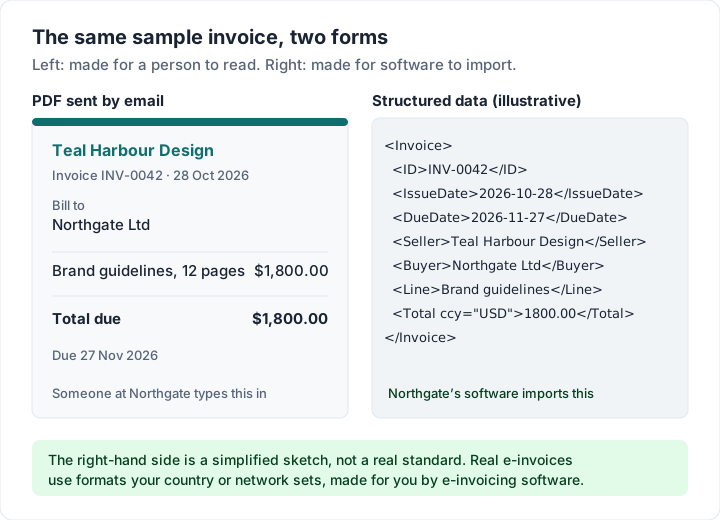
A worked example: the fields someone retypes#
Take the sample invoice above: a $1,800.00 design invoice from Teal Harbour Design to Northgate Ltd. As a PDF, someone in Northgate’s accounts team reads it and types at least seven fields into their system: invoice number, issue date, due date, supplier, buyer, line description and total. A real invoice usually has more, such as tax details, a purchase order number and bank details.
| Field | In the PDF | In a structured e-invoice |
|---|---|---|
| Invoice number | INV-0042, read and typed | A tagged value the system imports |
| Issue date | 28 Oct 2026, read and typed | A tagged date |
| Due date | 27 Nov 2026, read and typed | A tagged date |
| Supplier and buyer | Read from the header | Tagged parties |
| Line and total | $1,800.00, read and typed | Tagged amounts and currency |
The content is identical. What changes is the work on the buyer’s side, which is why larger buyers and governments care about the format. The fields an invoice has to show are a separate question; see what a tax invoice is and the field-by-field invoice checklist.
Digital invoice vs e-invoice#
“Digital invoice” is the phrase most people actually use, and it usually means the everyday thing: an invoice made and sent without paper. A PDF you email is a digital invoice. The trouble is that official pages use the related words in different ways, and even HMRC’s guidance uses two.
HMRC’s current guidance, Electronic invoicing (VAT Notice 700/63) (last updated 26 May 2022, read 28 October 2026), says in section 2.1:
Electronic invoicing is the transmission and storage of invoices in an electronic format without duplicate paper documents. The electronic format may be a structured format such as XML or an unstructured format such as PDF.
The UK’s roadmap for e-invoicing implementation (published 28 October 2026, read the same day), which describes the regime planned for 2029, draws the line elsewhere:
Invoices shared as digital files, but not as structured data, are not classed as e-invoices. Therefore, formats such as PDF, word-processed documents, image files such as JPEG, HTML invoices on a web page or email and images sent via fax machine do not count as e-invoices.
So the same PDF can be a digital invoice, electronic invoicing under today’s HMRC notice, and not an e-invoice under the roadmap. The table puts the three side by side.
| Term | Whose wording | Does an emailed PDF count? |
|---|---|---|
| Digital invoice | Everyday use | Yes: any paperless invoice |
| Electronic invoicing | HMRC VAT Notice 700/63, today | Yes: it names “an unstructured format such as PDF” |
| E-invoice | European Commission; the UK roadmap for 2029 | No: it has to be structured data |
Making a digital invoice in the everyday sense is the ordinary process: fill in the fields in software or a template, save it as a PDF, and email it or send a link. How to make an invoice walks through it. Say Kestrelford Studio emails a PDF to a client, Lindgate GmbH: that is a digital invoice. Whether Lindgate’s country expects a structured e-invoice instead is a question for that country’s rules and Lindgate’s accounts team.
What does not count as an e-invoice#
The official pages list formats that are not e-invoices in their sense. Here they are side by side, quoted exactly.
| Source (read 28 October 2026) | What the page says is not an e-invoice |
|---|---|
| European Commission, “What is eInvoicing” (last updated 6 March 2026) | “Unstructured invoice data issued in PDF or Word formats.” “Images of invoices such as JPG or TIFF.” “Unstructured HTML invoices on a web page or in an email.” “OCR (Scanned paper invoices).” “Paper invoices sent, like images, via fax machines.” |
| GOV.UK consultation response (updated 26 November 2025) | “Invoices in the following formats are not considered e-invoices for the purpose of this consultation: invoices in PDF or word formats, images such as JPEG, HTML invoices on a webpage or in an email, OCR or images sent via a fax machine.” |
| GOV.UK roadmap for e-invoicing implementation (published 28 October 2026) | The list quoted in the digital invoice section above: PDF, word-processed documents, JPEG images, HTML invoices on a web page or email, and fax images |
So an emailed PDF, and an invoice shown on a web page or in the body of an email, are electronic in the everyday sense and not e-invoices in the sense these pages use. Note the consultation’s wording: “for the purpose of this consultation”. Each country’s own rules say what counts there. For how an e-invoice compares with the other kinds of invoice, see the types of invoices.
What a UBL invoice looks like#
You will often see e-invoices described as “UBL”. UBL is the Universal Business Language, a standard published by OASIS, and it is one of the structured formats an e-invoice can take. The Peppol BIS Billing 3.0 specification (read 28 October 2026) lists UBL Invoice among its syntaxes.
The clearest way to see one is the official sample. OASIS publishes a UBL 2.1 example invoice (read 28 October 2026). Open it in a browser and you will see a text file of nested, named tags rather than a laid-out page. Every value sits inside a tag that says what it is. In that sample:
- The invoice number sits in a tag called cbc:ID, with the value TOSL108.
- The issue date sits in cbc:IssueDate, written as 2009-12-15.
- The currency sits in cbc:DocumentCurrencyCode, with the value EUR.
- The seller and the buyer each sit in a party block, with names such as “Salescompany ltd.” and “Buyercompany ltd”.
- The file has 5 invoice lines, a tax total and, at the end, an amount payable of 729 euros after an amount already paid.
The “cbc” and “cac” prefixes name the two families of building blocks the file draws on: basic values and groups of values. Nobody is expected to read the file the way they read a PDF. It is written for the buyer’s software, which picks out each tagged value.
Here is how the fields of our Teal Harbour Design sample would map to element names from the UBL 2.1 invoice. It is illustrative only: it shows where each value goes, not a complete or valid file.
| Field on the sample invoice | Value | UBL 2.1 element |
|---|---|---|
| Invoice number | INV-0042 | cbc:ID |
| Issue date | 28 Oct 2026 | cbc:IssueDate |
| Due date | 27 Nov 2026 | cbc:DueDate |
| Supplier | Teal Harbour Design | cac:AccountingSupplierParty |
| Buyer | Northgate Ltd | cac:AccountingCustomerParty |
| Line | Brand guidelines | cac:InvoiceLine |
| Amount to pay | $1,800.00 | cbc:PayableAmount, inside cac:LegalMonetaryTotal |
Peppol publishes its own example files on the specification site. If a client or your accountant asks for UBL or Peppol BIS, that is the cue to use an e-invoicing provider; you would not normally write these files by hand.
E-invoicing plans in the UK, the EU and elsewhere#
This is the part that changes fastest, so we quote and link rather than summarise.
The UK#
The GOV.UK consultation response (updated 26 November 2025) promised “an implementation roadmap at Budget 2026”, and the roadmap for e-invoicing implementation was published on 28 October 2026 (read the same day). Its executive summary says:
From 1 April 2029, VAT-registered persons (including public sector bodies) will need to be able to issue and receive VAT invoices as e-invoices, unless a specific exemption applies.
The roadmap’s “at a glance” table, quoted exactly:
| Stage | What’s happening |
|---|---|
| Already decided | “Mandatory e-invoicing for VAT invoices will begin in April 2029. Peppol will be the UK’s core interoperability framework.” |
| Budget 2026 to October 2027 | “Government will continue developing the detailed design of the regime and consult on technical standards.” |
| October 2027 to April 2028 | “Government will publish the key requirements organisations need to prepare, including scope, exclusions, standards, guidance, business identifiers and service-provider requirements.” |
| April 2028 to April 2029 | “Government communications campaign runs. Software providers, service providers, businesses and public bodies prepare for implementation, testing and onboarding.” |
| April 2029 | “Mandatory e-invoicing begins” |
On invoices outside the requirement, the roadmap says:
Not all invoices are official VAT invoices. For example, invoices issued to consumers are not VAT invoices, invoices for transactions not subject to VAT are not VAT invoices, and invoices issued by businesses which are not registered for VAT are not VAT invoices. These invoices will not be required to be issued as e-invoices; however, some organisations may choose to issue non-VAT invoices as e-invoices on a voluntary basis.
The same day, HMRC opened a consultation on e-invoicing digital reporting; we have not summarised it here. The earlier consultation response is still online for the background. For the current rules on sending a VAT invoice electronically today, HMRC’s VAT Notice 700/63, linked above, is the page to read.
The EU and elsewhere#
EU member states are introducing e-invoicing on their own timetables, and the details differ by country. Rather than build a country table that could be out of date by next month, we point you to the European Commission’s eInvoicing country factsheets, then to your own tax authority’s page. Outside Europe, check your tax authority directly.
Peppol, in brief#
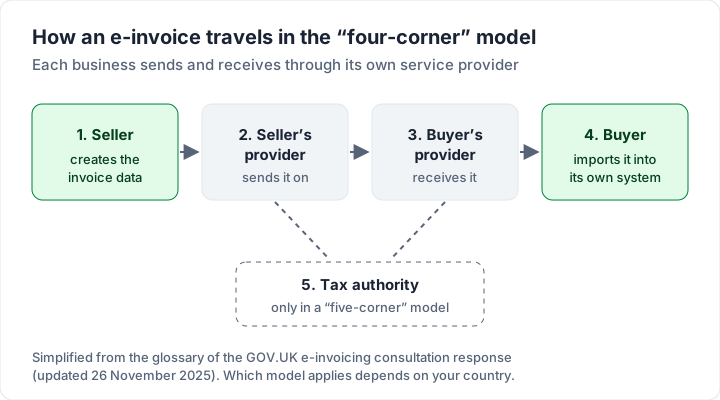
You will see “Peppol” wherever e-invoicing comes up. The glossary in the GOV.UK consultation response defines it as “Pan-European Public Procurement On-Line — A global network for the standardised exchange of electronic business documents.” The same glossary describes a “four-corner model” as “An e-invoicing model where businesses exchange e-invoices through their service providers, allowing for interoperability and flexibility in e-invoicing systems.” In practice, that means you usually connect through a provider rather than sending files to your client yourself.
For the UK, see the “Already decided” row of the roadmap table above. HMRC’s policy paper E-invoicing requirements (published 28 October 2026, read the same day) says the measure “confers the necessary functions on HMRC to undertake the role of the UK Peppol Authority”, and adds: “It is not yet determined when HMRC will become the Authority.”
Questions to ask your accountant or software provider#
You do not need to read the law yourself to get ready. You need the right questions, asked of the people who do read it. Take this list to your accountant:
- Am I VAT-registered, or likely to be? The UK roadmap above is about VAT invoices.
- Who are my clients? Businesses, government bodies or consumers, and in which countries.
- Which country’s rules apply to each client? Mine, theirs or both.
- Do I need to be able to receive e-invoices, as well as send them? The UK roadmap quoted above says “issue and receive”; ask about your country specifically.
- What format and channel do my clients expect? Some larger clients already ask suppliers for e-invoices or use a supplier portal; how to invoice a company covers what big clients often ask for.
- Does the software we already use for the books send e-invoices? If your accountant files from accounting software, it may already connect to the right network or portal.
- When should I switch, and what happens to invoices sent before then?
Ask your current invoicing tool the matching questions: which e-invoice formats it can produce, which networks or government portals it connects to, and whether it can receive e-invoices. Our guide to what to look for in invoicing software has more checks.
Software for e-invoices: what to look for#
If your accountant says you need structured e-invoices, the tool you need is an e-invoicing provider, or accounting software that connects to Peppol or your country’s government portal. We do not recommend a named provider here, because the right one depends on your country and your clients.
Look for:
- The formats your country and clients use, named specifically on the provider’s own pages.
- The network or portal it connects to, such as Peppol or a national platform, if your country uses one.
- Sending and receiving, if you may need both.
- A readable copy for you and your client, alongside the structured data.
- Export of your records, so you keep a copy of your own data.
Some self-hosted projects include e-invoice libraries or templates; our guide to open source invoicing software records what we could see in each project’s code, and the trade-off that you set it up and keep it current yourself. If you sell through WooCommerce, our WooCommerce invoice guide notes which free PDF invoice plugin lists e-invoice formats such as UBL and Peppol BIS.
Sending invoices electronically without e-invoicing#
Plenty of small businesses send PDFs and will keep doing so, because that is what their clients ask for. A sole trader billing individuals, a freelancer billing a small agency abroad, or anyone outside a country with a mandate may never be asked for a structured e-invoice. Whether that is you is a question for your accountant, not this page.
If a PDF is what your client expects, the practical points are the ones in how to send invoices by email. If you are unsure whether the PDF needs a signature, see whether invoices need to be signed.
What Charming does and does not do for e-invoicing#
Plainly, as the people who build it:
- It makes PDF invoices and a private link to an online copy your client opens without an account. You download the PDF or copy the link and send it however you like; Charming does not email it. Under the official lists quoted above, a PDF and an invoice in an email or on a web page are not e-invoices.
- It has no structured e-invoice output, such as UBL, and no Peppol or government-portal connection. If you need e-invoices, use an e-invoicing provider or accounting software that connects to Peppol or your country’s portal.
- It prints your tax ID in the invoice header and calculates tax to the cent. The trade-off: one tax rate per invoice, and no field for your client’s tax number.
- It exports your invoice list as a CSV for your bookkeeper. A CSV is not an e-invoice format, and there is no direct accounting integration.
- It invoices in 16 currencies, including euros and pounds, set per business.
It also takes no card payments; clients pay you directly and you mark the invoice paid. Free invoices print a small “Sent with Charming Invoices” line.
So Charming fits clients and countries where a well-presented PDF invoice is what you need. If that is your situation, you can create a free invoice with no invoice cap.
Questions about electronic invoices#
Is a PDF invoice an electronic invoice?#
In everyday speech, yes: it is sent electronically. HMRC’s current VAT Notice 700/63 also counts a PDF as electronic invoicing. In the sense used by the European Commission, the GOV.UK consultation response and the UK roadmap, no: all three list PDF invoices among the formats that are not e-invoices.
What is a digital invoice?#
Usually, any invoice made and sent without paper, such as a PDF you email or an invoice your client opens from a link. It is the everyday term; an e-invoice in the official sense is narrower, as the table in the digital invoice section shows.
What does a UBL invoice look like?#
A text file of named tags, one per value, written for software rather than people. The OASIS UBL 2.1 example invoice linked above is the official sample to look at.
Is an emailed invoice an e-invoice?#
Not by those definitions. The Commission lists “Unstructured HTML invoices on a web page or in an email” and GOV.UK lists “HTML invoices on a webpage or in an email” as not e-invoices. What counts in your country is set by its own rules.
What is Peppol?#
The glossary in the GOV.UK consultation response defines it as “Pan-European Public Procurement On-Line — A global network for the standardised exchange of electronic business documents.” Businesses usually connect to it through a service provider.
Do I need e-invoicing as a sole trader?#
It depends on your country, your VAT position and who you bill. For the UK, the roadmap says “invoices issued by businesses which are not registered for VAT are not VAT invoices”, and that those invoices “will not be required to be issued as e-invoices”. If you are VAT-registered, or near the point of registering, ask your accountant what the roadmap means for you. For anywhere else, see your country’s factsheet and ask an accountant.
Is “e-invoicing” the same as “online invoicing”?#
Not always. Online invoicing usually means making and sending invoices with web software. E-invoicing, in the official sense, means sending structured data the buyer’s system imports.
The short version#
If you email PDFs, you send digital invoices in the everyday sense, but not e-invoices in the sense the European Commission and the UK roadmap use. Whether you will need structured e-invoices depends on where you are, who you bill and your VAT position: read the official pages linked above and ask your accountant. Until then, and for clients who want a PDF, a clear, well-branded invoice still does the job. If that is what you need, start free with Charming Invoices.