Supplementary invoice and debit note: billing an undercharge

Nnabuike Okoroafor ·
On this page · 10 sections
You sent the invoice, the client may even have paid it, and then you notice: the materials never made it onto the bill. Or the agreed rate went up and the invoice used the old one. Or you charged tax at the wrong rate, too low. You are owed more than you asked for.
The tempting fix is to edit the original invoice and send it again. Most businesses do not: the original has already been issued, and the clean way to ask for more is a separate document that refers to it, a supplementary invoice, or in some places a debit note. This guide explains both, untangles the names, and fixes one real-sized undercharge three ways so you can see which route fits.
General information, not legal or tax advice. Tax rules on corrections vary by country and change; the official pages linked below are the source, and your accountant is the person to ask.
In short#
- A supplementary invoice bills an amount that was left off, or undercharged on, an earlier invoice. It refers to the original and charges only the difference.
- A debit note does a similar job under another name in some tax systems, and some official guidance covers both documents (examples below).
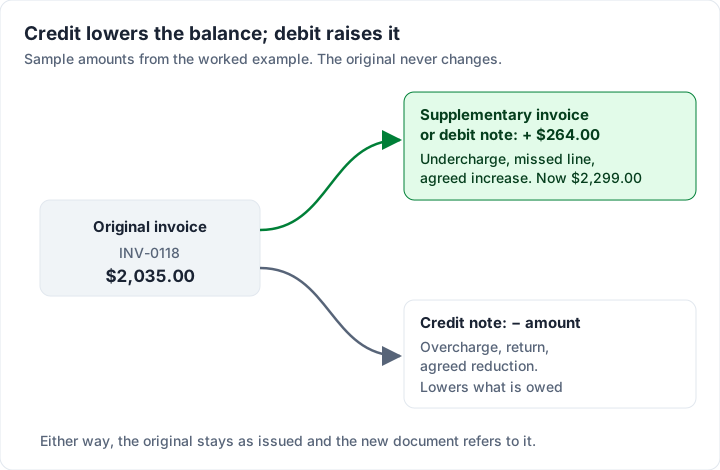
- It is the mirror image of a credit note. A credit note lowers what the client owes; a supplementary invoice or debit note raises it.
- Agree the extra amount with the client first. An undercharge you spot is not automatically money they agreed to pay.
- Leave the original invoice alone. Issue the new document with its own number and a clear reference back.
What a supplementary invoice is#
A supplementary invoice is an invoice that adds to an earlier one. It bills only the amount that should have been on the original but was not: a missed line, a price that was too low, tax at too low a rate, or an agreed increase after the invoice went out.
It is a full invoice in its own right, with its own number, date and payment terms, and it names the original invoice it supplements. The original stays exactly as it was issued. Together, the two show the correct total.
The term appears in tax guidance as well as in accounting. Paragraph 19.8 of HMRC’s VAT Notice 700, for example, mentions “issuing a supplementary invoice for the amount undercharged” (as of 23 October 2026).
Debit note, debit memo and supplementary invoice: the names explained#
Three names circle the same idea, and usage differs by country and by company:
| Name | What it usually means | Where you meet the term |
|---|---|---|
| Supplementary invoice | An extra invoice for an amount left off or undercharged | UK VAT guidance (section 19.8); India’s CGST Act (section 34) |
| Debit note | A document raising the amount owed on an earlier invoice | UK VAT guidance (section 18.2.4); India’s GST law (section 34) |
| Debit memo | A name some accounting systems and businesses use for a similar adjustment | Business practice, including in the US |
Sources: VAT Notice 700 sections 18.2.4 and 19.8; CGST Act, section 34.
You may also see the name used the other way round: some buyers send a supplier a document they call a debit note to record a deduction they are claiming. If a client sends you one, read what it does, not just its name, and check it against your own records.
In practice, many small businesses use a separate invoice clearly labelled as supplementary, unless their client or accountant asks for a document called a debit note.
When businesses issue one#
A supplementary invoice or debit note is the usual document when the client owes more than the original invoice asked for, and you both know it:
- A line was missed: materials, travel, an extra session, a rush fee that was agreed.
- The price was too low: the old rate, a wrong quantity, a discount that should not have applied.
- Tax was undercharged: the wrong rate, or tax left off a taxable line.
- The price went up by agreement after invoicing: extra scope approved after the invoice, or a final measurement higher than the estimate.
Two situations where it is not the right document:
- The client has not agreed the extra. Talk first. If the price was a fixed quote and the overrun is yours, the client may well decline it; what to do when the final price exceeds the estimate covers that conversation, and disputed invoices covers what happens when you disagree.
- You overcharged. That goes the other way: a credit note. Credit note vs invoice explains when and how.
A worked example: fixing an undercharge three ways#
The business, client and figures below are invented, and the 10% tax rate is an example, not the rate anywhere in particular.
Alder & Finch Joinery, a small workshop, built and fitted reception shelving for a client, Pinewood Physio. The accepted quote included $240.00 of hardwood edging and fittings. On Monday 5 October 2026, Alder & Finch sent this invoice, which Pinewood paid on Friday 9 October:
Invoice INV-0118, issued 5 October 2026
| Description | Qty | Rate | Amount |
|---|---|---|---|
| Reception shelving — design, build and fit | 1 | $1,850.00 | $1,850.00 |
| Subtotal | $1,850.00 | ||
| Tax (example rate, 10%) | $185.00 | ||
| Total | $2,035.00 |
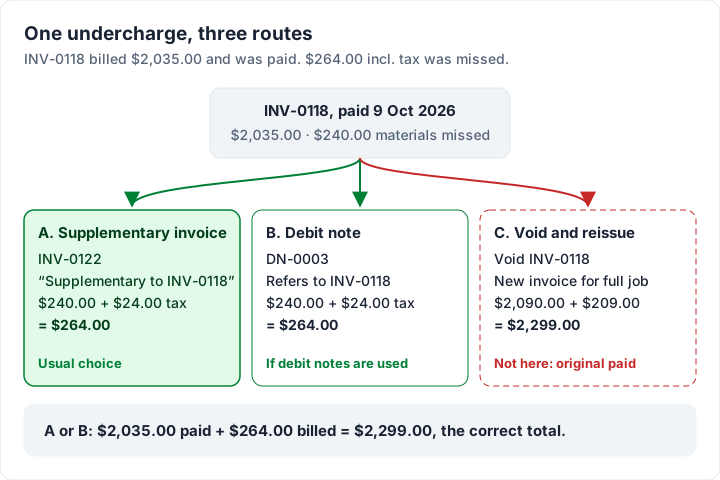
The $240.00 of materials is missing. On Wednesday 14 October, Alder & Finch spots it, emails Pinewood with the quote attached, and Pinewood agrees to pay the difference. The correct total was $1,850.00 + $240.00 = $2,090.00 before tax, plus $209.00 tax, or $2,299.00. Pinewood has paid $2,035.00, so $264.00 is still owed.
There are three ways to bill it:
| Route | Document | Amount | Works here? |
|---|---|---|---|
| A. Supplementary invoice | INV-0122, “Supplementary to INV-0118” | $240.00 + $24.00 tax = $264.00 | Yes. The usual choice, paid or unpaid |
| B. Debit note | DN-0003, referring to INV-0118 | $240.00 + $24.00 tax = $264.00 | Yes, where your tax system or client uses debit notes |
| C. Void and reissue | Void INV-0118, issue a replacement for the full amount | $2,090.00 + $209.00 tax = $2,299.00 | No. INV-0118 is already paid, so voiding it would misstate a paid invoice |
Route A is a common choice for small businesses, unless their client or accountant asks for something else. The supplementary invoice takes the next number in the normal invoice sequence, which in this example is INV-0122, because three other invoices went out in between. That is normal: invoice numbers follow the order invoices are issued, not the jobs they belong to. Invoice numbers: formats, gaps and examples explains why.
Route C only makes sense when the original is unpaid, has no payments against it and the client agrees. If you are registered for VAT or GST, check your tax authority’s rules (or ask your accountant) before voiding an invoice you have already sent. How to void an invoice, and when to cancel instead covers that route in full.
What a supplementary invoice commonly shows#
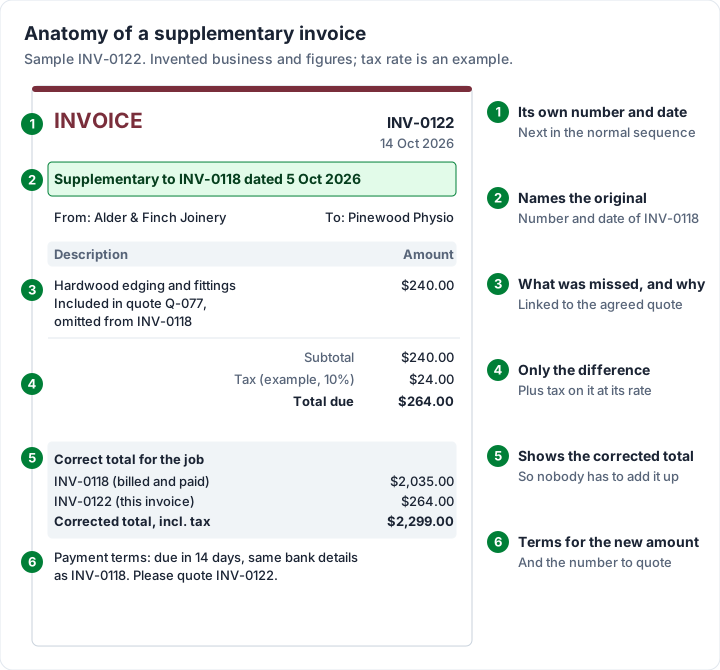
Everything a normal invoice shows, plus the link back to the original:
- A clear label, such as “Supplementary invoice” in the title or the first line: “Supplementary to INV-0118 dated 5 October 2026”.
- Its own number and date, from your normal sequence.
- The original invoice’s number and date. For UK VAT, paragraph 19.8 of VAT Notice 700 says (as of 23 October 2026): “If you issue a credit note or supplementary invoice to correct an error in a VAT invoice, it should bear a reference to the number and date of that VAT invoice and show clearly both the correct and incorrect amounts of VAT.”
- What was missed and why, in plain words: “Hardwood edging and fittings, included in quote Q-077, omitted from INV-0118.”
- Only the difference: the extra amount, any tax on it, and its total.
- If tax was wrong, many businesses show both the correct and incorrect tax figures, as the HMRC passage above describes for VAT.
- Payment terms for the new amount, and how to pay.
A short covering email helps the client’s accounts team. Our own sample wording, to adapt:
Hi Sam, as discussed, the hardwood edging and fittings from quote Q-077 were left off INV-0118. Attached is supplementary invoice INV-0122 for the $264.00 difference, including tax. INV-0118 stays as it is and is already paid, thank you. Payment terms are the same as before.
Supplementary invoices under GST and VAT#
Where you are registered for a consumption tax, the tax side of a correction has its own rules, and they differ by country. Three examples of where to look, quoted as of 23 October 2026:
India (GST)#
The Explanation to section 34 of India’s CGST Act says: “For the purposes of this Act, the expression "debit note" shall include a supplementary invoice.” (CGST Act, section 34). What a debit note contains is set out in Rule 53 of the CGST Rules. Read both, or ask your accountant, before you issue one.
United Kingdom (VAT)#
HMRC’s VAT Notice 700 (last updated 25 June 2026) covers both documents. Paragraph 18.2.4 begins: “To be valid for VAT purposes a debit note must:” and lists conditions and details, starting with “reflect a genuine mistake or undercharge or an agreed increase in the value of the supply, and be issued within 14 days of the increase being agreed between the supplier and the customer”. Paragraph 18.2.6 covers timing: “For increases in price this will be when the supplier and customer reach agreement over the increased value of the supply.” Paragraph 19.8 covers correcting VAT errors on invoices. Read the sections in full. Our guide to what HMRC lists for a UK VAT invoice quotes HMRC’s list for the original invoice, with a worked UK example.
European Union, the United States and elsewhere#
The European Commission’s VAT invoicing page lists among an invoice’s contents a “Specific, unambiguous reference to the initial invoice and the details that are being amended (on a credit note, debit note or other document treated as an invoice)”. The page also refers to “national rules set by the individual Member State”, so check with the tax authority concerned. If you undercharged US sales tax, check the rules of the state tax agency concerned. Anywhere else, your tax authority’s guidance is the place to look, and an accountant can point you to it.
For what changes once you are registered, tax invoice vs invoice lists the extra fields.
Debit note vs credit note vs invoice#
The three documents side by side:
| Invoice | Credit note | Supplementary invoice or debit note | |
|---|---|---|---|
| Direction | Creates the amount owed | Lowers it | Raises it |
| Typical cause | A sale or completed work | Overcharge, return, agreed reduction | Undercharge, missed line, agreed increase |
| Refers to an earlier invoice? | Not usually | Yes | Yes |
| Changes the original? | — | No | No |
| Own number? | Yes | Yes, often its own series | Yes; a supplementary invoice usually takes the next invoice number |
If the job is billed in stages, an increase can often wait for the next stage invoice instead, as a clearly labelled variation line. Progress invoicing explained shows how variations appear on stage invoices. For where all these documents sit among the other invoice types, see the types of invoices.
How to do this in Charming#
Charming Invoices has no debit-note document type and no “supplementary” invoice type. The workflow that works today is route A, as an ordinary invoice:
- Create a new invoice for the same client with one line for the difference, and make the first words of the description the reference: “Supplementary to INV-0118 dated 5 October 2026 — hardwood edging and fittings omitted”.
- Add the reason and the original total in the notes, and the client’s PO number in its own field if they use one.
- Issue it. It takes the next number in that business’s gapless sequence. Download the PDF or copy its private link and send it however you like.
- Record the payment when it arrives. Payments are recorded by you; Charming does not process them.
The limits, plainly:
- No debit notes or credit notes. If your tax system or your accountant calls for formal debit notes, use accounting or e-invoicing software that issues them.
- The document title label is set per business, so renaming it to “Supplementary invoice” would rename every invoice from that business. Keep the title as “Invoice” and put the word “Supplementary” in the first line instead.
- Issued invoices are locked against edits, so the original cannot be changed. For corrections this is what you want.
- One tax rate per invoice, set at the invoice level, so a correction that mixes tax rates needs separate invoices.
If you want this to be your invoicing from now on, you can create a free invoice in Charming. Free invoices carry a “Sent with Charming Invoices” line; paid plans hide it by default.
The short version#
When you undercharged, leave the invoice you sent as it is. Agree the extra with the client, then issue a supplementary invoice for the difference that names the original by number and date, says what was missed, and charges only the gap. Some tax systems call that document a debit note and set their own rules for it; the official pages linked above are where to check, and your accountant is the person to ask. Overcharges go the other way, with a credit note.
Related reading if you also sell goods abroad or need signed paperwork: the commercial invoice and do invoices need to be signed?