How to handle a disputed invoice

Nnabuike Okoroafor ·
On this page · 9 sections
You sent the invoice, and instead of a payment you got an email: “We have a problem with this.” A disputed invoice feels personal, especially when you did the work in good faith. Most of the time it is not a refusal to pay. It is a question about one line, one number or one assumption, and it can be settled in a few emails if you handle it in the right order.
This guide is written from your side, as the person who sent the invoice: what to ask, what to check, wording you can reuse, when to concede, and how to show a correction.
One line before we start: general information, not legal or tax advice. Contract, tax and debt-collection rules differ by country and by state, and they change. Where a rule matters, we quote and link the official source; for your own case, ask a lawyer or accountant.
Step one: find out exactly what is disputed#
“We are not happy with the invoice” is not a dispute you can answer. Before you defend anything, get three facts in writing:
- Which line or lines they are questioning.
- How much of the total that is.
- Why, in their words: the hours, the rate, the scope, the quality, a missing document.
Disputes often stall because nobody has said what the problem actually is. One consultant in a public online discussion described invoices that sat unpaid for months, and named the causes:
Usually happens with clients in financial strife, over leadership changes, or someone in the chain disputing the fee but no articulating it well.
(The people we quote come from public online discussions we researched. They are not Charming customers.)
A short, calm first reply does the work. Send it within a day or two:
Thanks for letting me know. So I can look into it properly, could you tell me which line or lines on invoice INV-0042 you are querying, the amount you think is wrong, and why? I will check my records and come back to you by Friday.
Do not argue, discount or apologise yet. You do not know what you are answering.
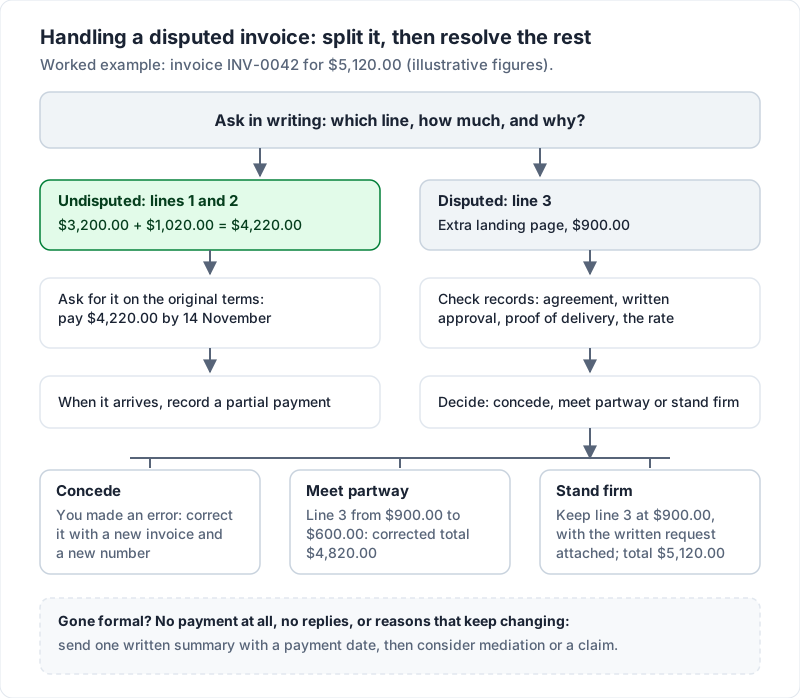
Once you have those three facts, the rest of this guide follows one shape: split the invoice, get the undisputed part paid, and resolve the disputed part on its own.
Separate the undisputed part and ask for it to be paid#
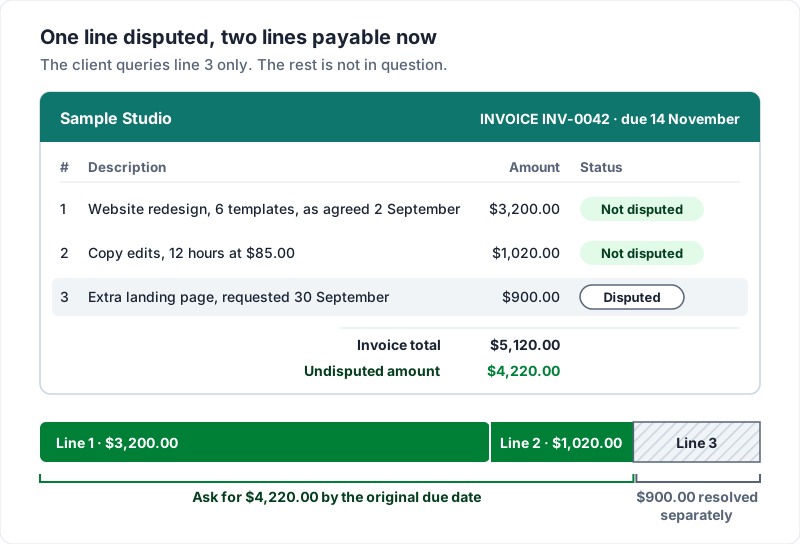
A disputed invoice is rarely disputed in full. If the client is questioning one line, the rest is not in question, and it is reasonable to ask for that part to be paid on the original terms while you resolve the remainder.
Here is a worked example (the figures are illustrative):
| Line | Description | Amount | Status |
|---|---|---|---|
| 1 | Website redesign, 6 templates, as agreed 2 September | $3,200.00 | Not disputed |
| 2 | Copy edits, 12 hours at $85.00 | $1,020.00 | Not disputed |
| 3 | Extra landing page, requested 30 September | $900.00 | Disputed |
| Invoice total | $5,120.00 | ||
| Undisputed amount | $4,220.00 |
Wording for the ask:
Thanks for confirming it is only the extra landing page (line 3, $900.00) you are querying. While we sort that out, could you pay the undisputed $4,220.00 by the original due date of 14 November? I will come back to you on line 3 separately.
Whether a client has to pay the undisputed part is a question for your contract and a lawyer, not this post. Many business contracts include a clause on it: raise a dispute in writing within a set time and pay the rest on time. If yours does, quote it. If it does not, ask anyway, politely. A client genuinely querying one line has little reason to hold back the rest.
When the undisputed part arrives, record it as a partial payment against the invoice so your own records stay straight.
Check your records before you reply#
Your reply is only as good as what you can point to. Before you write it, gather:
- The agreement: contract, statement of work, proposal or the email thread where the price and scope were agreed.
- Written approval of anything extra: the email or message where the client asked for, or agreed to, the work they are now querying.
- Proof of delivery: files sent, sign-off messages, timesheets, site photos, delivery notes.
- The rate: what you agreed per hour, day or item, and whether it changed.
- Their paperwork: a purchase order number or supplier reference they asked you to include.
- The invoice itself: re-read it as a stranger would. Check the arithmetic, the tax line, the dates and who it is addressed to.
Be honest with yourself here. Sometimes the client is right, and it is better to find that out now than after three combative emails.
Why invoice disputes happen, and the invoice line that prevents each#
Most disputes trace back to something the invoice did not say clearly. The fix is usually a better line next time.
| Cause | What the client says | Clearer invoice line |
|---|---|---|
| Vague line items | “What is ‘design services’?” | “Brand identity: 3 logo concepts, 2 revision rounds” |
| Scope changes | “That was not in the original price.” | “Extra landing page, requested by email 30 September (change 1)” |
| Missing PO number | “Our system cannot pay this.” | “PO 7781-B” in the header, on every invoice |
| Wrong hours or rate | “We agreed $85, not $95.” | “12 hours at $85.00, timesheet attached” |
| Wrong entity or address | “This is not our company name.” | The exact legal name they gave you |
| Quality or delivery complaint | “It arrived late and needed rework.” | Delivery and sign-off dates on the line |
Scope changes cause the most heat, because both sides remember the conversation differently. One freelancer in a public discussion put the problem in a sentence:
I recently completed a large project for a client which exceeded my original estimate for the whole thing and the client is refusing to pay anything over the estimate.
The prevention is unglamorous: price the change when it is asked for, get a yes in writing, and name that change on the invoice. If you work in trades, what a contractor invoice should show covers labour, materials and change orders line by line. If your client runs purchase orders, read where the PO number goes on an invoice before the next one.
A common variant: “Can you break down this fixed fee?” If you agreed a flat price for a defined result, you can describe what was delivered against the agreed scope rather than reveal your hours or costs, unless the agreement says otherwise. Itemising a fixed fee after the fact tends to invite haggling over a price that was already agreed. Our itemized invoice guide covers how to answer that request, with one job invoiced three ways.
How to reply to a client who disputes an invoice#
Whatever you decide, the reply follows the same shape: thank them, restate the specific point, give your answer with evidence, say what happens next, and give a date. Three versions you can adapt:
When they are right (you made an error):
You are right, and thank you for catching it. Line 2 should have been 9 hours of copy edits, not 12. I have cancelled INV-0042 and attached INV-0043 with the corrected total of $4,865.00. The due date stays 14 November.
When you stand by the charge:
I have checked this against our agreement. The extra landing page was requested in your email of 30 September (attached), and I confirmed the $900.00 price the same day before starting. So I am keeping line 3 as invoiced. If you see it differently, I am happy to get on a short call this week.
When you meet them partway:
I have looked at this again. The extra page was requested in writing, but I accept the turnaround was slower than we discussed. I can reduce line 3 from $900.00 to $600.00 as a one-off. I will send a corrected invoice for $4,820.00, due on the original date of 14 November.
Keep the tone factual, even if theirs was not. If a call happens, follow it with an email summarising what was agreed.
Concede, correct or stand firm: a decision checklist#
| If this is true | Usually the right move |
|---|---|
| You made a clear error (arithmetic, hours, rate, wrong client) | Correct it promptly, without a long apology |
| The charge is agreed in writing and the work was delivered | Stand by it, politely, with the evidence attached |
| The extra work was agreed verbally only | Consider a partial concession, and get changes in writing next time |
| There is a genuine quality problem | Offer a fix, a reduction or both, and agree it in writing |
| The amount is small next to the relationship | A goodwill reduction can be worth it, as a choice rather than a reflex |
| The “dispute” appeared only after you chased payment | Treat it as a late payment with a reason attached, and keep following up |
How a corrected invoice or credit should be shown#
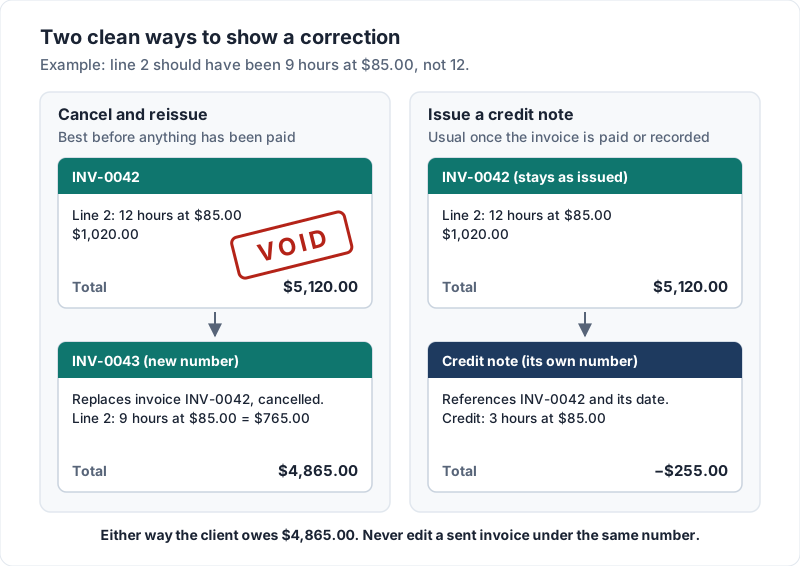
The one thing not to do: edit a sent invoice quietly and resend it under the same number. Your client may already have the original in their accounts system, and two different documents with one number is how small disputes become long ones.
The two common, clean approaches:
- Cancel and reissue. Mark the original as cancelled (void), then issue a new invoice with a new number. On the new invoice, say what it replaces: “Replaces invoice INV-0042, cancelled. Line 2 corrected from 12 to 9 hours.” This works best before anything has been paid. Voiding or cancelling an invoice covers the steps and what each does to your numbering.
- Issue a credit note. Leave the original invoice standing and issue a separate document that credits the agreed amount, referencing the original invoice number. This is the usual route once an invoice has been paid or recorded, or where tax rules expect it.
Here are both, using the copy-edits error from the example: line 2 billed at 12 hours instead of 9.
Which one you need can depend on your tax position. As one example, the UK tax authority’s VAT guide (Notice 700, section 18.2) says, as of 23 October 2026: “When you allow a credit or contingent discount to a customer who can reclaim all the tax on your supply as input tax, you do not have to adjust the original VAT charge provided both you and your customer agree not to do so. Otherwise, you should both adjust the original VAT charge. You should issue a credit note to your customer and keep a copy.” The same section lists what a credit note must show to be valid for VAT. Other countries set their own rules. If you are registered for VAT, GST or sales tax, check your tax authority’s guidance or ask an accountant once. The difference between the two documents is covered in credit notes vs invoices.
What Charming does here, and what it does not#
In Charming Invoices, an issued invoice is locked: it cannot be edited or deleted. To correct one, an owner or admin voids it and you issue a new one. A voided invoice stays on record with its number intact, and its private link stops opening for the client. Duplicate copies the client and line items into a new draft for you to correct, and it takes the next invoice number when you issue it. Charming does not email the corrected invoice for you: download the PDF or copy its private link and send it with your note to the client. The purchase order number is not copied, so add it again, and use the notes to say which invoice it replaces. You can also record a partial payment when the undisputed part arrives.
The catches. Charming has no credit note feature, so a credit against a paid invoice has to be handled outside the app. An invoice with a recorded payment cannot be voided until you remove those payments (Mark as unpaid), so decide whether you are reissuing before you record a partial payment. Charming does not send reminders, so nothing chases a disputed invoice while you talk it through. Payment tracking is manual, and clients cannot pay by card from the invoice.
When a disputed invoice becomes a formal dispute#
Most queries end with a corrected invoice or a payment. It has become something more formal when:
- the client refuses to pay any of it, including lines they have not questioned;
- they stop replying, or the reason keeps changing;
- they have stated a final position in writing and you disagree with it.
At that point, stop renegotiating line by line. Send one clear written summary: what was agreed, what was delivered, what is owed, what you will accept, and a date for payment. Keep a copy of everything.
What comes after that depends on where you and your client are, and the process varies by country and court. Two official pages, quoted as of 23 October 2026, to show the shape rather than the rules for your case:
- In England and Wales, GOV.UK’s guide to making a court claim for money says: “A mediation service could be quicker and cheaper than going to court.”
- In California, the courts’ self-help guide on writing a demand letter says asking for payment “is a step you must take before filing a small claims court case”.
If the amount is significant, talk to a local lawyer or advice service before you escalate. What to do when a client is not paying an invoice walks through the escalation steps in order, and if the invoice is late but nobody is disputing it, the overdue invoice email, step by step has the follow-up wording.
The short version#
- Ask which line, how much and why, in writing.
- Ask for the undisputed part to be paid on time.
- Check the agreement, the approvals and the invoice before replying.
- Reply with the specific point, your evidence, the next step and a date.
- Correct genuine errors fast, with a new invoice or a credit note that references the original.
- Never edit a sent invoice in place under the same number.
- Fix the cause on the next invoice: name the scope, the change and the PO.
A clear invoice will not prevent every dispute, but it gives both of you the same document to point at. If you want invoices where every line, PO number and note is printed exactly as you wrote it, create a free invoice.