Commercial invoice: what it is and how to fill one out

Nnabuike Okoroafor ·
On this page · 13 sections
You make things, and someone in another country wants to buy them. The order is agreed, the box is packed, and then the courier’s website asks for a commercial invoice. Suddenly there are fields you have never filled in: HS code, country of origin, Incoterms, gross weight.
This guide explains what a commercial invoice is, what customs actually uses it for, and which fields are commonly requested, with links to the official sources. It walks through a filled example for one real-sized shipment, points to Canada’s own published requirements, and is honest about when the carrier’s own form is the quicker route.
In short#
- A commercial invoice is the sale invoice for goods crossing a border. The US International Trade Administration describes it as the document customs in the buyer’s country uses to assess duties and taxes.
- It carries more than a normal invoice: a detailed description of the goods, an HS code, the country of origin, quantities and weights, the terms of sale (often an Incoterm), the currency and every charge.
- The seller or exporter prepares it. It travels with the goods, and the buyer’s customs broker or the carrier uses it to clear them.
- If you only sell services, you will rarely need one. Nothing physical crosses the border.
- Many carriers offer a tool that helps build one while you book the shipment. For regular exports, that or a customs broker is often easier than building your own.
This is general information, not legal, tax or customs advice. Customs rules differ by country and change, sometimes quickly. Where this guide quotes an official page, that page was read on 23 October 2026. Check the current rules for your destination with the customs authority, your carrier or a licensed customs broker before you ship.
What a commercial invoice is#
A commercial invoice is the invoice for a sale of goods that are being shipped internationally. It records who sold what to whom, at what price, on what terms, and it goes with the shipment so customs can see the transaction.
The US International Trade Administration describes it as “a required document for the export and import clearance process” and says that in the buyer’s country it is “the document that is used by their customs officials to assess import duties and taxes” (trade.gov, Commercial invoice, read 23 October 2026).
In other words, it is still an invoice: a request for payment for a sale. What an invoice is and what it does covers the basics that apply to every invoice. What makes it “commercial” is the extra detail customs needs to classify the goods, value them and check where they were made.
Who prepares it#
The seller, or whoever exports the goods for the seller. The buyer, or their customs broker, then uses it to clear the goods on arrival. Many forms also ask for the name and contact details of the person who prepared it.
Where it sits among the shipping documents#
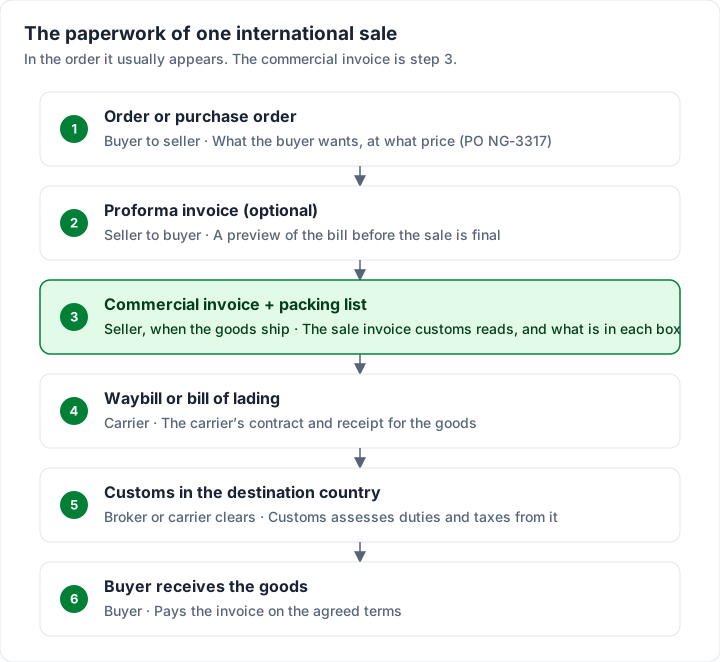
A commercial invoice is one of several papers that move with an export. Each has a different job:
| Document | Who prepares it | What it is for |
|---|---|---|
| Proforma invoice | Seller, before the sale is final | A preview of the bill, so the buyer can approve or pay against it |
| Commercial invoice | Seller or exporter, when the goods ship | The sale invoice customs uses to value and classify the goods |
| Packing list | Seller | What is in each package, by count and weight |
| Waybill or bill of lading | Carrier | The contract of carriage and receipt for the goods |
| Certificate of origin | Seller, sometimes certified by a chamber of commerce | Shows where the goods were made, when the buyer or customs asks for one |
How a proforma differs from the commercial invoice, and when each one is sent, is covered in detail in proforma invoice: meaning and examples. For the domestic paper trail of a sale, from quote to delivery note, see sales order vs sales invoice.
When you need one, and when you do not#
Carriers commonly ask for a commercial invoice when you ship goods you have sold to a buyer in another country. Your carrier’s own pages set out when it wants one on your route, so check them before you book.
Situations where you may need something else instead:
- You sell services only. Design, consulting, writing, software and coaching are not boxes in a van. An ordinary invoice is the usual document; sales invoice vs service invoice explains the difference.
- You are sending something that is not a sale. Free samples, gifts and replacements have no sale price. Carriers commonly still ask for a document declaring their value, often called a proforma or substitute invoice. Ask your carrier or broker what the destination expects.
- You are shipping within your own country. There is usually no customs border to cross, so your ordinary invoice does the job. Between countries that share customs arrangements, ask your carrier what it needs.
A note on low-value parcels#
Rules for low-value shipments have been changing in several countries, including the United States. Read the destination’s customs authority (for the US, CBP’s import and export pages), or ask your carrier or broker, on the day you ship.
Fields commonly requested on a commercial invoice#
There is no single worldwide format. Each country sets its own requirements, and some want their own form, a particular language or certified copies. Rules vary by country, so the list below is a general checklist of fields that are commonly requested, not a statement of what any one country requires. Ask your buyer’s customs broker or your carrier what the destination wants.
| Field | Why it is commonly asked for |
|---|---|
| Seller, buyer and consignee, with addresses | Customs and the carrier need to know who is selling to whom and where the goods go |
| Invoice number and date | A reference that matches the other shipping documents |
| Detailed description of the goods | Plain wording, including material, use and condition, helps the goods be classified |
| HS code | The shared classification number for traded goods; trade.gov says including it can speed up export clearance |
| Quantity, unit price and total | The basis for the declared value |
| Currency | So the value is clear |
| Country of origin | Where the goods were made |
| Terms of sale (for example an Incoterm) and payment terms | Shows who arranges and pays for what |
| Freight, insurance, packing and other charges | Shown on their own lines so the value of the goods is clear |
| Number of packages and weights | Should match the packing list and the waybill |
| Name and contact details of the person who prepared it | Someone who can answer questions about the shipment |
Where to read the official requirements: the International Trade Administration’s commercial invoice page, the UK government’s export goods guidance, the Canada Border Services Agency (CBSA) import pages, and, for goods entering the United States, the customs regulation on invoice contents published on eCFR. Other countries publish their own; search the destination’s customs authority. The table is a summary of common practice, so read the source for the exact wording.
If the buyer gave you a purchase order number, put it on the invoice too. Their customs broker and their accounts team will both look for it. What a PO number is and where it goes covers the reasons.
HS codes, country of origin and Incoterms, briefly#
These three are what make a commercial invoice look unfamiliar. Each one has a short, plain explanation.
HS codes#
The Harmonized System (HS) is the shared classification for traded goods. The World Customs Organization says it covers “more than 5,000 commodity groups; each identified by a six digit code” and is used by more than 200 countries and economies (WCO, read 23 October 2026).
Countries that use the HS usually add their own digits for their own tariff, so look the code up in the destination country’s tariff. The International Trade Administration’s HS codes page is a good starting point, and its commercial invoice page says including the HS code “can speed up the export clearance process”. If you are unsure, ask your buyer’s customs broker or the customs authority.
Country of origin#
In everyday terms, country of origin is about where the goods were made, not where they were shipped from. The rules for working it out differ by country, especially for goods made from imported parts or bought in and resold, so ask your broker if it is not obvious for your goods.
Incoterms#
Incoterms are standard trade terms published by the International Chamber of Commerce (ICC). The ICC describes its Incoterms rules as “a set of eleven three-letter trade terms, reflecting business-to-business practice in contracts for the sale and purchase of goods” (ICC, Incoterms rules, read 23 October 2026). On an invoice, the term is usually written with a named place and the edition the parties agreed, for example “DAP Vancouver, Incoterms 2020”.
This guide does not explain what each term means for who arranges, pays for and carries the risk of each stage, because the exact allocation matters and the ICC publishes the rules itself. Read the ICC’s guidance, or ask your carrier or customs broker, before you choose a term. Payment terms and ownership of the goods are separate points to set out in your sale terms.
A filled commercial invoice example#
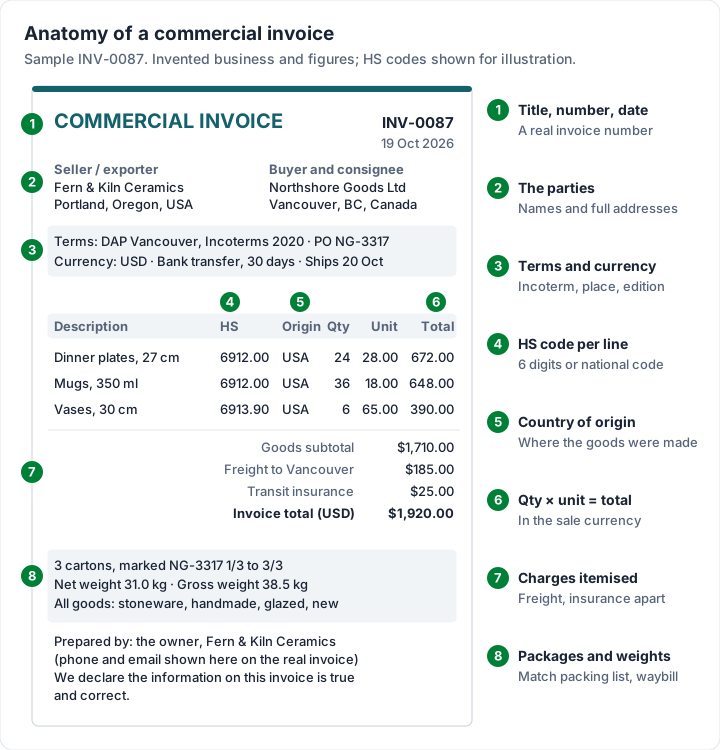
Here is one shipment, end to end. The business, the buyer and every figure are invented for illustration. The HS codes are shown only to illustrate the format and may not be right for real goods: look up the code for your own goods and ask a broker if unsure.
Fern & Kiln Ceramics, a two-person studio in Portland, Oregon, sells handmade stoneware to Northshore Goods Ltd, a shop in Vancouver, Canada. Northshore sent purchase order NG-3317. The two businesses agree in their sale terms that Fern & Kiln delivers to Vancouver and pays the freight, and that Northshore handles import clearance and any Canadian duties and taxes. They write the Incoterm they chose on the invoice as DAP Vancouver; that choice is illustrative, so check the ICC rules for what any term means before you use it.
Commercial invoice INV-0087, dated Monday 19 October 2026, goods shipped Tuesday 20 October 2026. Currency: US dollars. Terms: DAP Vancouver, Incoterms 2020; payment by bank transfer within 30 days.
| Description | HS code | Origin | Qty | Unit value | Total |
|---|---|---|---|---|---|
| Handmade stoneware dinner plates, 27 cm, glazed, new | 6912.00 | USA | 24 | $28.00 | $672.00 |
| Handmade stoneware mugs, 350 ml, glazed, new | 6912.00 | USA | 36 | $18.00 | $648.00 |
| Decorative stoneware vases, 30 cm, ornamental, new | 6913.90 | USA | 6 | $65.00 | $390.00 |
| Goods subtotal | $1,710.00 | ||||
| Freight to Vancouver (paid by seller) | $185.00 | ||||
| Transit insurance | $25.00 | ||||
| Invoice total | $1,920.00 |
Check the arithmetic: 24 × $28.00 = $672.00; 36 × $18.00 = $648.00; 6 × $65.00 = $390.00. Those make $1,710.00, and adding $185.00 freight and $25.00 insurance gives $1,920.00.
Below the lines, the invoice also states: 3 cartons, marked “NG-3317 1/3” to “3/3”; net weight 31.0 kg, gross weight 38.5 kg; exporter Fern & Kiln Ceramics; invoice prepared by the owner, with a phone number and email; and a short declaration that the information is true and correct. Freight and insurance sit on their own lines so the value of the goods is clear rather than buried in the unit prices; ask your broker how the destination wants charges shown.
Here is the same invoice with each part labelled:
How to fill out a commercial invoice, step by step#
- Check the destination’s rules first. Ask your buyer, your carrier or a customs broker whether the country wants a particular form, language, number of copies or certification.
- Start from your normal invoice. Your business details, the buyer’s, an invoice number from your normal sequence and the date. A commercial invoice is a real sale invoice, so it takes your next invoice number. How to number invoices covers sequences.
- Add the consignee if the goods go to someone other than the buyer, such as a warehouse.
- Describe each item precisely. What it is, what it is made of, what it is for, and its condition. “Stoneware mug, 350 ml, glazed, new” beats “gift” or “merchandise”.
- Add the HS code and country of origin to each line.
- Give quantity, unit value and line total in the currency of the sale, and state the currency.
- List every other charge on its own line: freight, insurance, packing, commissions.
- State the terms of sale: the Incoterm, the place and the edition, plus your payment terms.
- Add the packing details: number of packages, their marks, net and gross weight. Match the packing list and the waybill exactly.
- Name the person who prepared it and how to reach them. If your carrier asks for a signature or a declaration, add it.
- Print and attach the copies your carrier asks for, or upload it in their shipping tool, and keep your own copy. How long to keep export paperwork is set by each country; for UK exporters, GOV.UK’s export goods guidance covers it.
Commercial invoices for Canada#
Canada is a common first export market for US sellers. The Canada Border Services Agency (CBSA) publishes its own import guidance and a form, the Canada Customs Invoice (CBSA, CI1). Read CBSA’s import pages, or ask your buyer’s customs broker, for what applies to your shipment today. Other countries publish their own requirements on their customs authority’s website.
Carrier forms vs your own commercial invoice#
You do not have to design a commercial invoice from scratch. Most major carriers offer commercial invoice templates or guidance, and many of their online shipping tools can build one from the details you enter when you book the label. What they offer varies by carrier and by country, so check your carrier’s own pages for your route.
| Route | Good for | Watch out for |
|---|---|---|
| Carrier’s online tool | Occasional parcels; it fills in fields as you book | It only knows what you type; descriptions and codes are still your job |
| Carrier’s blank template | Shipping by a carrier that wants its own layout | Re-typing your sale details by hand |
| Your own invoice with the extra fields | Buyers who want one document that is both their bill and the customs invoice | It is on you to include every field the destination asks for |
| A customs broker | Regular exports, regulated goods, high values | A fee, but they know the destination’s rules |
Whichever you use, the numbers must agree. The value on the carrier’s form, your invoice to the buyer and the packing list should tell the same story.
Commercial invoice vs proforma invoice and packing list#
Three documents, often confused:
- Proforma invoice: sent before the sale is final, so the buyer can approve, pay or arrange an import licence. Not a bill. Proforma invoice: meaning and examples has the full comparison.
- Commercial invoice: the actual sale invoice, prepared when the goods ship. A bill, and the customs document.
- Packing list: what is in each package. No prices needed. Some countries want the contents of each package shown on the invoice or an attached list; ask your carrier or broker.
Two more documents sometimes travel with goods and get mixed up with invoices. A bill of lading is the carrier’s document, and a bill of sale records a transfer of ownership. Bill of sale vs invoice explains that one. If you later find you undercharged the buyer, the fix is a separate document, not an edit: see supplementary invoices and debit notes. For the other kinds of invoice and when each is sent, see the types of invoices.
Making a commercial invoice in Charming, and its limits#
Charming Invoices is built for invoicing clients, not for customs. It can produce a clean, branded commercial invoice for an occasional shipment, but it has no customs fields, so be clear about what you are getting.
What works:
- The title. You can rename the document title label, up to 60 characters, so the heading reads “Commercial invoice”.
- Lines with units. Each line has a description, quantity, unit and rate, so “Stoneware mug, 350 ml” with “36 pcs” reads properly.
- The buyer’s PO number in its own field, plus free-text notes and terms printed on the invoice.
- 16 currencies, including USD, CAD, GBP and EUR, with your next invoice number assigned when you issue it.
- Freight and insurance as their own line items, so they show separately from the goods.
What it does not do:
- No HS code, country of origin, weight, package or Incoterms fields. You would type the HS code and origin into each line’s description, and the Incoterm, weights and package count into the notes. That works on paper, but nothing is checked or structured.
- The title label is set for the whole business, not per invoice. Rename it to “Commercial invoice” and every invoice from that business says so until you change it back.
- The currency is set per business, not per invoice or client.
- No shipping charge field and one invoice-level tax rate, so tax-inclusive freight or several tax rates will not fit neatly.
- No connection to any carrier. It does not create labels, waybills or customs filings.
If you ship abroad every week, use your carrier’s tool or a customs broker. If you ship now and then and want the buyer’s bill to look like your business, you can create a free invoice in Charming and put the customs details in the descriptions and notes. Free invoices carry a “Sent with Charming Invoices” line; paid plans hide it by default. Payments from abroad are covered in invoice payment methods, and tax invoice vs invoice explains the separate VAT and GST rules on your own invoices.
Questions people ask about commercial invoices#
Is a commercial invoice the same as a normal invoice?#
It is a normal sale invoice with extra detail for customs: HS codes, origin, terms of sale, weights and itemised charges. If you sell goods abroad, one document can be both your bill to the buyer and the customs invoice.
Does a commercial invoice need to be signed?#
That depends on the carrier and the destination. Some ask for a signed declaration or signed copies, so check their instructions for your route. For ordinary invoices, see do invoices need to be signed?
What currency should a commercial invoice be in?#
The currency of the sale, stated clearly on the invoice. Some destinations ask for a specific currency, so check with your broker or the customs authority.
Who pays the duties?#
That depends on the terms of sale you and the buyer agreed. Settle it before you ship and write the agreed terms on the invoice.
Can I write “gift” to avoid duty?#
No. Describe a sale as a sale: customs declarations should be accurate. How genuine gifts are treated differs from country to country, so ask a broker or the customs authority.
The short version#
A commercial invoice is your sale invoice with the details customs commonly asks for: a precise description, HS code and country of origin for each line, values in the sale currency, charges on their own lines, the terms of sale, and package counts and weights. Check the destination’s rules with its customs authority or a broker before you ship, keep the numbers consistent across every document, and keep a copy. For occasional parcels, the carrier’s tool is often the fastest route; for regular exports, a customs broker earns their fee.