Bill of sale vs invoice: which one you need, and when

Nnabuike Okoroafor ·
On this page · 10 sections
You are selling something bigger than a job: an old work van, a trailer, a kiln, the camera kit you are upgrading from. The buyer asks for a bill of sale. Your bookkeeper asks for an invoice. Are they the same thing, and if not, which one do you actually need?
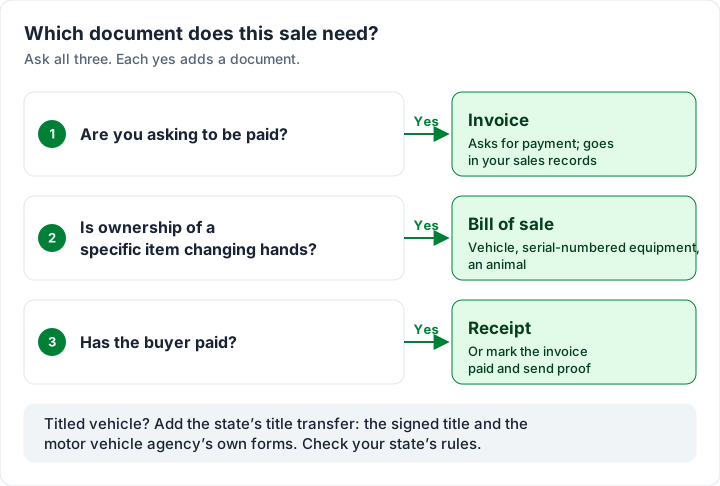
They are different documents with different jobs. An invoice asks for payment. A bill of sale records that ownership passed from you to the buyer. Plenty of sales need only one; some need both, plus a receipt. This guide explains each, puts them side by side, and walks through one sale of a used work van to show which document goes to whom.
In short#
- An invoice asks for payment. It records what was sold, for how much, and when it is due. It goes in your sales records.
- A bill of sale records a transfer of ownership. Cornell’s Legal Information Institute calls it “a written instrument that attests to a buyer’s purchase of property from a seller” (LII, Bill of sale).
- A receipt confirms payment. It is neither of the other two.
- In practice, most everyday sales use only an invoice, or only a receipt. A bill of sale earns its place for vehicles, equipment, animals, business assets and private sales of anything valuable.
- Vehicles have their own paperwork. Each state's motor vehicle agency sets what it wants, so check its page before the sale.
This is general information, not legal or tax advice. It is written mainly for readers in the United States, where these rules are set state by state. Where it quotes an official page, that page was read on 23 October 2026. Check your state’s rules with your motor vehicle agency, or ask a lawyer for anything high-value or unusual.
What a bill of sale is#
A bill of sale is a written record that a seller transferred a specific item to a buyer. Its job is to prove the change of ownership: who sold it, who bought it, what it was, when it changed hands and on what terms.
Cornell’s LII says a bill of sale “generally includes the transacting parties’ contact information, a description of the item sold”, along with any warranties, conditions, the date of transfer, the price, any payment schedule “and the parties’ signatures” (LII, read 23 October 2026). It adds that where ownership does not depend on physical possession, buyers lacking physical possession “may use a bill of sale as proof of their ownership rights”.
Whether a bill of sale is required, and when ownership passes, depends on the state and on the kind of item, so ask your state agency or a lawyer about anything high-value.
What an invoice is, briefly#
An invoice is a request for payment. It lists what you sold or did, the price, any tax, the total, and when and how to pay. It creates a record in your books that the buyer owes you money, and it is the document a business buyer files to pay you. What an invoice is and what it does covers it in full.
An invoice says nothing about ownership. It can be sent before the buyer has the item, and the item can change hands before the invoice is paid. On its own it is also not the agreement: how an invoice and a contract differ explains where the obligation to pay actually comes from.
Bill of sale vs invoice side by side#
The table compares the three documents most often confused in a sale of goods:
| Invoice | Bill of sale | Receipt | |
|---|---|---|---|
| Main job | Asks for payment | Records the transfer of ownership | Confirms payment was received |
| When it is issued | Before or at delivery, or after | At handover, often once paid | When the money arrives |
| Who signs | Usually nobody | Usually the seller, often both | Usually nobody |
| Proves ownership? | No | It is evidence of it | No |
| Proves payment? | No, it asks for it | Only if it says the price was paid | Yes |
| Who keeps it | Both; the seller’s sales record | The buyer, mainly; the seller keeps a copy | The buyer |
If the question you really have is about the word “bill”, the difference between an invoice and a bill covers every meaning, and the difference between invoice and receipt covers proof of payment in detail.
When you need both#
Use both when the sale needs a payment record and an ownership record. In practice that is:
- Vehicles, trailers and boats. Check with your state’s motor vehicle agency: many ask for a signed title, and some also ask for a bill of sale. Your books want an invoice if you are a business.
- Equipment and machinery sold by a business. The invoice records the sale for your accounts; the bill of sale gives the buyer proof they own a specific item, identified by serial number.
- Business assets sold privately, such as a food truck’s kit or a studio’s furniture, where the buyer may later need to show where they got it.
- Anything sold “as is”. A bill of sale is the natural place for the condition and warranty wording, signed by both sides.
For an ordinary sale of goods or a service you deliver, an invoice and, if wanted, a receipt are enough. Nobody needs a bill of sale for a box of business cards. For the ordinary paper trail of a sale, from quote to delivery note, see the paper trail of a sale. If you sell on eBay, an eBay invoice is a payment request inside eBay and the buyer's record of the purchase is their order details; our guide to sending an invoice on eBay explains both. For selling original artwork, the artist invoice template covers what the invoice for a painting or print should say.
A worked example: selling a used work van#
The business, buyer, dates and figures below are invented for illustration. Sales and use tax on vehicles is handled differently in each state, so it is left out here; check how your state collects it.
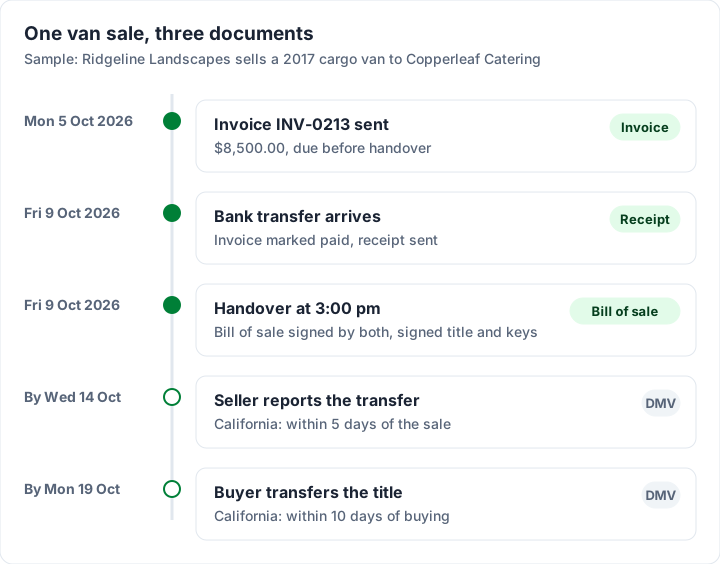
Ridgeline Landscapes LLC, a small landscaping company in California, is replacing its 2017 cargo van and agrees to sell the old one to Copperleaf Catering for $8,500.00, as is, paid in full before handover.
| Date | Document | From → to | What it does |
|---|---|---|---|
| Mon 5 Oct 2026 | Invoice INV-0213, $8,500.00, due before handover | Ridgeline → Copperleaf | Asks for the money and records the sale in Ridgeline’s books |
| Fri 9 Oct 2026 | Bank transfer of $8,500.00 | Copperleaf → Ridgeline | Payment |
| Fri 9 Oct 2026 | Invoice marked paid, receipt sent | Ridgeline → Copperleaf | Proof of payment |
| Fri 9 Oct 2026 | Bill of sale, signed by both, plus the signed title and keys | Ridgeline → Copperleaf | Proof that ownership passed, as is, at a stated date and time |
| By Wed 14 Oct 2026 | Report of the transfer to the DMV | Ridgeline → DMV | California gives sellers 5 days |
| By Mon 19 Oct 2026 | Title transfer into Copperleaf’s name | Copperleaf → DMV | California gives buyers 10 days |
The two deadlines in the table come from the California DMV, which says buyers “have 10 days after purchasing the vehicle to transfer ownership from the seller to themselves, and sellers have 5 days after the sale to report the transfer of ownership to DMV” (California DMV, private-party sales, read 23 October 2026). Other states set their own deadlines, and the DMV’s rules can change, so check your own state’s page.
Who needs which piece of paper afterwards:
| Who | Needs | Why |
|---|---|---|
| Copperleaf (buyer) | Signed title, bill of sale, receipt | To register the van and prove they own it and paid for it |
| Ridgeline (seller) | Copy of the invoice and bill of sale, payment record | Sales records, and proof of when the van left its hands |
| The DMV | The signed title and its own forms, plus a bill of sale where it asks for one | To record the new owner |
| Ridgeline’s bookkeeper | The paid invoice | To record the sale of a business asset |
What to put on a bill of sale#
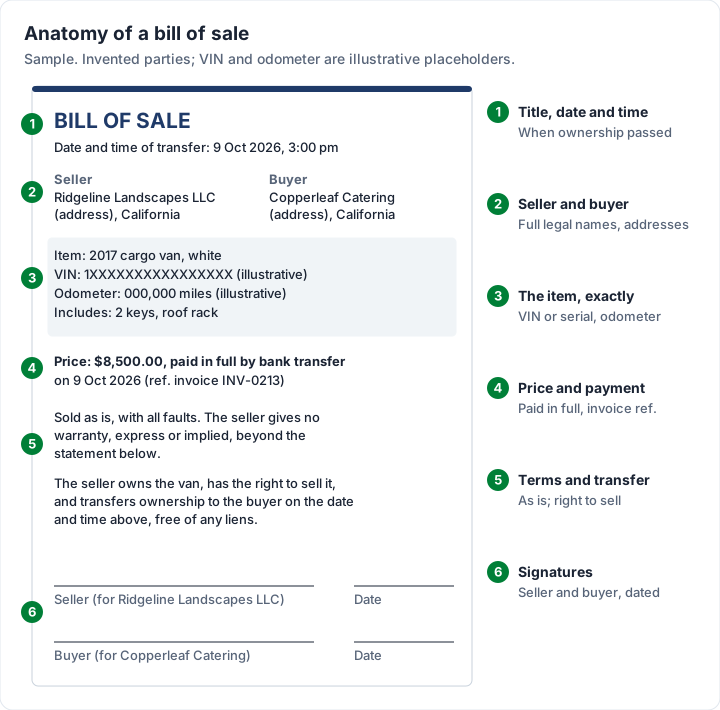
There is no single national format. A clear bill of sale usually covers:
- The words “Bill of sale” and the date and, for a vehicle, the time of the transfer.
- The seller and the buyer: full legal names and addresses. If a business is selling, use its legal name.
- The item, identified precisely: make, model, year, colour, and a serial number or, for a vehicle, the VIN and odometer reading.
- The price, and whether it has been paid in full, in part or on a schedule.
- The terms: any warranty, or a clear statement that there is none (see below), and any conditions.
- A statement that the seller transfers ownership to the buyer and has the right to sell.
- Signatures of the seller and, ideally, the buyer, with printed names.
Here is the bill of sale from the example, labelled. Its wording is a sample to show the parts, not a legal template:
“As is” wording#
Sellers of used equipment often sell “as is”. What that wording does depends on the state and on who is selling, so do not assume it covers everything. Say plainly in the bill of sale what condition the item is sold in and whether any warranty is given, and have the wording checked by a lawyer or your state agency if the sale matters.
Vehicles: bill of sale vs title, using California as an example#
For a titled vehicle, the state’s motor vehicle agency decides what paperwork it wants. California is one example, not a rule for everywhere; the quotes below are from its pages as read on 23 October 2026:
- The title is on the list. The DMV's list of what a buyer needs includes “The vehicle’s title (sometimes referred to as a pink slip), signed by the person selling the car.”
- A bill of sale is needed in particular cases. The DMV says: “If the seller is not the owner whose name is on the title, you will need a Bill of Sale signed by both the seller and the person whose name appears on the title” (California DMV).
- A clear bill of sale may be accepted. The DMV’s registration procedures manual says a bill of sale “generally refers to a DMV form, but any bill of sale that identifies the vehicle/vessel is acceptable” (DMV manual, section 1.020). That manual is written for the vehicle industry, so ask the DMV what it wants for your own sale.
So in the example, ask the DMV what it wants for this sale. Whatever it asks for, both sides can still want a bill of sale as a matter of practice: it fixes the price, the as-is terms and the moment the van stopped being Ridgeline’s problem. Other states have their own forms, deadlines and rules, so use your state agency’s own form where it has one.
Where Charming fits#
Charming Invoices handles the invoice side of a sale like this, and not the ownership side.
- The invoice: line items with quantity and unit, a PO or reference number, notes and terms. Issue it, then download the PDF or copy its private link and send it however you like.
- The payment record: you record the bank transfer against the invoice, with a method label, and it shows as paid. Charming does not process payments; you record them yourself.
- What it does not do: produce a bill of sale or any title transfer document. The document title label can be renamed, but it applies to every invoice from that business, and a renamed invoice is still an invoice with an invoice number and a balance due, not a transfer of ownership. Its optional signature section prints a blank line to sign on paper; it is not an e-signature.
For the invoice and the payment record, you can create a free invoice in Charming. On the free plan, invoices carry a “Sent with Charming Invoices” line; paid plans hide it by default. For the bill of sale, use your state’s form for vehicles, or a simple written bill of sale for other items.
If a signature on the invoice itself is what someone is asking for, do invoices need to be signed? covers when it matters. Selling goods to a buyer abroad is a different set of papers again: see the commercial invoice.
The short version#
An invoice asks to be paid. A receipt proves you were. A bill of sale proves the buyer now owns a specific item. Everyday sales usually use an invoice or a receipt; vehicles, equipment, animals and business assets often use all three, and titled vehicles have the state’s title paperwork on top. Write the bill of sale so precisely that nobody can doubt what was sold, when, and on what terms, and keep a copy.