Invoice vs bill: the real difference, and which to use

Nnabuike Okoroafor ·
On this page · 13 sections
A client writes “just send me the bill”. A template site offers “invoice bill format”. Your accountant talks about “bills” as money you owe and “invoices” as money owed to you. So is there a real difference in invoice vs bill, or are they two words for one thing?
For the document you send a client, they are mostly two words for one thing. An invoice is the seller's request for payment. A bill is very often the same document, named by the person who has to pay it. The confusion comes from everything else “bill” can mean: a restaurant check, a ten-dollar note, a law going through parliament, a shipping document. This guide sorts those out, explains billing vs invoicing and billed vs invoiced, shows how the words shift by country and trade, and ends with what to put at the top of your own document.
In short#
- An invoice is a request for payment from the seller. It lists what was supplied, the price, the total and when to pay.
- A bill is usually the same request, seen from the payer's side. Your invoice INV-0108 is a bill in your client's accounts.
- “Bill” has other meanings that are not invoices: paper money, a draft law, a bill of exchange, a bill of sale, a bill of lading.
- Billing is the whole process of charging a client. Invoicing is the part where you create and send the invoice.
- “Billed” and “invoiced” usually mean the same thing, though “invoiced” points to a specific numbered document.
- Title your own document “Invoice” (or “Tax invoice” or “VAT invoice” where your tax rules call for it). Saying “bill” in conversation is fine.
This post is general information, not legal or tax advice. Rules on invoices differ by country and sometimes by state, and they change.
Invoice vs bill: the plain difference#
Start with the dictionary. The American Heritage Dictionary defines an invoice as “a detailed list of goods shipped or services rendered, with an account of all costs; an itemized bill”, and a bill as “an itemized list or statement of fees or charges” (American Heritage Dictionary, invoice; bill). Each definition leans on the other: an invoice is an itemised bill, and a bill is a statement of charges.
Government guidance treats them the same way. GOV.UK's page on invoicing says that when you sell a product or service, “you need to give them an invoice (bill) by law” if both you and your customer are registered for VAT (GOV.UK, Invoicing and taking payment from customers, read 23 October 2026). The word in brackets is doing the translating.
The difference that does exist is about direction. Accounting software makes it explicit. The GnuCash manual says: “A bill is a request for payment you receive from a vendor.” When you enter one, its Bill ID field is “the identification number of the invoice as emitted by the vendor” (GnuCash manual, Bills). In other words, the bill in the buyer's books carries the seller's invoice number. One document, two labels.
Here is how the two words compare in everyday use:
| Invoice | Bill | |
|---|---|---|
| Who says it | The seller, about what they send | The payer, about what they receive |
| In accounting software | Sales side: money owed to you (receivable) | Purchases side: money you owe (payable) |
| Typical setting | Business to business, freelance and trade work | Households and consumers: phone, energy, restaurants |
| Tone | Formal, the word on the document | Everyday, often the word in conversation |
| In tax guidance | The usual word (“VAT invoice”, “tax invoice”) | Rarely the word used for a sales document |
| Request for payment? | Yes | Yes, in this sense |
So for a freelancer or small business, the real answer to “bill vs invoice difference” is short: you send an invoice, your client pays a bill, and it is the same piece of paper. If you want the fuller picture of what that document should contain, what an invoice is and how it works walks through one from draft to paid.
Is a bill the same as an invoice?#
When “bill” means a request for payment, yes. A few common claims say otherwise, and they do not hold up well.
“Bills are due immediately; invoices give you time.” Sometimes, but not as a rule. A restaurant bill is paid before you leave. A trucking freight bill, though, usually comes with a credit period set by the carrier's terms. And plenty of invoices are payable at once: due upon receipt is a common term. Timing comes from the payment terms, not from the word.
“Invoices are detailed; bills are just a total.” A plumber's final bill can be itemised line by line, and a one-line invoice is still an invoice. Detail depends on what your client needs and what your tax authority's guidance asks for, not on the label. What actually belongs on an invoice lists the fields that matter.
“A bill means you have already paid.” No. That is a receipt. A bill and an invoice both ask for money; a receipt proves it arrived. Invoice vs receipt covers when you need each. For the other documents that get confused with an invoice, see the types of invoices.
The one place the words really diverge is the rest of the dictionary.
The other meanings of “bill” that are not invoices#
Most of the confusion around invoice vs bill comes from searching for the wrong “bill”. The word has at least eight senses in business English, and only one of them is an invoice.
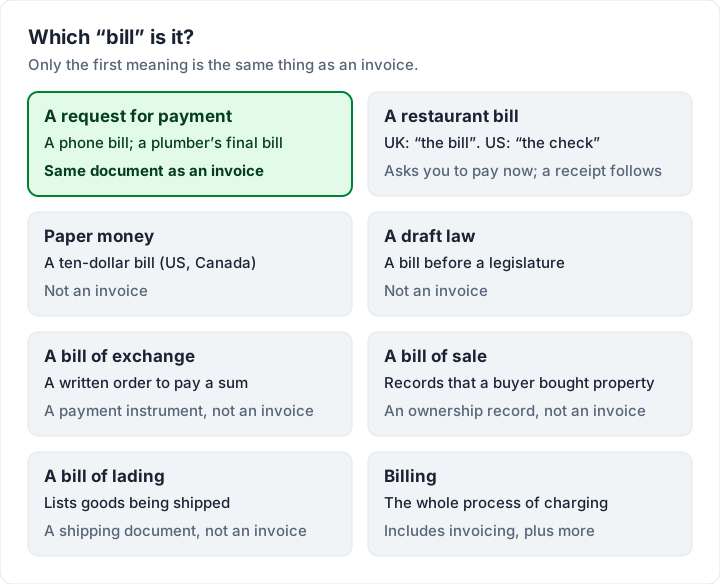
Here are the meanings with their sources, so you can tell which one a person or a search result means:
| Meaning | What it is | Same as an invoice? | Source |
|---|---|---|---|
| Statement of charges | “An itemized list or statement of fees or charges” | Yes | American Heritage Dictionary |
| Restaurant bill | The amount to pay for a meal; “check” in US English | Close: a request to pay now | Wiktionary, “check” (US sense) |
| Paper money | “A piece of legal paper money: a ten-dollar bill” | No | American Heritage Dictionary |
| Draft law | “A draft of a proposed law presented for approval to a legislative body” | No | American Heritage Dictionary |
| Bill of exchange | A written order telling one party to pay a set sum to another | No: a payment instrument | Plain-English description |
| Bill of sale | A written record that a buyer bought a piece of property | No: an ownership record | Plain-English description |
| Bill of lading | A carrier's document listing the goods being shipped and the terms of carriage | No: a shipping document | Plain-English description |
Sources: American Heritage Dictionary, Wiktionary, check. The last three rows are our own short descriptions, not legal definitions.
The bill of sale catches people out most. If you sell a used van, a bill of sale is the usual record that the buyer bought it. An invoice asks for the money. Some sales use both, and bill of sale vs invoice walks through a used van sale with each document. A bill of lading travels with freight; a trucking invoice usually quotes its number, which is why our trucking invoice template puts the BOL reference near the top.
Billing vs invoicing: the process and the document#
“Billing” and “invoicing” are not quite synonyms. Billing is the whole process of charging someone. Invoicing is the step where you make and send the invoice.
Billing starts before any document exists: agreeing a rate and terms, tracking what is billable, deciding when to charge. It carries on after the invoice goes out: reminders, recording payments, reconciling the account. Invoicing sits in the middle. When a client pays several invoices in one sum, remittance on an invoice explains the remittance advice that says which ones it covers.
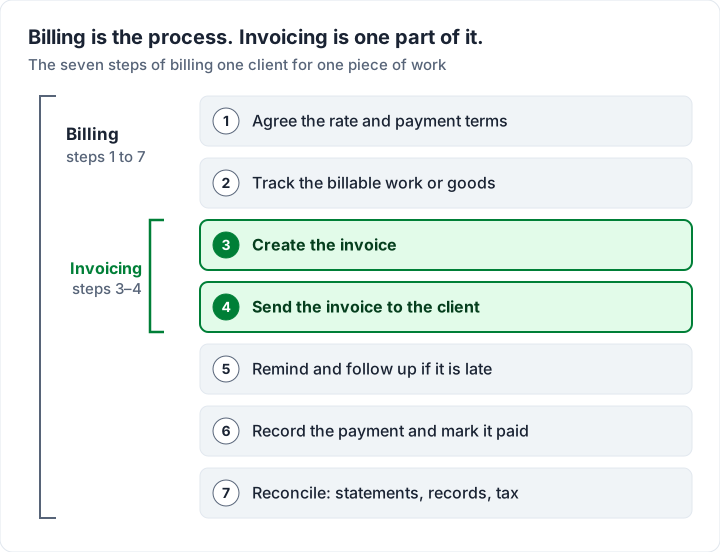
You can hear the distinction in how people describe their own setup: a business “sets up its billing” (rates, terms, schedules, payment methods) and, as one part of that, chooses its invoice templates. Billing is the system; invoicing is one part of it.
The plural “billings” has its own meaning too. The American Heritage Dictionary gives it as “the total amount of business done in a specific period, as by an advertising agency or a law firm” (American Heritage Dictionary, billing). When an agency says its billings grew, it means the total it charged clients, not a pile of documents.
The same split explains phrases you will meet:
- Billing cycle or billing schedule: how often you charge (monthly, per milestone). Each cycle produces an invoice.
- Billing address: where the invoice goes, which may differ from where the work happened.
- Progress billing: charging a large job in stages, with one invoice per stage. Progress invoicing explained shows the numbers.
- Billing in arrears or in advance: charging after the work, or before it. A deposit invoice is billing in advance.
Billed vs invoiced: what each one tells you#
As verbs, the dictionary makes them near twins. To bill is “to present a statement of costs or charges to”; to invoice is “to send an invoice to; bill” (American Heritage Dictionary). “We billed the client on Friday” and “we invoiced the client on Friday” describe the same event.
The difference is in what each word can also cover. “Billed” is looser. People say they billed 38 hours, meaning they charged for them, without naming a document. “Invoiced” points at a specific, numbered invoice you can look up. In bookkeeping that matters: “invoiced but unpaid” is a list you can produce; “billed” on its own might mean charged, or might mean billable.
Here is one illustrative month for a freelance web designer charging $85.00 an hour. The client and figures are invented for the example.
| Stage | What happened | Figure |
|---|---|---|
| Worked | All hours spent on the client in September 2026 | 42.0 hours |
| Non-billable | Admin and internal calls, agreed not to be charged | 4.0 hours |
| Billable, then billed | 38.0 hours × $85.00 | $3,230.00 |
| Invoiced | INV-0108, issued 30 September, Net 14 | $3,230.00 |
| Paid | Part payment received 7 October | $2,000.00 |
| Outstanding | Balance due 14 October | $1,230.00 |
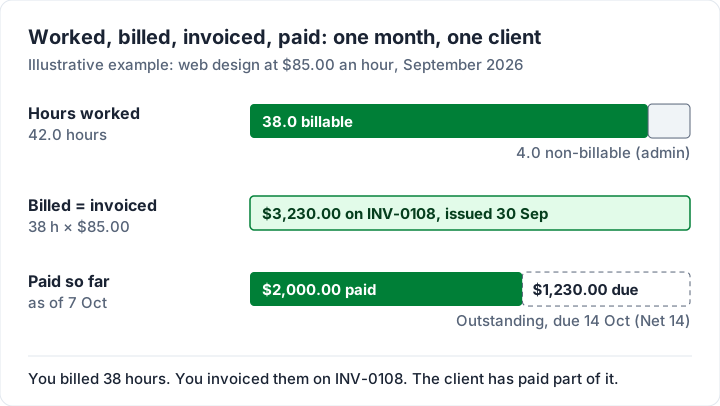
Notice where the real gaps are. The gap between worked and billed is a pricing decision. The gap between invoiced and paid is a collection question, and that is where outstanding, overdue and unpaid start to mean different things. Between billed and invoiced, there is normally no gap at all, unless you did the work and never sent the invoice. That gap has a name too: unbilled work. The gap between worked and billable starts with how you track time; time tracking and invoicing software compares tools that carry hours onto an invoice.
How the words change by country#
The core meaning travels, but everyday use does not.
| Where | What people usually say | Worth knowing |
|---|---|---|
| United States | “Bill” for household charges (phone, medical, utility); “invoice” in business | A restaurant bill is “the check”; a “bill” can also be a banknote |
| United Kingdom | “Bill” at a restaurant and for household charges; “invoice” between businesses | GOV.UK writes “invoice (bill)”; VAT guidance talks about the “VAT invoice” |
| Australia | “Invoice” and, for GST-registered sellers, “tax invoice” | business.gov.au explains when the term “tax invoice” is used |
| German-speaking countries | One word, Rechnung, for both a restaurant bill and an invoice | Do not expect a translation to preserve the English distinction |
| French-speaking countries | Facture for a bill or invoice; addition for a restaurant bill | A client may ask for a facture when they mean your invoice |
Sources: GOV.UK, business.gov.au, Invoicing, Wiktionary, Rechnung, Wiktionary, facture, Wiktionary, addition.
If you are registered for VAT or GST, the official guidance is the place to read what your invoices need: for the UK, HMRC's VAT Notice 700 (section 16 covers VAT invoices); for Australia, business.gov.au's invoicing page. Both talk about invoices, not bills. What a tax invoice is covers the extra fields in general terms.
How the words change by industry#
Trades and professions have their own habits, and they rarely cause problems as long as the document itself is right.
Trades. Electricians, plumbers and builders often say “bill” for their own invoice. In one public discussion on a UK electricians' forum, the electrician asking for advice wrote “I gave them an invoice with a list of everything done and then a final price at the end”, and a few lines later, “They paid the original bill.” A reply suggesting how to answer the customer used “bill” for the same document:
My original quote and final bill was accepted by yourselves and I do not provide further breakdowns of how I reach my quotes/estimates.
Same job, same document, two words, and nobody in the thread was confused about what it was. If you work in a trade, the electrician invoice template shows a fully itemised version.
Law firms. Solicitors in England and Wales commonly send a “bill”, or “bill of costs”. In legal work, “bill” is the formal word.
Trucking. Carriers present a “freight bill” to the shipper or broker. It works as an invoice for the load.
Utilities and phone. “Bill” is the household word for a recurring charge, and it usually comes with a due date rather than being payable on the spot.
Restaurants and hospitality. The bill (or check) is a request to pay now. What you get after paying is the receipt.
Accounting teams. Inside a company, invoices you send are sales invoices and money owed to you; invoices you receive are often logged as bills. A sales order sits earlier still, before the invoice: see sales order vs sales invoice for that step.
Worked examples: one transaction, both words#
A freelancer and a company client. You send INV-0108 for $3,230.00. In your records it is an invoice and a receivable. In your client's accounts payable system, someone enters it as a bill, types INV-0108 into the vendor invoice number field, and schedules payment. If they ask for a PO number on the invoice, that is because their bill entry has to match it. Invoices in accounting walks through those receivable and payable entries step by step.
A plumber and a homeowner. You finish a boiler repair and hand over a document headed “Invoice”. The homeowner says “thanks for the bill” and pays by bank transfer. Nothing needs correcting. What matters is that the document has your details, a number, the date, the work and the total.
A café owner paying a supplier. The café receives an invoice from its coffee roaster and files it under bills to pay. At month end, the roaster sends a statement listing every open invoice. That statement is not a new bill. Invoice vs statement explains the difference.
What to call your own document#
You can call it anything in conversation. On the page, the title should help the person who pays it. That points to “Invoice” for almost everyone, for three practical reasons.
- Accounts teams process invoices. A larger client's payables team receives invoices, logs them as bills and pays them. A document titled “Bill” or “Statement” gives them one more thing to check before it can be paid.
- Tax guidance uses the word invoice. Where you are registered for VAT or GST, your tax authority's guidance sets out the fields, and any label, it expects on an invoice.
- It removes doubt about what is being asked. “Invoice” plus a due date plainly asks for payment. “Bill” can read as a summary, a receipt or an estimate, depending on who reads it.
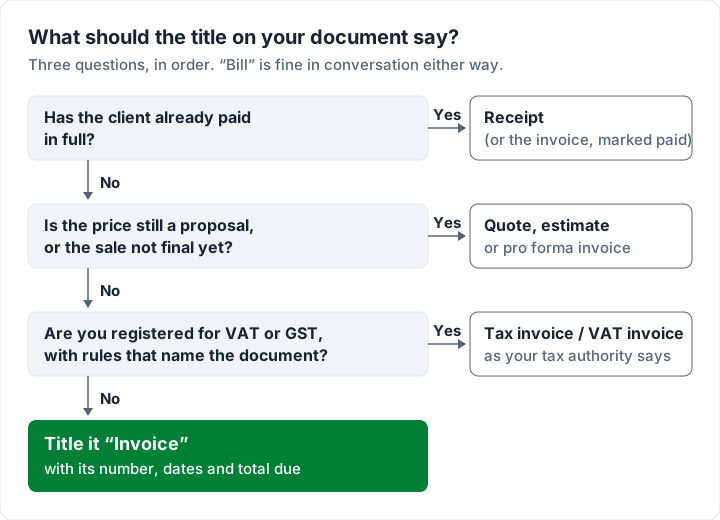
If the price is not agreed yet, the right document comes earlier: see invoice vs estimate or quote and pro forma invoices explained.
You can still use “bill” everywhere else. These lines are fine to copy:
- Email subject: Invoice INV-0108 from Fernhill Web Design, due 14 October
- Email body: Please find attached invoice INV-0108 for $3,230.00, the bill for September's work.
- Client label on the invoice: Bill to
“Bill to” is the standard heading for the client's details, and it is not a contradiction. It simply means “send the charge to”. For more on wording the email itself, see how to email an invoice.
Renaming the title in Charming, and what it does not change#
If your trade or your client genuinely expects a different word, the label is easy to change. In Charming Invoices, the Labels panel in the Template Studio lets you rename the fixed wording on the invoice (the title, headings and totals labels) on every plan, including the free one. You can change the title from “Invoice” to “Tax invoice”, rename “Bill to” to “Client”, or set the title to “Bill” if you really want it. Labels can be up to 60 characters.
The catch: a renamed title changes what prints on the invoice and its PDF, not the rest of the product. The app still calls the document an invoice, and so do its lists and statuses. Charming is also only the sending side, and it does not email the invoice for you: you download the PDF or copy its private link and send it however you like. It does not track bills you receive from suppliers, it is not a payment processor (your client pays you directly and you mark the invoice paid), and free-plan invoices carry a small “Sent with Charming Invoices” line in the footer. Customizing an invoice covers the rest of what you can change.
Common questions about invoices and bills#
Is an invoice a bill?#
Yes, in the sense that matters for getting paid. Both are requests for payment. “Invoice” is the seller's word and “bill” is often the payer's word for the same document.
Is a bill the same as an invoice in accounting?#
The document is the same; the side of the ledger differs. An invoice you send becomes money owed to you. When your client records it, it becomes a bill: money they owe.
What is the difference between billing and invoicing?#
Billing is the whole process of charging a client, from agreeing the rate to recording the payment. Invoicing is the part where you create and send the invoice.
Can I send a bill instead of an invoice?#
You can send a document titled “Bill”, and many trades do. For business clients and anywhere tax rules apply, title it “Invoice” (or the label your tax authority's guidance uses) so it is processed without questions.
Is a bill the same as a receipt?#
No. A bill asks for payment; a receipt confirms it was made. A paid invoice can work as a record of payment, but it is not a request any more.
Is a bill of sale an invoice?#
No. A bill of sale records that a buyer bought a piece of property. An invoice asks for the price. A sale of something like a vehicle may have both.
The short version#
An invoice is the request for payment you send. A bill is usually the same request, as the person paying it sees it. Billing is the whole process of charging; invoicing is the document at its centre. Call it “Invoice” at the top of the page, say “bill” whenever it sounds natural, and make sure the number, dates and total are right, because that is what gets it paid.
If you want one built for you with the title, labels and branding set the way you like, create a free invoice and send it when it looks right.