Invoices in accounting: receivable vs payable, explained

Nnabuike Okoroafor ·
On this page · 10 sections
You send an invoice, your client pays it, and as far as you are concerned that is the job done. Then your accountant asks for your receivables, or your client's accounts team says your invoice is “in payables”, and it becomes clear the same piece of paper means something different to everyone who touches it.
It does. In accounting, one invoice is recorded twice: once by you, as money you are owed, and once by your client, as money they owe. This guide explains what an invoice is once it reaches the books, the difference between accounts receivable and accounts payable, and then follows one invoice through both sets of books, with dates, amounts and the entries each side makes.
General information, not accounting or tax advice. Your accountant decides which accounting method you use and how your books are kept.
In short#
- An invoice is a source document. It is the evidence behind an entry in the books, for the business that sends it and the business that receives it.
- For the seller, an unpaid invoice is accounts receivable: money owed to you. For the buyer, the same invoice is accounts payable: money they owe.
- A payable invoice is the buyer's view of a supplier's invoice, often called a bill, purchase invoice or vendor invoice.
- Each payment reduces both balances at once. When your client pays, your receivable and their payable fall by the same amount.
- Cash or accrual decides when the invoice “counts”. On the cash method, income is recorded when money is received; on accrual, when it is earned.
- You do not need accounting software to send invoices, but you do need a clear list of who owes you what, and since when.
What an invoice is in accounting#
Outside accounting, an invoice is a request for payment. Inside accounting, it is a source document: the record that proves a sale (or a purchase) happened, for how much, and on what terms. Bookkeepers record entries from source documents, and an invoice is the most common one a small business produces.
The names change depending on which side you are on, which causes most of the mix-ups. These pairs mean the same document seen from two ends:
| Seller calls it | Buyer calls it | What it records |
|---|---|---|
| Invoice, sales invoice | Bill, purchase invoice, vendor invoice, supplier invoice | One sale, from one business to another |
| Accounts receivable (an unpaid invoice) | Accounts payable (an unpaid bill) | Money still owed on it |
| Payment received | Payment made | The money moving |
| Paid invoice | Settled bill | Nothing left owed |
If the invoice-or-bill wording still trips you up, the difference between an invoice and a bill covers it with examples. The short version: it is the same document, and the word depends on whether you are sending it or receiving it.
Accounts receivable vs accounts payable#
Accounts receivable (AR) is the total of unpaid invoices you have sent: money clients owe you. In a balance sheet it is usually shown as a current asset, because you expect to turn it into cash soon.
Accounts payable (AP) is the total of unpaid bills you have received: money you owe suppliers. It is usually shown as a current liability.
Most small businesses have both. A freelance designer has receivables from clients and payables to the printer, the font foundry and the software subscriptions. Here is how the two sides compare:
| Accounts receivable | Accounts payable | |
|---|---|---|
| Whose view | The seller's | The buyer's |
| What it is | Money owed to you | Money you owe |
| Where it sits | Usually a current asset | Usually a current liability |
| Starts with | An invoice you send | A bill you receive |
| Goes down when | Your client pays you | You pay your supplier |
| The daily question | “Who owes us, and how late are they?” | “What do we owe, and when is it due?” |
| What goes wrong | Late payment, lost invoices, disputes | Missed due dates, duplicate payments, fraud |
Is invoicing accounts receivable or accounts payable? Sending invoices is the receivable side. Every invoice you send adds to your receivables until it is paid; the client's version of it sits in their payables until they pay it.
What is a payable invoice?#
A payable invoice is an invoice your business has received and still has to pay. It is the buyer's name for the supplier's invoice: the same document, filed in accounts payable rather than receivable.
At larger companies, a payable invoice goes through a process before anyone pays it. It is checked against a purchase order and proof of delivery, approved by the person who ordered the work, entered into the payables ledger, and paid on a scheduled payment run. That is why invoicing a company works best when your invoice carries a PO number, the right billing contact and terms the accounts team can read at a glance. An invoice that cannot be matched to an order tends to wait.
What “payable to” means on an invoice#
“Payable to” names the person or business the payment should go to. On a simple invoice it is your business name, sometimes followed by the bank account name if it differs: “Please make payment payable to Mara Quinn Studio.” When an invoice is paid by cheque, it is the name the cheque should be written out to. The wider set of payment details, the remit-to block, is covered in remittance on an invoice.
It matters most when the name on the invoice is not the name on the account. If you trade under a brand name but your bank account is in your own name, say so in the payment details, so the buyer's accounts team does not hold the payment while they query it.
One invoice through both sets of books#
Here is a worked example. Every name and amount is invented; the dates and arithmetic are real.
The designer Mara Quinn Studio sends invoice INV-0057 for $3,450.00 to Oakfield Dental Ltd on Monday 2 November 2026, on Net 30 terms, so it is due on Wednesday 2 December 2026. (If you count Net 30 differently, what Net 30 actually means explains the counting.) Both businesses keep their books on the accrual method in this example.
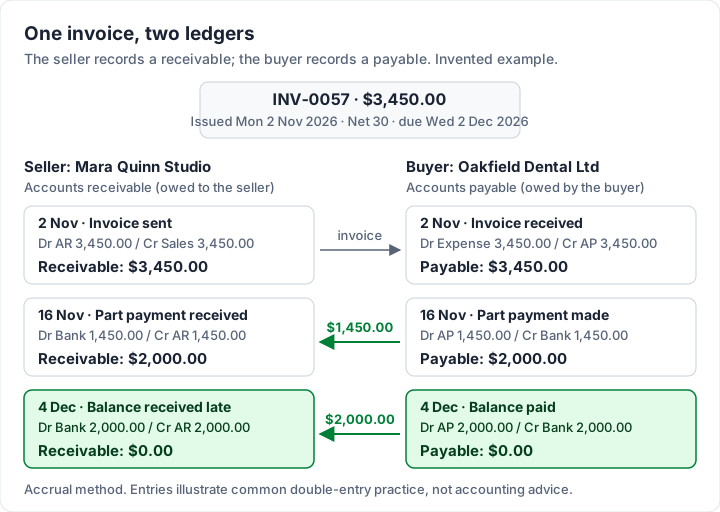
Here are the entries each side makes, in standard double-entry form. Dr is a debit and Cr is a credit; treat these as an illustration of common practice, not a template for your own books:
| Date | Event | Seller's entry | Buyer's entry | Seller's receivable after |
|---|---|---|---|---|
| Mon 2 Nov 2026 | Invoice sent | Dr Accounts receivable $3,450.00, Cr Sales $3,450.00 | Dr Design expense $3,450.00, Cr Accounts payable $3,450.00 | $3,450.00 |
| Mon 16 Nov 2026 | Part payment by bank transfer | Dr Bank $1,450.00, Cr Accounts receivable $1,450.00 | Dr Accounts payable $1,450.00, Cr Bank $1,450.00 | $2,000.00 |
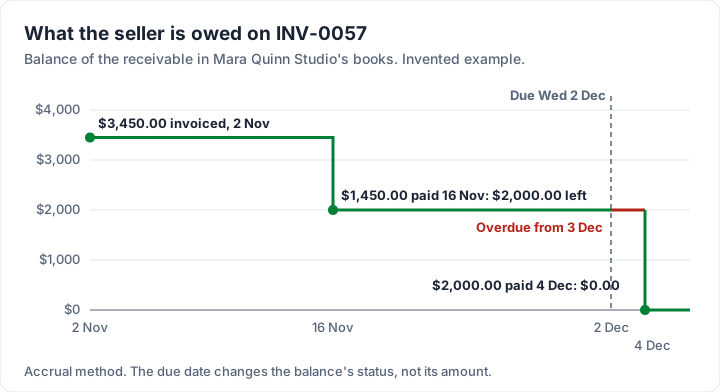
| Wed 2 Dec 2026 | Due date | No entry | No entry | $2,000.00, due today |
| Fri 4 Dec 2026 | Balance paid, 2 days late | Dr Bank $2,000.00, Cr Accounts receivable $2,000.00 | Dr Accounts payable $2,000.00, Cr Bank $2,000.00 | $0.00 |
Three things are worth noticing:
- The due date creates no entry. Nothing in the books changes on 2 December. What changes is the invoice's status: once the due date has passed, the $2,000.00 is overdue rather than simply outstanding. Outstanding vs overdue vs unpaid sets out the difference.
- The part payment leaves the invoice open. From 16 November to 4 December, INV-0057 is partly paid with $2,000.00 still owed. It only becomes a paid invoice when the balance reaches $0.00.
- The two sides should always agree. On any date, Mara's receivable for INV-0057 equals Oakfield's payable for it. When they do not, one side has missed a payment or recorded it against the wrong invoice. That is what matching payments to invoices is for.
The same studio also has payables. On Monday 9 November 2026 it receives a print bill for $380.00 on Net 14, due Monday 23 November 2026. For that bill, the roles swap: the printer has a $380.00 receivable, and Mara has a $380.00 payable until she pays it. Most small businesses sit on both sides of different invoices every month.
Cash vs accrual: when an invoice “counts”#
The entries above use the accrual method, where the sale is recorded when the invoice is issued. Many small businesses keep their books on the cash method instead, and then the invoice itself creates no income entry at all. The IRS describes the two methods in Publication 538, Accounting Periods and Methods (page last reviewed 30 April 2026, read 28 October 2026):
Under the cash method, you include in your gross income all items of income you actually or constructively received during the tax year.
Under an accrual method of accounting, you generally report income in the year it is earned and deduct or capitalize expenses in the year incurred.
The same publication explains what “constructively received” means:
Income is constructively received when an amount is credited to your account or made available to you without restriction.
As an illustration only: if Mara kept simple cash-basis books, the income would typically be recorded as $1,450.00 on 16 November and $2,000.00 on 4 December, with nothing on 2 November, and INV-0057 might never appear as a receivable in those books.
That does not mean the receivable stops mattering. Whatever your method, someone owes you $2,000.00 for three weeks, and you need to know that to chase it. Which method applies to you, and when, is a question for your accountant; rules vary by country, so check the official guidance where you are. Our guide on how to track open invoices covers the cash and accrual difference from the tracking side.
Keeping a receivables list without accounting software#
Plenty of freelancers and one-person businesses send a handful of invoices a month and have no accounting software at all. One person in a public discussion about invoicing apps (not a Charming customer; we read these threads while researching the product) put it this way:
I run a one-person business and invoice maybe 5–10 clients a month. I don't need accounting software, just a clean way to send invoices and track what's been paid.
What you do need is a receivables list your accountant can rely on. The problem it solves is a familiar one. Another person, in a thread about tracking invoices, described their month-end:
My setup with my accountant: we have a shared Dropbox folder. Every month I dump all my invoices in there (stuff I send out + stuff I receive) and email her that it's ready.
“Stuff I send out + stuff I receive” is receivables and payables, mixed in one folder. A few habits keep them apart and complete:
- One list of every invoice you send, with number, client, issue date, due date, total, amount paid and balance. Numbering them in sequence means a gap shows up straight away.
- Payments recorded against the invoice they pay, with the date and method, including part payments. A deposit that pays two invoices is two entries.
- Ageing on the open ones. Group unpaid balances by how late they are: current, 1-30 days past due, 31-60, 61-90 and over 90. The older the bucket, the more attention it needs. Our free invoice tracker for Excel keeps the list, the balances and the ageing on one sheet.
- A statement of open invoices for any client with several invoices outstanding, so both sides can check they agree. What a client statement shows explains how it differs from an invoice.
- Bills you receive kept separately, in their own folder or tab, with their due dates. They are your payables, and your accountant needs them too.
At month end, the receivables list and the bills folder are most of what a bookkeeper needs from the invoicing side. If you are the bookkeeper and want to bill your own clients, the bookkeeping invoice template has two filled-in samples.
How Charming fits, and what it does not do#
Charming Invoices covers the receivables side: the invoices you issue and what each client still owes. Checked in our code on 28 October 2026, on every plan, including the free one:
- An outstanding total and a count of overdue invoices on the dashboard, and each invoice's balance after the payments you record.
- Payments recorded by hand, including part payments, with the date, method (bank transfer, card, cash, check, online payment or other) and a note. An invoice becomes Paid when its payments cover the total.
- Client account statements as PDFs, with each open invoice placed in an ageing bucket: current, 1-30, 31-60, 61-90 and 90+.
- A CSV export of your invoices, with 21 columns including Invoice number, Status, Client, Issue date, Due date, Invoice total, Total, Amount paid, Balance due, Issued at and Paid at. That is the receivables list above, ready to hand to a bookkeeper.
The catches, plainly. Payment tracking is manual: there is no bank feed, so you record payments or mark invoices paid yourself. Statements are per client; there is no aged-receivables report across all clients at once. The CSV has one row per invoice, not per payment, and your bookkeeper imports it by hand, because Charming has no accounting integrations. Charming does not process card payments or email invoices (you send the PDF or link yourself), and free-plan invoices carry a “Sent with Charming Invoices” line.
Charming is not bookkeeping software. It does not track the bills you receive, keep a ledger or chart of accounts, make journal entries or file tax returns. If you need the payables side and full books, use accounting software such as QuickBooks, Xero, Wave or FreshBooks, or work with a bookkeeper. If your accountant uses Sage, Sage invoicing explains which Sage product to use. Many small businesses do both: invoices in a simple tool, books with an accountant.
If your bookkeeper works on your invoices directly, you can invite them as a teammate with the Member role on the Team plan ($79 once, up to 5 teammates per business) or Pro ($12 a month or $99 a year, unlimited teammates). A Member can create and issue invoices and record payments, but cannot change business settings, invite people or void invoices. Free and Individual ($29 once) are solo plans. Lifetime plans are final sale; compare them on the pricing page. If you run more than one brand, running more than one business from one login explains how that works. Letting a bookkeeper or teammate invoice for you, safely covers the roles and what to hand an accountant instead of a login.
Questions people ask#
Is an invoice accounts receivable or accounts payable?#
Both, depending on who is looking. The invoice you send is accounts receivable in your books until it is paid. The same invoice is accounts payable in your client's books until they pay it.
Is accounts receivable an asset?#
In standard accounting it is usually shown as a current asset, because it is money you expect to collect soon. Accounts payable is usually a current liability. How your own balance sheet is prepared is for your accountant.
What is the journal entry for an invoice?#
On the accrual method, a common entry when you issue a sales invoice is a debit to accounts receivable and a credit to sales, as in the worked example above. When the client pays, you debit the bank and credit accounts receivable. Ask your accountant how your own books are set up.
Do I need accounting software to send invoices?#
No. You need a way to send clear invoices and a reliable list of what each client owes. Accounting software becomes useful when you also want to track bills, run payroll or keep full books, and many people leave that to a bookkeeper.
What does “payable to” mean on an invoice?#
It names who the payment should go to: usually your business name, or the name on the bank account if that is different. For cheques, it is the name the cheque should be made out to.
Does cash-basis accounting use accounts receivable?#
On the cash method, income is generally counted when it is received, so a simple cash-basis set of books may not show unpaid invoices as receivables at all. How your own books handle it is for your accountant. Either way, you still need to track unpaid invoices so you know who to chase.
The short version#
Every invoice lives twice: as a receivable in the seller's books and as a payable in the buyer's. Payments bring both down together, and the due date changes the label, not the balance. Whether the invoice counts as income when you send it or when you are paid depends on your accounting method, which your accountant sets. Whatever the method, keep one clean list of what you are owed, with payments recorded against each invoice and the late ones grouped by age.
To keep that list without buying accounting software, create a free invoice in Charming and record payments as they arrive.
Source, read 28 October 2026: IRS Publication 538, Accounting Periods and Methods (page last reviewed 30 April 2026).
Free download
No sign-up and no email address. More on the free templates page.
- Download .xlsx: Invoice tracker for Excel
Invoice tracker for Excel
Excel .xlsxEvery invoice you have sent on one sheet, with its balance, status and how many days late it is.