Invoice vs statement: which one to send

Nnabuike Okoroafor ·
On this page · 13 sections
A client owes you for three jobs. One invoice is half paid, one is a month late, and one is not due yet. You could forward all three again, with three slightly different apologetic notes. Or you could send one page that shows the whole account. That page is a statement, and the invoice vs statement question comes down to this: an invoice asks for payment for one piece of work, and a statement shows where the whole account stands.
Both documents carry your name, the client's name and some money, which is why invoice versus statement confuses people. They do different jobs, and sending the right one at the right time saves you and your client a lot of back-and-forth.
Invoice vs statement at a glance#
Here is the difference between an invoice and a statement, attribute by attribute:
| Invoice | Statement | |
|---|---|---|
| What it covers | One sale or one piece of work | Every open invoice on the client's account |
| Detail | Line items, quantities, rates, tax, total | One line per invoice: number, dates, amount, paid, balance |
| When you send it | When the work is done, or a deposit is due | When several invoices are open, or on a regular cycle |
| What it asks for | Payment of this invoice by its due date | A check that both sides agree on what is still owed |
| Has its own number | Yes, unique and sequential | No. It is dated instead |
| In the client's books | Recorded as a bill to pay | Usually not recorded at all; it is used to check records |
| Replaces the other? | No | No. It points back to the invoices |
The last two rows matter most. AccountingTools, a reference site for accountants, describes a statement as “only informational in nature”: the client's accounts team records your invoice as something it owes, while a statement is used to reconcile (AccountingTools, invoice vs statement). A statement never creates a new amount owed. That is general information, not accounting advice. For matching payments against your own records, see invoice reconciliation.
What an invoice is for#
An invoice is the request for payment. It names the work, prices it line by line, adds any tax, states the total and says when and how to pay. It has a unique number, so you and your client can both say “invoice 019” and mean exactly one document.
If you are unsure what has to be on one, the field-by-field invoice checklist covers it. The short version: an invoice is detailed, final for that job, and it is what your client's accounts team actually pays against.
What a statement of account is for#
A statement of account (also called a client statement or an account statement) summarises the relationship rather than the job. It lists the invoices that are still open, what has been paid against each, what is left, and how late each one is. It carries a statement date instead of a number, because it is a snapshot of the account on that day.
Its job is agreement. A client who receives a statement can hold it against their own records and say “we paid 014 last week” or “we never received 019”. Either answer is useful to you. The first means your records need updating. The second means an invoice is stuck somewhere, and you now know which one.
Invoice vs billing statement#
Search for “billing statement” and you will meet a second meaning, mostly from American consumer bills. A credit card company, a utility or a medical practice sends a billing statement each month: the new charges for the period, the payments received, the balance and the date to pay by. For the person receiving it, that billing statement is the bill. It does the invoice's job and the statement's job on one page.
Business-to-business billing usually keeps the two apart. You send an invoice for each piece of work, and the statement (the statement of account described above) summarises those invoices without adding anything new. When a client or their accounts team asks for a billing statement, they almost always mean that account summary.
| Invoice | Statement of account | Consumer billing statement | |
|---|---|---|---|
| Who typically sends it | Any seller | A seller with several open invoices | Card issuers, utilities, medical practices |
| New charges on it? | Yes, itemised | No, it points back to invoices | Yes, for the period |
| Paid from directly? | Yes | Often, as a list of what is open | Yes |
| Has its own number | Yes | No, it is dated | Usually an account number and a statement date |
If you bill clients for ongoing work every month and want one page that does both jobs, the cleaner route is a monthly invoice plus, when older invoices are still open, a statement. Mixing new charges into a statement makes it hard for the client to know what they are approving.
What a client statement shows#
A useful statement has four parts:
- Who and when. Your business, the client, and the statement date.
- The open invoices. One row per invoice: number, issue date, due date, original amount, amount paid, balance left.
- Payments already received. Partial payments show against the invoice they belong to, so the client sees you have credited them.
- Ageing. The balance grouped by how late it is: current (not yet due), 1 to 30 days overdue, 31 to 60, 61 to 90, and over 90. The groups add up to the total due.
Ageing is the part people skip, and it is the most useful. A client who sees one total of $3,550.00 has to work out what is urgent. A client who sees $800.00 sitting in the 61 to 90 day column does not.
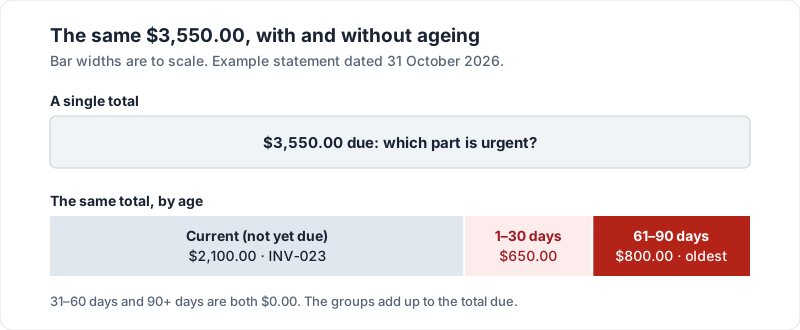
Some statements also list every invoice and payment over a period, with an opening and closing balance. That kind suits accounts with lots of activity. For most freelancers and small businesses, a list of open items is the clearer page: it shows only what is still owed. Our guide to making an invoice statement template compares the two kinds side by side, with a filled example and how to build one in Excel. If you would rather not build it, there is a free statement of account template for Excel with the ageing formulas in place.
A side-by-side example#
The numbers below are an illustrative example, not real data. A studio has sent three invoices to one client. Here is one of those invoices, followed by the statement for the whole account.
The invoice (INV-019, issued 3 September 2026, due 3 October 2026)
| Description | Qty | Rate | Amount |
|---|---|---|---|
| Product photography — menu items, edited | 12 | $45.00 | $540.00 |
| Location fee — half day | 1 | $110.00 | $110.00 |
| Total due | $650.00 |
No tax line here, to keep the example short.
The statement (statement date 31 October 2026)
| Invoice no. | Issued | Due | Amount | Paid | Balance | Overdue |
|---|---|---|---|---|---|---|
| INV-014 | 1 Aug 2026 | 31 Aug 2026 | $1,200.00 | $400.00 | $800.00 | 61 days |
| INV-019 | 3 Sep 2026 | 3 Oct 2026 | $650.00 | — | $650.00 | 28 days |
| INV-023 | 15 Oct 2026 | 14 Nov 2026 | $2,100.00 | — | $2,100.00 | — |
| Total | $3,950.00 | $400.00 | $3,550.00 |
Ageing summary
| Current | 1–30 days | 31–60 days | 61–90 days | 90+ days | Total due |
|---|---|---|---|---|---|
| $2,100.00 | $650.00 | $0.00 | $800.00 | $0.00 | $3,550.00 |
Drawn as two documents, the same example looks like this.
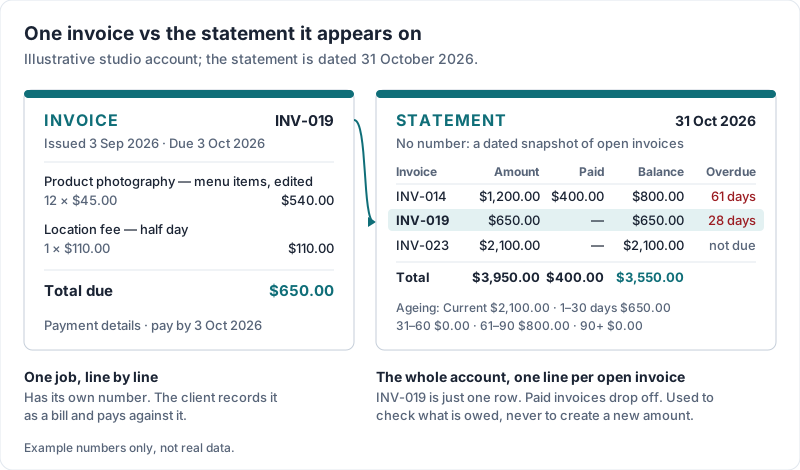
This is the invoice vs statement difference in practice. Look at what each one tells the client. The invoice explains what INV-019 was for. The statement says nothing about menu photography, but it shows in one glance that the oldest money is the remaining $800.00 on INV-014, that INV-019 is four weeks late, and that INV-023 is not due yet. Paid invoices do not appear at all.
When to send a statement instead of re-sending invoices#
Re-sending one overdue invoice is fine. It is the clearest follow-up there is, and the polite way to chase a late payment usually starts there. A statement earns its place in a few specific situations:
- The client has two or more open invoices. One page beats a thread of forwarded PDFs, and it stops anyone paying the newest invoice while the oldest one sits.
- Some payments were partial. A statement shows what was credited where. Re-sent invoices show the original totals and invite the question “but we already paid some of that”.
- A payment arrived that you cannot match. Send the statement and ask which invoices the payment covers.
- You bill the same client every month. A statement on a fixed day each month makes the account routine instead of a series of reminders.
- Their accounts team asks for one. Some finance departments reconcile from statements. Send one when asked; it is a normal request, not a complaint.
When there is only one invoice and it is a few days late, a short note with that invoice attached is enough. A statement for a single item looks more formal than the situation needs.
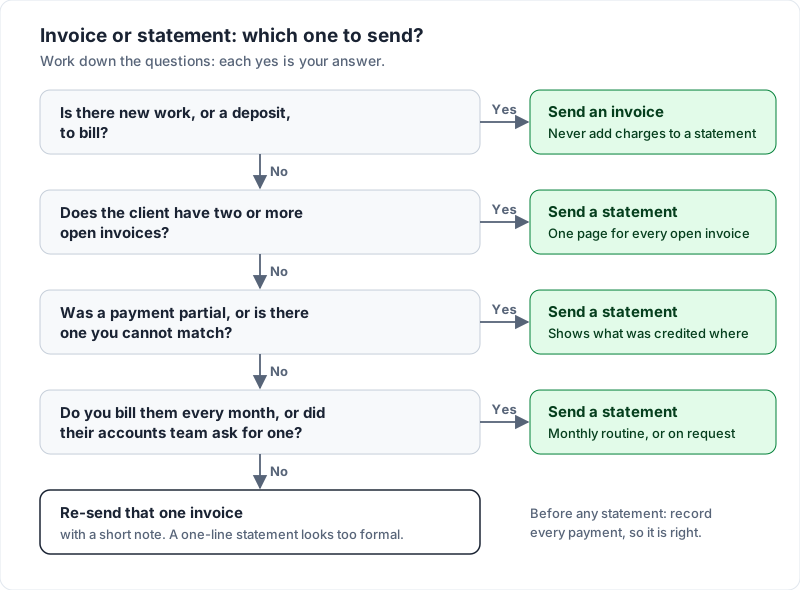
How a statement helps when a client has several unpaid invoices#
Several open invoices create a specific problem: money arrives in one lump, without a reference, and you have to work out which invoices it was for by trying combinations of amounts until one adds up. If you also want one list across all your clients, see how to run an open invoices report.
A statement does not stop a client paying in one lump, but it gives both of you the same list to work from. Before the payment, it shows exactly which invoices make up the total, so the client can pay the lot or say which ones they are paying. After the payment, it gives you something to ask against: “Your transfer of $1,450.00 arrived, thank you. Which invoices on the attached statement does it cover?”
It also changes the tone of the conversation. Three separate reminders feel like three separate complaints. One statement is an account summary, which is a neutral thing to send. If you want the difference between those labels spelled out, outstanding vs overdue vs unpaid covers what each one means.
Wording for the email that carries a statement#
Keep it short and factual. A sample you can adapt:
Hi Priya,
Attached is a statement of your account as of 31 October. It lists the three invoices still open, with $3,550.00 due in total. The oldest is the $800.00 balance on INV-014, which was due on 31 August.
If anything on it does not match your records, let me know and I will check it against mine. Payment details are at the bottom of the statement.
Thanks, Sam
Name the oldest amount. Invite a correction. Leave out apologies and threats. The statement already does the work of showing what is late.
Account statement vs invoice: where people go wrong#
- Sending a statement before checking your own records. If a payment came in yesterday and you have not recorded it, the statement is wrong and the client will say so. Update your payments first.
- Treating the statement as a new bill. It is not one. Do not add new charges to a statement; invoice them, then they will appear on the next statement. One bill for several jobs not yet invoiced is a consolidated invoice, not a statement.
- Leaving off the due dates. Without them the ageing means nothing, and the client cannot see what is late.
- Mixing currencies in one total. If you bill one client in two currencies, list each currency separately with its own total. Adding dollars to euros gives a number nobody owes.
- Dropping the payment details. A statement is often the document that gets paid from. Put your bank details or payment link on it, as you would on an invoice.
Client statements in Charming#
Charming Invoices builds this statement for you on every plan, including the free one. On your client list, each client has a Statement button. It opens a PDF in your invoice design with the client's open invoices, oldest first, showing number, issue date, due date, amount, paid, balance and days overdue, plus an ageing summary and a total due. Your bank details or payment link print at the bottom if you have added them, and amounts in different currencies get their own sections rather than one mixed total.
The catches, plainly. It lists open items only: paid invoices and the dates of individual payments do not appear, so it is not a full activity history. It is dated today and uses the balances as you have recorded them, and payment tracking is manual, so mark payments first or the statement will be out of date. Charming does not email the statement for you; you download the PDF and attach it yourself. On the free plan it carries a small “Sent with Charming Invoices” line, the same as your invoices.
Billing statements: quick answers#
What is a billing statement?#
A summary of an account for a period: what was charged, what was paid and what is still owed, with a date. On consumer bills it often includes the new charges and serves as the bill. Between businesses, the term usually means a statement of account.
Is a billing statement the same as an invoice?#
Not usually. An invoice requests payment for specific work and has its own number. A billing statement summarises the account. The exception is the consumer kind that lists new charges and a payment date, which does an invoice's job too.
Should I send my clients invoices or billing statements?#
Invoices for each piece of work, and a statement when several invoices are open or a client asks for one. If you invoice the same client every month, a recurring invoice handles the regular charge, and the statement handles anything left unpaid.
Invoice vs statement: the short answer#
An invoice asks for payment for one job. A statement shows the whole account, so both sides can agree on what is owed and what is late. Send invoices as the work is done. Send a statement when a client has several open invoices, when partial or unmatched payments have muddied the picture, or on a regular monthly cycle.
If you want both documents to come from the same place, create a free invoice and the statement for that client is one click away once it is issued.
Free download
No sign-up and no email address. More on the free templates page.
- Download .xlsx: Statement of account for Excel
Statement of account for Excel
Excel .xlsxFor a client with several unpaid invoices: one page listing each one, what is left and how late it is.