Open invoice: what it means and how to track open invoices

Nnabuike Okoroafor ·
On this page · 13 sections
You have sent a handful of invoices this month and a few from last month. Some are paid, some are half paid, one client says they paid but you cannot see it, and one invoice from the summer has gone quiet. Every one of those that is not settled is an open invoice, and the total of them is money you have earned and do not have yet.
This guide explains what an open invoice means, then spends most of its length on the practical part: how to keep an open invoices report, how to age it, why invoices stay open longer than they should, and a short weekly routine that closes them. (We mean the accounting term here, not the software company that shares the name.) Once money arrives, when an invoice counts as paid explains partial payments, and invoice reconciliation shows how to match a payment against your bank.
In short#
- An open invoice is one you have sent and that is not yet fully paid, voided or otherwise settled. It stays open until the balance is zero.
- Open is the opposite of closed. "Outstanding" is the money still owed on it; "overdue" means it is open and past its due date.
- Invoices stay open for fixable reasons: a partial payment, a payment you have not matched, a dispute over one line, or an invoice that should have been voided.
- An open invoices report lists each one with its balance and how many days past due it is, grouped into ageing buckets: current, 1 to 30, 31 to 60, 61 to 90 and over 90 days.
- Fifteen minutes a week of matching, chasing and closing keeps the list honest.
What an open invoice means#
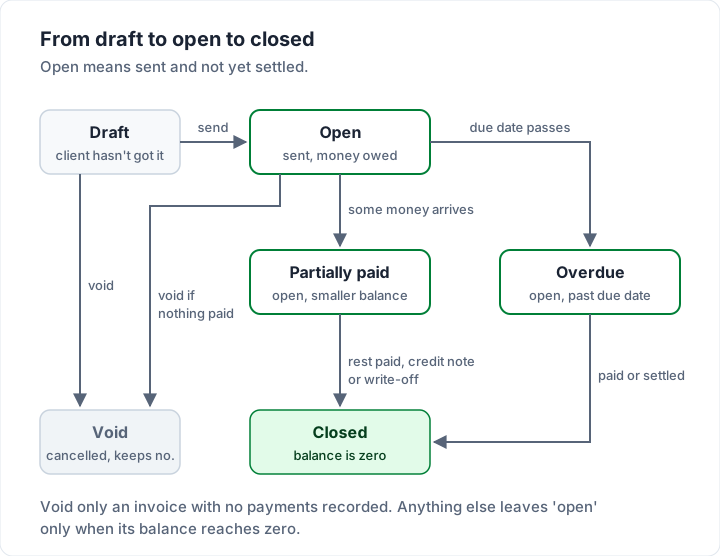
An open invoice is an invoice you have issued that still has money owing on it. It opens when you send it and closes when the balance reaches zero: the client pays in full, you record the last partial payment, or you settle the rest another way, such as a credit note or a write-off.
A draft is not open, because the client has not received it. A voided invoice is not open, because it has been cancelled. Here is how the states compare:
| Status | Has the client got it? | Counts as money owed? | What closes it |
|---|---|---|---|
| Draft | No | No | Sending it (it becomes open) or deleting it |
| Open, not yet due | Yes | Yes | Full payment, credit note or write-off |
| Open and partially paid | Yes | Yes, the balance | The rest of the payment |
| Open and overdue | Yes | Yes | Payment, or one of the routes in "How to close an open invoice properly" |
| Closed (paid) | Yes | No | Already closed |
| Void | Cancelled | No | Already closed; it keeps its number |
Open, closed, outstanding and overdue#
These words are often used interchangeably. A simple way to keep them apart:
- Open or closed describes the invoice: is it still live?
- Outstanding describes the money: how much is still owed on the open invoice?
- Overdue describes the timing: the invoice is open and its due date has passed.
So a $2,400.00 invoice with $1,200.00 paid is open, has $1,200.00 outstanding, and may or may not be overdue. For the full set of terms (outstanding, unpaid, overdue, past due, delinquent) with a worked timeline, see what an outstanding invoice means. This post is about managing the list.
Why invoices stay open#
Most invoices close themselves: the client pays and you record it. The ones that linger usually have one of these causes, each with its own fix.
| Why it is still open | How you spot it | The fix |
|---|---|---|
| The client has not paid yet | No payment, due date in the future | Nothing yet; a reminder before the due date helps |
| The client paid part | A partial payment recorded | Ask for the balance, quoting the amount left |
| The client paid and you have not matched it | Money in the bank, invoice still open | Find the payment and record it against the invoice |
| The client disputes one line | They said so, or they paid all but one line | Settle the disputed line; ask for the undisputed part now |
| The invoice was wrong or cancelled | You agreed a change, or the job did not go ahead | Void it, or issue a credit note if it was already paid or partly paid |
| The client cannot or will not pay | Months overdue, no reply | The escalation ladder, then a write-off if needed |
Two of these are worth extra care. A disputed line should not hold up the rest of the invoice; our guide to getting the undisputed part of an invoice paid shows how to split it. And an unmatched payment is the most common false alarm on any open list: the money is in your bank, but the invoice still looks unpaid until you record it.
The open invoices report: columns that matter#
An open invoices report (or open invoice report) is a list of every open invoice with enough detail to act on. It can be a page in your invoicing software, a spreadsheet or a printed sheet. These columns do the work:
- Invoice number so you and the client are talking about the same document.
- Client so you can group several invoices into one conversation.
- Issue date and due date so you know what the client agreed to.
- Total, paid and balance so a partial payment is visible, not hidden in a total.
- Days past due so you can sort by urgency.
- Ageing bucket so you can see where the money sits at a glance.
- Status note for anything the numbers do not show: "disputed line", "client says paid on 13 Oct", "promised Friday".
Sort it by days past due, oldest first, and the list tells you who to call.
A worked example: one business's open invoices on one day#
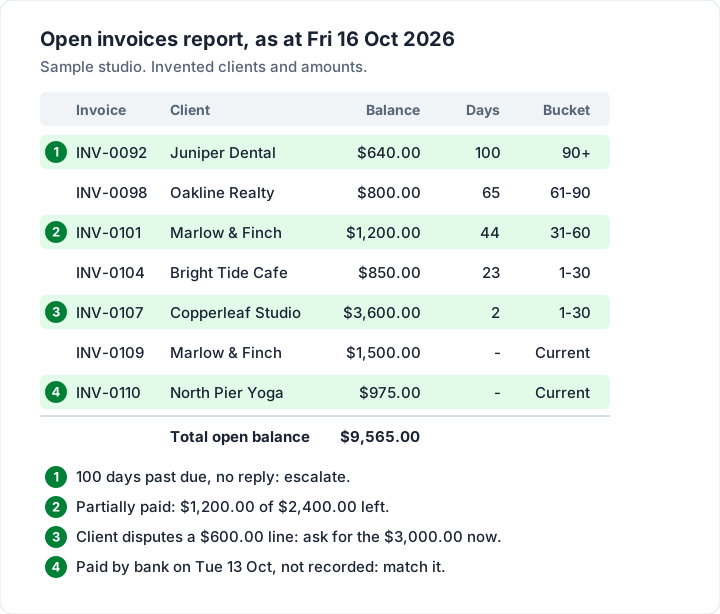
Here is a sample open invoices report for an invented design studio, as at Friday 16 October 2026. Every client and amount is invented for illustration; the arithmetic is real. Days past due count from the due date to 16 October.
| Invoice | Client | Issued | Due | Total | Paid | Balance | Days past due | Bucket |
|---|---|---|---|---|---|---|---|---|
| INV-0092 | Juniper Dental | 8 Jun | 8 Jul | $640.00 | $0.00 | $640.00 | 100 | 90+ |
| INV-0098 | Oakline Realty | 13 Jul | 12 Aug | $1,100.00 | $300.00 | $800.00 | 65 | 61-90 |
| INV-0101 | Marlow & Finch | 3 Aug | 2 Sep | $2,400.00 | $1,200.00 | $1,200.00 | 44 | 31-60 |
| INV-0104 | Bright Tide Cafe | 24 Aug | 23 Sep | $850.00 | $0.00 | $850.00 | 23 | 1-30 |
| INV-0107 | Copperleaf Studio | 14 Sep | 14 Oct | $3,600.00 | $0.00 | $3,600.00 | 2 | 1-30 |
| INV-0109 | Marlow & Finch | 28 Sep | 28 Oct | $1,500.00 | $0.00 | $1,500.00 | not due | Current |
| INV-0110 | North Pier Yoga | 5 Oct | 4 Nov | $975.00 | $0.00 | $975.00 | not due | Current |
| Total | $11,065.00 | $1,500.00 | $9,565.00 |
The numbers alone hide three stories, which is why the status note column exists:
- INV-0107 has a disputed line. Copperleaf Studio questioned a $600.00 revision round and has paid nothing. The undisputed $3,000.00 should not wait for that conversation.
- INV-0110 is not really open. North Pier Yoga paid $975.00 by bank transfer on Tuesday 13 October; it has not been recorded. Matching it removes $975.00 from the list in one minute.
- INV-0092 is 100 days past due with no reply. That is the one to escalate.
Ageing your open invoices#
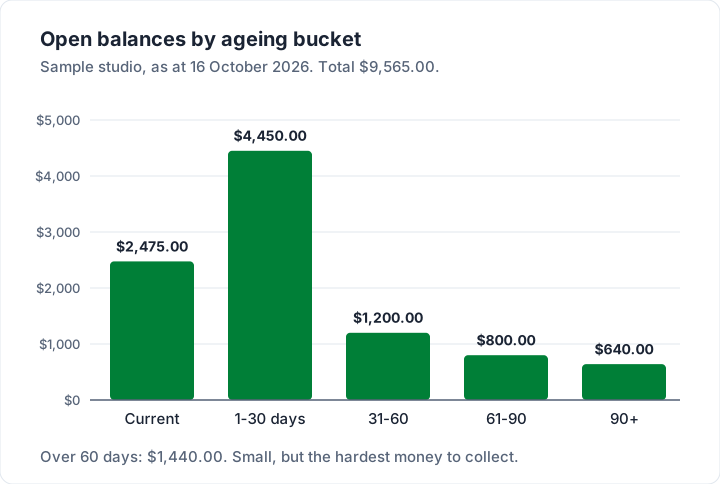
Ageing groups the balances by how late they are. The usual buckets are current (not yet due), 1 to 30 days past due, 31 to 60, 61 to 90 and over 90. Here is the worked example summarised:
| Ageing bucket | Invoices | Balance | Share of what is owed |
|---|---|---|---|
| Current | INV-0109, INV-0110 | $2,475.00 | 25.9% |
| 1-30 days past due | INV-0104, INV-0107 | $4,450.00 | 46.5% |
| 31-60 days | INV-0101 | $1,200.00 | 12.5% |
| 61-90 days | INV-0098 | $800.00 | 8.4% |
| Over 90 days | INV-0092 | $640.00 | 6.7% |
| Total | 7 invoices | $9,565.00 | 100% |
What the ageing tells you:
- Most of the money is in the first two buckets. That is normal and healthy: reminders and one polite email close most of it.
- The money over 60 days is small but slow. $1,440.00 sits in the last two buckets. Each week it stays there, the conversation gets harder.
- Matching INV-0110 changes the picture at once. Recording that payment drops the current bucket to $1,500.00 and the total to $8,590.00.
If your payment terms are Net 30, an invoice moves into the 1-30 bucket the day after its due date, not 30 days after it is sent. Our guide to what Net 30 actually means explains the counting, and the invoice due date calculator works out a due date for any terms. To show one client the same ageing on a single page, our invoice statement template guide has a filled example with all five buckets.
How to close an open invoice properly#
An invoice should leave the open list only when its balance is genuinely settled. The right route depends on why it is open:
- Payment arrived: record it against the invoice, partial or full. A partial payment keeps the invoice open with a smaller balance.
- The invoice should never have been sent, and nothing was paid: void it. A void keeps the number, so your sequence has no gap. Our guide to when to delete, void or cancel an invoice covers which to use.
- You agreed to reduce what is owed after sending: issue a credit note for the reduction and collect the rest. See when to issue a credit note.
- The client will not pay and you have stopped chasing: follow the escalation ladder for unpaid invoices first; if you still write it off, talk to your accountant about how to record it.
What not to do: delete a sent invoice, or mark it paid when it was not. Both make the open list look shorter and your records wrong.
Open invoices on cash vs accrual books#
General information, not tax advice. For US businesses, the IRS ties the timing of income to your accounting method. Here is what the IRS's Publication 538 (revised January 2022) said when we read it on 23 October 2026:
- Cash method: "Under the cash method, you generally report income in the tax year you receive it".
- Accrual method: "Under the accrual method, you generally report income in the tax year you earn it, regardless of when payment is received." The same publication says an amount is included when "all events have occurred which fix your right to receive the income" and "you can determine the amount with reasonable accuracy."
The method also matters when an invoice never gets paid. The IRS's Topic 453 on bad debts (last reviewed 24 September 2026; read 23 October 2026) says "You may deduct business bad debts, in full or in part, only if the amount you were owed is included in your gross income", and "If you're a cash method taxpayer (most individuals are), you generally can't take a bad debt deduction for unpaid salaries, wages, rents, fees, interests, dividends, and similar items of taxable income."
Rules differ outside the US and change over time, and your own position depends on facts these pages cannot know. Ask your accountant how your open invoices should be treated at year end, and before writing one off. For the receivable side of an open invoice in plain terms, see invoices in accounting.
A weekly routine for open invoices#
The open list gets out of hand when it is looked at once a quarter. Fifteen minutes on the same day each week is enough for most small businesses. One person in a public small-business discussion (not a Charming customer) asked the question most of us have asked at some point:
When you have invoices for payments that people need to send you, how do you keep track of it and ensure that it's paid on time? Also, do you send the other party regular reminders for the payment? Do you charge a fine if they take too long?
Here is one answer, in five steps:
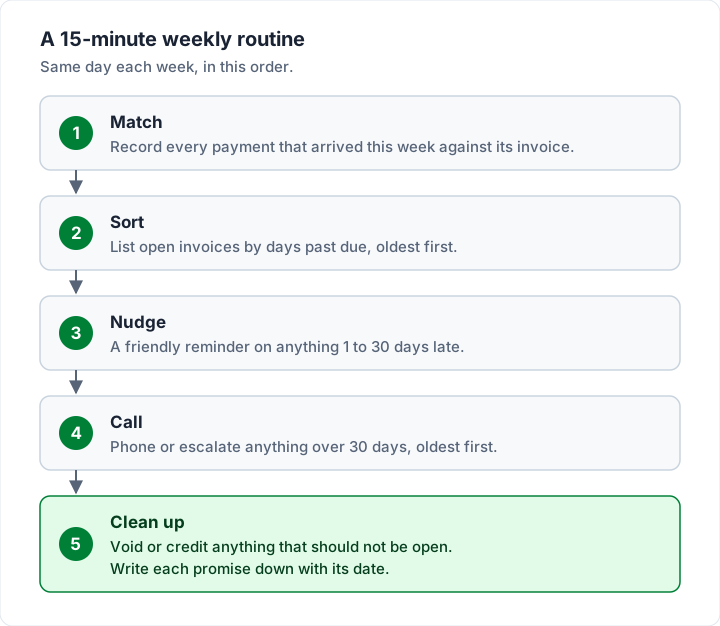
- Match payments. Go through your bank feed and payment apps and record every payment against its invoice. Do this first; it removes false alarms.
- Sort the list. Open invoices by days past due, oldest first.
- Nudge the recent ones. A short, friendly reminder for anything 1 to 30 days late. Our follow-up sequence for unpaid invoices has the wording.
- Call the old ones. Anything over 30 days gets a phone call or the next step on your escalation ladder. If your terms allow it, this is also when late fees on invoices come in.
- Clean up. Void or credit anything that should not be open, and write each promise down with its date ("will pay Friday 23 Oct").
If the same clients keep appearing in the over-60 buckets, change the terms for future work: a deposit invoice before you start, or shorter payment terms. Some businesses sell their open invoices to a factor instead of waiting; invoice factoring explained sets out what that costs.
Tracking open invoices in Charming, and what it does not do#
Charming Invoices covers most of this routine. Here is what it does, checked in our code on 22 October 2026:
- Dashboard tiles for "Outstanding" and "Overdue", next to "Paid this month" and "Drafts", so you see the open total when you log in.
- Invoice list filters for All, Draft, Issued, Partially paid, Overdue, Paid and Void. The "Overdue" and "Partially paid" statuses appear automatically: overdue when an issued invoice passes its due date with money owed, partially paid when your recorded payments cover part of the total.
- Partial payments, recorded with a date and a method (bank transfer, card, cash, check, online payment or other). The invoice closes as Paid when your recorded payments cover the total.
- A client statement PDF listing that client's open invoices with ageing buckets: current, 1-30, 31-60, 61-90 and 90+ days, per currency.
- Void, for a draft or issued invoice with no payments recorded, keeping its number.
- CSV export of your invoices, if you want to build the full report above in a spreadsheet. An invoice tracker in Excel or Google Sheets sets out the columns and formulas for that sheet, and the same tracker is a free Excel download.
The limits, plainly: payment tracking is manual (an invoice closes only when you record payments or mark it paid; Charming never sees your bank); there is no aged-receivables report across all clients on the dashboard (ageing is on each client's statement); the statement is a download, not emailed from the app; Charming does not email invoices or send reminders, so you send them and follow up from your own email; Charming has no credit notes; and invoices on the free plan carry a "Sent with Charming Invoices" line. The free plan has unlimited invoices and clients for 1 business.
If your open list lives in your head or your inbox today, create a free invoice, download the PDF and send it your way; the Overdue tile shows what is late. For the client statement itself, see what a client statement shows; if you keep statements in a spreadsheet, our free statement of account for Excel ages each invoice from the statement date.
Questions people ask#
What does open invoice mean?#
An open invoice is one you have sent that is not yet fully paid, voided or otherwise settled. It stays open until its balance is zero.
Is an open invoice the same as an outstanding invoice?#
Nearly. "Open" describes the invoice's state; "outstanding" usually describes the amount still owed on it. An open invoice with a partial payment has an outstanding balance smaller than its total.
Is a partially paid invoice open?#
Yes. It stays open until the rest is paid or settled another way.
What is an open invoice report?#
A list of every open invoice with its client, dates, total, amount paid, balance and days past due, usually grouped into ageing buckets. The worked example above is one.
How long should an invoice stay open?#
Until its due date, ideally. Anything past due needs a reminder; anything well past due needs a call or the next escalation step.
Can I close an invoice without payment?#
Only by voiding it (if it was wrong or cancelled and nothing was paid), issuing a credit note, or writing it off. Do not mark it paid.
The short version#
An open invoice is sent and not fully settled. Keep a list of them with the balance and days past due, group the balances into ageing buckets, and look at it once a week: match payments first, nudge the recent ones, call the old ones, and close anything that should not be open with a void, a credit note or a write-off. In our sample report, matching one unrecorded payment cut the open total from $9,565.00 to $8,590.00 before a single reminder went out. If some clients pay you through apps, our guides to the PayPal invoice and trucking invoice factoring cover two very different ways that money arrives.
Sources, checked 23 October 2026: IRS Publication 538, Accounting Periods and Methods; IRS Topic 453, Bad debt deduction.
Free downloads
No sign-up and no email address. More on the free templates page.
- Download .xlsx: Invoice tracker for Excel
Invoice tracker for Excel
Excel .xlsxEvery invoice you have sent on one sheet, with its balance, status and how many days late it is.
- Download .xlsx: Statement of account for Excel
Statement of account for Excel
Excel .xlsxFor a client with several unpaid invoices: one page listing each one, what is left and how late it is.