Paid invoice: when it counts as paid, and what to send

Nnabuike Okoroafor ·
On this page · 13 sections
The client says they have paid. Your bank shows something arriving, but not quite the full amount. Your invoicing tool still says “sent”, and the client has now asked for a receipt. Getting from “I've sent it” to “invoice paid” sounds like one step. In practice it is four or five, and most of the awkward moments in billing happen inside them.
This guide covers the whole stretch: when an invoice really counts as paid, how invoice payments work from sent to settled, what a paid invoice should show after partial payments, what to send the client once it is paid (with a confirmation email you can copy), how to mark an invoice paid in a spreadsheet or an app, and how long to keep paid invoices for tax records.
General information, not legal or tax advice. Where a rule is mentioned, we quote and link the official page; ask an accountant or lawyer about your own situation.
In short#
- An invoice is paid when the full balance has arrived in your account, not when the client says it is on its way. Until then it is open, even if part of it is paid.
- Partial payments reduce the balance; they do not close the invoice. It becomes paid on the day the last payment clears.
- Once it is paid, send the lightest thing that answers the client: a short confirmation email, a copy of the invoice marked paid, or a separate receipt if their employer or a tax rule needs one.
- Mark it paid with the date, amount, method and reference, so the record still makes sense in three years.
- Keep paid invoices for years, not months. Tax authorities set the period, and it differs by country and situation: the IRS, GOV.UK, the CRA and business.gov.au each say how long on their own pages, quoted below.
When is an invoice paid?#
An invoice is paid when the money owed on it has reached you in full: the balance is zero, and the funds are in your account rather than promised or in transit. That sounds obvious until you meet the cases in between. Here is how the common ones should be treated in your records:
| What has happened | Count it as paid? | Why |
|---|---|---|
| The client says “paid it this morning” | Not yet | Nothing has arrived. Record it when it does |
| A bank transfer shows as pending | Not yet | Pending transfers can still fail or be recalled |
| A check is in your hand, not yet cleared | Not yet | Checks can bounce. Record the payment once it clears |
| A card payment is approved, payout due in two days | Yes, usually | The client has paid; the processor owes you. Note the fee it keeps |
| Half the total has arrived | No: partially paid | The invoice stays open with a smaller balance |
| The full balance has arrived and cleared | Yes | Mark it paid with the date the last money arrived |
| The client paid less because a bank or processor took a fee | Often, yes | Many businesses treat the invoice as paid and the fee as a cost; ask your accountant how to record it |
| You agreed a reduction after sending | Not by payment | Settle it with a credit note for the reduction, then the payment for the rest |
Two rows deserve a word. A card payment can be disputed by the cardholder later, so “paid” is not the same as “beyond question”: keep the paid invoice and your proof of delivery together. And a reduction you agreed is not a payment at all; our guide to when to issue a credit note shows how to record it so your numbers still add up.
If you need the vocabulary for the states before “paid” (open, outstanding, overdue, past due), what an outstanding invoice means lays them out on one timeline. This post is about the end of that timeline. For what happens to the receivable in your books, see invoices in accounting.
How invoice payment works, from sent to paid#
Every invoice payment follows roughly the same path, whatever the payment method. The client receives your invoice, approves it (a person, or a company's accounts team), pays it by the method you offered, and the money arrives and clears. Then comes the step that is easy to skip: you record the payment against the right invoice. Only after that does your list of open invoices tell the truth.
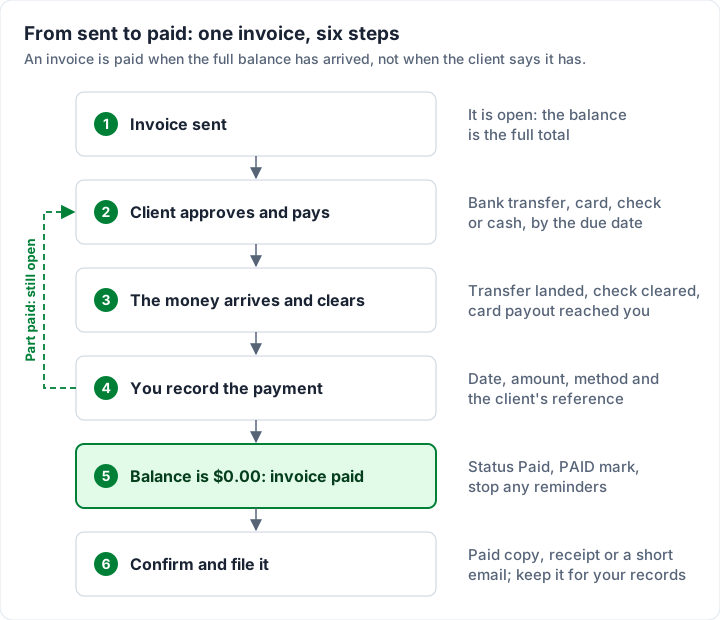
Step 4 is where most mistakes happen, because it relies on you. A payment in the bank with no matching invoice means whoever does your books has to stop, ask and come back to it, and if you pay them by the hour, that time is on your bill.
The fix is a habit, not a tool: record each payment the day you see it, against the invoice number it pays. If payments arrive in lumps or without a reference, our guide to invoice reconciliation covers matching bank deposits to invoices, including the awkward cases.
How the client pays affects how quickly money clears and what it costs you. Which invoice payment methods to offer compares bank transfer, card, check and payment links, and what Square, PayPal and Stripe charge per invoice works through the fees.
Partial payments: how an invoice gets to paid#
Many invoices are paid in more than one piece: a client spreads a large bill over a few weeks, pays what they agree with while querying a line, or pays from two accounts. Each payment lowers the balance. The invoice stays open until the balance reaches zero.
Here is a worked example. Every name and number is invented for illustration; the arithmetic is real.
Invoice INV-0215 from Kestrel Joinery (a sample business) to Harbour & Vale Interiors (a sample client), issued Monday 21 September 2026 on Net 30 terms, so due Wednesday 21 October 2026. No sales tax is shown, to keep the arithmetic plain.
| Description | Qty | Rate | Amount |
|---|---|---|---|
| Alcove shelving, built in | 2 | $1,150.00 | $2,300.00 |
| Window seat with storage | 1 | $950.00 | $950.00 |
| Paint finish and fitting | 1 | $350.00 | $350.00 |
| Total | $3,600.00 |
The client paid in three parts:
| Date | Payment | Method | Balance after | Status |
|---|---|---|---|---|
| Mon 21 Sep | (invoice issued) | $3,600.00 | Open | |
| Fri 2 Oct | $1,500.00 | Bank transfer | $2,100.00 | Partially paid |
| Fri 9 Oct | $1,000.00 | Bank transfer | $1,100.00 | Partially paid |
| Wed 21 Oct | $1,100.00 | Check, deposited Mon 19 Oct, cleared Wed 21 Oct | $0.00 | Paid |
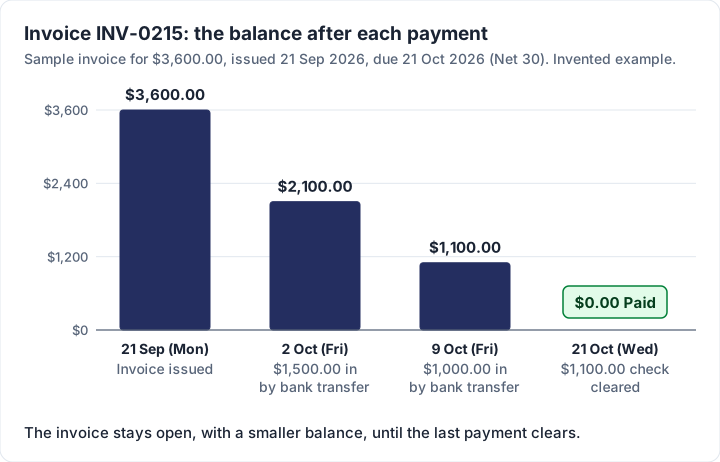
Three things to notice:
- The paid date is 21 October, the day the check cleared, not 19 October when it was deposited. That date is the one to record.
- It was paid on time. The due date was 21 October and the last payment cleared that day. A reminder sent on 20 October would have been correct; one sent on 22 October would have annoyed a client who had paid.
- Payments ($1,500.00 + $1,000.00 + $1,100.00) add up to the total of $3,600.00 exactly. If they do not, the invoice is not paid, however close it is.
If you plan staged payments from the start, a deposit invoice up front, then a balance invoice, is usually tidier than one invoice paid in pieces.
What a paid invoice should show#
A paid invoice is the original invoice, unchanged, with the payment information added: it says paid, it shows what arrived and when, and the balance is zero. It keeps the same number, so it matches the copy already in your client's files. You do not issue a new invoice to show that the old one is paid.
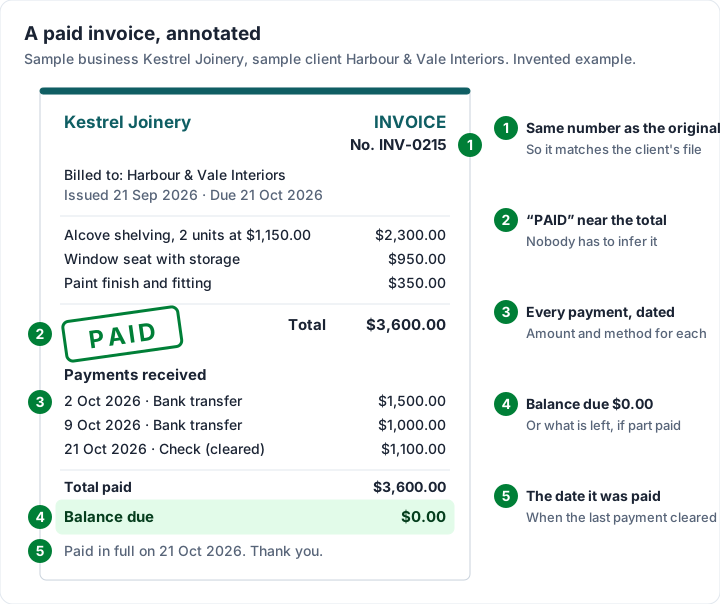
If you keep a paid invoice template, these are the fields it adds to an ordinary invoice:
| Field | Example (sample) | Why it is there |
|---|---|---|
| A clear “Paid” mark | PAID, near the total | Nobody has to work it out from the numbers |
| Each payment, with date and method | 9 Oct 2026, bank transfer, $1,000.00 | Shows how the balance reached zero |
| Total paid | $3,600.00 | Must equal the invoice total |
| Balance due | $0.00 | The single number that says it is settled |
| Date paid in full | 21 October 2026 | The date the last payment cleared |
| Payment reference (optional) | The client's transfer reference | Lets either side find the payment in a bank statement |
What a paid invoice should not do: change the line items, the total or the issue date. If something on the invoice was wrong, that is a credit note or a corrected invoice, not an edit to a paid one. Our guide to voiding, cancelling or correcting an invoice covers which to use.
What to send when an invoice is paid#
Many clients expect nothing when they pay, but a short note is good practice, and some need proof (an employer, a funder or a tax rule may ask for a receipt; the invoice vs receipt guide linked below covers it). Pick the lightest option that answers their question:
| Option | What it is | Best when |
|---|---|---|
| Payment confirmation email | A few lines: amount, date, invoice number, nothing outstanding | The client has not asked for anything; you want to close the loop |
| Invoice marked paid | The original invoice with the paid mark, payment dates and $0.00 balance | The client asked for proof, and an invoice marked paid will do |
| Separate receipt | A document that confirms payment and names the invoice it settles | An employer, funder or tax rule asks for a receipt specifically |
| The processor's receipt | The email a card processor or payment link sends the payer | The client paid by card through it; it may already be enough |
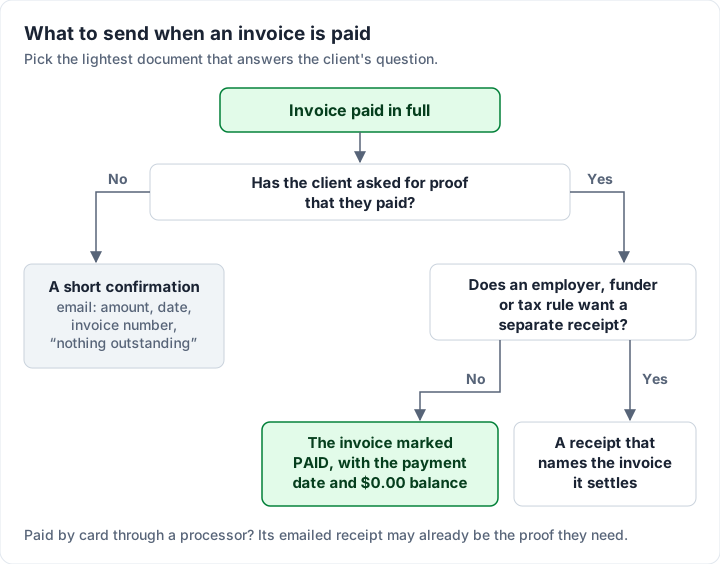
The difference between an invoice and a receipt, and when a paid invoice can stand in for one, is covered in depth in the difference between an invoice and a receipt. The short version: an unpaid invoice proves nothing about payment; an invoice clearly marked paid, with the date and a zero balance, usually works as the receipt.
A payment confirmation email you can copy#
This is a sample to adapt, not a quote from anyone. It uses the worked example above.
Subject: Payment received for invoice INV-0215, thank you
Hi Sam,
Thank you. Your payment of $1,100.00 for invoice INV-0215 cleared on 21 October 2026. With your earlier payments of $1,500.00 on 2 October and $1,000.00 on 9 October, the invoice is now paid in full: $3,600.00 received, nothing outstanding.
I have attached a copy marked paid for your records.
Best wishes, Kestrel Joinery
Keep it this short. Name the invoice number, the amount, the date and the words “paid in full” or “nothing outstanding”. If it was a partial payment, say what is left instead: “This leaves a balance of $1,100.00, due by 21 October 2026.”
A paid invoice receipt: what it needs#
If the client needs a separate receipt for a paid invoice, it does not have to be elaborate. Include your business name, the client's name, “Receipt” as the title, the amount received, the date received, the method, “for invoice INV-0215” and the balance remaining. A receipt that names the invoice is what ties the two documents together. Our invoice receipt template has filled samples and the wording, and a free receipt template for Excel (also in Word) works out the balance remaining for you.
How to mark an invoice paid#
Whatever you use to invoice, the steps are the same:
- Confirm the money has arrived and cleared. Look at the bank account or the processor's payout, not the client's email.
- Find the invoice it pays, by the invoice number in the payment reference, the amount or the client. If one payment covers several invoices, split it before you record anything.
- Record the payment against that invoice: amount, date received, method and the client's reference.
- Check the balance. Zero means paid. Anything else means partially paid, and the invoice stays open.
- Stop any reminders for that invoice, then send a confirmation if it helps (see above).
How that looks in practice depends on the tool:
- A spreadsheet: add “Amount paid”, “Date paid” and “Balance” columns to your invoice list, with Balance = Total minus Amount paid. Sort or filter on Balance greater than zero to see what is still open. Our free invoice tracker for Excel has paid, balance and status columns ready-made. Our guide to creating an invoice in Excel covers the invoice itself.
- Accounting software with a bank feed: you usually match the deposit in the bank feed to the open invoice, which records the payment and marks it paid in one move. The same matching is what an open invoices list relies on.
- A payment processor's own invoices: when the client pays through the processor's invoice page, the invoice usually updates itself. Payments made outside it, by bank transfer or check, still have to be recorded by hand. Our guides to Square invoices and QuickBooks invoices show where each one's mark-paid step sits.
Do not mark an invoice paid to make a list look shorter. If the client is not going to pay, that is not a payment; ask your accountant whether to write it off or issue a credit note. A false “paid” hides the debt from you and makes your records wrong.
When a client pays twice, or pays too much#
It happens: a client pays the invoice and also the reminder, or pays a rounded-up figure. The invoice is still simply paid; what you do with the extra is a separate question.
- Tell the client what arrived and what the invoice was for, with both dates.
- Agree what happens to the extra: a refund, or a credit against their next invoice. Put the agreement in writing.
- Record it as what it is. A refund goes back out as a payment from you. A credit is often recorded with a credit note; when to issue a credit note covers how.
Do not raise the invoice total to match the overpayment, and do not leave the extra sitting unrecorded. Both make the account hard to follow later.
Can you edit or undo a paid invoice?#
Do not edit a paid invoice's lines or total. The client has already filed it, and both copies should match. If the work or price was wrong, issue a credit note or a corrected invoice and explain the change.
Undoing a payment you recorded by mistake is different and usually fine: remove or reverse the payment, and the invoice goes back to open with its full balance. A good tool keeps a log of that change; Charming does (see below).
How long to keep paid invoices#
Paid invoices are part of your tax records: they support the income you report. The IRS's Publication 583 (revised December 2024) lists invoices, bank deposit slips and receipt books among the documents that show gross receipts. How long to keep them depends on where you are taxed and your situation, so here is what each tax authority's own page says, quoted as of 23 October 2026:
| Where | What the official page says | Source |
|---|---|---|
| United States | “Keep records for 3 years if situations (4), (5), and (6) below do not apply to you.” The longer situations include 6 years, 7 years and “indefinitely” | IRS: How long should I keep records? |
| United Kingdom, self-employed | “You must keep your records for at least 5 years after the 31 January submission deadline of the relevant tax year.” | GOV.UK: business records if you're self-employed |
| United Kingdom, limited companies | “You must keep records for 6 years from the end of the last company financial year they relate to, or longer if:” the page then lists four cases | GOV.UK: company and accounting records |
| Canada | “Generally, you must keep all required records and supporting documents for a period of six years from the end of the last tax year they relate to.” | CRA: how long to keep your records |
| Australia | “You need to keep most business records for 5 years.” | business.gov.au: record keeping |
Each page has exceptions the table cannot hold. The IRS page, for example, words its rule around the “period of limitations” and lists longer periods for some situations, including “Keep records for 7 years if you file a claim for a loss from worthless securities or bad debt deduction.” GOV.UK gives its own example for the self-employed rule: “If you sent your 2022 to 2023 tax return online by 31 January 2024, you must keep your records until at least the end of January 2029.”
Sales tax, VAT and GST records, employment records and property records can have their own periods, and rules change. Read the page for your country, and ask your accountant or the tax authority how long to keep your own records.
A practical point: keep the paid invoice and the evidence of payment together (the bank statement line, the processor's payout, a copy of the check), or at least make sure the invoice number connects them. Records that can be matched up years later are what makes them useful.
Paid invoices in Charming, and what it does not do#
Here is what Charming Invoices does with payments, checked in our code on 22 October 2026. All of it is on every plan, including the free one.
- “Record payment” and “Mark as paid”. Record a payment with its amount, date, method (bank transfer, card, cash, check, online payment or other) and an optional note for the reference. “Mark as paid” records whatever is still owed in one click. Partial payments keep the invoice open as partially paid.
- Paid at zero balance. The status becomes Paid when your recorded payments cover the total, and the paid date is the date of the payment that settled it.
- A “PAID” mark on the PDF of a paid invoice, on by default. You can turn the paid stamp off in your template.
- The private link updates. Your client's link shows “Paid in full — thank you!” once it is paid, or the amount already paid and what is still due after a partial payment.
- A CSV export of your invoices includes Amount paid, Balance due and Paid at columns, for your accountant or your own records.
The limits, plainly. Payment tracking is manual: Charming never sees your bank and never moves money, so an invoice becomes paid only when you record the payment. It does not process card payments; a payment link you add to your invoices goes to your own provider. It does not send a payment-received email or produce a separate receipt, so send your own confirmation (the sample above) with the PDF attached. The PDF shows the PAID mark but not a list of individual payments, so put the payment dates in your email. A payment cannot be recorded for more than the balance, so an overpayment has to be handled outside the app, and Charming has no credit notes. Issued and paid invoices cannot be edited, by design; if you recorded a payment by mistake, “Mark as unpaid” removes the recorded payments and keeps the change in the activity log. Free-plan invoices carry a “Sent with Charming Invoices” line, and the free plan covers 1 business with unlimited invoices and clients.
If you want the paid state handled for you, down to the stamp on the PDF, create a free invoice and mark it paid when the money lands.
Questions people ask#
Is a paid invoice the same as a receipt?#
Not quite, but it often does the same job. An invoice marked paid, with the date and a zero balance, is usually enough for a client who wants proof of payment. If someone specifically needs a receipt document, send one that names the invoice. Invoice vs receipt covers the difference.
What does “invoice paid” mean on my statement or in my app?#
It means the full balance of that invoice has been recorded as received. It says nothing about when the money will reach you if a processor is still holding a payout, so check your bank too.
Should I send the client a copy of the paid invoice?#
Only if they ask, or if it helps them: individuals claiming expenses often do. A short confirmation email is enough for most business clients.
Can I mark an invoice paid before the money clears?#
You can, but we would not. A check can bounce and a transfer can be recalled. Recording the payment on the day it clears keeps your records true.
What if the client paid the wrong invoice?#
Record the payment against the invoice they meant to pay, once they confirm which one, and tell them. If they paid an invoice that was already settled, treat it as an overpayment.
Is an invoice payment the same as a paid invoice?#
An invoice payment is one amount of money arriving against an invoice. A paid invoice is the result once those payments add up to the total. One invoice can have several payments.
The short version#
An invoice is paid when the full balance has arrived and cleared. Until then it is open, however much of it is paid. Record each payment against the invoice it pays, with the date, method and reference; mark it paid on the day the last money clears; send a short confirmation, or a copy marked paid if the client wants proof; and keep it, with the payment evidence, for as long as your tax authority asks. For what comes before “paid”, see what an invoice is and how it works, and if a client has several invoices open at once, a client statement shows them all on one page.
Sources, checked 23 October 2026: IRS, How long should I keep records? (page reviewed 30 June 2026); IRS Publication 583, Starting a Business and Keeping Records (revised December 2024); GOV.UK, Business records if you're self-employed: how long to keep your records; GOV.UK, Running a limited company: company and accounting records; Canada Revenue Agency, Where to keep your records, for how long and how to request permission to destroy them early; business.gov.au, Record keeping.
Free downloads
No sign-up and no email address. More on the free templates page.
- Download .xlsx: Receipt template for Excel
Receipt template for Excel
Excel .xlsxConfirm a payment: paid in full, a part payment against an invoice, or a cash sale with change.
- Download .docx: Receipt template for Word
Receipt template for Word
Word .docxThe same receipt as a Word document, for people who would rather type than use cells.
- Download .xlsx: Invoice tracker for Excel
Invoice tracker for Excel
Excel .xlsxEvery invoice you have sent on one sheet, with its balance, status and how many days late it is.