Invoice payment methods: what to offer and how to list them

Nnabuike Okoroafor ·
On this page · 10 sections
In short
- Offer bank transfer first and one card option second. That covers almost every client, and it puts the cheapest method where clients look first.
- Print the exact details the client's bank will ask for. US: account name, routing number, account number. UK: account name, sort code, account number. International: account name, IBAN and BIC/SWIFT.
- Always ask for a reference. The invoice number as the payment reference is what lets you match money to invoices.
- Write down how bank details change. Invoice-redirection fraud works by sending a client "new" bank details. A one-line rule on the invoice helps them refuse it.
- Speed and cost differ a lot by method. The table below uses figures from official pages only, dated October 2026.
You have the invoice ready and one section left: how the client actually pays you. Choosing an invoice payment method sounds like a formality until a client writes back asking for your routing number, a company's accounts team rejects your PDF because the bank details are incomplete, or a payment lands with no reference and you cannot tell which invoice it was for.
This guide covers which payment methods to offer, exactly what to print for each one (by region), how to word the instructions so clients get them right the first time, what changes for international clients, and how to keep your bank details from being used against you. There is a worked example of a full invoice footer near the end that you can copy.
General information, not legal, tax or financial advice. Payment-system facts below are quoted from official pages and linked.
Which invoice payment method should you offer?#
Most people who bill clients need two methods, not six: a bank transfer and one card or online option. The right pair depends on who is paying, where they are and how large the invoice is.
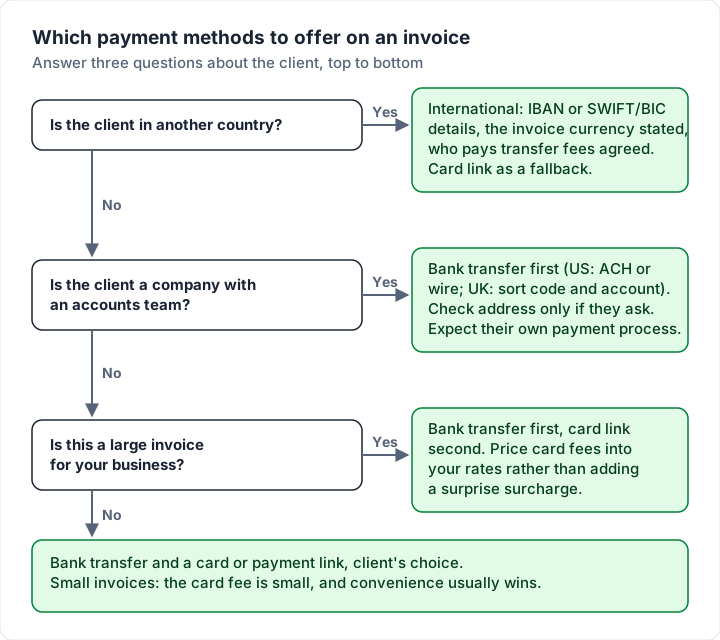
Here is how the common methods compare from the point of view of the person being paid:
| Method | Suits | What you print on the invoice | Main drawback |
|---|---|---|---|
| Bank transfer (ACH in the US, Faster Payments or Bacs in the UK, SEPA in Europe) | Almost every client, especially companies | Account name and the local bank identifiers | The client types your details; matching money to invoices is your job |
| Wire transfer | Large or international payments | Account name, routing number or IBAN, BIC/SWIFT, sometimes the bank's address | Fees on both sides, and a wire is hard to reverse if sent to the wrong account |
| Card or online payment link | Individuals, small invoices, clients who want to pay now | A link from your payment provider | The provider takes a fee on every payment |
| Check | Clients whose accounts teams still pay by post | Who to make it payable to and a mailing address | Slow, and you have to deposit it |
| Payment apps (for example PayPal or Venmo) | Individuals who already use them | Your business handle or a link | Fees and terms set by the app; check that business clients can pay this way |
One person in a public discussion about invoicing (not a Charming customer) described a mix that will sound familiar:
I don't mind the credit card fee for the customers convenience if that's what they want. I typically prefer check. I don't know how to do ACH just yet to be honest.
If ACH is the unknown part for you too, the next two sections cover what it costs, how long it takes and exactly what to put on the invoice. If clients would rather pay by app, Venmo and Zelle invoices explains what each app records and what to print on the invoice.
Cost and speed of each payment method#
Every figure in this table comes from the operator's or regulator's own page, checked on 22 October 2026, with the quoted lines re-read on 23 October 2026. Where an official page gives no fee, the table says so instead of guessing: what your bank charges to receive a transfer is on its own fee schedule.
| Method | How fast (official source) | What it costs you |
|---|---|---|
| US ACH credit from the client's bank | Nacha says ACH credits "can settle the same day, the next banking day, or in two banking days" | Set by your bank; check its fee schedule |
| US domestic wire (Fedwire) | The Federal Reserve calls Fedwire transfers "immediate, final, and irrevocable once processed", Monday to Friday | Set by your bank; ask what it charges for incoming wires |
| UK Faster Payments | Pay.UK: "real-time payments of up to £1m", "available day and night, 365 days per year" (individual banks set their own limits) | Set by your bank |
| Euro SEPA Instant | European Payments Council: funds available "in less than ten seconds", 24/7/365 | Set by your bank |
| Card via PayPal invoicing (US) | Payout timing set by PayPal | 2.99% + $0.49 per card payment; +1.50% for international invoices |
| Card via Stripe (US) | Payout timing set by Stripe | 2.9% + 30¢ per domestic card; +1.5% for international cards |
| ACH through PayPal or Stripe (US) | Payout timing set by the provider | PayPal Pay by Bank: 1%, capped at $10.00. Stripe ACH Direct Debit: 0.8%, capped at $5.00 |
| Check | Deposit holds vary; the CFPB's page on check holds explains how long a deposit can take to clear | Usually your time and postage; check your bank's fees |
Sources: Nacha on how ACH payments work, the Federal Reserve on Fedwire, Pay.UK on Faster Payments, the European Payments Council on SEPA Instant, PayPal business fees (page marked last updated 1 October 2026), Stripe pricing and the CFPB on check holds. Fees and limits change, so treat this as the state of things in October 2026.
On a $4,200.00 invoice, a card payment through PayPal invoicing costs $126.07 (2.99% plus $0.49), while PayPal's capped bank option costs $10.00. Our breakdown of the Square, PayPal and Stripe invoice fees works these out at three invoice sizes and lists where to check before surcharging.
How to put bank details on an invoice, by region#
The payment section should contain exactly what the client's bank form will ask for, in the order it asks. Missing one item, such as the account name or the account type, is a common reason a client writes back instead of paying.
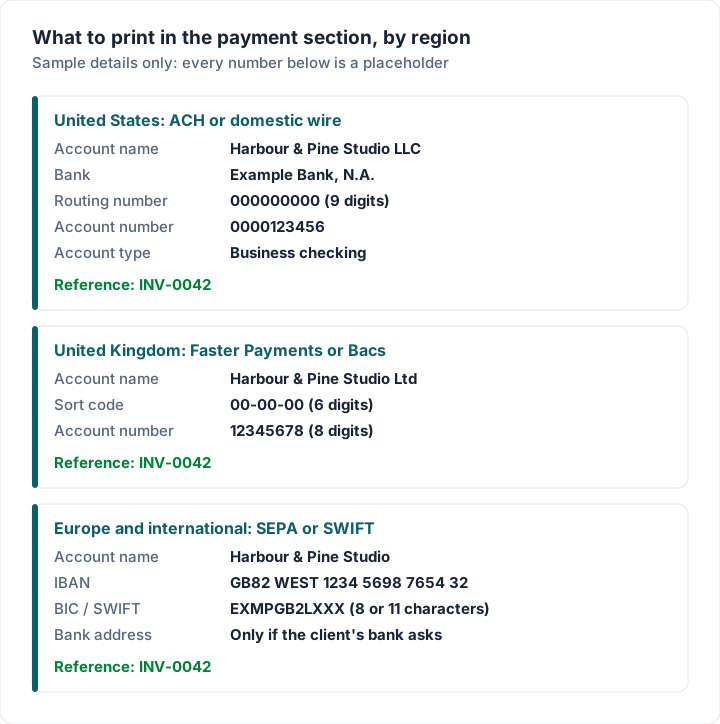
US: ACH invoice and wire transfer invoice details#
An ACH invoice is simply an invoice that asks the client to pay by ACH bank transfer. For a US client, print:
- Account name: the legal name on the account, exactly as your bank has it.
- Bank name.
- Routing number: the nine-digit number that identifies your bank. The Federal Reserve's Regulation CC routing number guide describes this "nine-digit form" and explains that its first two digits identify the Federal Reserve District.
- Account number.
- Account type: checking or savings. Many bank forms ask.
For wire transfer invoice details, ask your bank which routing number to give for incoming wires and whether it wants its own name and address included. Print what it tells you rather than reusing the ACH line by habit. For an international client wiring to a US account, add your bank's SWIFT code.
UK: sort code and account number#
A UK client paying by Faster Payments or Bacs needs the account name, the six-digit sort code and the account number. HMRC's own payment page is a good model of the layout: sort code written in pairs, an eight-digit account number, the account name, and a separate block with the IBAN and BIC for overseas payers.
The account name matters more in the UK than people expect. Pay.UK's Confirmation of Payee is "an account name-checking service" designed "to help reduce misdirected payments". If the name on your invoice does not match the name on your account, the client's bank may warn them before they pay. Write it exactly as your bank holds it, including "Ltd" or a trading name if that is how the account is set up.
Europe and international: IBAN and SWIFT/BIC#
For clients in Europe and most other countries, print your IBAN and BIC. The IBAN identifies the account; the BIC (also called the SWIFT code) identifies the bank. The Banco de España explains that a SWIFT code "normally comprises eleven characters, although on occasion there may only be eight", and that “In February 2016, the SWIFT code was replaced by the IBAN for transactions within the Single Euro Payments Area (SEPA).” The same page also tells payers to give their bank both the IBAN and the SWIFT code for an EU transfer to cost the same as a domestic one, so print both.
Print the IBAN in groups of four characters, as banks do. It is far easier to copy correctly than one 22-character string.
Checks#
If you accept checks, print two things: who the check should be made payable to (the exact name on your account) and the mailing address. Add the invoice number as something to write on the memo line. If you would rather not take checks, simply leave them off: clients usually use what the invoice offers. Our guide to remittance on an invoice covers the full remit-to block.
Card payments and payment links#
To let a client pay an invoice with a credit card, you need a payment provider that gives you a link, such as PayPal, Square or Stripe. Print the link in the payment section and, if you email the invoice, put it in the email too. Our post on how to email an invoice has wording for that email. If the client wants a PayPal invoice instead of a link, how a PayPal invoice works walks through sending one and what it costs, and our Stripe invoice guide does the same for Stripe, including when a Stripe Payment Link is enough. If you sell through a Shopify store, a draft-order invoice sends the customer a Shopify checkout link instead; Shopify invoices walks through it.
The fee comes out of what you receive, not what the client pays, unless you add a surcharge. Surcharging is a rules question (card networks, your processor and, in some places, the law); pricing the fee into your rates is usually simpler.
How to word payment instructions on an invoice#
Good payment instructions on an invoice answer four questions in a few lines: how much, by when, how, and with what reference. Put the method you prefer first and say it is preferred.
Copy and adapt the version that fits:
US client:
Payment due by 2 December 2026. Please pay by bank transfer (ACH),
quoting INV-0042 as the reference.
Account name: [legal name] · Bank: [bank name]
Routing: [9 digits] · Account: [number] · Type: business checking

UK client:
Payment due within 30 days. Please pay by bank transfer to
[account name], sort code [00-00-00], account [8 digits],
using INV-0042 as the reference.

International client:
Amount due: [amount and currency, e.g. EUR 3,850.00].
Please pay by bank transfer to [account name],
IBAN [in groups of four], BIC [8 or 11 characters].
Reference: INV-0042. Transfer fees are paid by the sender.
A few wording rules make the difference:
- Name the reference. "Please use INV-0042 as the payment reference" works better than "quote the invoice number", because it leaves nothing to interpret. If your numbering is messy, how to number invoices helps, and our free invoice number generator gives you a sequence to start from.
- Give a date, not only a term. "Due by 2 December 2026" is harder to misread than "net 30". The invoice due date calculator works the date out, and invoice payment terms explains the terms themselves.
- Say what happens to fees. "Transfer fees are paid by the sender" or "card fees are included in our rates" settles the question before it is asked.
- Keep it short. One block, in the same place on every invoice. Clients who pay you regularly learn where to look.
Worked example: an invoice footer with payment instructions#
Here is a sample invoice for an invented business, Harbour & Pine Studio, billing an invented client, Northwind Logistics Ltd. Every name and number is an example.
| Description | Qty | Rate | Amount |
|---|---|---|---|
| Brand identity design | 1 | $2,400.00 | $2,400.00 |
| Website copy, per page | 12 | $150.00 | $1,800.00 |
| Amount due | $4,200.00 |
Invoice INV-0042, issued 2 November 2026, due 2 December 2026 (30 days). No tax applies in this example; whether yours needs tax is a question for your accountant.
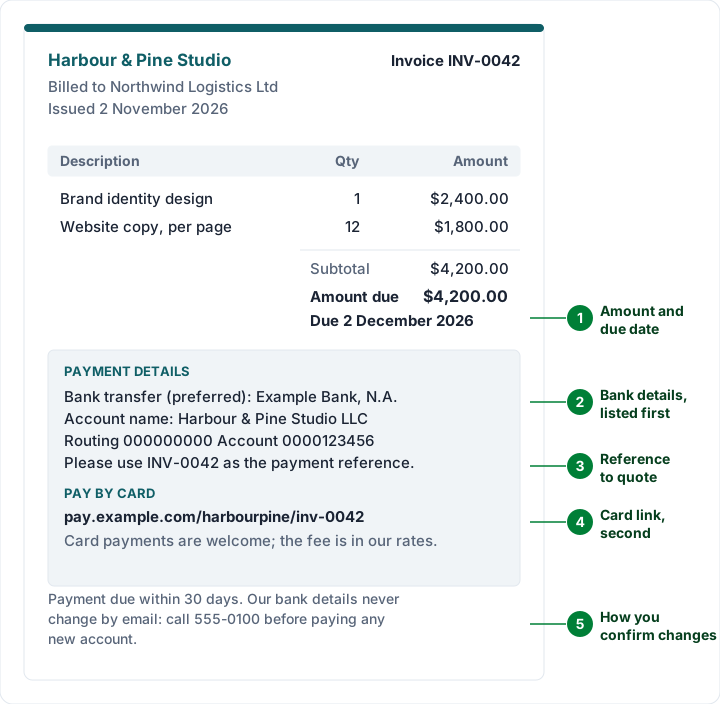
The footer does five jobs, in this order:
- Amount and due date sit right above the payment section, so nobody has to scroll back up.
- Bank details come first, marked preferred, with the account name, routing number and account number on their own lines.
- The reference to quote is the invoice number, written out in full.
- A card link comes second, with one line on fees, for the client who would rather pay now.
- A line on changes tells the client your bank details never change by email and gives a number to call. That one line is the cheapest fraud protection you can add.
For the rest of the invoice, how to make an invoice walks through every field, and if the client is a company with its own accounts process, invoicing a company covers purchase orders, supplier forms and who to send it to.
Invoicing an international client: what to include#
International payments fail for small reasons: the wrong currency, a missing BIC, fees deducted on the way that leave the invoice short. Agree these before the work starts, then print them on the invoice:
| Item | What to put on the invoice | Why it matters |
|---|---|---|
| Currency | The currency code next to every amount (EUR 3,850.00, not 3,850) | A bare number invites the client to pay in their own currency |
| Account identifiers | IBAN and BIC, or local details if you have a local account | Without them the client's bank cannot send the payment |
| Who pays fees | "Transfer fees are paid by the sender", or whatever you agreed | Otherwise fees may be taken from the amount you receive |
| Your full business name and address | As registered | Company accounts teams often need them to set you up as a supplier |
| Client's legal name and address | As their accounts team gave it | Companies match invoices to their own supplier records |
| Reference | The invoice number | The same reason as at home, only more so |
Ask your own bank what it charges to receive an international payment, and whether a local-currency account would be cheaper for clients who pay you often. Rules on invoices, tax and cross-border payments differ by country, so ask your accountant what applies to you.
Keeping payment details safe: invoice fraud and changed bank details#
Putting your bank details on an invoice is normal. Your clients cannot pay you without them. The risk is less that someone sees your account number and more that someone pretends to be you and gives your client a different one.
This is business email compromise. The FBI's Internet Crime Complaint Center reported $55,499,915,582 in exposed losses from business email compromise between October 2013 and December 2023, and advises using "secondary channels and/or two-factor authentication to verify requests for changes in account information". The FTC's business email imposters guidance describes how scammers "often mimic a recognizable email address to make it look like it's coming from a trusted source", and suggests: “Remind customers that you'll never ask them in an email or text for their credit card or bank account number.” The FTC's guide to scams and your small business adds that phony invoices are designed to look like something you ordered, so whoever pays the bills assumes they are real. Our guide to spotting fake invoices and invoice scams covers those scams from both sides, with checks to run before paying and where to report one.
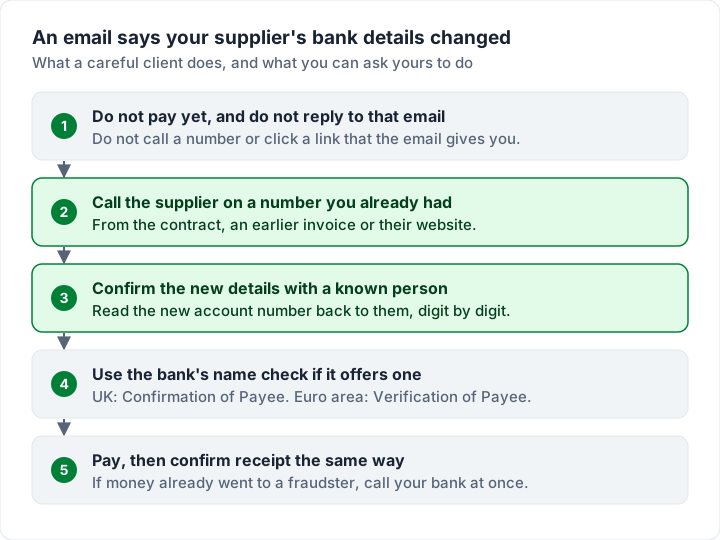
What you can do as the person being paid:
- Keep your details the same. Every change is a chance for a mistake. If you must change accounts, tell clients by phone or in person as well as in writing.
- Put your change rule on the invoice. "Our bank details never change by email; call [number] before paying any new account" gives an accounts team a reason to stop.
- Send invoices from one address, consistently. A client who always gets invoices from the same address is more likely to notice an odd one.
- Use the name check that exists. In the UK, keep your account name matching Confirmation of Payee. In the euro area, the European Payments Council's Verification of Payee scheme lets payers "check that the name and IBAN of a payee match before making a payment".
- Consider a separate account for client payments. Ask your bank what protections it offers on accounts whose details you share, such as alerts or blocks on unexpected debits.
- Report it. In the US, fraud goes to ReportFraud.ftc.gov and to the FBI's IC3, and the first call is to your bank.
How to get paid by invoice: from sent to paid#
The payment section is one step in a short chain. Each link affects whether the money arrives on the date you wrote.
- Agree the method and terms before the work. Put them in the quote or contract, and ask for a deposit on larger jobs.
- Send the invoice the day the work is delivered, with the payment details inside the invoice, not in a separate message. Our guide on how to invoice as a freelancer covers timing.
- Make paying easy: the preferred method first, a reference, and a link for those who want to pay by card.
- Record the payment when it arrives, matched by its reference, and send a receipt if the client wants one (invoice vs receipt explains the difference).
- Follow up on the due date if nothing has arrived. Our follow-up emails for overdue invoices give the wording for each stage.
Nothing on this list guarantees a client pays on time. It removes the reasons a willing client might not.
Payment details on an invoice in Charming#
Charming Invoices prints your payment details on every invoice; it does not process payments. Here is what it does, checked in our code today, with the catches next to each part:
- Bank details and a payment link print in the invoice's payment section. Each business has a bank details box (free text, so you can list ACH, wire and IBAN details together) and a payment link field for a link you created with PayPal, Square, Stripe or similar. Both are copied onto the invoice from your business settings each time you save it, and the issued invoice keeps its own copy. The catch: the bank details live on the business and are not edited per invoice, so a client who needs different details means changing the business setting before you save (or re-save) their invoice.
- The client gets an "Open payment link" button on the invoice's private link, where it shows until the invoice is marked paid. The catch: clients cannot pay by card through Charming itself. Whatever your provider charges on its link is what you pay.
- Default terms and footer notes. Each business has default terms and footer notes, copied onto every new invoice, where your due-date wording and the "bank details never change by email" line can live. You can edit them on any invoice.
- Payments are recorded by hand. When money arrives, you mark the invoice paid or record a partial payment, with the method (bank transfer, card, cash, check, online payment or other). Charming does not read your bank account, so nothing marks itself paid.
- Overdue invoices are flagged. An issued invoice past its due date shows as Overdue. The catch: Charming does not email invoices or send reminders. You download the PDF or copy the private link and send it yourself, and follow up from your own email.
The free plan covers 1 business with unlimited invoices and clients, and free invoices carry a small "Sent with Charming Invoices" line. Each business invoices in one of 16 currencies at a time. You can change it on any plan (issued invoices keep their currency); to bill in two currencies side by side, with separate bank details, add a second business on a paid plan (from $29 once, on the pricing page). Invoice currency walks through billing a client abroad. If you want to see the layouts first, browse the invoice templates.
Create a free invoice with your bank details listed first and your reference rule in the terms.
Frequently asked questions#
Is it safe to put bank details on an invoice?#
It is normal and necessary for bank transfers: the client cannot pay without them. The bigger risk is someone impersonating you with different details, so state on the invoice that your details never change by email, and keep a consistent sending address.
What is an ACH invoice?#
An invoice that asks the client to pay by ACH bank transfer in the US. It lists your account name, bank, nine-digit routing number, account number and account type, plus a reference. It can also carry an ACH payment link from a provider such as PayPal or Stripe, which charges a capped fee.
Can a client pay an invoice with a credit card?#
Yes, if you give them a way to: a payment link from a provider such as PayPal, Square or Stripe, printed on the invoice. The provider charges you a fee on each payment, as of October 2026 about 3% of the invoice on the US card rates above. How a Square invoice reaches the client and what Free and Plus include is covered in our Square invoice guide.
Do I need a SWIFT code for an IBAN payment?#
Banco de España says the IBAN replaced the SWIFT code for transactions within SEPA in 2016, but the same page tells payers to give their bank both codes for an EU transfer. Printing both does no harm; your bank can tell you what it needs.
What should the payment reference be?#
The invoice number, written exactly as it appears on the invoice. It is unique, it is already on the client's copy and it lets you match the payment in seconds. See outstanding vs overdue vs unpaid invoices for keeping track of what is still owed.
Sources, checked 22 October 2026, with the Nacha, Federal Reserve, Pay.UK, European Payments Council, Banco de España, IC3 and FTC quotes re-read 23 October 2026: Nacha, how ACH payments work; Federal Reserve, Fedwire Funds Service; Federal Reserve, Regulation CC Appendix A; Pay.UK, Faster Payments; Pay.UK, Confirmation of Payee; GOV.UK, HMRC bank details; European Payments Council, SEPA Instant and Verification of Payee; Banco de España, SWIFT code; FBI IC3 PSA I-091124; FTC, business email imposters; FTC, scams and your small business; CFPB, check holds; PayPal business fees; Stripe pricing.