What an outstanding invoice means

Nnabuike Okoroafor ·
On this page · 8 sections
You sent the invoice. The money has not arrived. Somewhere between those two facts sit five words that people use as if they mean the same thing: outstanding, unpaid, overdue, past due and delinquent. They do not, and the difference decides whether you should wait, send a polite note or start being firm.
The short version: an outstanding invoice means one you have sent that still has money owing on it. That is all. It does not mean late. A client can have an outstanding invoice for three weeks and be doing nothing wrong, because the due date has not arrived yet.
This post defines each word, walks one example invoice through every state on a timeline, and says what each state means for what you do next. It is general information, not legal or tax advice.
What an outstanding invoice means#
An invoice is outstanding from the moment you send it until the full amount is paid. If your client pays part of it, the invoice stays outstanding for the rest. The outstanding amount is the total minus whatever has been paid so far. When an invoice counts as paid covers what happens at the other end.
Two things make an invoice stop being outstanding:
- It is paid in full. Every cent of the total has arrived.
- It is cancelled. You void it, or replace it with a corrected one, so nothing is owed on it any more.
A draft you have not sent is not outstanding, because your client has not been asked to pay it. In bookkeeping terms, your outstanding invoices are your accounts receivable: money you have earned and not yet collected.
What does outstanding mean on an invoice itself?#
Sometimes you see the word printed on the document rather than used about it. “Balance outstanding” or “Amount outstanding” on an invoice or a statement is the figure still owed after any payments and credits. On a fresh invoice it equals the total. On a part-paid one it is smaller, and it is the number your client should actually pay.
Outstanding, unpaid, overdue, past due and delinquent, side by side#
Here is what each word tells you, and what it does not.
| Word | What it means | Is the client late? |
|---|---|---|
| Outstanding | Sent, and some or all of it is still owed | Not necessarily |
| Unpaid | Sent, and nothing has been paid yet | Not necessarily |
| Overdue | Money still owed after the due date | Yes |
| Past due | The same as overdue | Yes |
| Delinquent | Seriously overdue, by someone's definition | Yes, and for a while |
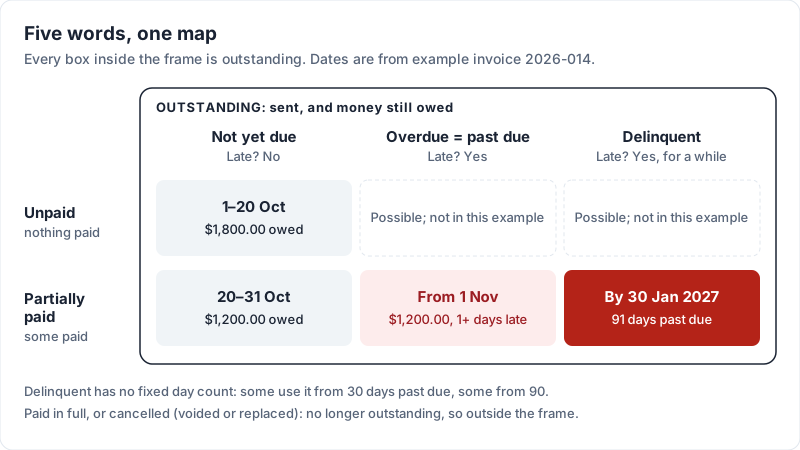
The words describe two different things: how much has been paid, and whether the due date has passed. Mapped against each other, with dates from the example invoice used later in this post, they look like this.
Unpaid invoices vs outstanding invoices#
“Unpaid” is the narrower word. An invoice with nothing paid against it is both unpaid and outstanding. An invoice where the client paid half is outstanding but, strictly, partially paid rather than unpaid. In everyday speech people use “unpaid invoice” for both, which is fine between friends and less fine in a reminder, where “the remaining balance of $1,200.00” is clearer than “your unpaid invoice”.
Overdue and past due are the same thing#
There is no difference in meaning: an overdue invoice and an invoice that is past due are the same invoice. “Past due” is more common in American usage and in banking; “overdue” is more common in British English. Both mean the due date has passed and money is still owed. Pick one and use it consistently with each client.
Delinquent is a judgement, not a date#
“Delinquent” is the word lenders and accounts departments use for an account that is badly behind. There is no universal number of days attached to it. Some businesses use it from 30 days past due, some from 90, and some only once they have given up asking. Treat it as an internal label. It is not a word to put in an email to your client.
A worked timeline: one invoice, every state#
To make this concrete, follow one example invoice through its life. The numbers are illustrative.
Invoice 2026-014 for $1,800.00, issued on 1 October 2026 on Net 30 terms, so it is due on 31 October. The client pays $600.00 on 20 October and then goes quiet.
| Date | What happened | Amount outstanding | State |
|---|---|---|---|
| 1 October | Invoice sent | $1,800.00 | Outstanding, unpaid, not due |
| 20 October | Client pays $600.00 | $1,200.00 | Outstanding, partially paid, not due |
| 31 October | Due date | $1,200.00 | Outstanding, due today, not late yet |
| 1 November | Day after the due date | $1,200.00 | Overdue (1 day past due) |
| 1 December | No further payment | $1,200.00 | Overdue (31 days past due) |
| 30 January 2027 | Still nothing | $1,200.00 | Overdue (91 days past due), delinquent by most definitions |
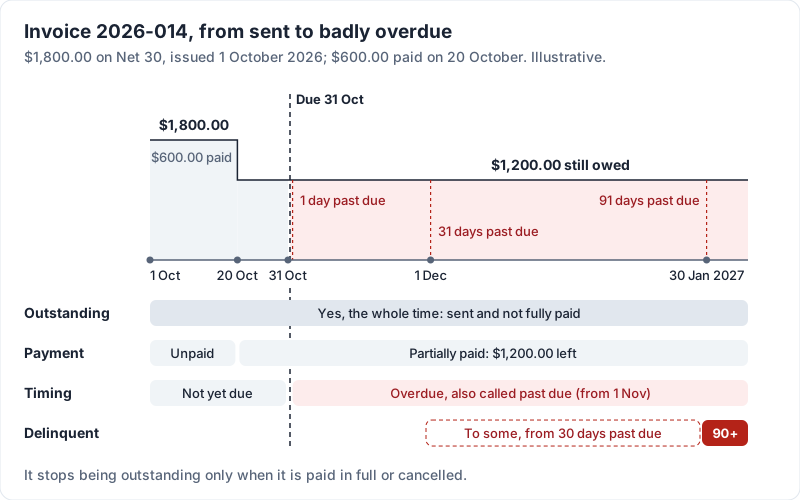
Notice how long the invoice was outstanding before it was late: a full month. That gap is where most of the confusion comes from. Someone in our research, which draws on public online discussions (the people quoted are not Charming customers), described an invoice in exactly that position:
Hi there... we did about $2400 worth of work for a client who hasn't paid the invoice for over a month now (it's 13 days late).
Outstanding for over a month, overdue for 13 days. Both true at once, and the second number is the one that matters for what happens next.
If your invoice has no due date at all, “overdue” becomes hard to argue. Some places have rules for this. In the UK, for example, GOV.UK's page on late commercial payments says: “If you do not agree a payment date, the law says the payment is late 30 days after either:” “the customer gets the invoice” or “you deliver the goods or provide the service (if this is later)” (as of 23 October 2026). Rules differ elsewhere and change, so the safer habit is to print a real date on every invoice. Your first invoice: what actually has to be on it covers how to pick one.
What to do about an outstanding or overdue invoice#
The state of the invoice tells you how firm to be. Here is a reasonable sequence, using the timeline above. If the client has stopped answering altogether, what to do when a client is not paying an invoice takes it from there.
- Outstanding, not yet due. Nothing to chase. If the invoice is large or the client is new, a short check that it reached the right person is worth sending in the first few days. Accounts departments lose invoices sent to the wrong inbox.
- A few days before the due date. Optional, friendly, and useful for clients who pay in batches. One line saying the invoice is due on Friday, with the amount.
- 1 to 30 days past due. A polite follow-up that assumes a mistake rather than bad faith. State the invoice number, the amount outstanding and the original due date. Our guide to the overdue invoice follow-up email has wording you can copy.
- 31 to 60 days past due. Pick up the phone, or ask who in accounts can tell you when it will be paid. This is also the point to pause new work for that client.
- 61 to 90 days and beyond. A formal letter that sets a final date, mentions any late fee or interest you agreed in advance, and says what you will do next. Get proper advice before taking legal steps.
On late fees and interest: they are strongest when agreed before the work starts. If you agreed one, the free late fee calculator works out what it comes to. Some countries also have rules on interest for late business payments. In the UK, GOV.UK's page on interest on late commercial payments says statutory interest “is 8% plus the Bank of England base rate for business to business transactions” and “You cannot claim statutory interest if there’s a different rate of interest in a contract.” (as of 23 October 2026). That is one country's page, shown as an example, so check the rules where you are, or ask a lawyer, before you add interest to a balance.
The hardest part is often not the wording but the feeling. If asking at all makes you wince, asking for money without the awkwardness is worth reading before the first follow-up goes out.
Reading invoices past due across a whole client#
Once a client has several invoices with you, the single-invoice view stops being enough. One may be current, one 20 days late and one 70 days late. The standard way to see that at a glance is ageing: grouping what is owed by how far past due it is. An invoice tracker in Excel or Google Sheets works out those buckets with formulas.
A typical ageing summary uses five columns:
| Current | 1–30 days | 31–60 days | 61–90 days | 90+ days |
|---|---|---|---|---|
| $950.00 | $1,200.00 | $0.00 | $400.00 | $0.00 |
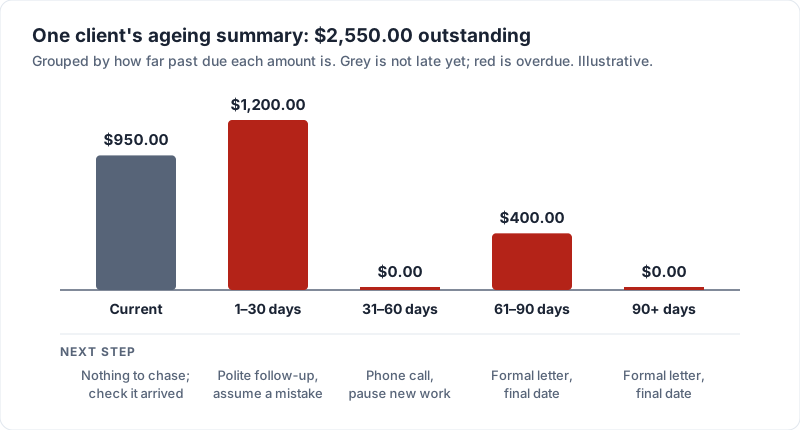
“Current” means outstanding but not yet late. Everything to the right of it is overdue, and the further right the money sits, the firmer your next message should be. Long-running accounts drift right without anyone deciding they should, as one person in the research found:
Agreed, one of my best accounts has nearly $3,000 at 128 days past due - I’ve followed up at 30, 60, 90 days, and again last week.
A client statement with ageing is also a useful thing to send. It shows your client every open invoice on one page, which is often what their accounts team needs to pay several at once. For the same view across every client, how to track open invoices sets out an open invoices report and a weekly routine, and our guide to the invoice statement template shows what to put on a statement, with a worked ageing example.
Charming Invoices can build that statement for any client as a PDF, on every plan. It lists each issued invoice that still has a balance, oldest first, with the amount, what has been paid, the balance and the days overdue, then the ageing totals in exactly those five columns. Invoices in different currencies are kept in separate tables rather than added together. The catch: the balances are only as accurate as the payments you record. Charming does not see your bank account, so payment tracking is manual (you record each payment and mark it paid), clients cannot pay by card from the invoice, and on the free plan the statement carries a small “Sent with Charming Invoices” line.
The same words drive the invoice list. Charming never asks you to set an invoice to overdue: an issued invoice with money still owed shows as “Overdue” from the day after its due date (the app counts calendar days in UTC), and as “Partially paid” when your recorded payments cover part of the total and it is not yet overdue. Above the list, an “Outstanding” tile totals what is awaiting payment and an “Overdue” tile totals what is past due, both in the business's current currency only. Charming does not send reminders, so the follow-ups are yours: set a calendar reminder for each due date and send them from your own inbox. When to send invoice reminders and what to say covers the schedule.
Words to use with your client#
The labels above are for your own records. With clients, plain and specific wording works better than any of them. Some lines you can adapt:
- Not yet due: “Invoice 2026-014 for $1,800.00 is due on 31 October. Let me know if anything on it needs changing.”
- Partly paid: “Thanks for the $600.00. The remaining $1,200.00 on invoice 2026-014 is due on 31 October.”
- Overdue: “Invoice 2026-014 was due on 31 October and $1,200.00 is still outstanding. Could you let me know when it is scheduled for payment?”
- Several invoices: “I have attached a statement of your open invoices. Two are past their due dates; the total outstanding is $2,550.00.”
Each one names the invoice, the amount and the date. None of them uses “delinquent”, and none of them apologises for asking.
Outstanding, overdue and unpaid invoices: quick answers#
What is an outstanding invoice?#
An outstanding invoice is one you have sent that still has money owing on it, whether or not it is due yet. It stops being outstanding when it is paid in full or cancelled.
Is an outstanding invoice the same as an overdue invoice?#
No. Every overdue invoice is outstanding, but an outstanding invoice is only overdue once its due date has passed. In the example above, invoice 2026-014 was outstanding for 30 days before it became overdue on 1 November.
What does it mean when an invoice is past due?#
The due date printed on the invoice has passed and money is still owed. “Past due” and “overdue” mean the same thing. An invoice due on 31 October is past due from 1 November.
Are unpaid invoices always late?#
No. An unpaid invoice has had nothing paid against it, but if the due date has not arrived, the client is not late. Unpaid invoices only become a problem once they are also overdue.
What counts as a late invoice payment?#
A payment that arrives after the due date. If the invoice had no due date, “late” is harder to pin down, which is why a real date beats a vague phrase: invoice payment terms, in plain English shows how to set one. If you want to charge a fee for paying late, agree it with the client before the work starts; late fees on invoices covers the wording.
How do I keep track of overdue invoices?#
Keep one list of every sent invoice with its due date and balance, and look at it weekly. A spreadsheet works (the invoice tracker guide has the formulas, and our free invoice tracker for Excel has them filled in), or an invoicing app that works out the overdue status from the due date for you.
The short version#
- Outstanding means money is still owed. It says nothing about lateness.
- Unpaid means nothing has been paid yet.
- Overdue and past due mean the due date has passed with money still owed.
- Delinquent means badly overdue, by whatever definition the person using it has chosen.
Know which state each invoice is in, and you know whether to wait, nudge or get firm. If you want the due dates, balances and statements worked out for you, create a free invoice and see how the numbers look on your own work.
Free download
No sign-up and no email address. More on the free templates page.
- Download .xlsx: Invoice tracker for Excel
Invoice tracker for Excel
Excel .xlsxEvery invoice you have sent on one sheet, with its balance, status and how many days late it is.